Search This Blog

Showing posts with label Jane Austen. Show all posts

Friday, February 9, 2018

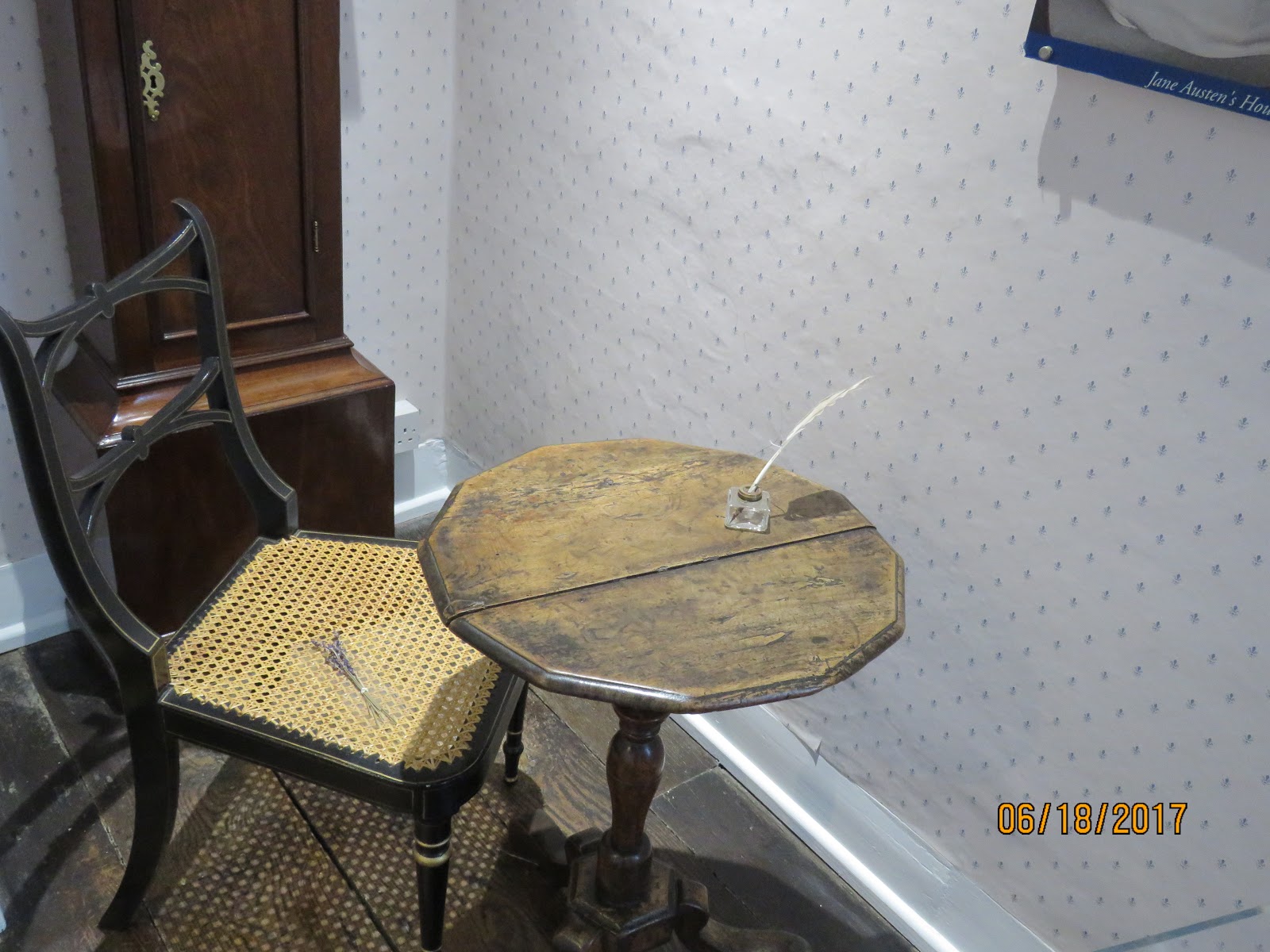
Jane Austen's writing table, copyright Donna Hatch
by Donna Hatch
www.donnahatch.com

In a time before phones, email, text messages, and social media, Regency ladies and gentlemen had only one way of keeping in touch with friends and family too far distant to see frequently; they wrote letters. The upper classes took their writing very seriously, and often wrote long, detailed letters to family and friends. Many also wrote religiously in their journals. And, of course, poets and authors needed reliable writing instruments.

Necessary writing tools included a quill pen, an inkstand or inkwell filled with ink, a pen knife, and sand or blotters. Often these implements were stored together in a little box inside a desk.

Looking at the process through the lens of our modern eye, it is easy to overlook the pen knife. Yet it is as essential as the pen and ink for anyone who wanted to write. Quill pens, which were usually goose quills (but could also be from peacock, swan, or even crow feathers) always needed sharpening, trimming, and shaping, just as today's pencils need sharpening. They could also be used to sharpen the pencil, which had only been in use since the 1700's, as opposed to the quill pen that people had been using for two centuries.

Cutting a quill pen took a great deal of skill. The nib had to be carefully shaped in order for the hollow core to hold the correct amount of ink, and then be released smoothly as the writer pressed on it. I found detailed instructions about how to sharpen a quill here

Many quills were kept together in a little box. I suspect if one planned to do a lot of writing, one sharpened the quills all at once, then in the course of their writing, simply set aside a flattened or misshapen quill and picked up another  from the box without losing the rhythm of writing. 

In Pride and Prejudice, the proud yet fawning Caroline Bingley offered to mend Mr. Darcy's pen, adding that she mended pens "remarkably well."


Quills and inkwell (Photo credit: studentofrhythm)
Pen knives could be ornate, made of expensive materials such as agate or ivory or mother-of-pearl. They were often gilded or encrusted with precious metals and even jewels. These were purchased from a jeweler. Plainer styles which came from the stationers had wooden handles and were merely sanded and polished, without adornment. 

For hundreds of years, pen knives had a blade that was fixed in the handle. During the 1700's pen knives could be folded, like today's pocket knife.

In Jane Austen's Mansfield park, Fanny Price's two younger sisters fight over a silver pen knife which had been a gift from the godmother of a dead sister. The sister had handed the knife to Susan before she died.

Pen knives had other uses. Many new few books were uncut at top and front. They had to be sliced open so one could read the book. A sharp knife was needed to keep the pages from tearing. I suspect the wealthy had a knife specifically used for this purpose, and did not double up using the precious pen knife, but the average person probably had to made do with an all-purpose knife.

Pen knives were as important to a Regency household as pencil sharpeners are to an elementary student today. 


Jane Austen's Chawton House Museum, copyright Donna Hatch
Above is a photo I took while visiting the home of Jane Austen in Chawton, now a museum. I can so easily imagine picturing her here writing her novels and her letters, can't you?

Here is a photo of the house where she lived so happily with her mother and beloved sister, Cassandra, and did so much writing.

I found the images of pen knives that you may wish to view here, and here.


Sources:


Friday, November 18, 2016

5 Fun Facts About Coming Out in Regency England

by Donna Hatch

To quote the famous first line of Pride and Prejudice: "It is a truth universally acknowledged, that a single man in possession of a good fortune must be in want of a wife."

It was also a universal fact that a young lady of good breeding must be in want of a husband. Coming "out" during the Regency, was crucial to a gently bred young lady's future, since she basically had no future unless she married. Without being "out" she could not attend dinner parties or balls or any other society function. Basically, until she was out, she was considered a child. Here are some fun facts about this vital process.

1. The young lady's parents decided when she could come out—there was no set age. The very snooty Lady Catherine De Bourgh from Price and Prejudice exclaimed over the Bennett family’s five girls out at the same time. This suggests that the ages of the girls were not surprising, but rather that so many from one family were out at the same time. In Mansfield Park, people were surprised to learn that Fanny Price was not yet out, who, if memory serves, was seventeen (or nearly so) at the time. The age for coming out seems to have ranged from fifteen to eighteen.


2. Trips to London for the Season were not imperative to being out or finding a husband. Many young ladies married well to someone from their home or neighboring towns. However, a trip to London for the Season provided an exciting opportunity to meet any number of eligible bachelors, including sons of peers, and indulge in all the delights only London could offer.

3. Young ladies entering society were not called “debutantes.” During the Regency, that term applied to actresses debuting on stage. Sometime during the Victorian Era (which came after the Regency Era) the term gradually began to apply to young ladies coming out. About that time, parents started the tradition of throwing debutante balls. During the Regency, one may or may not have a ball for a young lady new to society.

4. Not every young lady took her bows to the queen. It wasn't necessary to curtsy to the Queen prior to entering society and coming out. In fact, unless the lady was a daughter of a peer who wanted to appear in court, or the newly married wife of a peer, bowing to the queen would have been totally unnecessary. Also, Queen Charlotte didn't hold drawing rooms (where young ladies could be presented to her) on a regular basis between1811 and 1818 to due her health.
 
5. Young ladies were required to have a chaperone with them at all times outside of their home or while entertaining a male visitor. Maids were not chaperones—they were too easily bribed or bullied. Male relatives were not generally considered chaperones, but they might do in a pinch, depending on the circumstances. The only truly appropriate chaperone was a matron or spinster of good character and family, and who spoke with a genteel accent, generally of the upper classes. Mothers or aunts were preferred chaperones. One might also hired companion, a respectable woman who’d probably fallen on hard times enough to need to earn wages, similar in class and situation as to those who became a governess.


As a mother of daughters, I’m kind of in favor of the idea of a chaperone. 

Friday, May 6, 2016

English House Servants

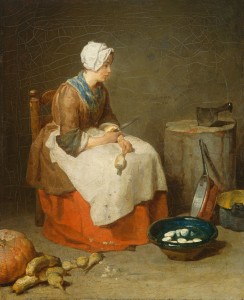
By Jean-Baptiste-Siméon Chardin - Visipix.com
by Donna Hatch
www.donnahatch.com

Servants were an indispensable part of running any Big House throughout the ages, including those in existence in Regency England. Manor houses and castles where the upper classes lived were huge and required an army of servants to keep them clean and well-maintained. Also, the owners themselves required a great deal of help from their staff. 

According to  The Victorian Domestic Servant, the Duke of Bedford had 300 servants in his employ, and the Duke of Portland employed 320. To be sure, not all Big Houses had quite so many, and upper class people who lived in more modest houses employed far fewer servants. However, all seemed to have servants.

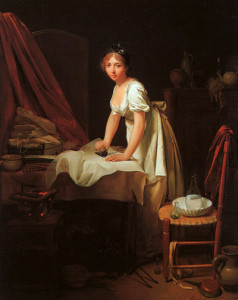
In Jane Austen's Sense and Sensibility, the Dashwood ladies had to count every penny once they were removed from their home, but they still had two servants to help them while they lived in their humble cottage. The care of clothing alone, not to mention cooking or cleaning, was a major undertaking in those days, and gently bred ladies certainly would have lacked those skills. Even members of the gentry who considered themselves poor probably had at least a maid of all work who did everything--cleaning fireplaces, laundry, dishes, dusting, sweeping, scrubbing floors, etc. and was still expected to wait on the ladies in the home. Single gentlemen who lived alone in their bachelor's rooms had at least one male equivalent of a maid of all work, often referred to as a valet (though his tasks would have been more varied than if he were a valet for a lord in a Big House). This all-around male servant was often simply referred to as a "boy" or a "man."
Servants' duties mostly took place out of sight. It was good form for a servant to be silent and invisible, which is why so many houses have secret passageways--they were usually servants' stairways and corridors. Servants arose hours before their masters and worked late into the night. They were also at the mercy of their employers and were called upon to work in any kind of weather, at any hour of the day, with few personal days off, and often had poor accommodations.

servantClasses existed in the world of servants from the top which included the head butler, head housekeeper, and chef, right down the to very bottom to the scullery maid and 'tween stairs maid. They all knew where they fit in that hierarchy, just as businesses have a hierarchy from the president down to the janitor. Ladies' maids were high on that ladder, often dressed well and had only to serve their lady's personal needs, dress her, and style her hair. In some houses, the lady's maid was also charged with caring for her lady's clothing, but most houses sent the laundry out to a laundress. The footman was also a coveted position. His main role was to be young and handsome, wear livery (a costly uniform), and open doors as well as run the occasional errand such as carrying his lady's packages on a shopping expedition.

Most servants were unmarried. Employers didn't want servants distracted by spouses or children. Since servants must be at their lord and lady's beck and call, they slept in the servants' quarters, usually in the upper floors or attic, or on a pallet in the kitchen floor, and could be dragged out of bed without a second thought if their lord had need of them. Essentially, servants were married to their jobs. Some male house servants married, but they had very few days off a month when they could go home. Outdoor servants, however, such as stable hands, gardeners, and gamekeepers usually stayed in their own little cottages somewhere on the grounds. It was fairly common for these servants to be married and have families.

Female servants who wanted to marry did so with the understanding that their position in the house was forfeit.  Occasionally, the head housekeeper and butler were a couple, but she only joined the staff after her children were raised.

A servant's pay was meager, the hours long, and the work often back-breaking, but there was never a shortage of applicants--after all, house servants had a place to sleep and regular meals, not something they could obtain from most other jobs such as those in a factory. In addition, their tasks usually had little to no risk of danger, also unlike factory jobs.
I admit, having a chef and maid of all work sounds very appealing, doesn't it?

For further reading, I recommend:
The Victorian Domestic Servant by Trevor May
Novels told from a servants' point of view which are well-written and carefully researched are:
Longbourn by Jo Baker
Maid to Match by Deeanne Gist
Eng

Tuesday, August 18, 2015

A Regency Exhibit

Cheryl Bolen attended the exhibit to commemorate the 200th anniversary of the English Regency at California's Huntington Library.

©By Cheryl Bolen

As an author whose first Regency historical romance was published in 1998, I've long been a student of the period, and in 2011 I had the opportunity to visit a fabulous exhibit on the English Regency at the Huntington in Los Angeles County.

The Huntington (Library, Art Museum and Botanical Gardens) offered the exhibit to commemorate the 200th anniversary of the Regency, which began in 1811 when George III was declared too mad to rule. His eldest son served as Prince Regent until his father died in 1820, whereupon the regent became King George IV.

I particularly enjoyed reading the era's newspapers. The following advertisement (these were intermingled with news stories) I think must be geared to men, but could also apply to women:

HAIR
A new oil which gradually changes white, gray or red hair to a beautiful brown – gives softness, elasticity, curl and thickens – 7 shillings, 6 pence per bottle
 
A loan office, located at 2 Craven, Strand, advertised that it gave loans "to persons of fashion, promisary notes to persons of known credit and consequence." The office was open from 10-4.
 
The most well-known jewelry store of the era offered this advertisement:
Rundell, Bridge, Rundell
Goldsmiths & Jewelers
to Their Majesties
Their Royal Highnesses the Prince of Wales
and the Duke of York and Royal Family
Ludgate Hill
 

And the last advertisement I'm going to feature was for an on-premises auction by "Mr. Christie." Yes, that Christie's auction house!
Valuable Library Richmond Surrey – By Mr. Christie on the premises by order of the Executors of Miss Hotham deceased, 6,000 volumes. Catalogues are preparing.
 

The Huntington Library and Art Museum itself is a treasure to visit. The former estate of rail magnate Henry Huntington, it's nestled on a few hundred acres of lush botanical gardens in the foothills of the San Gabriel Mountains. The Huntington collections of rare manuscripts and old master paintings is particularly geared for English history. It houses Gainsborough's Blue Boy (as well as Pinkie), first editions of Jane Austen, and an original Chaucer manuscript. And almost half a million rare manuscripts.

This article was first published in The Regency Reader in September 2011.
 
Cheryl Bolen is pleased to announce the re-elease of her Counterfeit Countess, a book that has been out of print for more than a decade and which has never before been an eBook. This Daphne finalist for Best Historical Mystery is the first book in the lighthearted Brazen Brides series and releases on Sept. 1. It can be preordered everywhere now.
 

Friday, April 24, 2015

A New Book on Regency-Era Fashions


©Cheryl Bolen

As an author of historcial books, I have found Jody Gayle's first book, Fashions in the Era of Jane Austen, an invaluable research resource. I have it both in print and ebook. Now I am delighted to have her newest release, Fashions in the Era after Jane Austen. Discerning readers won't find dramatic differences in the two eras since they are separated by just a few years. The first book covers 1809-1820; the second, 1821-1828.


Ms. Gayle has given us another gem. She goes directly to the source: Ackermann's Repository of the Arts, a popular woman's magazine in Georgian England. Moreover, each of these stunning fashion prints is accompanied by its original text, carefully presented with sometimes-archaic spellings that lend (if possible) even more authenticity.


"The illustrations need to be described in the language of their time," Ms. Gayle writes in her preface. "The words add a whole new depth to the illustrations and, most importantly, a glimpse into the culture."


I concur. One particularly vital reason for including these rather comprehensive written descriptions is that they describe what types of fabrics were used in each facet of the dress. This is of immense importance to historical writers.


In addition, each hairstyle depicted is described. Here's an example: "The hind hair is arranged in braids and bows, which do not rise much above the crown of the head. The front hair is brought very low at the sides of the face in light curls: the forehead is left bare, with the exception of a single ringlet in the middle. A coral wreath is placed rather far back."


Fabrics of gloves and shoes are also given, as well as explanations of jewelry worn.


An added bonus for us historical writers is little plugs—with locations—of various tradespersons associated with the dress.
 
The above is an illustration of Ms. Gayle's first book next to my last mass-market paperback, used to illustrate the size of Ms. Gayle's books.

The oversized paper-bound book features just about one hundred fashion plates, and these include morning dress, promenade dress, wedding dress, evening dress, ball dress, carriage dress, head dress (which features multiple prints of head wear), full dress, walking dress, and garden costume. The prints in this new book are of considerably higher quality than the ones in the first.
 

I am indebted to Ms. Gayle and to my fellow author of historical romance, Candice Hern, for making this book possible: Ms. Gayle, for dedicating herself to unearthing publications from the eighteenth and nineteenth centuries and bringing them to life; Candice, whose wonderful website inspired Ms. Gayle's passion for early nineteenth-century fashion.—Cheryl Bolen, whose newest release is Duchess by Mistake, a House of Haverstock book


Friday, March 20, 2015

Spotlight on Regency Fashion: the pelisse

By Donna Hatch

Ladies in Regency England had more reasons to change clothes than the modern-day woman would ever believe. They had special clothes for relaxing at home, walking, riding, going for a drive in a carriage, afternoon gowns, evening gowns, ball gowns, etc. And the number of accessories is even more mind-boggling.

But one of the Regency ladies' fashion accessories was practical as well as fashionable. It was the pelisse. Generally lightweight, Regency ladies wore this long over-garment to protect her clothes from dust and dirt. Since many roads were unpaved, walking and riding in a carriage produced dust and dirt that would sully a gown. And since fashionable ladies often wore white or light colors as a status symble, keeping clothing clean in a not-so-terribly clean environment must have proved challenging. Big cities such as London were even dirtier with all the soot polluting the air from burning coal.

Wearing a pelise became an indespensible part of fashion, as well as a necessary garment, outside one's home. Though pelisses didn't generally take the place of a warm coat or cloak, they also added a layer of warmth in the event the weather took a sudden turn.

I have additional pictures of pelisses and gowns on my Pinterest Regency and Jane Austen Page.


Donna Hatch is a noted Regency researcher, enthusiast, and historical romance author. You can visit her website at www.donnahatch.com
Like her author page on Facebook
Follow her blog at www.donnahatch.com/blog

Friday, June 21, 2013

Happy Birthday, Pride & Prejudice!

Did you know that Jane Austen's masterpiece, Pride & Prejudice was published two hundred years ago? That's right, it was published in January 1813. To celebrate, BBC has put together an amazing documentary that I found on Two Nerdy History Girls. The video depicts the pains they went to in order to recreate a Regency-style ball as Jane Austen herself would have experienced, and which is portrayed in her novel Pride & Prejudice. They hired the experts in Regency food, fashion, music and the dances Elizabeth and Darcy knew and lived to fill the the details Jane Austen would not have needed to include for her contemporary readers but which all Regency fans crave and adore.

Every Jane Austen fan should watch this fascinating BBC documentary recreation of a Regency ball on Two Nerdy History Girls.

What did you learn?

Wednesday, March 6, 2013

Fashions in Era of Jane Austen


Jody Gayle is the editor/designer of Fashions in the Era of Jane Austen, and it is solely through her efforts that this wonderful resource is now available both electronically and as an oversized paperback with hundreds of color illustrations.


Cheryl Bolen: Thank you, Jody, for being our guest today, and thank you for introducing a whole new generation (and more) to Ackermann's Repository. First, will you tell us what Ackermann's Repository was?


The Ackermann’s Repository of the Arts was a monthly British periodical published from 1809-1829 by Rudolph Ackermann.  It was a highly popular nineteenth-century publication devoted to the study of the arts, literature, commerce, manufacturing, politics and fashion.  I believe a contemporary example could be a monthly version of the New York Times with somewhere between 60-80 pages.  However, the Repository of the Arts included a significant amount of information provided by the readers including personal letters, poems, opinion pieces and general articles. 


Each monthly issue contained several illustrations produced by artists using a technique called etching. Two of the illustrations were always hand-painted prints normally featuring the whole body of a woman dressed in the latest fashions.  Every fashion print included a detailed description of the type of clothing shown, its style, cut, trim, color, type of fabric and the accompanying accessories. 


Cheryl Bolen: In compiling your book, why did you make the decision to reproduce all the illustrations with the exact same language that was used in their original publication?


There were a couple reasons why it was important to include the language of the time to accompany the fashion plates.  When I began my research I found books with tons of beautiful fashion prints.  Then I began reading Ackermann’s Repository that included the descriptions and discovered a whole new dimension and depth to the illustrations.  It seemed sad that the words of the past were being forgotten and I felt there would be others who might like to read the descriptions.  Plus, I wanted to provide a convenient means for scholars and authors to access this information.  There are over 240 issues of Ackermann’s Repository and over 16,000 pages!  It can take months to research or find all the fashion prints.  


Cheryl Bolen: Can you describe for us the some of the steps you had to take in order to produce your incomparable work?


Just a few years ago I worked for a local newspaper company and they also published a bridal magazine so I had some idea of the process of printing and design.  I was able to publish my book due to the fantastic program through Amazon.  It allows authors to self-publish their own digital and paperback books but then every little detail and decision has to be made by the author without the assistance of a publishing house.

I began by contacting the Philadelphia Museum of Art Library for the permission to use their copies of Ackermann’s Repository of Arts.   Then I spent my time searching, scanning, and organizing the illustrations and then searching, typing and organizing all of the text.  Developing the organization system was crucial to keep the illustrations and the accompanying descriptions straight.  I had to be meticulous since one of my goals was to provide a resource to scholars and authors.  Everything had to be exactly right and accurate.   There wasn’t an easy way to accomplishing this task other than pure determination and hard work.  Then I had the whole book professionally proofread and compared to the original documents. 


The Kindle book was designed by me but I paid an experienced company to format the book but for future projects I can format the book myself.  A critical decision in designing the paperback book was choosing the size of the book.  This decision impacted everything from the fashion plate quality and detail, the book design, and ultimately the price of the book and shipping costs.  In the end I chose the largest book size available and the size is similar to a textbook. 


Cheryl Bolen: Just how many pages are in your book, and how many illustrations?


Well, since you asked I counted and there are 291 illustrations and 376 total pages.  When I first uploaded my book to Amazon it was too many pages and I had to redesign the book so some of the illustrations included the descriptions on the same page.  When you purchase the Kindle version there is a note to readers that due to its large file size, this book may take longer to download.  Fashions in the Era of Jane Austen are the fashion plates from 1809 to 1820.  My next project will contain the next nine years I was unable to include in the in the first book.  I am having a difficult time deciding on a title. 

Cheryl Bolen: Thank you, Jody, for visiting with us -- and for making this fabulous resource available to us.
 

Wednesday, July 13, 2011

Guest Mary Lydon Simonsen: Elizabeth Bennet--the Good, the Bad and the Other Woman

Linda Banche here. My guest today is Mary Lydon Simonsen and her latest Pride and Prejudice retelling, A Wife for Mr. Darcy. Here she elaborates on why we love Elizabeth Bennet--she was wrong about Darcy, admitted her mistake and changed her mind. Mary also tackles the question of what could have happened if Darcy had already committed himself to another woman.

Leave a comment with your email address for a chance to win the copy of A Wife for Mr. Darcy which Sourcebooks has generously provided. Mary will select the winner. Check the comments to see who won, and how to contact me to claim your book. If I cannot contact the winner within a week of selection, I will award the book to an alternate. Note, Sourcebooks can mail to USA and Canada addresses only.

And the winner Mary selected is cyn209! Congratulations, cyn209, and thanks to all for coming over.

Welcome, Mary. Happy to have you here.

Mary Lydon Simonsen:

Hi, Linda. Thank you for having me back at Historical Hussies, one of my favorite historical blogs. You have asked me to write about the good and the bad of Elizabeth Bennet from Pride and Prejudice and the “other woman” in my novel, A Wife for Mr. Darcy.

Like most of us who were born without the Mother Teresa gene, we have our good side and our bad side. Elizabeth Bennet was no different. When she first met Mr. Darcy, she was greatly insulted by his comments and his rude behavior at an assembly in Meryton. Because her pride had been wounded, she was determined not to hear any good of him. She did not ask herself why a man of the landed gentry, and someone with such high connections, would befriend Charles Bingley, a man whose family had made its fortune in trade. Nor did she take into consideration that poor Mr. Darcy had spent endless afternoons and evenings at Netherfield Park with Caroline Bingley and Louisa Hurst, two felines who always had their claws out. Even after she learned of his devotion to his sister or that he visited his autocratic aunt, Lady Catherine de Bourgh, and her sickly daughter, her opinion of the gentleman remained unchanged. Why? Because Darcy had wronged her. It wasn’t until Mr. Darcy revealed all in his letter following her rejection of his proposal at Hunsford Lodge that she took a step back and reviewed the whole of their acquaintance, and when she did, she didn’t like what she saw.

But that is the beauty of Elizabeth Bennet. Unlike Wickham or Mr. Collins or Lady Catherine, she is capable of correction. When presented with an opportunity to set things right, she does. By the time she meets Darcy at his estate in Derbyshire, her opinion of the man has undergone a sea change, and because of that, the ground is fertile for the seeds of romance.

Now, as to the other woman in A Wife for Mr. Darcy. Her name is Letitia Montford, and she is everything that an accomplished woman of the Regency Era should be. She draws, paints, does needlework, sings, plays on the piano-forte, and knows the modern languages. She is an excellent dancer and performs well in public. What’s not to like? At first that is Mr. Darcy’s conclusion as well, and since he is of an age when a man’s thoughts tend toward taking a wife for the purpose of producing an heir, he seeks her out at the different venues during the season. Because Mr. Darcy had paid sufficient attention to Miss Montford, rumors are circulating that the gentleman from Derbyshire has found a wife. But that was before he had set eyes on Elizabeth Bennet. So what is a man to do? You’ll have to read the novel to find out.

What do you think about Lizzy Bennet? Did she make other mistakes? For example, why was she so willing to believe Mr. Wickham, someone she hardly knew, when he was telling lies about Mr. Darcy? I would love to hear from you. Thanks for reading my post.

A WIFE FOR MR. DARCY BY MARY LYDON SIMONSEN
A gentleman should always render an apology...
When Mr. Darcy realizes he insulted Miss Elizabeth Bennet at the Meryton Assembly, he feels duty bound to seek her out and apologize...

When he has insulted a lady...
But instead of meekly accepting his apology, Elizabeth stands up to him, and Mr. Darcy realizes with a shock that she is a very different type of lady than he is used to...

ABOUT THE AUTHOR
Mary Lydon Simonsen’s first book, Searching for Pemberley, was acclaimed by Booklist, Publishers Weekly, and RT Book Reviews. She is well loved and widely followed on all the Jane Austen fanfic sites, with tens of thousands of hits and hundreds of reviews whenever she posts. She lives in Peoria, Arizona where she is working on her next Jane Austen novel. For more information, please visit http://marysimonsenfanfiction.blogspot.com/ and http://www.austenauthors.com/, where she regularly contributes.

Monday, February 7, 2011

Ladies Regency Fashion--"Undress"

The Regency era brought dramatic changes in women's fashion. Those huge hoop skirts and pinched waistlines popular in the Elizabethan Era disappeared in favor of the Roman style gown with high waistlines and lighter fabrics.

Ladies of the Beau Monde changed her clothing at least three different times a day depending on the time of day and her activities. Because the aristocracy and upper crust were so steeped in tradition and manners, they had no trouble following the rules. However, I have no doubt that arrivistes and the rising middle class found this custom bewildering.

UNDRESS
The term Undress, or dishabille, was the more casual or simpler style of gown worn at home usually in the morning. These were loose, comfortable gowns made with warmer fabrics and had higher necklines than gowns worn later in the day. Ladies often wore a cap in the morning, too. Ladies wore Undress gowns all morning until noon, depending on scheduled outings or visitors. On a quiet day, a lady might wear Undress until four or five in the afternoon. Sometimes undress gowns were quite decorative. Alison Steadman as Mrs. Bennet in the 1996 film version of Sense and Sensibility wore a morning gown in the film that closely resembled an 1815 Ackermann fashion plate. The actresses playing the Dashwood women often wore an apron or pinafore over their dresses when picking herbs or working in the kitchen. I don't know how accurate this is, or if they only did so because they were not overly wealthy and had to be very careful with their clothing.

Mornings were a time for solitude and tending to the house. For the lady of the house, her morning activities were fairly regimented. After rising, dressing, and eating breakfast, she consulted with her cook and housekeeper, and caught up on her correspondence.

Young ladies such as Jane Austen often practiced the pianoforte first thing in the morning. Ladies also read, sewed, wrote letters, made preserves, and oversaw the gardens.

When I'm staying home, I like pajama pants or stretch pants and a big soft T-shirt. (My favorite writing attire) Of course, if I were to tell my husband I planned to wear undress today, he'd imagine something entirely different ;-)

What do you like to wear when you're at home?

Friday, October 1, 2010

Guest Abigail Reynolds: Social Classes in Regency England

Linda Banche here. Today I welcome Abigail Reynolds, author of Mr. Darcy's Obsession, the latest of her Pride and Prejudice Variations. Today she discusses social classes, one of the major facts of life in Regency England.

Leave a comment for a chance to win one of the two copies of Mr. Darcy's Obsession which Sourcebooks has generously provided. Abigail will select the winners. Check the comments to see who won, and how to contact me to claim your book. If I cannot contact the winners within a week of their selection, I will award the books to alternates. Note, Sourcebooks can mail to USA and Canada addresses only.

Abigail selected the winners Margay and Dee. Dee, please send me an email at linda@lindabanche.com to collect your prize. Margay, I've sent you an email. If I do not hear from you by October 12, I will award the books to alternates.

Welcome, Abigail!

There is a huge social gap between Mr. Darcy and Elizabeth in Pride & Prejudice, which is why Darcy’s proposal to her is such a testament to the power of love. When I wrote Mr. Darcy’s Obsession, I wanted modern readers to feel the depth of Darcy’s love and devotion the way a Regency reader would have felt it in the original. I took the gap between Darcy and Elizabeth – practically insurmountable at the time - and made it even larger. In Mr. Darcy’s Obsession, Elizabeth’s father has died and the Bennets are displaced from Longbourn. They are taken in by family, but the accommodations are not what they were accustomed to. Elizabeth lives with the Gardiners as an unpaid governess for their children. Although the Gardiners treat her as part of the family, she feels unable to ask them for anything because they are already helping support the rest of her family. Her wardrobe becomes shabbier, and her time is not her own. She isn’t remotely suitable as a wife for Darcy.

But Elizabeth was always unsuitable for him in Pride & Prejudice, just like Cinderella was unsuitable for the Prince, but modern readers find it difficult to understand the nuances of the time. The simplest piece of it is money. To the gentry, keeping the estate intact was of primary importance. That’s why they didn’t divide up property between children, and why property was often entailed. It was part of the landowner’s duty to preserve the estate and to add to it if possible. Darcy’s estate is already facing a loss – 30,000 pounds for Georgiana’s dowry, to be precise – and he would be expected to bring home a bride whose dowry would at least compensate for that loss. He is failing in his family duty.

The social nuances are more complex. Despite their meeting at Netherfield, Darcy and Elizabeth would not ordinarily move in the same social circles, as the Bingley sisters make clear. As Darcy is presented as the future son-in-law of Lady Catherine; Elizabeth is a poor cousin of one of Lady Catherine’s dependents. Elizabeth would not be accepted among the ton, whose languid snobbery would be offended by her presumption. Darcy’s social status would fall if he married her. Worse yet, so would his sister’s. Georgiana’s marriage prospects would be significantly harmed by such a marriage.

Elizabeth also has low connections, including kin in trade. Being in trade was a mark of low upbringing, and children of tradesmen had a difficult time being accepted by the ton. This is why Darcy is seen as superior to Bingley, and why Bingley will never be seen as quite up to snuff in society. And Elizabeth, unlike Bingley, isn’t even stylish or well-to-do.

Those alone are enough to make it extraordinarily unlikely that a gentleman like Darcy would consider marrying so far below him, but that’s not enough for Jane Austen. She stacks the deck yet further by giving Elizabeth embarrassing relations and a disgraced sister. Darcy knows perfectly well that he will be the subject of mockery because of her family’s behavior, and he’s right. But his love for Elizabeth is more powerful than all those things. He is truly a man before his time.

MR. DARCY’S OBSESSION BY ABIGAIL REYNOLDS—IN STORES OCTOBER 2010
The more he tries to stay away from her, the more his obsession grows...
“[Reynolds] has creatively blended a classic love story with a saucy romance novel.” —Austenprose

“Developed so well that it made the age-old storyline new and fresh…Her writing gripped my attention and did not let go.”—The Romance Studio

“The style and wit of Ms. Austen are compellingly replicated…spellbinding. Kudos to Ms. Reynolds!” —A Reader’s Respite

In this Pride and Prejudice variation, Elizabeth is called away before Darcy proposes for the first time and Darcy decides to find a more suitable wife. But when Darcy encounters Elizabeth living in London after the death of her father, he can’t fight his desire to see and speak with her again…and again and again. But now that her circumstances have made her even more unsuitable, will Darcy be able to let go of all his long held pride to marry a woman who, though she is beneath his station, is the only woman capable of winning his heart?

About the Author
Abigail Reynolds is a physician and a lifelong Jane Austen enthusiast. She began writing the Pride and Prejudice Variations series in 2001, and encouragement from fellow Austen fans convinced her to continue asking “What if…?” She lives with her husband and two teenage children in Madison, Wisconsin. For more information, please visit http://www.pemberleyvariations.com/ or http://www.austenauthors.com/.

Monday, September 27, 2010

Guest C. Allyn Pierson: Regency Spies

Linda Banche here. Today I welcome C. Allyn Pierson, whose latest book is her Jane Austen historical romance, Mr. Darcy's Little Sister. As you can tell from the title, she continues Pride and Prejudice with Georgiana's story. But here she talks about Regency spies. Mr. Darcy and spies?

Leave a comment for a chance to win one of the two copies of Mr. Darcy's Little Sister which Sourcebooks has generously provided. C. Allyn will select the winners. Check the comments to see who won, and how to contact me to claim your book. If I cannot contact the winners within a week of their selection, I will award the books to alternates. Note, Sourcebooks can mail to USA and Canada addresses only.

C. Allyn has selected the winners Tiffany Green and gigi. Congratulations! I've sent you both emails. If I do not hear from you by October 8, I will select alternates.

Welcome, C. Allyn!

In my latest release, Mr. Darcy’s Little Sister, many of the characters from Jane Austen’s Pride and Prejudice make appearances, including Col. Fitzwilliam and we learn more about what I thought he might be up to while in the military. I selected the Horse Guards as Col. Fitzwilliam’s regiment because I felt that the son of an Earl would be in one of the elite regiments, and the cavalry was the most glamorous branch of the service. In addition, the Horse Guards and the Life Guards were part of the Household Cavalry so they would be stationed in London and not sent off to the battlefields of Europe to fight Napoleon. I decided upon the Horse Guards because one of their primary functions at that time was to guard the safety of the royal family, so I could give Colonel Fitzwilliam access to the highest levels of the court.

In the Regency Era, England had not yet developed an organization dedicated to covert operations (sorry, no MI6 or James Bond!). Various ministers, such as the Foreign Minister and Prime Minister, however, needed a source of information about the actions and plans of the enemies of the state. What these leaders did was develop their own system of contacts and informants, and these sources would then develop their own information systems. Because of the individual nature of these systems there was a great deal of duplication, and sometimes, holes in the system. The Horse Guards were not charged with carrying out covert actions, but I felt that their access to the most powerful men in England would make them an obvious choice when it came to sub rosa activities. I envision the Foreign Minister and the Prime Minister getting to know Col. Fitzwilliam over the years and coming to realize that his easy-going appearance hid a trustworthy man who could keep his mouth shut and deal with problems diplomatically.

Eventually, the Horse Guards headquarters in Whitehall became the army headquarters and the term “Horse Guards” came to be used as the name of the building, like we use the term “Pentagon” for our military headquarters.

The English government first established the Secret Service Bureau in 1909 and it eventually changed name to the Secret Intelligence Service (SIS). Foreign intelligence became Military Intelligence, Section 6 (MI6) just before WWI. Until this time, all covert operations were strictly individual plans by powerful Ministers.

I hope you will pick up a copy of Mr. Darcy’s Little Sister to see how the Horse Guards are represented! Thank you to all of the Historical Hussies for having me on the blog today!


MR. DARCY’S LITTLE SISTER BY C. ALLYN PIERSON—IN STORES SEPTEMBER 2010

Pride and Prejudice continues...

Georgiana Darcy grows up and goes in pursuit of happiness and true love, much to her big brother's consternation.

A whole new side of Mr. Darcy...

He's the best big brother, generous to a fault. Protective, never teases. But over his dead body is any rogue or fortune hunter going to get near his little sister! (Unfortunately, any gentleman who wants to court Georgiana is going to have the same problem...)

So how's a girl ever going to meet the gentleman of her dreams?

About the Author
C. Allyn Pierson is the nom-de-plume of a physician, who has combined her many years of interest in the works of Jane Austen and the history of Regency England into this sequel to Pride and Prejudice. She lives with her family and three dogs in Fort Dodge, Iowa. http://www.callynpierson.com/