Search This Blog

Showing posts with label Halloween. Show all posts

Friday, October 27, 2023

All Hallow's Eve and Jack O'Lanterns


by Donna Hatch

Halloween is even more popular than ever. In the United States, more Americans celebrate Halloween than Christmas. I have my own opinion on that, but really, what's not to love about love costumes, decorations, parties, and special treats?

 Origin of Halloween -- All Hallow's Eve

An ancient Celticic festival Samhain (a Gaelic word pronounced "SOW-en" or “SAH-win”) celebrated the end of summer's end, the harvest, and the new year, which, at the time, landed on November 1st. the Celts believed that during Samhain, the barrier between the living and the dead became thin enough that ghosts, monsters, and fairies walked the earth to steal souls. They also believed that ghosts of their ancestors could visit that night. The multi-day celebration included sacrifices, fires, dancing, drinking, and much revelry, as well as wearing disguises to hide from the souls wandering around. 

Eventually, with the rise of Christianity, the Roman Catholic Church replaced Samhain with All Saints’ Day or All Soul's Day, which celebrates the church’s saints on November 1. The day before All Saints' Day became All Hallows’ Eve. Many Samhain traditions have endured until today.

Carved Jack O'Lanterns

Ancient Celts invented Jack O'Lanterns. But since pumpkins are native to North America, so the Celts hollowed out and carved rutabagas, gourds, potatoes, beets, and even turnips. To make their faces glow, they put a candle or lit ember inside. These lit root vegetables guided their doorways to ward off evil spirits. 

The Celts also left doors and windows open to welcome in the spirits of their ancestors and set out food for them because, of course, ghosts get hungry. And apparently, only wicked, non-family ghosts were frightened away by glowing veggie faces. To the right are a few examples of the faces that artistic carvers can make from turnips.

Origin of the Name Jack O'Lantern
Photo by Andy Holmes on Unsplash

Although historians aren't positive about how a lit, carved vegetable became known as Jack O'Lantern, there are two prevailing theories. 

From about the 17th century, the term referred to a night watchman who carried a lantern and patrolled the streets to curtail crime. The British often called men whose names they didn't know by a common name like Jack. So, a nightwatchman whose name was unknown carrying a lantern was referred to as Jack with the Lantern or Jack of the Lantern or Jack O'Lantern.

The name's origin may have arisen from a legend about Stingy Jack who played tricks on the devil. As punishment, he was doomed to wander the earth as a spirit carrying a lit coal which he later put into a carved-out turnip. The story about Stingy Jack became a part of All Hallow's Eve and is often referenced when spooky, unexplained lights are sighted, sometimes called Spook Lights. 

Modern Jack O' Lanterns

Jack O'Lanterns today range from scary, to funny, to elegant to reflect the taste of the creator. So this Halloween spare a thought to your ancestors who have passed on. Who knows? They just might visit you.

All Hallows Eve during Regency England, filled with ancient English customs, sets the scene for my newest short novel, A Ghost of a Chance.

A lost soul searching for hope...

After a devastating loss, a young lady throws herself into searching for her missing brother and taking solace in her musical composition. When a handsome and captivating stranger comes to town one All Hallows Eve, she dares to hope for more than her endlessly lonely existence.

A tormented war hero seeking redemption...

Unable to flee the memories of war, a retired cavalry captain spends his days helping the men who served under his command adjust to civilian life. Perhaps if he helps them all, he can atone for some of his past failures. When he stops for the night at a small English village celebrating All Hallows Eve, he meets an enchanting young lady unlike any other and suspects that what he needed all along was not only redemption but love.

They must find the courage to take a leap of faith and choose love over fear

It will take faith and valor to overcome the barriers between their worlds and let go of their past heartaches. As they discover love and happiness neither had imagined, they will have to delve into the shadow world between life and death to beg for another chance from the Angel of Death.

A Ghost of a Chance is available in ebook, Kindle Unlimited, and paperback.  

Sources:

https://www.merriam-webster.com/wordplay/the-history-of-jack-o-lantern

https://www.history.com/news/history-of-the-jack-o-lantern-irish-origins

https://time.com/5419385/why-jack-o-lanterns-halloween/

https://www.britannica.com/story/why-do-we-carve-pumpkins-at-halloween

https://worldpopulationreview.com/country-rankings/countries-that-celebrate-halloween    

https://www.history.com/topics/holidays/samhain#samhain-merges-with-halloween

Thursday, October 4, 2018

Halloween Celebrations in Regency England

I am unfortunately a day late with this post, but as I am such a fan of October, I just couldn't let the opportunity pass to post on my favorite holiday. Hope you enjoy!

As October is the month of Halloween (at least I celebrate all month long), I thought I’d take a look at some traditions people might have observed in the Regency during this (currently) very popular holiday.

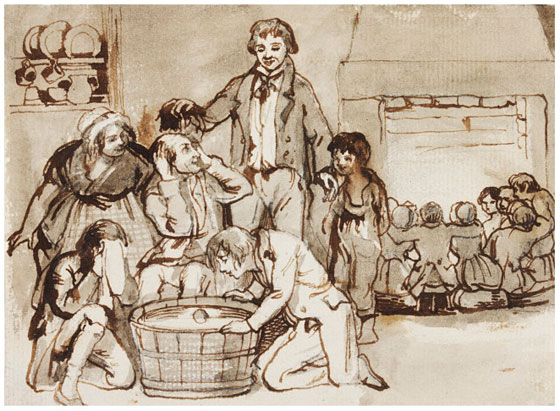
Ever heard of bobbing for apples on Halloween? What about tossing an apple peeling or roasting hazelnuts to find your future marriage partner? Staring into a mirror to reveal your spouse? How about carving jack ‘o lanterns?

All of these familiar (and not so familiar) activities were practiced during the Regency, although many were carried out in rural areas rather
than the parlors of London townhouses or country manor houses. Regency Society tended to ignore most of these celebrations.

The holiday itself was more religious in nature during this period, being the day before All Saint’s Day, a day of recognition for those who had died. A total of three days (October 31, November 1, and November 2) comprised the holiday: All Hallows’ Eve, All Saints’ Day, and All Souls’ Day. This was called Allhallowtide.

But the celebrations originated in Celtic rituals on Saimhain (sow-ain) night, marking the end of harvest and the beginning of winter. According to the ancient Celts, this day, All Hallows Eve, was a time when the barriers between our world and the “Otherworld” became thinner, and spirits could pass through to walk in our world.

Then where do the celebrations in the Regency come in? One of the traditions passed down from ancient times was the idea that on one day out of the year, spirits of one’s own family walked the earth and visited them seeking hospitality. Therefore, it became a custom to have celebrations with food, drink, and games that usually revolved around foretelling the future. One such game was bobbing for apples.

So at some parties in rural areas, single women might peel an apple, being careful not to break the peeling. Then she would toss the peel over her shoulder and it was supposed to land in the shape of a letter—the first letter of her future husband’s name. Another way to foretell your future husband was to put two hazelnuts in a fire side by side and name one for you and the other for the person you desired. If the nuts jumped apart as they heated, you were not meant to be with this person; however, if the two nuts roasted amicably together, then you would end up together. Unmarried women would go into a darkened room on All Hallows’ Eve and stare into a
mirror. If the face of a man appeared beside her, he was the man she would marry. If a skull appeared instead, then she would die before marrying.

Carving jack o’ lanterns was also popular in the Regency, though it too originated with Celtic celebrations. A turnip was the vegetable usually carved into a scary face in Ireland and Scotland, meant to frighten away spirits. The name comes from a 17th century Irish legend, Shifty or Stingy Jack who was so evil neither Hell nor Heaven would let him in. Therefore, he was doomed to wander the earth carrying a lantern.
So although the Regency didn’t have a huge celebration for Halloween, they did manage to enjoy this harvest festival in some very interesting ways.

My own Halloween story, Hearts at All Hallows’ Eve, is a sweet Regency that takes place at a masquerade ball on October 31, which would not have been typical, but could have been part of a round of Little Season entertainments. And it does take into consideration the widely held belief of spirits roaming the earth on this particular night. Why not check out this short story and get into the swing of the season early?

Wednesday, October 9, 2013

Pumpkins and Jack O'-Lanterns


What's Halloween without pumpkins?

Ah, pumpkins, those usually orange squash piled high in grocery stores and farm stands this time of year. Large, small, rounded, not-so-round, orange, yellow, white and striped. There are all kinds of pumpkins. Some you can eat, some are for show, but they're all pumpkins, and they all say fall. In the form of jack o'-lanterns, they also say Halloween.

Although pumpkins are native to the Americas, their usage in Halloween traditions originated in Great Britain. Lighted vegetable lanterns have long been part of Britain's harvest festivals. The vegetables most often used were turnips and mangelwurzels, which are relatively small, solid and hard to cut. Columbus introduced to Europe many of the Americas' plants and animals, pumpkins among them. Called pompions in Tudor England, pumpkins made their way to Scotland, Wales and Ireland. Since pumpkins are hollow and easy to carve, they replaced the turnips and mangelwurzels as the vegetable of choice for harvest lanterns.

"Jack o'-lantern" itself is an English term originating in East Anglia in the 1660's, and meant a night watchman or a man who carried a lantern. Later the phrase attached itself to the ignis fatuus, or will-o'-the-wisp, a bobbing sphere of marsh gas ignited by spontaneous combustion. Not until 1837 did its modern usage of "vegetable lantern" arise.

The Irish legend of Shifty Jack adds a layer of Halloween evil to the various meanings of jack o'-lantern. Shifty, or Stingy, Jack was an Irish blacksmith who used a cross to trap the Devil up a tree. Jack refused to let him down until the Devil promised not to take him to Hell. Secure in the knowledge he would never burn in Hell, Jack wasted his life in evil. But when he died, God denied him entrance to Heaven. With nowhere else to go, Jack implored the Devil to take him in. The Devil, abiding by his promise, refused, condemning Jack forever to walk the earth. But the Devil gave him a hell-coal to light his way, which Jack secured in a vegetable lantern. Jack's bobbing light as he wanders is a Halloween reminder of the wages of sin.

Pumpkinnapper, my Regency Halloween comedy, incorporates pumpkins, bobbing lights and geese (yes, geese) that go bump in the night into the story. 


BLURB:
Let me tell you a tale of a love triangle: man, woman and goose. Join the fowl frolic as Henry the man and Henry the goose spar over heroine Emily's affections while they try to capture the foul (or is it fowl?) pumpkin thieves.

Pumpkin thieves, a youthful love rekindled and a jealous goose. Oh my!

Last night someone tried to steal the widowed Mrs. Emily Metcalfe's pumpkins. She's certain the culprit is her old childhood nemesis and the secret love of her youth, Henry, nicknamed Hank, whom she hasn't seen in ten years.

Henry, Baron Grey, who's never forgotten the girl he loved but couldn't pursue so long ago, decides to catch Emily's would-be thief. Even after she reveals his childhood nickname--the one he would rather forget. And even after her jealous pet goose bites him in an embarrassing place.

Oh, the things a man does for love.

EXCERPT:

"Emily, even with Henry, formidable as he is--" Hank glared at the goose. The goose glared back "--you need protection. I will send over some footmen to guard the place."

"No. Turnip Cottage belongs to Charlotte's husband. What will the townspeople think, with Lord Grey's servants about my house?"

Her refusal increased his fury. The sight of her hand on that damned goose's head didn't improve his mood, either. He balled his fists as his patience thinned and something else thickened. "I'll find you a guard dog. You must have some protection out here all alone."

"But I have Henry." She patted the goose's head and the bird snuggled into her hand. Again.

Heat flooded Hank, part desire for Emily's touch, and part desire to murder that damned goose, who was where he wanted to be. His insides groaned. "Very well, then, you leave me no choice. I will help you catch the culprits."

"But--"

He changed his voice to the voice that either melted a woman or earned him a slap in the face. "Who knows, mayhap we would enjoy ourselves as I lie in wait with you." I would love to lie with you.

Her eyes widened. Had she understood the innuendo?

"I cannot stay alone with you, and you know it," she said, her voice severe.

"You are a widow in your own home and no one will see. I will make sure of it."

"No." She marched back into her cottage and slammed the door. Henry smirked and waddled away.

Hank grinned. He would be back, whether she liked it or not.
 

All reviews are here.

Pumpkinnapper is available at The Wild Rose Press, Amazon, Barnes and Noble, All Romance Ebooks and other places where ebooks are sold.

Thank you all and Happy Halloween.
Linda

Monday, October 31, 2011

Regency Death and Burial

Since it's Halloween, I decided to get a little macabre and delve into the area of death and burial practices in Regency England. Though I'm an author of Regency Romance novels, I do a great deal of research in order to keep my books feeling as authentic as possible, not just as a pretty backdrop to my stories, but because their customs shaped the people, and therefore, my characters.

In England during the Regency Era, there were no funeral parlors or funeral homes. When a person died, the body remained at home. Sometimes an undertaker came prepare the body and sometimes a family member or a servant such as a valet usually did it. Most often, though, women were expected to perform that duty. (Odd that, since women weren't generally allowed to attend the funeral lest their delicate constitutions be too strained.) Anyway, whomever had this unpleasant task washed the hair and body also dressed the body. They often used props to arrange the body's position, such as under the chin to keep the mouth closed.

Bodies were usually laid out on a table for mourners to come pay their respects. The bodies were encased in a shroud, even in the coffin, which was usually made of wool or cambric unless the family were willing to pay for silk. A law was passed in the 18th century that shrouds had to be wool, unless people paid for the privilege of having something else. This act was passed to protect the wool trade. I could comment on that, but I won't. :-)

They didn't embalm in those days. Though America began embalming as early as the Civil War, (well after the Regency Era) that practice didn't take off in England for many years. To help with preservation, bodies were sometimes laid on ice. As you can imagine, that created problems with melting ice and disposing of the water. Usually, burials happened within a week since bodily decay happened quickly and depended on many factors beyond just climate. Obese bodies decay faster than thin ones. Alcoholics, contrary to popular belief, do not get "pickled" but instead decay faster. This is the same for those who suffered from long-term disease.

Queen Victoria and her beloved Prince Albert
Prince Albert died on December 14, 1861--a chilly time of year, to be sure--and was not actually buried for nearly two weeks. The stench was so bad that the nearby guards had to be changed every two hours, despite the profusion of lilies around his coffin. Albert was relatively thin, but had been suffering from typhoid fever for probably two years.


The rich were buried in family tombs or inside churches. The middle class were buried in the ground in coffins. The very poor were thrown into common graves. I also read that poor people sometimes rented a coffin to get the body to the graveyard and then tipped it until the body slid out and into the grave. The leased coffin was then returned to the coffin maker. That conjures up all kinds of images, doesn't it?

They didn't use "caskets," they used "coffins," which had a widened area for the shoulders like what we think of for Dracula's coffin. Coffins were fresh-cut from pine after a person's death, so that the strong pine smell could help with body odors. Hmmm, maybe they should have strewn pine chips or cedar chips around Prince Albert's body in addition to the lilies :-)

A person who committed the heinous crime of suicide, also know as self-murder, was buried vertically at a cross roads, supposedly to keep the spirit from knowing which way to travel. Why, vertically, I don't know.

If you want more information, I recommend "The Victorian Undertaker" by Trevor May, a thin volume that you can read in about an hour. Although it discusses the Victorian Era, there isn't much about death and burial had changed from the Regency Era.

This concludes your trip into the macabre.

Oh, and Happy Halloween.  Mwahahaha.


Wednesday, September 30, 2009

Pumpkinnapper is Here!


The time has come! The Wild Rose Press has released my Regency Halloween comedy novella, Pumpkinnapper.


Buy link here. Note, depending on your location, the link may not yet be active.


Join the fun as Henry the man and Henry the goose spar over heroine Emily's affections while they try to capture the foul pumpkin thieves.


The day's events (September 30):


3-5 PM Eastern time: I'll be at the Classic Romance Revival loop
9-10 PM Eastern time: I'll be at The Wild Rose Press loop. I'll drop in all day, but I'll be there for sure at this time.


You must join the loops in order to post.


And enter my CONTEST--Find Me a Hero! Prize is a PDF copy of Pumpkinnapper. Contest runs through October 31. Details on my Contest page.


BLURB:


Pumpkin thieves, a youthful love rekindled and a jealous goose. Oh my.


Last night someone tried to steal the widowed Mrs. Emily Metcalfe's pumpkins. She's certain the culprit is her old childhood nemesis and the secret love of her youth, Henry, nicknamed Hank, whom she hasn't seen in ten years.


Henry, Baron Grey, who's never forgotten the girl he loved but couldn’t pursue so long ago, decides to catch Emily's would-be thief. Even after she reveals his childhood nickname--the one he would rather forget. And even after her jealous pet goose bites him in an embarrassing place.


Oh, the things a man does for love.


EXCERPT:


"Emily, even with Henry, formidable as he is--" Hank glared at the goose. The goose glared back "--you need protection. I will send over some footmen to guard the place."


"No. Turnip Cottage belongs to Charlotte's husband. What will the townspeople think, with Lord Grey's servants about my house?"


Her refusal increased his fury. The sight of her hand on that damned goose's head didn't improve his mood, either. He balled his fists as his patience thinned and something else thickened. "I'll find you a guard dog. You must have some protection out here all alone."


"But I have Henry." She patted the goose's head and the bird snuggled into her hand. Again.


Heat flooded Hank, part desire for Emily's touch, and part desire to murder that damned goose, who was where he wanted to be. His insides groaned. "Very well, then, you leave me no choice. I will help you catch the culprits."


"But--"


He changed his voice to the voice that either melted a woman or earned him a slap in the face. "Who knows, mayhap we would enjoy ourselves as I lie in wait with you." I would love to lie with you.


Her eyes widened. Had she understood the innuendo?


"I cannot stay alone with you, and you know it," she said, her voice severe.


"You are a widow in your own home and no one will see. I will make sure of it."


"No." She marched back into her cottage and slammed the door. Henry smirked and waddled away.


Hank grinned. He would be back, whether she liked it or not.


Thank you, all

Linda

Linda Banche

Regency romance--most with humor, some with fantasy, and occasionally a paranormal

Lady of the Stars--4 stars from Romantic Times, Regency time travel available from The Wild Rose Press

Pumpkinnapper--Regency Halloween comedy, available from The Wild Rose Press

Website Blog Myspace Facebook Twitter