Search This Blog

Showing posts with label Japan. Show all posts

Wednesday, April 8, 2020

The Japanese love affair with cherry blossoms

We are just at the "Hanami" season in Japan. Hanami literally means "look at the flowers", but this simple translation does not do justice to the country's largest spring event that celebrates its national flower – the Sakura, or cherry blossoms. Millions of people gather with friends and families under Sakura trees to enjoy a picnic, to sing, to drink and above all admire the very temporary display of beautiful Sakura flowers.
The Japanese affair with Sakura goes back centuries. It is believed to have started in the Nara Period (710 – 794), but it was during the Heian Era (794 – 1183), Sakura was given a pride of place in the Japanese culture, alongside the chrysanthemum. An important fact of the Heian period was the establishment of the capital in Kyoto, where it would stay for the next 1,000 years.
The Heian period is considered a high point in Japanese culture. It was the Japanese Renaissance (aka Kokufu Bunka), a time when the country emerged from below the wing of China and established an identity as an independent nation. Sponsored by the Imperial House and the aristocracy, the Japanese arts, literature, poems, architecture, music, and any other form of human creativity expression of love and beauty, flourished and expanded.

Modelled in the Chinese capital of Chang'an, the new capital city Heian, or Kyoto was a masterpiece, built in a geometric grid with straight roads extending from north to south, east to west.
The Sakura blossoming that sustained the Buddhist teachings of beauty and ephemerality was well placed to stir the wave of new writers, poets, and artists. Mentioned in the country's first historical annals (Kojiki) and in the oldest collection of Japanese poetry (Manyoshu), Sakura became the staple of the Japanese simplicity and transient feelings of sadness and happiness. It inspired and depressed; gave life and called death; seduced and rejected; teasing with antagonism an entire nation that revered with adoration its huge varieties of white to dark pink coloured flowers. When they bloomed, it was a sign from the Kami that it was time to plant rice.
The great unifier Toyotomi Hideyoshi was one of Sakura's staunch admirer. In 1594 he held a five-day hanami party for 5,000 in Nara Prefecture. Four years later, another hanami bash followed for 1,300 people at Kyoto’s Daigo Temple, where 700 cherry trees had been planted. An estimate of 490,000 cherry trees are planted today along roadsides throughout Japan. The attached image is a Hiroshige woodblock print of cherry blossoms with Mount Fuji in the backdrop. It belongs to the collection of Thirty-six Views of Mount Fuji (ca 1840).
Clockwise from top left, Sakura themed goods: Starbucks frappuccino, the 100 yen coin, the traditional noodle soba, sundry snacks, Kit Kat chocolate, Coca-Cola sakura favoured beverage, and McDonald Sakura Menu.
Local people and tourists enjoying the "hanami" under sakura trees. Unfortunately, due to the spread of Covid-19, this scene will be severely reduced in 2020 

The epic saga of the oldest, continuous hereditary monarchy in the world (2600) years – the Chrysanthemum Throne of Japan can be read in my book "The Goddesses of Japan" sold on Amazon.

The royal bloodline is traced back to the Creators of the Country and their descendants – the founders of the legendary Yamato Dynasty.


Friday, February 14, 2020

Nara – Relics of a historical cultural capital of Japan

Shika, or Japanese deer are the illustrious dwellers of Nara
Nara or Heijo was Japan's first permanent capital established in the year 710. Before that date, the capital moved to a new location whenever a new emperor ascended to the throne.
However, as the influence and political ambitions of the city's powerful Buddhist monasteries grew to become a serious threat to the government, the capital was moved away to Nagaoka in 784 and a few years later to Kyoto, where it stayed for over 1,000 years.


The Todai-ji (the Great Eastern Temple) is Nara's most iconic temple (above). It was constructed in 752 and houses one of Japan’s largest statue of the Buddha – the 16 metre bronze Dainichi Buddha.


The 16-metre-bronze statue of Dainichi Buddha. 

According to the records, more than 2,600,000 people helped to construct the Great Buddha and its hall. The project was so ostentatious that consumed most of the available bronze of the country and nearly bankrupted the economy.

The Buddhism entered Japan in the 6th century, transmitted from China and Korea. It became one of the main religions of the country but faced initially rejection from the conservative Shintoists. 

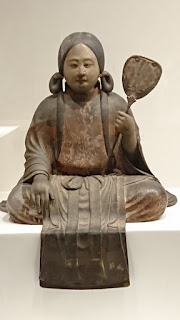
Prince Shotoku (574 – 622 CE) was the early champion of Buddhism. He served as regent under his aunt Empress Suiko (554 – 628 CE). The picture below is the oldest sculpted portrait of the prince currently known, showing him as an adolescent.


Wednesday, October 9, 2019

Castles that tell the History of a Nation


The iconic castles seen today in many Japanese postcards have a history of their own to tell the world. Their architecture and structures changed, evolved and shaped to suit the needs of the time they were built; yet, they all had a common point–they were majestic and commanding.

Castle foundation
Kin no Sachi, a castle roof decoration
During the turbulent Warring States period (1467–1568) the castles were constructed as fortresses to guard the feudal warlords and their retainers against the enemies. Built on top of mountains (yamajiro) for defence purposes, they were surrounded by a moat and fourfold overlapping stone walls of height of 61 meters/200 feet. The section of the walls placed in front of the gates were angled to confuse the intruders. Should the trespassers overcome this obstacle, then sudden descents and switchbacks on the ground layout, stopped them from finding the entrance of the main keep. Should the entrance be found, however, some areas of the floors of the main keep were partitioned as a maze to trap the invaders. Furthermore, the use of technique of piling disordered stones (ranseki-zumi) to build the foundation, not only added to its security, as it was very hard to climb them, but also allowed for flexibility and movement during an earthquake. These fortifications were considered impregnable.
Nagoya Castle Interior
In the second half of the 16th century, the country was unified, and people lived more peaceful times. Unlike their predecessors, the new castles were built on flatlands (hirajiro) or on small hills in the plains (hirayamajiro), where they served as a region's administrative and military headquarters and a symbol of authority. Usually a small town called jokamachi (castle town) formed around these structures, breeding a lively urban area of vassal dwellings, merchants and artisans.
Once achieving a pinnacle of 5,000, many castles were destroyed voluntarily or involuntarily along the history.
In 1615, the Shogun issued a decree prohibiting the warlords to have more than one castle in their domains and many had to be destroyed.
The Osaka Castle
After the Meiji Restoration of 1868, the incoming government issued its own decree on removal of castles, and many more were crashed to the ground.
During the World War II, many were shattered and today, only a dozen original castles, survives.
Yet, several dozen castles were reconstructed over the past decades, bringing them back to their former glory.

The Tokyo Imperial Palace, the official residence of the Imperial Family was the last dwelling of the Shogun, who was deposed in 1868. The capital then moved from Kyoto to Edo, the city known today as Tokyo.

The Tokyo Imperial Palace

The epic saga of the oldest, continuous hereditary monarchy in the world (2600 years) – the Chrysanthemum Throne of Japan can be read in my book "The Goddesses of Japan" sold on Amazon.
The royal bloodline is traced back to the Creators of the Country and their descendants – the founders of the legendary Yamato Dynasty.


Facebook: https://www.facebook.com/thegoddessesofjapan/

Website: https://www.kazukonishimura.com/

Wednesday, August 14, 2019

The Bomb of Hiroshima


On 8th October 1968, the people in Japan started their day exalted by the news that had travelled the night before all the way from Sweden to the Far East–the novelist Yasunari Kawabata had been awarded the Nobel Prize for Literature–he was the first Japanese person to receive such a distinction.
Kawabata’s books have enjoyed broad international appeal and are still widely read. Amongst them we can underline “The Snow Country (1937)”, “The Old Capital (1962)”, “The Scarlet Gang of Asakusa (1929)” and many others.
A crane origami
Though one of his works, which I liked best whilst disliking it mostly is the “Senbatzuru”–translated into English as “Thousand Cranes”. The novel is set in Japan after the Second World War and the tea ceremony plays the role of characters’ connector and wheeler-dealer of the plot. A love quadrangle transcends two generations, moving zigzaggedly from the father to the mistress, then from the mistress to his son, later from the son to her daughter.

However, what I wish to emphasise and give some depth to, is the word “Senbatzuru”. Tsuru (becomes tzuru with the liaison), or crane, is the most sacred bird of Japan. They appear often in the narratives of mythological books, fables and folk stories.
Combine the holy bird with the Japanese quintessential art of folding paper into decorative figures­–the origami, and we get to the millenary myth that if you fold a thousand crane origami, a wish will be granted to you by the gods–the Senbatzuru.
It was in this belief that the twelve-year-old Sadako Sasaki started the undertaking of crafting one thousand tsuru origami in her hospital room.
Sadako Sasaki
Sadako was born in Hiroshima in 1943. She was two years old when the atomic bomb was dropped on Hiroshima on August 6, 1945. The blast blew her out of the window of her house, but she survived. She went on to lead a normal life, excelling in sports and in school. But the exposure to the radiation of the atomic bomb eventually caught up with her and she developed leukaemia. In February 1955 she was hospitalised with swellings on her neck and behind her ears and purpuras formed in her legs. The doctors gave her one year to live.
Yet Sadako clung on to the Senbatzuru hope… she wanted to live. Night and day her tiny hands folded the holy bird in the loneliness of her hospital bedroom. 101…, 102…, 103…

It was a race against time.
When she ran out of paper, she used medicine wrappings, scavenged the garbage for any sort of paper sheets, went to the rooms of other inpatients to ask for the wrapping papers of the presents they were given and straighten them to fold origami, 445…, 446…, 447… 

Sadako Peace Monument
Regrettably, she ran out of time…
Upon her death, she had crafted 644 tsuru. Her classmates crafted the remaining 356 and she was buried with the thousand crane origami, and with them, her hope…
In 1958, a statue of Sadako holding a golden crane was unveiled in the Hiroshima Peace Memorial Park. At the foot of the statue is a plaque that reads: "This is our cry. This is our prayer. Peace in the world."
The culture of Senbatzuru is spread today around the world. Specially in schools, children craft them as a symbol of peace and hope. 


Cristian Marianciuc from Romania is an enthusiastic origami crafter. Below are some examples of his creation. Four years ago, he started a creative project which involved the folding and decorating of an origami crane every single day for 1000 days. It was his personal attempt to deal with depression and exercise his creativity.


The romanticised history of Japan, covering its Creation to its modernisation in the Nineteen Century can be read in my book "The Goddesses of Japan" sold on Amazon.


Facebook: https://www.facebook.com/thegoddessesofjapan/
Website: https://www.kazukonishimura.com/