Search This Blog

Showing posts with label Victorian era. Show all posts

Wednesday, February 2, 2022

Victorian Valentines by Jenna Jaxon

As with many things, the Victorians gave us most of the traditions we use in our celebration of Valentine’s Day. The most prevalent tradition, sending and receiving Valentine’s cards, can be laid at the doorstep of a member of the British postal system, Rowland Hill, who came up with the idea that letters or cards should be charged by their weight rather than by the distance they traveled. Thus the penny post was born and mailing letters and cards suddenly became affordable for all classes.


The first penny stamp was created in 1840 and with it the tradition of sending Valentine cards was born. By 1841 more than 400,000 Valentine cards were sent in England; by 1870 the number had grown to 1.2 million.

Victorian Valentine’s Day cards were originally full sheets of paper, decorated with pictures and messages, then folded and sealed with wax in order to mail them. (Remember, envelopes did not come into practical use until 1845 when they could be mass produced.) Victorians could purchase ready-made cards or they could create their own.


The DIY Valentine cards were made with different materials that could be purchased at the stationer’s:  paper, bits of mirror, seashells, lace, silk or foil appliques, ribbons, seeds, and paste jewels, as well as ready made sentiments like “Be Mine” or “True Love.” Ladies and gents would take the materials home, assemble the cards, and send them out to arrive on Valentine’s Day, February 14. They grew to be more and more elaborate as the century progressed.

Here are some pictures of Victorian Valentines:


I hope you have a very Happy Valentine’s Day!


References:

5-Minute History. “Valentine’s Day in the Victorian Era.”

Gilbert, Sarah. “Victorian Valentine’s Day cards—in pictures.” The Guardian, February 13, 2014.

Letter Jackets. “The History of Envelopes.” July 14, 2016.

Friday, May 17, 2019

Florence Nightingale and the Crimean War

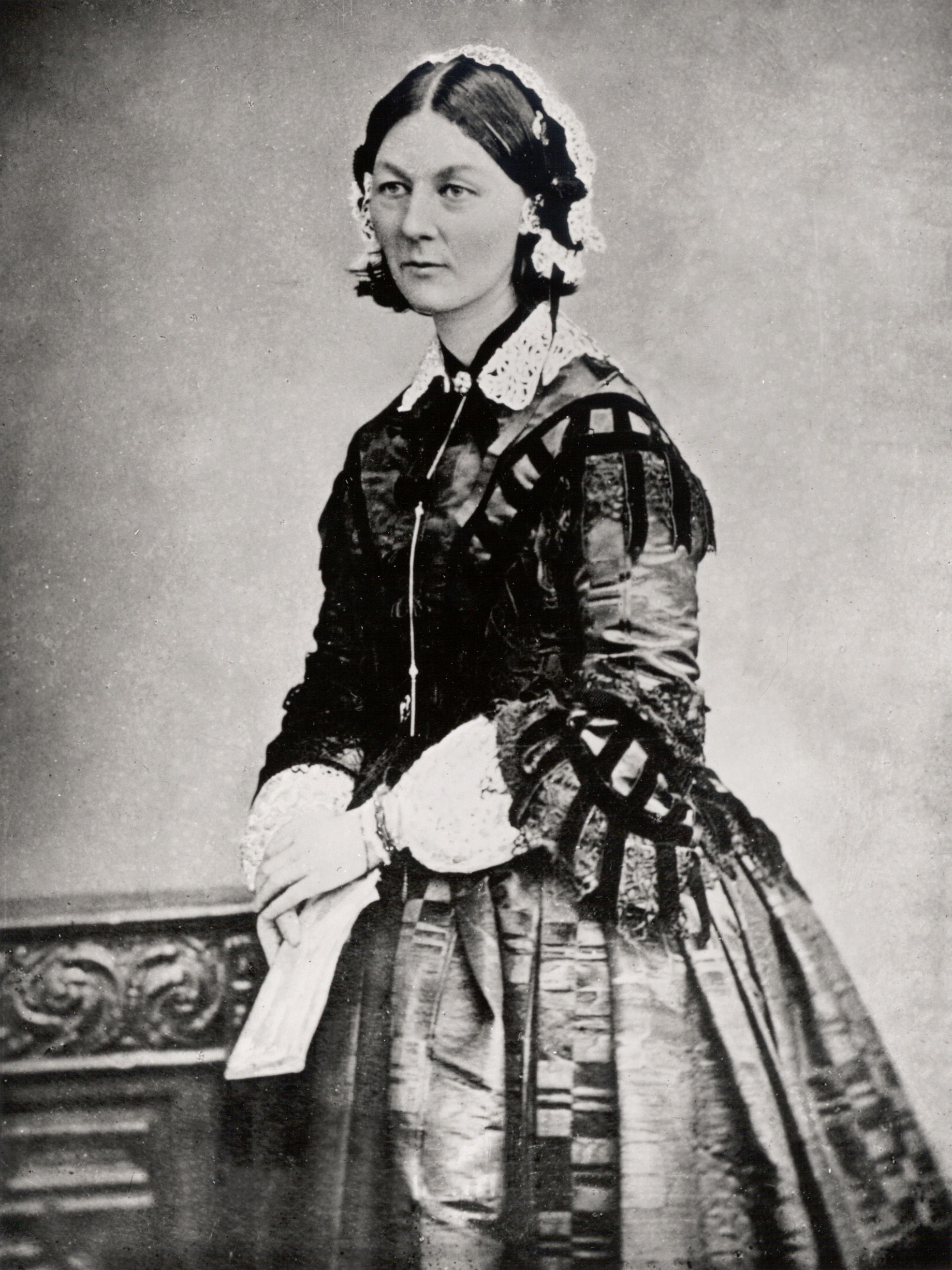
When I was 11 or 12, my grandparents asked me to help them sort all of their books in their dungeon of a basement. In the midst of the dusty stacks, I found a children's set of biographies, including one on Florence Nightingale. I remember sitting down and reading it right there. I loved the poetic beauty and ethereal image the nickname "The Lady with the Lamp" called up and fell in love with Florence.

Last year I was reading up on fox hunting and found a little book called "Fox-Hunting Recollections" by Sir Reginald Graham, Bart. He starts off with his younger years, including a couple of vignettes of his time in the Crimean War. This particular one jumped out at me.


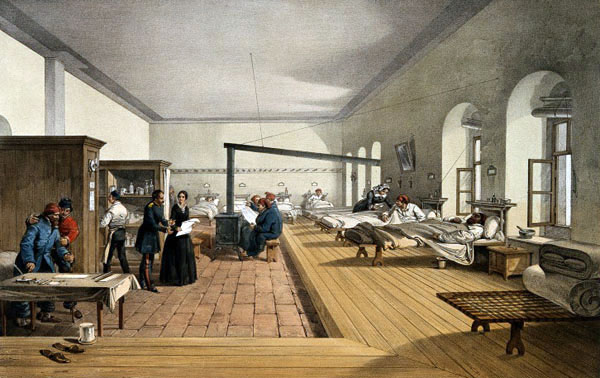
Ward at Scutari hospital
"Malta was but a brief halting-place on the way to the Crimea, and we landed at Balaclava the first week of November 1854. The 14th [Regiment] was soon moved to the front, and posted to the Third Division, commanded by General Sir Richard England. Our chief duty for many months to come was in the trenches day and night, and my most vivid recollection of that dreary time is snow, everlasting snow, throughout the bitterly severe winter of 1854-55. Owing to our hasty departure from Malta we, like the rest of the army, were ill-provided with suitable clothing, and I remember the joy with which I received at last a fur coat and a pair of long brown boots sent out from England, ready-made and not exactly a perfect fit; but to me at that time they were beyond all price. I kept well, and was as happy as the day was long (the days were rather long in the trenches); but soon after Sebastopol was evacuated by the Russians on the 8th September 1855, I had a very bad turn of Crimean fever, and was sent down to the hospital at Scutari, where my head was shaved, and for some weeks it seemed doubtful how matters would end for me. Our chief interest in hospital was to watch for Florence Nightingale as she passed through the wards with a gentle words for all,--a weary time until I improved and was invalided to England towards the end of 1855. My Crimean experience was at the age of from nineteen to twenty, and, looking back to such distant times, it seems to me nowadays as if those scenes had been in another world, and I feel myself a veritable Rip Van Winkle as I muse upon those far-off days and wonder how many officers still survive who landed at Balaclava with the old Fighting Fourteenth on that November day in 1854." 

Sadly, he didn't mention anything else about Florence.

Florence herself landed in Scutari in early November of 1854, and discovered that the medical conditions there were absolutely horrendous. The "hospital" of that time lacked many of the basics we consider integral to modern hospitals, including proper hygiene, medication, and bedding. "The hospital sat on top of a large cesspool, which contaminated the water and the building itself. Patients lay in their own excrement on stretchers strewn throughout the hallways. Rodents and bugs scurried past them. The most basic supplies, such as bandages and soap, grew increasingly scarce as the number of ill and wounded steadily increased. Even water needed to be rationed. More soldiers were dying from infectious diseases like typhoid and cholera than from injuries incurred in battle.(Florence Nightingale Biography) 


 It was Florence's responsibility to work with and oversee the 38 other nurses who arrived with her as they cleaned and dressed wounds, cooked and fed the soldiers in their wards, and in general, kept everything much more sanitary. In many ways, Florence and her nurses were expected to be glorified house maids.

"An article published about her in the Times newspaper on Thursday 8 February 1855, which reads: ‘She is a “ministering angel” without any exaggeration in these hospitals, and as her slender form glides quietly along each corridor every poor fellow’s face softens with gratitude at the sight of her. When all the medical officers have retired for the night, and silence and darkness have settled down upon these miles of prostrate sick, she may be observed alone, with a little lamp in her hand, making her solitary rounds.’ The mention of the miles of sick relates to contemporary reports that the wards at Scutari stretched for four miles." (National Archives)

While in Scutari, she began researching and advocating for reforming medical hospitals, particularly the living conditions of the soldiers. After she returned to England, she worked to improve sanitation in both hospitals and regular homes, and began the first modern nursing school.

Sources: 
"Fox-Hunting Recollections" Sir Reginald Graham, Bart. (available for free on Google Books)
http://www.nationalarchives.gov.uk/education/resources/florence-nightingale/
https://www.biography.com/scientist/florence-nightingale
https://www.britannica.com/biography/Florence-Nightingale
https://www.florence-nightingale.co.uk/?v=7516fd43adaa
https://en.wikipedia.org/wiki/Florence_Nightingale


Friday, March 29, 2019

(East) Indians in Georgian and Victorian Britain

Usually when we hear of Britain and Indians, we think of the East India Company and the British Raj—British colonialism. But were you aware that Indians were in England and Ireland in the 1700s (or earlier)? By 1850, there were over 40,000 Indians recorded as living in London. And that’s only the recorded ones.

Sake Deen Mahomed
When you think about it, it makes sense. British merchants who lived in India tried to stick as close as possible to the same quality (or better) lifestyles they had in England, so they'd hire Indian servants. When these merchants came home, they frequently brought some of those servants with them. Or they'd send their children back with their ayahs (nursemaids) with them. 

Some of these Indians returned to India, but a large number of them stayed. A handful were able to create successful lives in England (like Sake Mahomed, Shampooing Surgeon to George IV), but the majority of them were less fortunate. 

Abdul Karim (the Munshi) and Queen Victoria
"Since many Indian servants were discharged without ceremony after their arrival in England, it was not uncommon to see destitute Indians begging in the streets of London" (18 Vizram) and the East India Company made several attempts to discourage bringing Indian servants over, including imposing fees. Abdul Karim, Queen Victoria’s Munshi (teacher), was one such servant—he was brought over to help serve during her Golden Jubilee.

A large number of those who stayed were Indian sailors (lascars) who deserted their ships upon arrival to avoid abuse from their superiors (including other lascars). Towards the end of the Napoleonic Wars, over 1,000 lascars arrived in London each year.

If the lascars or ayahs and other servants were unable to find a new position or a way back to India, then they might have lived in a group home that one of any number of missionary societies had set up. In one home for ayahs, there were as many as 60 women crammed in. The lascars were in an even more desperate situation.

Fortunately, not all Indians who came to England were left in poverty. A large number of Indians voluntarily came for education. They could not take the higher-paying positions in civil service without certain qualifications, available only through English universities.
Princess Sophia Dhuleep Singh


Several maharajahs also came to experience European culture and to pay their respects to the British crown. Some, such as Maharajah Dhuleep Singh and his daughter, Sophia, were raised in England as part of the aristocracy and with Queen Victoria’s approval. 

While we're fortunate to have the personal records of some of the more educated Indians, we've lost a great deal of information about the lower classes who managed to survive in Britain. Perhaps some day more information will manage to make its way into public consciousness again. 


Sources: Ayahs, Lascars, and Princes: The Story of Indians in Britain 1700-1947 by Rozina Visram
https://smartbitchestrashybooks.com/2017/03/guest-post-diversity-thorn-ethnic-identity-history-historical-romance/

Wednesday, July 23, 2014

How Much I Know About the Regency


More than I used to. :)

I will never know everything, but part of the fun is finding out new things.

About six years ago, when I got it into my head the idea to write a regency, I looked for library books on the subject. One of the books I found was What Jane Austen Ate and Charles Dickens Knew by Daniel Pool.

I was in alt. Here was a list of lots of the things I read about in regencies, but had no idea what they were. Pounds and pence, Parliament sessions, Whitsunday and Michaelmas, quarter days and consols, pelisses, footmen and scullery maids. I was also totally confused. How would I ever remember all this stuff?

I recently reread the book. And, lo and behold, much of the information has become second nature. I guess I've learned a lot in the past few years.

Some will scoff at the book. What Jane Austen Ate and Charles Dickens Knew covers both the Regency and the Victorian eras, so not everything is valid for the Regency. And the information is general. But the book is a good overview and has an extensive bibliography and a great glossary.

I will always make errors, and I hope my readers will be forgiving because I try to get things right.

Thank you all,
Linda
Linda Banche
Welcome to My World of Historical Hilarity!
http://www.lindabanche.com

The picture is Carlton House, the Prince Regent's home during the Regency, from Wikipedia.

Wednesday, February 2, 2011

Cosmetics in the Past


Makeup, in one form or another, has been used since before the dawn of Christianity. In ancient tombs, archaeologists have found evidence of the use of unguents to hydrate the skin in the hot, dry climate of Egypt. In addition, Egyptians colored the underlid of their eyes with dark green, and blackened their lashes and upper lids with kohl. The ancient Greeks used mulberry juice to color their cheeks and lips, while other civilizations used concoctions made from beet juice or other berries.
In Rome, during the 1st century AD, citizens used kohl, too, along with chalk to whiten their faces, rouge to color lips and cheeks, and pumice to clean their teeth. Persians preferred henna to stain their hair and faces.
During the Victorian era, it was considered vulgar for women to use coloring on their faces, so when a young lady wanted to make a favorable impression on a suitor, she was inclined to pinch her cheeks and dab a little grease on her lips to make them shine.
Ladies were not the only ones to use makeup. Up until the middle of the nineteenth century, men wore rouge, and of course used talcum to whiten their wigs, when those hairpieces were in fashion.
George IV is said to have spent a small fortune on cosmetics, unguents and cologne.
Here are a few cosmetic recipes used in the late 1800s:
For freckle removal, squeeze the juice of chickweed, and add three times that amount of water to the chickweed juice, then bathe the skin ten minutes morning and evening.
To wash the complexion: Take one teaspoon flour of sulphur, and to that, add a wine glass of lime water well shaken. Mix in one-half glass glycerin and a full glass of rose water. Rub on face nightly before bedtime.

Wednesday, October 13, 2010

Robert Chambers's THE BOOK OF DAYS


I've always enjoyed the newspaper's This Day in History feature. Imagine my delight when I discovered Robert Chambers's The Book of Days.

The Book of Days: A Miscellany of popular antiquities in connection with the calendar, including anecdote, biography & history, curiosities of literature, and oddities of human life and character (now there's a TITLE) is This Day in History plus, a la 1864 England.

Organized by the days of the calendar, each entry provides multiple tidbits of information about events that occurred on that day. The two volumes of the book are available in Google books Volume 1 here and Volume 2 here, but an easier-to-read, online searchable version is here.

As an example, here's some information from the entry for today, October 13. Each article starts, as my newspaper feature does, with those who were born and died on this date. Then, because The Book of Days is Victorian, the Feast Days come next.

On October 13, 1630, Sophia, Electress of Hanover and mother of George I of England was born. Also on this day in 1815, of interest to Regency authors like me, Joachim Murat, Bonapartist king of Naples, was shot and killed. Saints Faustus, Januarius, and Martialis, martyrs who died in 304, celebrate their Feast Day today.

Three essays follow: First, NOTES FROM AUBREY: ON ENGLISH MANNERS IN OLD TIMES, where we learn "The use of 'Your humble servant,' [as a greeting] came first into England on the marriage of Queen Mary, daughter of Henry IV of France to King Charles I." This article also explains the origin of the boar's head custom at Christmas and why certain dishes are eaten on feast days.

Next is the TRAGEDY OF THE GALAS FAMILY, a sad tale of French justice gone wrong, followed by the story of Mrs. Elizabeth Fry, who improved conditions among the prisoners at Newgate prison in London.

Today's entire entry is here: http://www.thebookofdays.com/months/oct/13.htm

Too bad I didn't blog on October 14, because the Battle of Hastings, which changed England from Saxon to French, was fought on October 14, 1066.

You learn something new every day. Enjoy.

Thank you all,
Linda
Welcome to My World of Historical Hilarity!
http://www.lindabanche.com