That journey has always fascinated me and made me think about how and what the Victorians ate at Christmas.
Depending on class and location, Christmas food traditions varied quite a bit, although there is also a lot of agreement on what should be eaten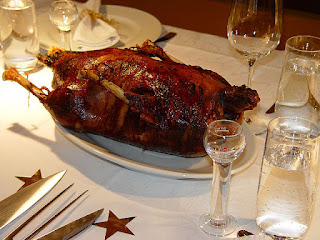 for the holiday feast, generally the most meal extravagant of the year. The centerpiece was usually either a standing rib of beef with Yorkshire pudding in the households of the North, while the roasted goose with sage and onion stuffing graced the tables of the South.
Another tradition was to serve a rum punch, apparently a favorite Christmastide ritual for Charles Dickens. The making of the punch was quite a production, and Dickens would explain each step to his guests as they watched the punch being concocted. The drink is made in a large fire-proof punch bowl, where you combine lemon peel and sugar, dark rum and cognac, stir well, then take a spoonful of the mixture and light it on fire and return to the punch bowl to set it alight. Dickens would then lift out fiery lemon peels for the guests to admire. Afterwards, the flames are extinguished by a metal tray placed over the punch bowl. Nutmeg was then grated over the punch and ladled out to the guests.
 There are many other traditional foods the Victorians ate at Christmas, but I thought these three would give a good idea of how the Victorian chose to celebrate the Season with fabulous food.
Another tradition was to serve a rum punch, apparently a favorite Christmastide ritual for Charles Dickens. The making of the punch was quite a production, and Dickens would explain each step to his guests as they watched the punch being concocted. The drink is made in a large fire-proof punch bowl, where you combine lemon peel and sugar, dark rum and cognac, stir well, then take a spoonful of the mixture and light it on fire and return to the punch bowl to set it alight. Dickens would then lift out fiery lemon peels for the guests to admire. Afterwards, the flames are extinguished by a metal tray placed over the punch bowl. Nutmeg was then grated over the punch and ladled out to the guests.

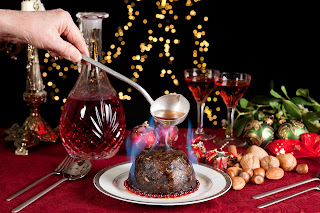
And last but not least was the Christmas or Plum pudding. Traditionally, this pudding was begun on the Sunday before the beginning of Advent, called Stir-up Sunday. If the household was to have good luck, the Christmas pudding must be begun on this day and left to ripen until Christmas Day. God’s blessing would only be bestowed on those who started their puddings on this day. For good fortune, the entire household should help with stirring the pudding with a wooden spoon and only clockwise and only East to West to honor the journey of the three kings. Once all the ingredients are assembled—raisins, currants, sultanas, dates, citrus peel, almonds, spices, cake crumb or breadcrumbs, brown sugar, butter, brandy or tum, and stout—the pudding is boiled or steamed for six hours, then removed from the pudding basin and wrapped with foil and a pudding cloth. It is then aged for about two months. On Christmas Day it is boiled for another four hours, then unmolded onto a platter. A ladle of brandy is heated then poured over the pudding and set alight for a dazzling desert.
I sincerely hope everyone has a warm and wonderful holiday season with your own special traditions and food.
Sources:
Burns-Booth, Karen. “Stir-Up Sunday, Traditions and My Traditional Victorian Christmas
Pudding Recipe.” Lavender and Lovage: Food and Travel from Home and Abroad,
November 24, 2012.
Graham, Colleen. “English Christmas Punch.” The Spruce Eats Newsletter. May 13, 2021.
Wondrich, David. “Holiday Punch—Plus a Cozy Fire.” Esquire, December 11, 2012.


 Posts
Posts


