Search This Blog

Showing posts with label Indians. Show all posts

Friday, September 20, 2019

The Ayahs of London

How many of us have read and/or watched either The Secret Garden or A Little Princess? Both are about young British girls who grew up in India and were brought back to England/the United States.
In one scene where she's told to get dressed, Mary Lennox admits she's never done it herself since her ayah always dressed her. As a kid, I kinda picked up that an ayah was a servant, but I didn't understand that ayahs were Indian nursemaids. I'm not entirely sure what happened to Mary's ayah, but I'm assuming that she either died in the same epidemic as Mary's parents, or she decided to stay in India.

Sara Crewe most likely had an ayah as well (I don't remember any mention of one), but since she was headed off to boarding school, she didn't need one.

In both of these instances, their families didn't bring their ayah back to England with them, but it was surprisingly common for British families to bring their servants, especially ayahs, with them. "As travelling nannies [ayahs] formed the most valuable adjunct to the whole life style of the Raj between Britain and India. Essential for the memsahib's [an upper-class white woman] household in India, they were considered indispensable for the long voyage home -- either the trusted family ayah or an experienced travelling ayah. Once on board, the ayah took complete charge of the children, the baggage, and the memsahib. Good ayahs were not only meant to be clean, honest and trustworthy with children, but capable as nurses and excellent sailors too." (Visram p 29)

Unfortunately, many of the ayahs were abandoned once the family reached England. Left without money, resources, and frequently with little English-language skills, these ayahs would try to find new employment either in England or on a return trip back to India. Theoretically, their previous employers had already paid for their return tickets when they paid a small fee to bring them in the first place, but often the ayahs didn't have access to that ticket or the money from the fee.

While waiting, they would live in "squalid lodging houses" that were overcrowded and sparsely furnished. Records show that it wasn't uncommon for a lodging home to have anywhere from 20 to 60 women living in the same home at the same time. And these were the ones fortunate enough to pay the 16 shillings/week's rent. Others had to resort to begging.

There were several half-hearted (and a smattering of more sincere) attempts throughout the mid-19th century by various societies and the East India Company to improve conditions for these ayahs.
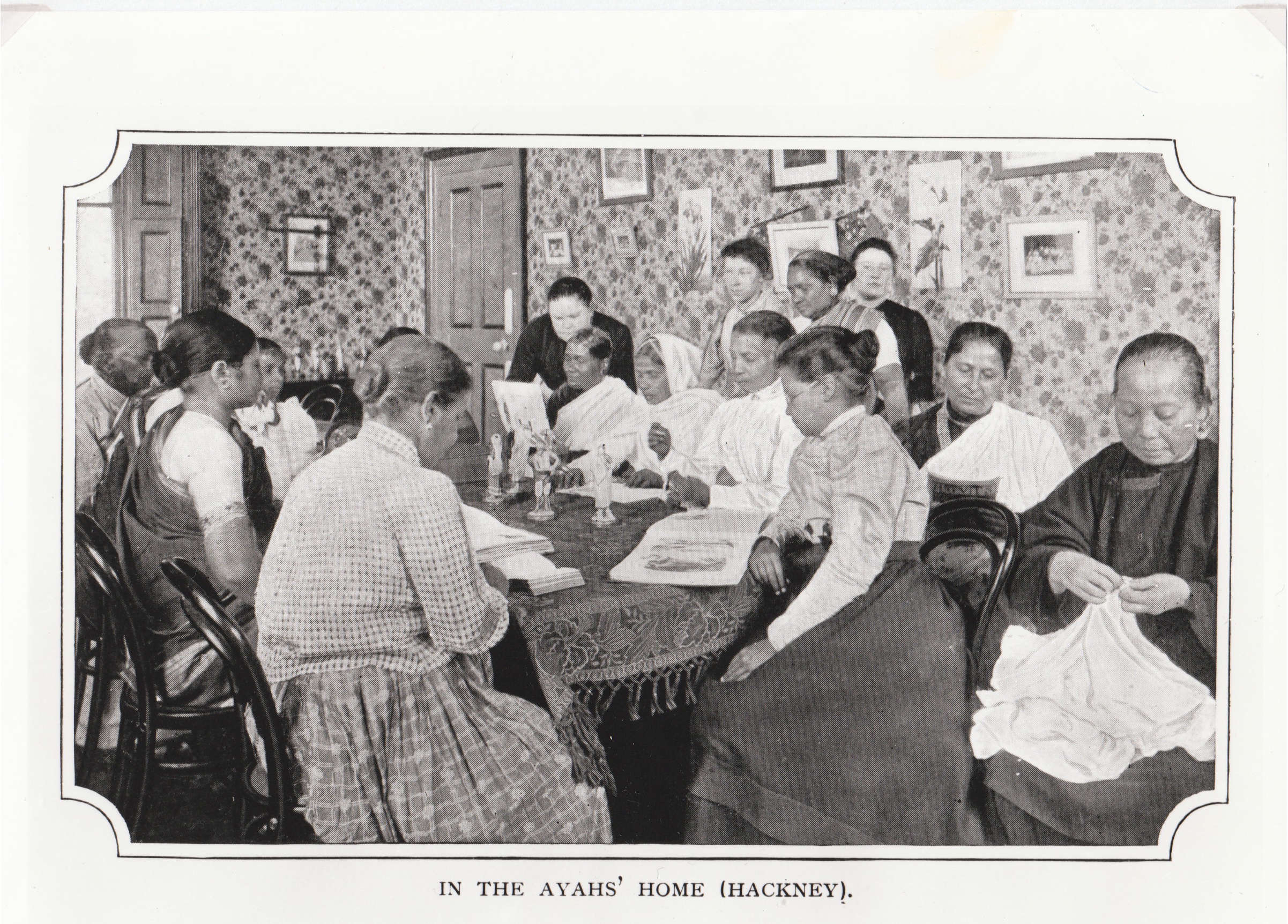
One such effort was the Ayahs' Home in London. It's unclear exactly when the Ayahs'  Home started (one record indicates it was as early as 1825) but there definitely was one established in 1891 at 6 Jewry St, Aldgate in East London. Initially the Home was run by a committee of volunteer women. In 1900, the London City Mission took over and moved the Home to King Edward's Road. Its mission remained the same: to provide refuge and find return employment for abandoned Indian ayahs and Chinese amahs.

The Home would usually receive the return tickets from employers who no longer wanted to employ their ayah and then sell the tickets to families looking to hire an ayah for trips back to India. They would then use the funds from the sale to pay for the ayahs' room and board until they returned. Of course, when the London City Mission took over running the Home, they used it as an opportunity to convert the ayahs to Christianity. While it wasn't an ideal solution, it was more effective than most to help these women.

Sources:
Ayahs, Lascars, and Princes: The Story of Indians in Britain 1700-1947 by Rozina Visram
https://www.thefridaytimes.com/ayahs-home-london-1921/
https://en.wikipedia.org/wiki/Ayahs%27_Home
http://www.open.ac.uk/researchprojects/makingbritain/content/ayahs-home
https://www.ourmigrationstory.org.uk/oms/a-home-for-the-ayahs-https://www.bl.uk/learning/timeline/item124195.html
https://www.andrewwhitehead.net/blog/the-ayahs-home-in-hackney
https://www.ststworld.com/ayahs-home-in-london-where-abandoned-indian-nannies-were-sent-to-live-out-the-rest-of-their-days/

Saturday, July 20, 2019

Mary Ann Jolley and Old Choog

When I was in elementary school, I was absolutely obsessed with Native Americans and discovered several instances where a white child was abducted and/or raised by them. This particular story (ca.  1880s) is from my family's history and I thought it would be fun to share, especially since it includes some interesting details. 

Source: "The Jolley Family Book" published by Brigham Young University Press 1966, written by Bryant Manning Jolley and his committee.

Mary Catherine Jolley and her husband, James Blazzard, lived in Glendale, a few miles up Long Valley from Mount Carmel. They were hospitable people, often feeding the Indians as well as other passers by. Following is the story as told by Mary Catherine Jolley Blazzard. “I did not mind, even when Jim brought home old Choog, a reprobated Indian, almost mortally ill. We made him a bed of sacks and camp quilts in the lean-to shed. We nursed him back to life, not begrudging him a share of our food and shelter.” “We lived in Glendale until we had three babies. Jim had been talking about our moving to Arizona, but when I was about five months along with the third child, Wes, a sorrowful tragedy occurred and all else was forgotten. Little Mary Ann was playing in the doorway one minute and the next minute she could not be found.” “In the heart breaking days that followed, I could not be comforted by my second child, Jimmie, nor by the thoughts of the expecting baby. All I could think of was my little Mary Ann in her blue pinafore, her bright pigtails hanging over her shoulders.” “Tracks of Indian ponies were found leading out of the river, and it was thought that the indians had stolen our little girl to sell to another tribe. The hunt continued far and wide for traces of the child, but it was to no avail. Scouts were sent out from Salt Lake City, but the search was futile.” “More than a year had passed, during which time all of Southern Utah had kept on the outlook. Jim and I decided to move to Arizona with the next covered wagon train, in the company of Andrew Gibbons who later married Nancy Nobles. In this company were to be ten adults, at least eleven children, six wagons, twenty horses, besides a few head of cows and calves.” “Your pa and I one the last night, sat in front of the fire, half in the dark, thinking about the move, and thinking of our lost baby.” “Suddenly a dark face was pressed against the window. I screamed in terror, while Jim crouched in readiness by the window. I dragged Jimmy back behind the bed, out of sight. Then unexpectedly there came a tapping at the door: One, One-two; One, One-two; One, One-two.” “That is old Choog’s knock Jim! The one he used when he was here sick.” “Jim crawled toward the door, and signaled back, then slid the bolt expecting Choog to come in, but instead the Indian thrust a small Indian child through the door. Me bring you Indian Papoose, he said, then disappeared into the dark.” “There stood a little Indian girl, in ragged clothing with tangled hair, looking from one to the other with blinking eyes.” “He’s brought us an Indian child to take the place of ours! I don’t want an Indian child. She can’t take the place of ours! I bet she is lousy, too. Go call him back, and make him take her!” “Jim hunted around outside, but Choog had gone for good.” “We’ll have to keep her overnight. We’ll comb her hair out with coal-oil, heat water on the fireplace and bath her and let her sleep in one of Mary Ann’s clean night gowns. We’ll put her clothing outside the house for the night.” “ As a last thing, I started braiding her hair. All this time the child stood silent, and stoical. Now as I combed through the hair on her neck, the comb caught and she put her hand to the back of her neck. I looked closer to see what had obstructed the comb.” “Jim, come here! Look at this! Then I tumbled over on the floor. Jim lifted me onto the bed and bathed my face in cool water until I revived. What is the matter, my Girl?” “I parted the child’s hair, and there at the edge of the neck was the long dark mole! Mary Ann’s birthmark. Jim held the lamp close to her face. Her eyes were blue. We knew the little Indian girl was Mary Ann, stained brown with wild berries, her hair dyed black with walnut bark.” “Mary Ann, have you forgotten how to talk? Have you forgotten your mother and father?” “I sat rocking the child back and forth, while Jim tried to induce her to talk.’ “I thought her hair felt finer when I was combing the coal-oil through it, than any I have ever felt on an Indian.” “Look, the dye was worn off her armpits. She was white under her arms.” “It won’t take the dye many weeks to wear off. The Indians keep it renewed every day or two, after they steal a white child. We carried her over to the bed, and showed her the little brother. When she saw Jimmy she started to cry, and commenced a jargon we could not understand. It took us an hour to quiet her.” “They made her talk “Indian talk, Jim told me.” “The news of Mary Ann’s restoration spread rapidly up and down Long Valley. The settlers crowded around to see her and to discuss the circumstances surrounding her return to her parents.” “They were all agreed that Choog himself had not stolen her, but that he had rescued her for us because we had taken care of him when he was sick.” “Overjoyed with Mary Ann’s return, we lovingly called her, ‘Our little Indian girl,’ as we strove to become acquainted with her all over again.”
James Blazzard (center left with mustache), Mary Catherine Jolley (lower right), James "Little Jimmie" Blazzard Jr (back left), Mary Ann (back right), and their younger siblings  ca. 1890 Luna, New Mexico Territory, USA