Historical Hussies would like to introduce to you, our readers, the authors who are and will be contributing to this blog. We kick off our introductions with a question/answer interview with Joyce DiPastena, author of the medieval romance,
Loyalty’s Web.
Historical Hussies: When did you start to write and how long did it take you get published?

Joyce: I dabbled with writing as far back as high school, but I started my first novel in college. I didn’t think of it as a “novel” at first, just as another story that I was “dabbling” with. But the characters really captured my imagination, and unlike my earlier writing efforts, all of which had eventually fizzled out, these characters continued to propel me forward until six years later, I found myself with a full-fledged novel on my hands. (Yes, it took me four undergraduate years and two years of graduate school to finish my first book.) And yes, in case you’re wondering, my first book was a medieval novel. ☺
That novel was never published, and neither was its sequel (which took me another six yeas to write).
Loyalty’s Web was the third book in my series. It was also the best written, since I’d learned tons more about good writing technique since those very early efforts. Still, it remained unpublished for probably a good fifteen years while I worked on other projects. It came close to being published by a national publisher once, but my potential publishing house merged with another house, my editor was let go and
Loyalty’s Web was dropped. Throughout all those years, I continued to return to
Loyalty’s Web and polished and repolished and polished it again. I always thought I had a good story, and I never completely gave up on it.
HH: How did you break into publishing?
Joyce: By the end of 2006, I’d pretty much given up on ever finding a publisher for my books. I’d never seriously considered self-publishing before, but technology was changing. With the new print-on-demand option, I no longer had to invest thousands of dollars to self-publish a garage-full of books that I knew I’d be too shy to ever try to sell. But now, for a relatively small investment, I learned that I could self-publish, get my book posted on Amazon and Barnes&Noble.com, and my books would be printed only as orders were placed for them. I found myself thinking, “I’ve allowed all my books to (figuratively) sit tucked away in a drawer for all these years. I can either leave them there till the day I die, or I can take a chance on them, try a print-on-demand self-publishing program, and see if there really is an audience out there for my stories.” I figured I would never know if I never tried. So in 2007, I began by self-publishing
Loyalty’s Web.
To my surprise, people actually started buying copies and seemed to be enjoying them! Later that year, I learned about a contest for published books that allowed self-published entries. I decided I had nothing to lose by entering, so I did. Early in 2008, I learned that
Loyalty’s Web had been selected as one of five finalists for a Whitney Award.
Loyalty’s Web didn’t win, but it caught the attention of a small publishing house called Leatherwood Press. Their editor contacted me and expressed interest in republishing
Loyalty’s Web for a wider audience. And the rest, as they say, is history.
HH: What genre or sub-genre do you write?
Joyce: I write a sort of medieval cross-genre. Romance, with strong mystery, suspense and political elements…a drawback in the national market, according to the many editors who turned me down because they didn’t know how to “peg”, and therefore, market my writing. But Leatherwood Press has shown wonderful faith in me, and readers’ response has been extremely positive. Leatherwood has marketed
Loyalty’s Web as a romance, and a romance is always at the heart of each of my stories, but there is usually much, much more going on alongside the romance. I like to play with lots of different plot threads, but in the end, my stories are ultimately about two people falling in love and living happily ever after.
HH: What difficulties does writing this genre present?
Joyce: I suppose the obvious answer to this question would be “research”, but I love researching my novels. I guess the greatest difficulty is finding specific bits and pieces of research that I need for my story. You’d think the internet would have made that aspect of writing easier, but I haven’t always found that to be the case. So much on the internet is “general” rather than “specific” oriented, plus a lot of it is simply splashed on a website without any clear authentication of where the site came up with their “facts”. I prefer to know I have a reliable source before I insert a bit of research into my novels. Two reliable sources confirming the same fact is even better. I continue to have my best research luck with good old fashioned books. Book sites like Amazon.com have made it much easier to track down research books dealing with delightfully arcane bits of medieval knowledge, so in that respect, that internet has truly been a blessing.
I have a blog called
Medieval Research with Joyce, if your readers would like to take a look at some of the books I found particularly helpful in writing
Loyalty’s Web. Some of those posts may be making guest appearances in future Historical Hussies blog posts. ☺
HH: What are you working on now?
Joyce: I’m just at the very beginnings of what I’m calling my “troubadour book”. The hero, a very young man, is torn between whether to become a knight, as his birth entitles him to, or follow his love of music and become a troubadour instead. Don’t ask me about the heroine. She’s still very much in flux! If you’d like to read something of my current wrestles to get this story off the ground, you can read my post on “Alligators and Me” on my
JDP NEWS blog.
HH: What has surprised you about being a published author?
Joyce: What surprises me the most is that people will actually plunk down money to buy something that I’ve written. What thrills me the most is when they actually enjoy my book!
HH: What do you like to do when you aren't writing?
Joyce: Sleep, eat, watch TV…all that good lazy kind of stuff.
HH: What advice would you give aspiring writers today?
Joyce: Write because you love to write and never give up. It took me over twenty years to get my first book published. There were times I gave up on publishing, but I never gave up on writing. Of course I wanted to be published much earlier, but I simply wanted to write even more. Learn all you can about “good writing”, then write what you love and write from your heart. If you love what you’re writing about and it comes from your heart, that will come through to your readers. And have faith that you will have readers one day, no matter how long it takes. To paraphrase Saint Paul, “The race is not to the swift, but to he who endures to the end.”
HH: Can you give us a summary of
Loyalty’s Web?Joyce: Sure. Here’s the backcover blurb:
In twelfth century France, King Henry II of England has just finished quashing a rebellion by his power-hungry sons and now seeks to tame the lawless barons who supported them in this corner of his "Angevin empire." To this end, the king has sent the Earl of Gunthar as his royal representative to ensure that Prince Richard and his former cohorts faithfully adhere to the terms of the peace treaty.Far from being welcomed with open arms, Gunthar no sooner steps foot in the county of Poitou than he is greeted by a series of assassination attempts. All appear to be linked to the former rebellious prince through the agents of the family and friends of young Heléne de Laurant. A clever, intrepid young woman, she realizes that the only way to prove her loved ones’ innocence is by exposing the true assassin. Heléne races against time—and dark secrets of the past—to unmask the killer before the kingdom plunges back into war.Fierce determination gives way to mutual attraction as Heléne and Gunthar spar over the identity of the traitor. But their blinding magnetism almost causes them to overlook an even deadlier threat from an entirely unexpected direction.
HH: It sounds fascinating. Where can interested readers purchase a copy of
Loyalty’s Web?
Joyce:
Loyalty’s Web is available on
Amazon.com,
DeseretBook.com, or in Deseret Bookstores in Arizona, California, Colorado, Idaho, New Mexico, Nevada, Oregon, Utah, and Washington state.
HH: Thank you for joining us today, Joyce. We look forward to your future posts on Historical Hussies.
Joyce: Thank you for the interview. It’s been a delight to share some of my thoughts and reflections with your readers. I’m excited to be part of this group, and look forward to sharing some of my research with your readers in the future!
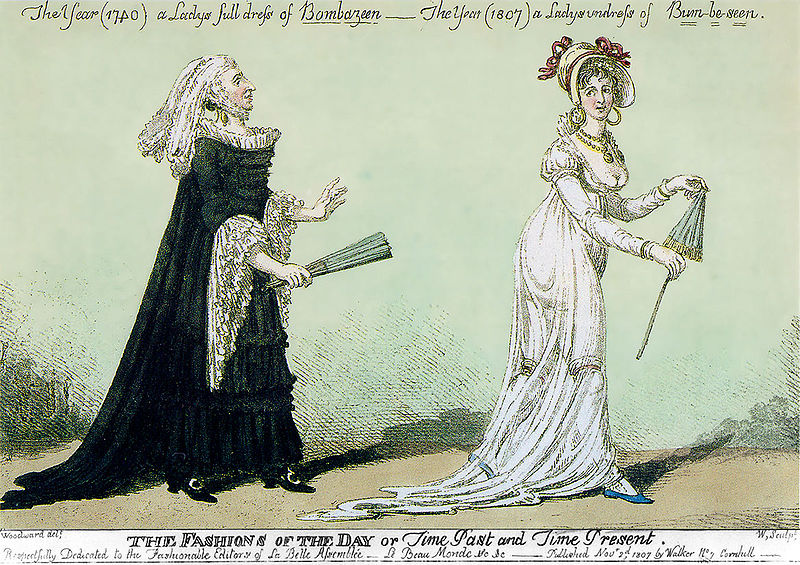 Fans have been used as both a fashion accessory and a useful tool of staying comfortable for hundreds of years. Nearly every culture has a fan of some sort and the Regency Era, the time period in which I base all my romance novels, is no exception.


 Posts
Posts


