Search This Blog

Showing posts with label Regency Romance Author. Show all posts

Friday, March 20, 2015

Spotlight on Regency Fashion: the pelisse

By Donna Hatch

Ladies in Regency England had more reasons to change clothes than the modern-day woman would ever believe. They had special clothes for relaxing at home, walking, riding, going for a drive in a carriage, afternoon gowns, evening gowns, ball gowns, etc. And the number of accessories is even more mind-boggling.

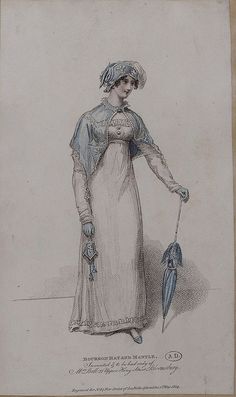
But one of the Regency ladies' fashion accessories was practical as well as fashionable. It was the pelisse. Generally lightweight, Regency ladies wore this long over-garment to protect her clothes from dust and dirt. Since many roads were unpaved, walking and riding in a carriage produced dust and dirt that would sully a gown. And since fashionable ladies often wore white or light colors as a status symble, keeping clothing clean in a not-so-terribly clean environment must have proved challenging. Big cities such as London were even dirtier with all the soot polluting the air from burning coal.

Wearing a pelise became an indespensible part of fashion, as well as a necessary garment, outside one's home. Though pelisses didn't generally take the place of a warm coat or cloak, they also added a layer of warmth in the event the weather took a sudden turn.

I have additional pictures of pelisses and gowns on my Pinterest Regency and Jane Austen Page.


Donna Hatch is a noted Regency researcher, enthusiast, and historical romance author. You can visit her website at www.donnahatch.com
Like her author page on Facebook
Follow her blog at www.donnahatch.com/blog

Friday, January 16, 2015

Regency Sun Protection

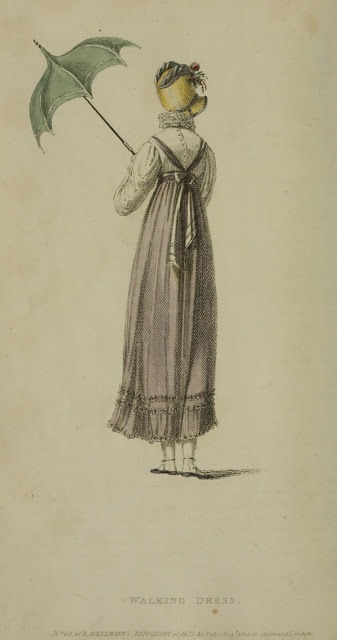
Regency fashion plate, parasolby Donna Hatch

Unlike the sun-kissed tans admired by some women today, (and let's face it, chalk-white legs just aren't coveted) a pale complexion was a fashion statement during much of England's history. Since laborers often worked long hours outside, their skins got tanned and weathered from exposure to the sun and the elements. A lady with a creamy complexion loudly proclaimed, without uttering a word, that she was wealthy enough not to have to spend a great deal of time out of doors. But since a lady's skin could become unfashionably brown simply by walking outside, even with the protection of a hat or bonnet, she had to take measures to protect her skin from the sun.

During previous eras, ladies and gentlemen of the upper classes powered their faces to maintain a pale complexion.  But by the Regency Era, people abandoned the powder, rouge, lipstick, and powered wigs, as well as ostentatiously ornate clothing, in favor of a more natural, comfortable look. They also started bathing on a regular basis, which I think is not a coincidence.

Regency fashion plate and parasol
What was a lady to do if she wanted to spend time outside but keep her skin alabaster white without the use of powder? Sunscreen, obviously, was not the answer, since it had yet to be invented. Bonnets and hats certainly helped but there were times when those failed to protect a lady's face from all angles of the sun.

Enter the parasol. Made of natural fabrics such as cotton and silk and often embellished with lace, these functional little beauties became so popular in England early in the 19th century that they became part of a fashionable ensemble.  Depending on how they were made, they could even protect a lady from a light rain.

Winter Collection, 6 historical short storiesSo the next time your Regency lady goes for a walk, make sure she brings her bonnet and parasol to keep her face un-freckled and white, and her gloves to protect her hands, lest she fall under criticism of becoming "brown." Horrors!

For more pictures, feel free to check out  my Regency Accessories Pinterest Board with lots of images and fashion plates of parasols, fans, shoes, and other fun Regency accessories.

Laura Boyl on Jane Austen Center has some lovely pictures of ladies and children carrying parasols.

Louise Allen, on her blog, History of Costume, has a great collection of pictures as well as how the "correct" way to hold a parasol evolved.

Sources:
http://janeaustenslondon.com/tag/history-of-costume/
http://www.janeausten.co.uk/parasols/