During the Regency era there were very strict rules for courting couples. They could never be alone together unless they were chaperoned, were betrothed, were in an open carriage, or on horseback. With all these strictures, our modern sensibilities make us wonder how they ever found time to get to know one another. There were, however, several outings the couple could indulge in and not create a scandal.
A gentleman could, in all propriety, accompany a young woman to several public sightseeing landmarks without censure. Places such as the Tower of London, Hampton Court, Hyde Park, or the British Museum to see the Elgin Marbles. As long as the couple were in full view of the public, they could walk and talk together and preserve the proprieties.
Carriage rides were a very popular way for a couple to indulge in private time together while courting. The carriage had to be open, but could also be a sporty curricle or a high-perch phaeton (the sports cars of the Regency period). Rides were usually taken in Hyde Park during the most fashionable hours between 4:30pm and 7:30pm, the point being to see and be seen by everyone else in the ton.
One favorite outing was to go to Gunter’s Tea Shop, one of the most fashionable light eateries in London. Gunter’s was famous fortheir ices and sorbets. Located in Berkley Square in Mayfair, it was another establishment where the ton came to see and be seen. The Georgian Index reports that it became popular to eat the ices outside. “Gunter's Tea Shop was the only establishment where a lady could be seen eating alone with a gentleman who was not a relative without harming her reputation. The ladies would remain seated in the carriages in the shade of the Maples. Their gentlemen escorts would step down from their equipages and come round to the passenger side of the curricle or barouche and lean against the Square's railings sharing the lady's company and the treat.”
Another outing, also very popular and a bit daring, was a trip to the Vauxhall Pleasure Gardens. This was a vast park of several acres of land that had different kinds of entertainments at night, from musical presentation to fireworks. Vendors sold various wares and although the best lit place in London at night, it still boasted several darker pathways down which a couple might stroll for a bit more private conversation. Usually ladies formed parties to attend Vauxhall insuring chaperones for a couple until they had agreed to a formal engagement.
These outings were an approved part of courtship during the Regency. In many of my Regency romances, my courting couples make use of these excursions as they try to get to know one another, as did countless real couples of the period. Check out this social whirl in Heart of Desire or any of my Handful of Hearts novellas, all on sale during the month of April for .99 each.
Showing posts with label curricle. Show all posts
Wednesday, April 1, 2020
Tuesday, January 10, 2017
Carried Away by Carriages
In this era of the auto, we look
back on carriages as romantic—but in the English Regency, the carriage was
practical, sporting, and a sign of status. It was also an era in which technical
improvements resulted in faster, lighter and more comfortable carriages.
In 1804, Obadiah Elliott of Lambeth
invented the elliptic spring, lightening the weight and eliminating the need
for perches. Samuel Hobson improved carriage shapes by lowering the wheels in
1820. At the same time, the engineer Jon Loudon McAdam introduced his process
to pave roads to create a hard, smooth surface and double the speed at which
carriages could travel.
Perhaps the most popular of
carriages for those who could afford fashionable vehicles were the phaetons, the
sporting curricles, and the landau and barouche.
Phaetons first appeared around 1788
and the Prince of Wales—then a dashing young man—popularized their use in the
1790's. They were noted for being built very high over the body, with four
wheels (large wheels in back and smaller wheels in the front). They sported two
types of under-carriage. A perch phaeton had a straight or slightly curved
central beam that connected the two axles. The 'superior' crane-neck phaeton
offered a heavier construction of iron with two beams and hoops which allowed
the front wheels to turn.
Ladies as well as gentlemen drove
spider, park and ladies phaetons that were often drawn by ponies. Lady Archer,
Lady Stormont, Mrs. Garden and even the Princess of Wales were noted whips.
Among the gentlemen, Sir John Lade, Lord Rodney, Charles Finch and Lord Onslow
set the pace.
The curricle, a two-wheel and more
sporting vehicle, came into fashion in the 1800's. The sponsorship of the
Prince of Wales—who was becoming too fat to climb into his high perch phaeton—promoted
the curricle’s popularity. Horses were attached to the light-weight body by
harness connected pole, with a steel bar that attached to pads on the horse's
back to support the pole. The curricle offered seats for two, with a groom's
seat behind.
By the 1800's, the sociable had
evolved into a carriage named the sociable-landau or simply the landau. This
carriage was drawn by a pair of horses, and driven with post boys (riders on
the horses) or by a coachman if a box seat had been built onto the body. Hoods
could be raised, front and back, so that the landau resembled a coach, or the
hood could be lowered in fine weather. Luke Hopkinson of Holborn introduced the
Briska-landau, which offered seats that rose six inches then the top was put
down. Canoe-landaus offered curved, shallow bodies and were sometimes called
Sefton-landaus, after the Earl of Sefton.
The barouche did not gain in
popularity until its heavy body and low build had been modified. When Mr.
Charles Buxton founded the Whip Club in 1808 (which became the Four-In-Hand
Club the following spring), its members drove "...fifteen barouches and
landaus with four horses to each...." to the first June meeting on a
Monday in Park Lane. Because its members often drove barouches, the Whip Club
sometimes came to be called the Barouche Club.
The barouche required large,
'upstanding' horses, with impressive action. It could be driven from the box or
with postillion riders, and could accommodate a pair, four or six horses. Two
passengers could be seated in the body, and a seat provided comfort for two
grooms.
Many noted whips designed their own
carriages, which is how we come by the Stanhope Gig, made popular after 1815 to
the design of the Hon. Fitzroy Stanhope. Carriages also bore the name of their
builders. The Tilbury Gig of 1820 was designed and made by Tilbury the
coach-builder. Unlike other gigs it had no boot, and the rib-chair body was
supported entirely on seven springs, making it a popular vehicle for use on
rough roads.
Other carriages in use during the
Regency included a drag, which was the slang term for a gentleman's private
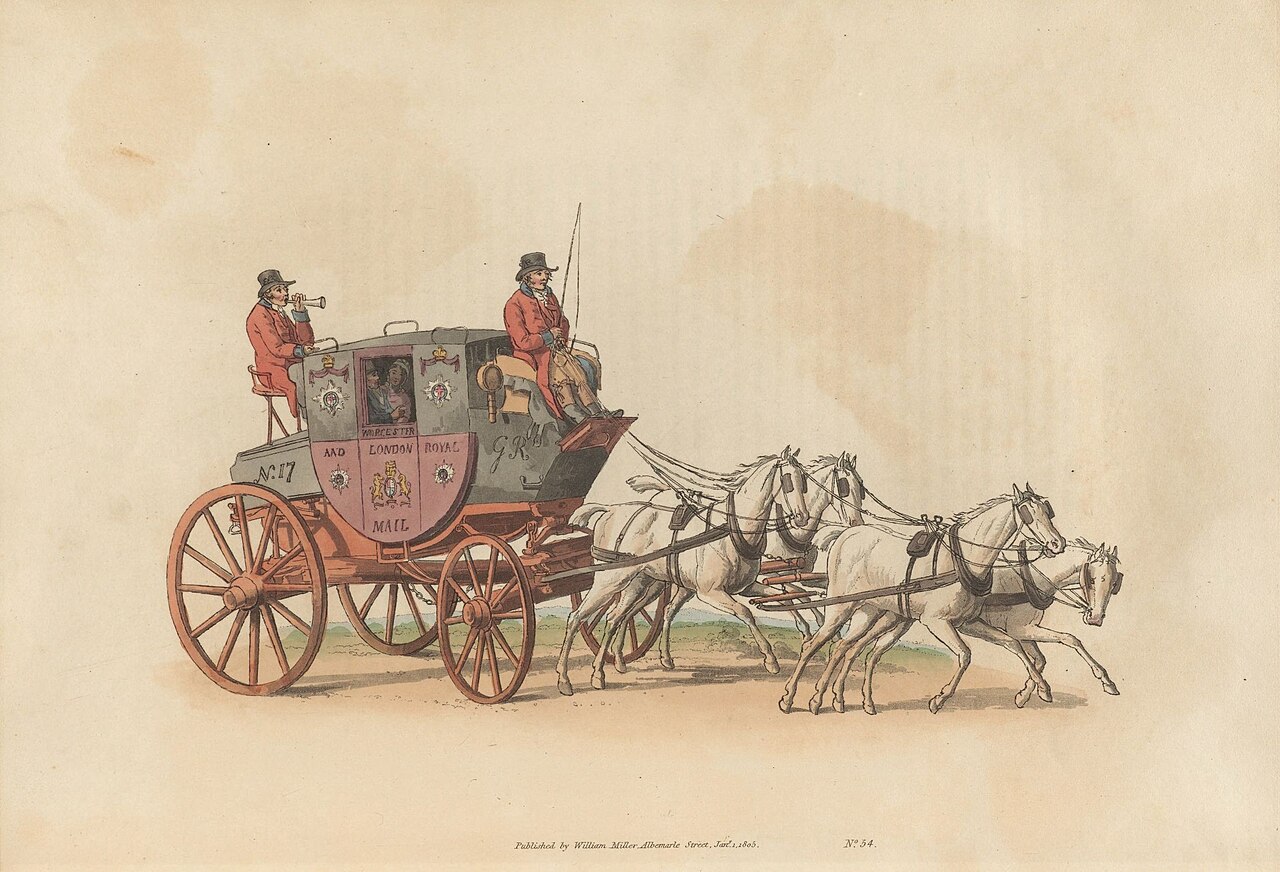
coach. These were built for four-in-hand teams and copied the mail coach with seats
inside the coach and on the roof. Gentlemen drove their drags to race meetings so
the carriage could act as a grandstand. A convenient tray in the boot could
even be lowered to create a table for picnics.
By 1815, the heavy traveling coach of
the previous century had been replaced by the traveling chariot, a light-body
vehicle usually driven by postillions or post boys who rode two of the horses
harnessed to the carriage. These vehicles served as the post-chaise carriages that
could be hired at various posting houses. At a cost of one shilling and six
pence per mile for a pair of horses—and double that for four horses—a post-chaise
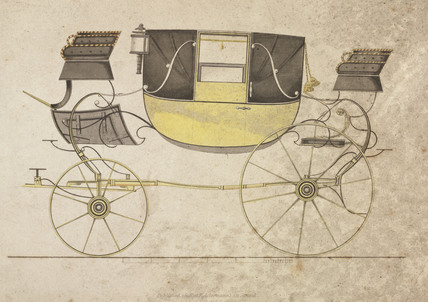
was not an economical method of travel. They earned the slang name 'Yellow
Bounder' for the almost inevitable yellow bodies.
After 1830, the increasing
popularity of the railroad meant the end of the carriage for long-distance
travel. But until the advent of the automobile, carriages continued to flourish
in type and design. But beauty in shape and color for carriages and horses are
still symbols of wealth and leisure.
SOURCES:
The Elegant
Carriage, 1979, Marylian Watney
Horse &
Carriage, 1990, J.N.P. Watson
The History of
Coaches, 1877, George A. Thrupp
The Coachmakers,
1977, Harold Nockolds
Thursday, January 21, 2016
Carriages and Coaches in Regency England
By Donna Hatch
People in Regency England depended heavily upon horseback and carriage to get around. Many of them traveled extensively from their country homes to London for the Season, which was both a social and political time of year while the House of Lords was in session. Many roads were terrible, and weather and highwaymen made travel uncomfortable as well as dangerous. To accommodate the Regency gentry or nobility, the styles, paint design and features of carriages were as varied as today’s automobiles, and many were also custom-made. Nobility had their family coat of arms painted on the side of their family coach. Image, status, and money, as well as personal taste, were all factors in choosing a carriage. A reader may come across a number of different names for conveyances. Unless one is willing to do research, these names may mean nothing. So, to help you visualize types of vehicles in historical novels, here are some more commonly used types:
- Barouche
Barouche (pictured): a very expensive and large four-passenger carriage pulled by four horses. Its folding hood could be raised but it only covered two of the passengers. This was viewed as a status symbol to own and provided a stylish way to be seen showing off wealth and clothing. It also allowed for unimpeded views, so they were ideal for sight-seeing.

- https://commons.wikimedia.org/wiki/File:Curricle.jpg
Curricle: (pictured) a vehicle meant for two horses, it was small and only had two wheels. Its hood folded down, like a convertible. Lightweight and very fast, it was a favorite of young men who wished to show off driving skills and a perfectly matched team. Thrill-seekers often used it in racing, but it tipped over easily, so it was dangerous, hence the challenge and allure.
Dog cart: named so because owners often used it for taking fox hounds to a hunt. It had a seat in front for one driver, and a seat facing the rear of the carriage that could fold down for two passengers. Originally named a dog cart due to the ventilated box under the seat to keep hunting dogs when they drove to the fox hunt, this box also created an ideal place to stow cargo. There were both two- and four-wheeled versions. Another vehicle called a dog cart was a small four-wheeled cart pulled by dogs, generally to transport containers of milk or other cargo.
Family coach: a closed carriage that comfortably seated four passengers. The driver sat up front, way up high. It had windows, curtains, lanterns and usually storage compartments for refreshments and supplies. They also normally featured small desks for writing the many extensive letters Regency people were so mad about sending and receiving.
Gig: much like the dog cart, often popular with country doctors, is a two-wheeled vehicle with a seat wide enough for one or two people.
Governess cart: also called a “jaunting cart,” sometimes driven by ladies but most often by children. It was small and light, and pulled by one pony or donkey.

- Hackney Coach 1800 @wikimedia commons
Hackney (pictured): like the modern day taxi cab, these could be carriages of any kind, but typically those that were closed, and driven by the cab driver, called a jarvey. They were most often used in London. One could hail them from the street, or go to a hackney stand where the jarveys hung out until they found a paying passenger.
Hansom: a two-wheeled carriage used as a cab. Most sources date its usage beginning with the Victorian Era. If this is true, it would not have been around during the Regency.

- en.wikipedia.org/wiki/Landau_(carriage)
Landau (pictured): an open carriage with folding hoods that could be raised to protect the passengers. Like the Barouche, it was ideal when one wanted to see and be seen. It, too, had a driver up front and was pulled by four horses. Cinderella's carriage reminds me of a Landau.

- https://en.wikipedia.org/wiki/Phaeton_(carriage)
Phaeton(pictured): a smaller two-seater used by owners who drove themselves. It had a roof, but the front and sides were open, although some pictures show it as having a folding hood. The front two wheels were smaller than the back wheels. Often the seat was very high, so much so that one required a ladder to reach it. It was also often referred to as the high-perch phaeton. It was considered stylish and rakish.
Post Chaise: technically any carriage that could be hired out by someone who wished to travel privately and not with a group of strangers such as a stage coach or mail coach. By the Regency it was usually small, chariot-style carriage which could be pulled by two or four horses, (but usually four) often painted yellow, and had one seat, which seated two. It also had an outside, rear facing seat for servants and a platform in front for luggage. The driver, called a postilion, rode on the backs of the left lead horse instead of on a bench on the carriage.

- https://en.wikipedia.org/wiki/Stagecoach
There were also stage coaches and mail coaches, which were public transportation for the person who didn’t mind (or were forced by the size of their purse) to travel with other passengers. They followed select routes and stopped at inns for food and for changing out the team of horses. The mail coach was the cheapest way to travel, and the most uncomfortable because its primary function was to carry mail rather than passengers. Sometimes, passengers were obliged to ride on top, and there are stories of that proving a fatal way to travel.
Traveling in Regency England was so difficult and dangerous, I'm honestly surprised people did it at all. But I suppose our ancestors will look back at us and how many car accidents and traffic jams occur in our era, and will wonder the same about us. It all boils down to a need to get somewhere, and the means at one's disposal for getting there.
Subscribe to:
Posts (Atom)