Search This Blog

Wednesday, November 28, 2012

A SIMILAR TASTE IN BOOKS, My Latest Regency comedy

I love books, I love libraries and I love Regencies. I've combined all three in my first self-published book,  A Similar Taste in Books, a sweet regency romance novelette.

I wrote A Similar Taste in Books as a standalone to see what all the self-publishing fuss was about. But thanks to an author friend who suggested I continue the story, I've decided to make it the first book in the series Love and the Library. There will be three more novelettes (which I have yet to write) detailing the romantic journeys of the Book 1 hero's three friends as each finds his lady at the library.

I almost used Love and the Library as the title of the first book. Good thing I didn't.

A Similar Taste in Books, Book 1 of Love and the Library

BLURB:
Pride and Prejudice has always brought lovers together, even in the Regency.

Justin has a deep, dark secret—he likes that most despised form of literature, the novel. His favorite novel is Pride and Prejudice, and, especially, Miss Elizabeth Bennet. Intelligent, lively, fiercely loyal Miss Elizabeth. How he would love to meet a lady like her.

Clara’s favorite novel is Pride and Prejudice and Mr. Fitzwilliam Darcy. Intelligent, steadfast and willing to admit when he is wrong. Can such a splendid man exist? And can she find him?

One day in the library, they both check out copies of their favorite book. When Justin bumps into Clara, the magic of their similar taste in books just might make their wishes come true.

A sweet, traditional Regency romance. 

EXCERPT:

With a curt nod to the officious clerk, Justin gathered up his package and stepped back. He collided with the person next in the queue. “I beg your par—” 

Before him stood the loveliest lady he had ever seen. She was short and willowy, her dark pink muslin walking dress emphasizing every slender curve. Deep brown curls peeped from the sides of a gauzy matching pink bonnet to frame an oval face. Her skin was creamy, her nose straight and proud.

Miss Elizabeth Bennet! The lady of his dreams! His jaw sagged.

“No harm done, sir.” The vision lifted a shapely dark eyebrow. “If I may reach the clerk?” Merry chocolate-colored eyes twinkled up at him and sweet rosy lips dimpled in an amused arch of a grin. A whiff of lilac perfume, delicate as the lady, wafted toward him.

He snapped his mouth shut with an audible click. “Oh, sorry.” Damn him for gaping like the veriest fool. Hugging his package to his chest, he stumbled away from the young lady and the plainly dressed woman, most likely her maid, who stood beside her. The maid flashed a grin as if she knew every one of his admiring thoughts.

He bumped into the table by the counter, and pain lanced through his elbow. Cradling his bundle with one arm while rubbing his throbbing forearm, he pretended to study the list of new books on the table, but kept his gaze fixed on the young lady. She was exactly as he had imagined Miss Elizabeth Bennet.

Who was she? And how could he make her acquaintance?
   
Ebook available at 

Amazon Kindle US
Amazon Kindle UK
Barnes and Noble
Smashwords
Kobo
Sony Reader Store
Diesel

Two five star reviews, here and here.
 
Thank you all,
Linda

Wednesday, November 14, 2012

Guest Christy English: Shakespeare Updated to Regency England

Linda Banche here. My guest today is Christy English and her How to Tame a Willful Wife, an updating of Shakespeare's The Taming of the Shrew to Regency England. Here she tells us about her heroine's take on the strictures placed on Regency women, and the connections between Shakespeare's England and the Regency.

Leave a comment with your email address for a chance to win the copy of How to Tame a Willful Wife which Sourcebooks has generously provided. Christy will select the winner. Check the comments to see who won, and how to contact me to claim your book. If I cannot contact the winner within a week of selection, I will award the book to an alternate. Note, Sourcebooks can mail to USA and Canada addresses only.


And the winner is catslady! Congratulations, catslady, and thanks to all who came over.

Christy English:
1. What was proper behavior for women in Regency England, and how doesn't Caroline fit?

Women in Regency England were tied to the men in their lives by chains of adamant. Though widows could and did inherit money on the deaths of their husbands, they were also given guardians to oversee their finances and their lives, as well as the lives of their children.

Caroline Montague, the heroine of my novel, HOW TO TAME A WILLFUL WIFE, is aware of the limits placed on her existence. She just prefers to ignore them.

While she agrees to marry as her father bids her, her acquiescence to an arranged marriage does not change how she chooses to live her life. Raised by her father’s veterans as much as her own parents, Caroline has spent the years of her girlhood learning to fence, to ride astride her war horse, Hercules, to shoot with a bow and to defend herself by throwing knives. Not one of these occupations, save archery, was acceptable for women during the Regency, and her husband begins the long, slow process of taming her, i.e. bringing her back into the fold of what is proper for a lady, and for a countess in the year 1816.

As the story continues, the romance between Anthony and Caroline blossoms, and they learn, in fits and starts, how to live together as equals. Any sense of equality between an earl and his wife would have been considered ludicrous in the Regency period, but fortunately, I am writing for the modern world, where we are all still striving for the ideal of equality.


2. Why did you update Shakespeare to Regency England? What are the connections between the two eras?

Shakespeare’s work lives and breathes in any age, and many of the themes explored in The Taming of the Shrew, such as power within marriage and who wields it, were as relevant during the Regency period as during the Renaissance.

On paper during both time periods, the man held the power in any relationship. But the human factor must be brought into account, the fact that all men did not wield their legal authority like a sledge hammer, but instead worked to find ways in which they and their wives could live together in harmony, if not equality.

Unlike Katherine and Petrucchio in Shakespeare’s play, Anthony and Caroline find ways of living and working together that do not include starving her into submission. Though Shrew is a comedy and meant to be taken as such, Petrucchio does keep his wife from sleeping and eating for days at a time in order to make her obey him, indeed, to force her to conclude that whatever he says is true, including whether the sun is the moon, simply because he says it is.

Anthony and Caroline never fall into this level of conflict. Though Anthony strives to make Caroline obey him, he never resorts to the measures Petrucchio adopts in Shrew. Though a husband had complete authority over his wife in both Renaissance England and Regency England, the world had become a bit more enlightened along the lines of gender by 1816. There was certainly more social pressure, if not legal pressure, to treat a woman as a human being. As we move from Shakespearean England into the Regency, we see that socially, things are getting better for women, though it will take another hundred years and more before the legalities catch up.

HOW TO TAME A WILLFUL WIFE by CHRISTY ENGLISH

How To Tame A Willful Wife:

1. Forbid her from riding astride
2. Hide her dueling sword
3. Burn all her breeches and buy her silk drawers
4. Frisk her for hidden daggers
5. Don't get distracted while frisking her for hidden daggers...

Anthony Carrington, Earl of Ravensbrook, expects a biddable bride. A man of fiery passion tempted by the rigors of war into steely self-control, he demands obedience from his troops and his future wife. Regardless of how fetching she looks in breeches.

Promised to the Earl of Plump Pockets by her impoverished father, Caroline Montague is no simpering miss. She rides a war stallion named Hercules, fights with a blade, and can best most men with both bow and rifle. She finds Anthony autocratic, domineering, and...ridiculously handsome.

It's a duel of wit and wills in this charming retelling of The Taming of the Shrew. But the question is...who's taming whom?

ABOUT THE AUTHOR
After years of acting in Shakespeare’s plays, Christy English is excited to bring the Bard to Regency England in How to Tame a Willful Wife , a re-telling of The Taming of the Shrew. Connect with her at http://www.christyenglish.com/ and https://twitter.com/ChristyEnglish

Photo of lady embroidering from the movie Emma

Monday, October 8, 2012

Gloves Through History


Gloves are one of the most versatile articles of clothing. Not only do they serve a specific purpose, they are wonderful fashion accessory.

Glove makers made gloves out of almost anything; sheepskin or deerskin, silk, linen, and often decorated them with precious metals, jewels, and fine embroidery. Gloves were worn to help protect the hands as well as keep them warm. Many people wore them when handling tools or working with leather. Warriors and knights wore gauntlets which is a very heavy duty glove. Falconers, as a matter of survival, wore gloves or gauntlets very early to protect their hands from the sharp claws of their beautiful hunting birds. Sometimes they decorated their gauntlets to match the hood they used to covered their bird's eyes. 
The earliest gloves probably were created to keep people's hands warm. Though  there are earlier mentions of gloves, once instance was documented in 1st century AD by Pliny the Younger. He wrote of a scribe who wore them in the winter, probably to keep his hands warm enough to write in a cold and drafty castle. Though nothing in my research suggested women wore glove as early as men, I can't believe women didn't need them for warmth just as men did, maybe more so.

Gloves were found in Egyptian Pyramids in the tomb of King Tutankhamen, a.k.a. "King Tut" circa 1400 B.C. These were made of linen. Apparently, pharaohs wore gloves as a symbol of wealth and power, while women wore them as a beauty treatment--they rubbed oil on their hands and them put on silk gloves over them to protect them and let the oil soak into the skin.  I do a similar thing with socks on my feet


In England, women’s gloves became a fashion accessory during the thirteenth century, most often made of linen and silk. A guild of glove makers in 13th century Paris made them of skin or fur. They didn't become truly fashionable until the 16th century. Queen Elizabeth wore jeweled and embroidered gloves, and she reportedly slipped them off frequently to show off her beautiful hands.

During the Regency Era, men and women wore different gloves for different occasions. They wore them during the day at home, sometimes with holes in the fingers, so they could read, do needlepoint, and write. Usually those were knitted or crocheted. They always wore them when they left their homes to go for walks or call on friends. They had special riding gloves to protect their hands from the reins. And they wore them when attending balls, the opera and dinners with friends. It was considered bad form for a gentleman to touch a lady without his gloves on--far too intimate, you know. About the only time they didn't wear gloves was while eating.

I wear gloves for warmth and for driving, but the only other time I wear gloves is when I'm in Regency costume. It is nice to have on gloves when dancing, because if the man with whom I'm dancing has sweaty hands, I don't know it :-)


Monday, September 24, 2012

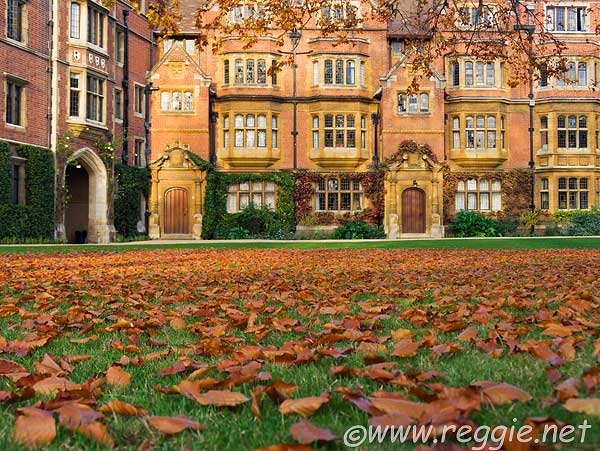
Welcome Autumn


September 22, 2012 was officially the first day of Autumn, or "Fall" as we Americans call it.

Long ago, when the air cooled and the leaves turned gorgeous shades of gold, red and burgundy, people did more than don sweaters and switch their clothing to darker colors.

In the Northern Hemisphere, the first day of autumn or fall is officially the day when the Sun crosses the celestial equator moving southward on September 22nd or 23rd.  This day is called the Autumnal Equinox which is Latin for  "equal night" when the days and nights are almost exactly twelve hours long.

Anciently, the Autumn Equinox or Harvest Home was called "Mabon," pronounced 'MAY-bon', after a Welsh god called Mabon ap Modron which literally means 'son of mother'.

The full moon nearest to the Autumn Equinox is called the Harvest Moon. Historically, farmers harvested their crops by then and had a harvest celebration.

One Mabon Celtic ritual was dressing the last sheaf of corn harvested in fine clothes, or weaving it into a wicker-like man or woman. Apparently, they believed the sun was trapped in the corn and needed to be set free. So they  burned it and spread the ashes  on their fields.

Mabon is also known as the Feast of Avalon, derived from the meaning of Avalon being, 'the land of the apples'.  It also traditional at Mabon to honor the dead by placing apples on burial cairns as a symbolism of rebirth. It was also a way for the living to anticipate being reunited with their loved ones who had passed on.

Many people often associate autumn with melancholy, and facing the end of the liveliness of summer and the beginning of the bleakness of winter. Grey skies cause many people to retreat, both physically and mentally. Autumn is the time of year when the celebrated English poet, John Keats, wrote his most acclaimed poem, "To Autumn" which has a distinctly melancholy beauty.

The ancient Celtics used this time to reflect on the past year as well as celebrate nature's bounty by  having a feast and a celebration. I imagine those were the roots for the Thanksgiving feast we Americans we celebrate.
Since Autumn or fall is when the torrid heat finally cools where I live in southwestern Arizona in the U.S., I welcome the seasonal change with open arms. Although we don't get the gorgeous color autumn is famous for having, I gaze wistfully and pictures of places that do.

Is there any fun personal or family tradition you do during autumn? 

Monday, September 10, 2012

Why I Read Historical Fiction


In a recent survey, 80% of people who called themselves avid readers listed historical novels as one of their top 3 favorite types of books to read. I wasn’t really surprised, since historical fiction, especially historical romance fiction, is my favorite genre. But it got me thinking; why the broad appeal?

First, historical novels provide a fantastic escape. When life gets stressful, the first thing I want to do is pick up a book. When I read a historical novel, I am transported to another place and time, to a setting so completely different from my reality, that it feels like a vacation without the hassle and expense of travel. Immersing myself into someone else’s life and seeing them triumph over all gives me a lift that lasts long after I close the book. Total escapism can and does happen with modern-day novels, but the less the book contains about present-day issues, the better an escape it provides. Plus, historical fiction lends itself to lovelier, more lyrical writing that modern day or futuristic novels often lack.

Second, historical novels appeal to the closet history buff. Most authors pride themselves on careful research—myself included—so we put a great deal of effort into getting our facts straight. I know an attorney who loves learning about the Napoleonic Wars and has an entire wall in his library devoted to books—both fiction and nonfiction—about that particular war. I have other friends who adore Jane Austen era novels, so they devour any books set in the Jane Austen Era or the Regency Era. As a Regency romance author, I continue to extensively research English history, particularly the early 1800’s, so I can create a virtual trip through time. Having my facts straight is not just a pretty backdrop for my stories; the manners and mores of society helped shape people who lived in that time, both those who embraced customs of the time, and those who challenged them.


Third, historical novels help teach others about a particular time in history.  

TO READ THE REST OF THIS ARTICLE, PLEASE VISIT MY NEW BLOG AT http://donnahatch.com/historical-fiction-my-favorite-escape/

Monday, August 27, 2012

Hyde Park, THE Place to See and Be Seen


Hyde Park was THE place to see and be seen during Regency England. Regency ladies and gentlemen chose Hyde Park as favorite place to drive in open carriages or ride on horseback to show off clothing, or the latest rig, or horses.

The "fashionable hour" was, in fact three hours; from four thirty to seven thirty in the evening, though most ladies didn't appear until about half past five. By seven thirty, it was time to return to one's townhouse or lodgings and change into evening dress for dinner. The Ton, or members of the 2,000 aristocratic families at the height of English society, and social climbers trying to fit in, promenaded at Hyde Park, peacocking and flirting with others drawn to take part in the social rituals.

A brick wall enclosed Hyde Park in 1660 at the order of James Hamilton the Keeper of the Park under Charles II. The avenue fashionable for disporting oneself in Georgian Times was Rotten Row, a corruption of La Route du Roi. On Rotten Row one could be seen, flirt, greet friends, and show off beautiful driving clothes and equipage or mount. Gentlemen wearing the ankle length drab coat and yellow striped blue waistcoat of the Four-in-Hand club were sprinkled in the passing cavalcade.

Carriages bearing the painted and gilded family crests of the Ton and the living ornament of a dalmatian coach dog and liveried servants glide by in spotless splendor. The pair of footmen riding at the back of the coaches are as well matched as the teams of horses in their coloring and six-foot or better height. Among the carriages are those of courtesans bearing faux crests meant to remind them of the crests of their titled lovers.

C. J. Apperley writes of the fashionable hour in Hyde Park, "on any fine afternoon in the height of the London season…he will see a thousand well appointed equipages pass before him…Everything he sees is peculiar, the silent roll and easy motion of the London-built carriage, the style of the coachmen - it is hard to determine which shine brightest, the lace on their clothes, their own round faces, or flaxen wigs - the pipe-clayed reins - pipe-clayed lest they should spoil the clean white gloves…not forgetting the "spotted coach-dog, which has been washed for the occasion…such a blaze of splendor…is now to be seen nowhere but in London."

The movie An Ideal Husband shows a scene of a Victorian drive in Hyde Park, and many of my heroes and heroines go driving or riding in Hyde Park.

Wednesday, August 22, 2012

Giveaway: THE TROUBLE WITH MAGIC by Patricia Rice

Linda Banche here. If you haven't read a Patricia Rice book, now's your chance to win a copy of The Trouble with Magic, the second book of Ms. Rice's paranormal romance Magic series set in Georgian England. The Magic series is the story of the Malcolm sisters, all of whom have magic, and the non-magic Ives brothers.

Sourcebooks has offered a copy of The Trouble with Magic to one of the people who comment on this blog (US and Canada addresses only). And this time, I’m the one who will select the winner. So, leave your comments with your email address in the comment section.

And the winner is phastings! Congratulations, phastings, and thanks to all who came over.

Do you like paranormal in your historicals? I usually don't. The paranormal tends to overwhelm the history, and the book becomes a  paranormal historical rather than an historical paranormal. But some authors, like Ms. Rice, manage to keep the history foremost. I've read the first book in her Magic series, Merely Magic. My review is here.


My first Patricia Rice paranomal was Mystic Guardian, the first book in her paranormal Mystic Isle series, set in France during the French Revolution. The French Revolution isn't my cup of tea, so I took out the library copy. I read the first five pages and then ran out and bought the book and everything else of hers I could find. And then I waited in suspense until the other two Mystic Isles books came out. I have my copy of The Trouble with Magic on my TBR pile.

What are your thoughts about paranormal in historicals?

The Trouble With Magic: August 2012, Casablanca Classics

Is Her Magic a Gift or a Curse...?

All the Malcolms have some magic, but Lady Felicity's ability to read people's emotions simply by touching them or their possessions overwhelms her. She's reached a marriageable age, but how can she ever wed when she can see so clearly a man's guilty secrets?

Only He Can Tell the Difference...

Ewen Ives, itinerant rake and adventurous inventor, knows better than to underestimate the mischief of the Malcolms. But sparks fly when he encounters Felicity, and Ewen can't seem to refuse her plea for assistance...

PRAISE FOR PATRICIA RICE:


“Rice's enchanting book is truly spellbinding.” —Booklist

“You can always count on Patricia Rice for an entertaining story with just the right mix of romance, humor, and emotion.” —The Romantic Reader

“Patricia Rice's historicals are deliciously fresh, sexy fun. Never has the battle of the sexes been more charming!” —Mary Jo Putney, New York Times bestselling author

ABOUT THE AUTHOR:
With five million books in print and New York Times and USA Today bestseller lists under her belt, Patricia Rice’s emotionally-charged contemporary and historical romances have won RT Book Reviews Reviewers Choice and Career Achievement Awards and have been honored as Romance Writers of America RITA finalists in the historical, Regency and contemporary categories. A former CPA, Patricia Rice is a native of Kentucky and New York, a past resident of North Carolina, and currently resides in St. Louis, Missouri. For more information on Patricia’s current releases, please visit www.patriciarice.com.

Now where are those comments?