Search This Blog

Friday, July 26, 2013

Oliver Goldsmith Describes Vauxhall Gardens


Vauxhall Gardens in their glory days, mid 18th century
 
By Cheryl Bolen

On my recent sojourn in England I came across a small 1909 book titled London’s Lure: An Anthology in Prose & Verse compiled by Helen and Lewis Melville. Some of that country’s greatest authors are represented in these pages, and I shall be blogging about their observations about their nation’s capital.
Today I present “Lien Chi Altagi at Vauxhall Gardens” written by Oliver Goldsmith:
                                                                 Oliver Goldsmith

The people of London are as fond of walking as our friends at Pekin of riding; one of the principal entertainments of the citizens here in Summer is to repair about nightfall to a garden not far from town, where they walk about, show their best clothes and best faces, and listen to a concert provided for the occasion. . .

Musicians entertain at Vauxhall Gardens
 
The illuminations began before we arrived, and I must confess, that upon entering the Gardens, I found every sense overpaid with more than expected pleasure; the lights everywhere glimmering through the scarcely moving trees, the full-bodied concert bursting on the stillness of the night, the natural concert of the birds in the more retired part of the grove, vying with that which was formed by art; the company gaily dressed, looking satisfaction, and the tables spread with various delicacies, all conspired to fill my imagination with visionary happiness of the Arabian lawgiver, and lifted me into an ecstasy of admiration.

“Head of Confucious,” cried I to my friend, “this is fine! This unites rural beauty with courtly magnificence! If we except the virgins of immortality that hang on every tree, and may be plucked at every desire, I do not see this falls short of Mahomet’s paradise!”
"As for virgins,” cries my friend, “it is true they are a fruit that do not much abound in our Gardens here; but if ladies, as plenty as apples in autumn, and as complying as any houri of them all, can content you, I fancy we have no need to go to heaven for paradise.” (Goldsmith died in 1774 at the age of 44.)

Cheryl Bolen is the award-winning author of 23 books, most of them set in Regency England. Her lighter books have been compared to Georgette Heyer, and her emotional ones (where the heroine overcomes almost insurmountable obstacles on the way to her happy ending) have been likened to Mary Balogh. Her three latest releases (Christmas Brides, Marriage of Inconvenience, and her Regent Mystery A Most Discreet Inquiry) are classified as "sweet" while some of her earlier works are moderately steamy.

Monday, July 22, 2013

What's a Blancmange?


Food seems to always find a way into my books. In A Cardros Ruby, a blancmange features in the story--a tainted blancmange. But not everyone today knows this formerly common dish.

The name comes from Old French for "whitedish" or blanc mangier, and was a common upper-class dish for most of Europe since early times (the dish is said to originally have an Arabic influence in a rice pudding). Early cookbooks use the basic ingredients of milk or almond milk, sugar, rosewater, rice flower, and flavoring such as saffron, cinnamon, or various foul (chicken, quail or partridge). The dish could be made more fancy for festivals, or simplified into a very bland dish for invalids. Irish moss, or agar, is mentioned in one recipe to make a better cure-all dish, and the moss helps to thicken the dish.

Blancmange is unlike a custard, which requires eggs. It's more like what Americans call a pudding, but it wiggles like a jelly, and the "slithery" texture is not appealing to everyone. (In A Cardros Ruby, the invalid in question, Havelock Seaford, refuses the blancmange, and his sister, Helena, tosses it from a window.)

(The image here is of a fancy blancmange, formed and presented so that those who dislike the taste could at least admire the form.)

For an ancient blancmange, this recipe below is for a sweet casserole of chicken and rice. It was described as being suitable for the infirm, but also found a place on the menus of banquets and wedding feasts (and would have been served in the Regency).

Ingredients:
1 pound chicken (or use just chicken breasts)
4 cups cooked white rice
1/2 cup almond milk
1 cup water (or milk for a richer recipe)
2 tsp. sugar
1/2 tsp. salt
1/4 tsp. ginger
1/8 tsp. white pepper
(Optionally, substitute saffron for the ginger color and a more savory flavor.)

Boil chicken until tender. When cool shred meat and put into a large pot with all other ingredients. Cook over medium heat until thick. Serve hot or cold.

If you'd like to try a more modern blancmange, here's a recipe using arrowroot or cornstarch for thickening:

Ingredients:
3 Tablespoons cornstarch
4 Tablespoons sugar
1/8 tsp. salt
2 cups milk
1 tsp. vanilla

Mix cornstarch, sugar, and salt with 1/4 cup of cold milk. Heat the remaining milk over a low heat. Slowly whisk the cold mix into the heated milk.Do not boil, but cook over a low heat for 15 minutes until the mix thickens. Cool, add vanilla, cover and serve chilled.

There was interest enough in food skills that by 1765 Hanna Glasse's The Art of Cookery, Made Plain and Easy had gone into nine editions, selling for five shillings if bound. (Back then, one could buy unbound books and have them custom bound to match the rest of the books in one’s library.) Hanna’s book remained popular for over a hundred years. However, her recipes can be difficult to translate into modern terms--the quantities often seem aimed to feed an army, as in this recipe for ‘An Oxford Pudding’:

"A quarter of a pound of biscuit grated, a quarter of a pound of currants clean washed and picked, a quarter of a pound of suet shred small, half a large spoonful of powder-sugar, a very little salt, and some grated nutmeg; mix all well together, then take two yolks of eggs, and make it up in balls as big as a turkey's egg. Fry them in fresh butter of a fine light brown; for sauce have melted butter and sugar, with a little sack or white wine. You must mind to keep the pan shaking about, that they may be all of a light brown."

I’ve yet to try this recipe, and when I do I’ll probably substitute vegetable oil for suet, but it does sound tasty.

Amounts in older cookbooks can also confuse a modern reader, often listing ingredients to be added as handfuls, as in the rue, sage, mint, rosemary, wormwood and lavender for a "recipt against the plague" given by Hanna Glasse.

The time spent on making these recipes could also be considerable. This was an era when labor was cheap, and if one could afford servants, they could provide that labor. Shank Jelly for an invalid requires lamb to be left salted for four hours, brushed with herbs, and simmered for five hours. There are few today who have time for such a recipe, unless they, too, are dedicated cooks.

Sick cookery was an item of importance for this era. Most households looked after their own, creating recipes for heart burn or making "Dr. Ratcliff's restorative Pork Jelly." Coffee milk is recommended for invalids as is asses’ milk, milk porridge, saloop (water, wine, lemon-peel, and sugar), chocolate, barley water, and baked soup. (Interestingly, my grandmother swore by an old family recipe of hot water, whiskey, lemon, and sugar as a cough syrup, and that’s one recipe I still use.)

As interest expanded, and a market was created by the rise of the middle class, other cook books came out. Elizabeth Raffald had a bestseller with The Experienced English Housekeeper. The first edition came out in 1769, with thirteen subsequent authorized edition and twenty-three unauthorized versions.
In 1808, Maria Rundell, wife of the famous jeweler, came out with her book A New System of Domestic Cookery for Private Families. This book expanded on recipes to also offer full menu suggestions, as well as recipes for the care of the sick, household hints, and directions for servants.

This shows how the influence of the industrial revolution had created a new class of gentry who needed instructions on running a household, instructions that previously had been handed down through the generations with an oral tradition. The rise of the “mushrooms” and the “cit”, merchants who’d made fortunes from new inventions and industry, created a need for their wives and daughters to learn how to deal with staff and households.

-----------------------------------------------------------------------------

Shannon Donnelly


Shannon Donnelly’s writing has won numerous awards, including a RITA nomination for Best Regency, the Grand Prize in the "Minute Maid Sensational Romance Writer" contest, judged by Nora Roberts, RWA's Golden Heart, and others. Her writing has repeatedly earned 4½ Star Top Pick reviews from Romantic Times magazine, as well as praise from Booklist and other reviewers, who note: "simply superb"..."wonderfully uplifting"....and "beautifully written."

Her Regency romances can be found as ebooks on all formats, and with Cool Gus Publishing, and include a series of four novellas.

She also has out the Mackenzie Solomon, Demon/Warders Urban Fantasy series, Burn Baby Burn and Riding in on a Burning Tire, and the Urban Fantasy, Edge Walkers. Her work has been on the top seller list of Amazon.com and includes Paths of Desire, a Historical Regency romance, and The Cardros Ruby.
 

Friday, June 28, 2013

Then & now - London Kensington's Holland House


What Devonshire House was to the late eighteenth century, Holland House was to the early nineteenth century.  And then some. Holland House has been called the closest thing England ever had to a continental salon.  For Holland House, in the first 40 years of the nineteenth century, referred not only to the house built in 1605 but to a gathering place of the era's movers and shakers.
This photo of Holland House was likely taken at the turn of the 20th century.


Holland House was built in the seventeenth century by Sir Walter Cope and was originally called Cope Castle. The baronet's gracious, turreted three-storey structure was placed upon a hill surveying his vast parkland in what is now Kensington.

Though only two miles from the present Marble Arch of central London's Hyde Park, that part of Kensington was considered "country" even later in Regency times.  In fact, the 3rd Lord Holland (whose 40 plus years of dinners made Holland House internationally famous) always rented a house in the city during Parliamentary sessions. (Three miles through bustling London with its hundreds of toll gates was an arduous journey well into the nineteenth century.)

Sometime after Sir Walter Cope's death, the house passed to the first Earl of Holland, whose title became extinct. However, the title was revived by eighteenth-century politician Henry Fox (1705-1774), who became the first Baron Holland after purchasing the house. Enormously wealthy (until his sons squandered his money gambling), Fox eloped in 1744 with the Duke of Richmond's daughter, Lady Caroline Lennox, who was 18 years his junior.

The most famous of their three (spoiled) sons was Charles James Fox, who was elected to Parliament before he was 21 and led the Whig party until his 1806 death. After the early death of Charles James Fox's older brother, Stephen, the Holland title passed to his young son, the 3rd Lord Holland (1773-1840). It is he who brought prominence to Holland House. He enjoyed an especially close relationship to his uncle, Charles James Fox, who had no legitimate children.

Having succeeded to the title while still a boy, the 3rd Lord Holland fell in love with Sir Godfrey Webster's wife while traveling in Italy before his twenty-first birthday. After her divorce, she and Holland married in 1797—but not before the birth of their first child, Charles Fox, named for the uncle Holland idolized throughout his life. (Her first husband kept the children from that marriage.)

 Likely because as a divorced woman, Lady Elizabeth Holland (whose journal review can be found on my website) could not be received in polite society, she began presiding over dinners at her new home with other "Foxite" Whigs. These dinners grew to include the most interesting men of the era: important Tories, visiting Europeans of prominence—including heads of state—and some of the greatest writers of the nineteenth century.

The massive home was filled with portraits of nineteenth-century notables who exchanged portraits with the Hollands, which was a custom of the day. (The exchanged portraits were typically copies of portraits by more well known painters.)

Lady Holland kept “dinner books” for 40 years—virtually a People magazine of early nineteenth-century England.

Sadly, the Holland title went extinct when the 3rd Lord Holland's son and heir died childless in 1859, nineteen years after succeeding his father. He left Holland House to his widow, urging her to keep the historical structure and its priceless contents intact. Upon his widow's death 30 years later, she left Holland House to the 5th Earl of Ilchester, a member of the Fox family. She had turned down opportunities to sell it or its contents in respect of her late husband's wishes.

The wealthy Lord Ilchester had previously worked out an agreement with the last Lady Holland to give her a generous annuity and to be responsible for the upkeep on the house until her death. Also, he agreed that when he took possession of the residence he would keep the house and its immediately surrounding property as she left it.
Cheryl Bolen peers at what's left on Holland House on her recent trip to England. The hostel is located in the heart of London's beautiful Holland Park.


That Lord Ilchester's son, the talented author of the two-volume history of Holland House, came into possession of Holland House on his mother's death in 1935. Little did he know when writing the saga of Holland House that German bombs would destroy it in 1940, two years after his second volume was published.

Only one of the rambling mansion’s wings was not destroyed, and this is now a youth hostle. Also, an original arcade and orangery remain. These structures are surrounded by a beautifully landscaped 54-acre park which is maintained by the Royal Borough of Kensington and Chelsea and which is now close to the center of bustling London. Holland Park is a must-see.

The 6th Lord Ilchester sold the ruin and land to London City Council in 1952.

I have not been able to learn if he was able to save the house's treasures or the dozens of  portraits it held.

One treasure that will always be preserved for posterity is Lord Ilchester’s painstaking research about Holland House. -- by Cheryl Bolen -- author of the Regent Mysteries

Friday, June 21, 2013

Happy Birthday, Pride & Prejudice!

Did you know that Jane Austen's masterpiece, Pride & Prejudice was published two hundred years ago? That's right, it was published in January 1813. To celebrate, BBC has put together an amazing documentary that I found on Two Nerdy History Girls. The video depicts the pains they went to in order to recreate a Regency-style ball as Jane Austen herself would have experienced, and which is portrayed in her novel Pride & Prejudice. They hired the experts in Regency food, fashion, music and the dances Elizabeth and Darcy knew and lived to fill the the details Jane Austen would not have needed to include for her contemporary readers but which all Regency fans crave and adore.

Every Jane Austen fan should watch this fascinating BBC documentary recreation of a Regency ball on Two Nerdy History Girls.

What did you learn?

Friday, June 7, 2013

How to Tie a Cravat

Any well dressed, fashionable man living in Regency England prided himself on having a perfectly tied cravat, or necktie. Some were so fussy about their cravats that they went through a dozen starched neckcloths until they got exactly the look they desired. Of course, having a skilled valet who specialized in knots would be a great commodity. After achieving the perfect knot, the trick was not to move one's head enough to muss the creation.  Some gentlemen changed the knots for the occasion, others prided themselves on having one particular signature look. The kind of knots a man used often said much about him--the more difficult knots would tell people that this man was very fastidious, and prided himself on his appearance.

A really great illustration of the various types of knots can be found at Nekclothitania  along with instructions.  Here is a picture I found on Wikimedia Commons showing the most popular knots for a Regency gentleman's cravat.


Each type of knot had a name; for example, the Mathematical, the Waterfall, the Oriental, etc. I have read that the Waterfall, also called the Mail Coach, consisted of taking a very starched tie, wrapping it around the neck and lowering the chin so the creases fell into a uniform pattern, and tucking the ends into the waistcoat. Supposedly Beau Brommell, (pictured below) accredited with making cravat knots an art form, preferred this type of type because it catered to his fussiness--apparently this style was so difficult  to achieve that he went through dozens of ties until he got exactly the right look. Talk about a dandy, right?

Some knots require the waistcoat (which looks like a vest) to be off, while others clearly must be left outside the waistcoat in order to achieve the right look. It also depended on the waistcoat. Some had high, attached collars which would pretty much require the cravat be tied first and tucked inside.

Most cravats were white, but some called for colors, and some informal gentleman's clubs also called for a certain color or cravat to distinguish them as members.

For those of you looking for something more modern, there is a great tutorial on how to tie a Windsor Knot on You Tube here

For once, I'm glad as a woman, I will probably never have to tie something this complicated :-)


Tuesday, June 4, 2013

My Regency Comedy A MUTUAL INTEREST IN NUMBERS is Here!


A Mutual Interest in Numbers, Book 2 in my Love and the Library series is now available!

Love and the Library--A celebration of the beginnings of love wherein four Regency gentlemen meet their matches over a copy of Pride and Prejudice at the library.

A Mutual Interest in Numbers
BLURB:
Love and the Library Book 2: Ellen and Laurence

Lightning doesn’t strike in the same place twice. Does it?

Regency gentleman Mr. Laurence Coffey doesn’t care for libraries and novels. His interests run to steam engines and mathematics. But his friend found the lady of his dreams at the library over a copy of Pride and Prejudice. Laurence yearns for a lady of his own, one of wit and cleverness as well as beauty. And while he doesn’t expect his friend’s luck, visiting the library can’t hurt.

Miss Ellen Palmer enjoys mathematics, but, unfortunately, many men frown on bluestockings. She loves the library and its mathematics books as well as its novels, especially her favorite, Pride and Prejudice. How she would like to find her own Mr. Darcy. Perhaps someday, somewhere, she can discover a man who wants an intelligent woman.

At the library, they both reach for a copy of Pride and Prejudice at the same time. Can their mutual interest in numbers--and this particular novel--make their dreams come true?

A sweet, traditional Regency romance. With a duck. Quack.

EXCERPT:
Laurence pushed aside a copy of Byron’s The Corsair and then curled his lip at a volume of sermons. Gads, sermons on Sunday were enough for anyone.

He set the sermons aside to reveal the book beneath. Pride and Prejudice. The novel that had brought his friend his lady.

Could this book somehow help a man find his love? He extended his hand toward the tome...

A gloved feminine hand, also reaching for the novel, bumped into his. “Oh, I beg your pardon.” The voice was soft and musical.

He jerked upright. “No, I beg your pardon.” The same extraordinary blue eyes that had almost knocked him flat a moment ago threatened to do so again. And he wouldn’t even care.

As if he were under the effect of Mr. Mesmer’s animal magnetism, he waved in the general direction of the book. “Please, be my guest.” Take the book. Take me.

A Mutual Interest in Numbers at Amazon, Amazon UK, Smashwords, and Barnes and Noble

And if you want to start with A Similar Taste in Books, Part 1 of Love and the Library, the blurb, excerpt and buy links are here.

Thank you all,
Linda


Friday, May 24, 2013

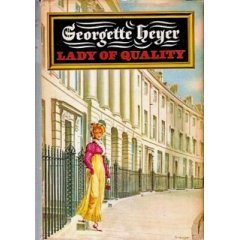
New Georgette Heyer Biography


Two years after it was published in Great Britain, Jennifer Kloester's brilliant biography of Georgette Heyer has been brought out this year in the U.S. by Sourcebooks. Kloester dedicates the book to Heyer's only child, Richard Rougier (1932-2007) and to the author of the 1984 biography of Heyer, Jane Aiken Hodge, both of whom gave her complete access to their letters, notes, and in the case of Rougier, remembrances. He also provided the author with many personal pictures of Heyer.

The new biography differs vastly from Hodge's earlier effort. While both stress that Georgette Heyer (1902-1974) was intensely private, never gave interviews, never took a book tour, did not sit for autographing, refused to pose for author pictures, and never revealed her married name (Rougier), Aiken's book attempts to reveal Heyer's personality by analyzing her novels—and in many instances by supposition and inferences.

Kloester's imminently readable book makes no inferences but lets Heyer's extant letters, numbering over 1,000 pages, breathe life into the clever, erudite, humorous, and self-deprecating Heyer, who wrote 55 novels, six of which she later suppressed.

The heart and soul of Kloester's 400-page book are the letters Heyer wrote to her agents and publishers over the course of her career. In her ten years of researching, Kloester managed not only to assemble these letters from the earliest days of Heyer's 50-year career but also to present them in highly readable form with elucidating footnotes and helpful contextual information.

A published author—at 18 

 Heyer was a rare breed like J.R.R. Tolkein who invented a genre which has been widely imitated. Astonishingly, the first of her Regency romances was written when she was just seventeen. The Black Moth, her first book, debuted in 1921 and has remained in print for more than 90 years.

During those early years, she dabbled with serious contemporary, coming-of-age stories as well as an ambitious Restoration-era tome, but found her calling with her witty period romances that were noted for their humor and the thoroughness of her research.
 
Heyer’s research

For Infamous Army, she read 26 books about Waterloo’s campaign, soldiers, officers, etc. and for four months filled notebooks with detailed information on the hundred days between Napolean’s escape from Elba and the clash at Waterloo. This included biographies of notables, troop movements, uniforms, weaponry, first-person accounts, maps, and a detailed chronology. She was flattered that her book was used by military students at Sandhurst.

Her personal library included more than 2,000 historical reference books, even though she preferred primary references.

In fact when she wanted her publisher to sue Barbara Cartland for a number of instances which Heyer considered blatant plagiarism, she said words she had used – and which had been copied—she had never seen anywhere else except in one of her unpublished sources. (The Aiken biography never names Cartland as the author imitating Heyer.) Though Heyer felt strongly Cartland had plagariized not only her plots but many of her characters as well as terminology, no lawsuit was ever filed, but her publishers must have been in communication with Cartland’s publishers because the “copying” stopped.

The Breadwinner

After a five-year, largely absentee courtship and two months after a heart attack claimed her adored father, Heyer at age twenty three married mining engineer Ronald Rougier. Her father's sudden death left her mother in financial difficulties, and Georgette took on the burden of providing for her mother and paying for the education of the youngest of her two brothers.

Between 1921 and 1935 she published 19 novels, and from the time that Ronald gave up his engineering career to return to England, Heyer was never free of financial worries. Her letters to her agent are full of her blown-up fears of bankruptcy.
 
In 1935 she suffered a nervous breakdown, and the following year she backed her husband's plan to study for the bar even though it meant she was the only wage earner for their family of three as well as her mother.

Her financial worries continued to mount. It is interesting to read her complaints to her agent about being treated like a midlist author, though that term was never used:

            They [publisher] are only concerned with their high lights. . . First, they apparently regard me as a certain seller up to a certain number of copies, & see little point in trying to push sales beyond that maximum. Second, they do not advertize me. Third, they seem to be unable to get the book reviewed.

More of her discontent with her publisher was expressed to her agent in 1937 when she informed her agent she was quite sure her editors “or any member of the firm” ever read her books. “No one ever bothers me for a synopsis for the purpose of advertising.”  In that same lengthy diatribe, she writes that no one in the firm even realized Devil’s Cub was a sequel to her popular These Old Shades.

She was always encouraging her agent to get her books serialized in the magazines, which was not only a great way to build an author but also paid extremely well. 


Sells rights to books for £250 

At one point she was so desperate for money, she sold the rights to three of her books for £750—or £250 a book! In 1940 she signed away British Commonwealth copyrights to These Old Shades, Devil's Cub, and Regency Buck to her publisher, Heinemann. Reflecting on that 30 years later when she was at the pinnacle of her success, Heyer wrote:

            Doesn't it seem fantastic thirty years later that £750 should have been considered by the valuers on both sides to have been a pretty generous price? It led me to rout out my old account book, and I see that it was generous! In those days my gross income very rarely got into four figures. It is now five figures. . . They got a very good bargain, but I don't begrudge it them, remembering, as I do to what straits we were reduced at the time.

The golden years

It had taken her more than twenty years to build her career to be lucrative, and by then—in the late 1940s—she had to pay the Inland Revenue approximately 85 percent of her annual earnings. At that time Ronald purchased a Rolls Royce, and they had moved into Albany, a quiet oasis in the heart of London. Albany had been the residence of several noted authors and a couple of prime ministers over its two-century history. The Rougiers would make their home there for a quarter of a century.

 Though her books had sold moderately in the United States over the years, sales took off in the 1950s. From the late forties until her death in 1974, she was one of the world’s bestselling authors, though she had difficulty believing that “books of substance” did not sell better than her “fluff.” She was shocked when her publisher told her there was no other author who could rival her world-wide sales.

The had always aspired to write respected historical novels and never realized the witty Regency romance genre she created would immortalize her. Now, forty years after her death, her books are still bestsellers.—Cheryl Bolen, author of the Regent Mysteries