Search This Blog

Friday, September 20, 2019

The Ayahs of London

How many of us have read and/or watched either The Secret Garden or A Little Princess? Both are about young British girls who grew up in India and were brought back to England/the United States.
In one scene where she's told to get dressed, Mary Lennox admits she's never done it herself since her ayah always dressed her. As a kid, I kinda picked up that an ayah was a servant, but I didn't understand that ayahs were Indian nursemaids. I'm not entirely sure what happened to Mary's ayah, but I'm assuming that she either died in the same epidemic as Mary's parents, or she decided to stay in India.

Sara Crewe most likely had an ayah as well (I don't remember any mention of one), but since she was headed off to boarding school, she didn't need one.

In both of these instances, their families didn't bring their ayah back to England with them, but it was surprisingly common for British families to bring their servants, especially ayahs, with them. "As travelling nannies [ayahs] formed the most valuable adjunct to the whole life style of the Raj between Britain and India. Essential for the memsahib's [an upper-class white woman] household in India, they were considered indispensable for the long voyage home -- either the trusted family ayah or an experienced travelling ayah. Once on board, the ayah took complete charge of the children, the baggage, and the memsahib. Good ayahs were not only meant to be clean, honest and trustworthy with children, but capable as nurses and excellent sailors too." (Visram p 29)

Unfortunately, many of the ayahs were abandoned once the family reached England. Left without money, resources, and frequently with little English-language skills, these ayahs would try to find new employment either in England or on a return trip back to India. Theoretically, their previous employers had already paid for their return tickets when they paid a small fee to bring them in the first place, but often the ayahs didn't have access to that ticket or the money from the fee.

While waiting, they would live in "squalid lodging houses" that were overcrowded and sparsely furnished. Records show that it wasn't uncommon for a lodging home to have anywhere from 20 to 60 women living in the same home at the same time. And these were the ones fortunate enough to pay the 16 shillings/week's rent. Others had to resort to begging.

There were several half-hearted (and a smattering of more sincere) attempts throughout the mid-19th century by various societies and the East India Company to improve conditions for these ayahs.
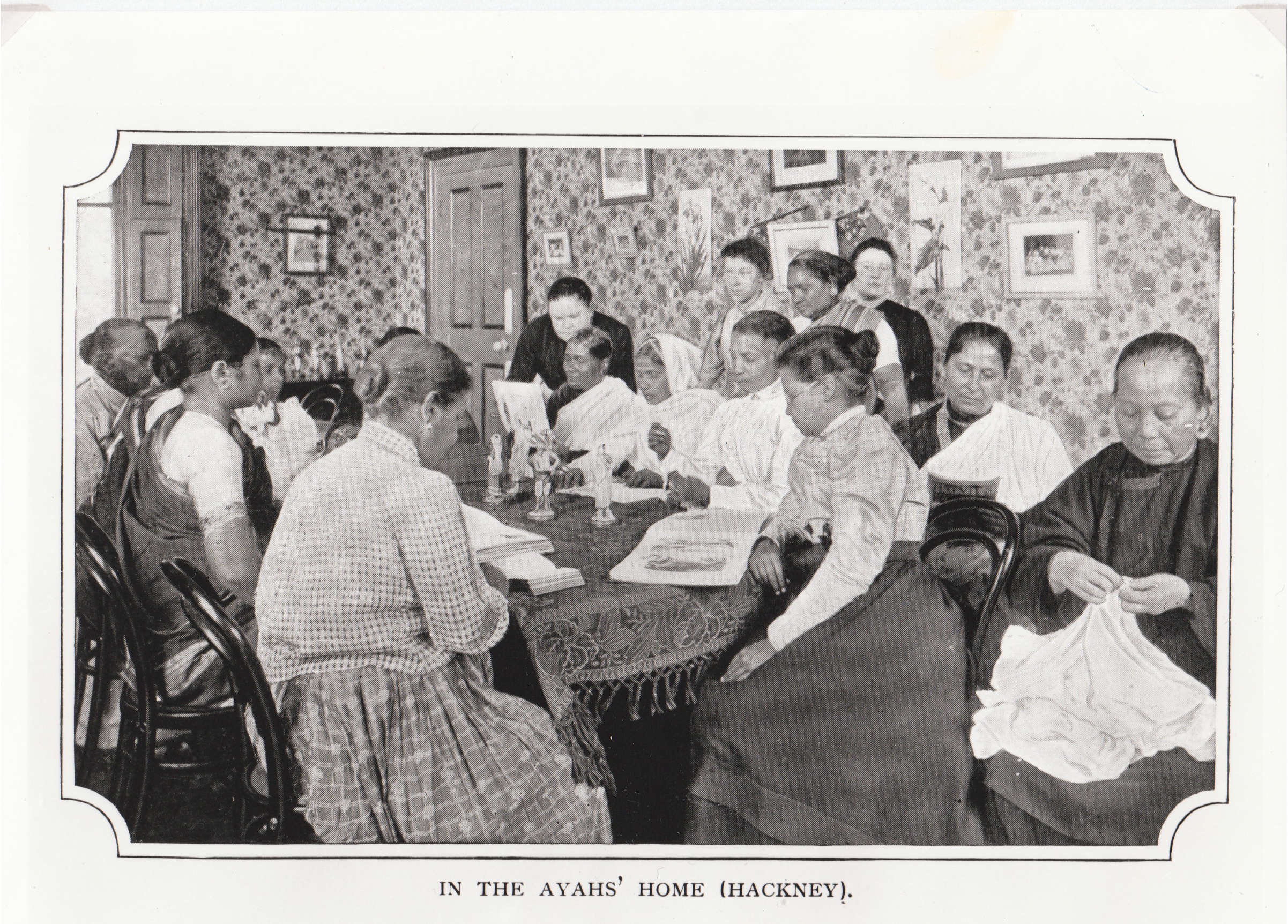
One such effort was the Ayahs' Home in London. It's unclear exactly when the Ayahs'  Home started (one record indicates it was as early as 1825) but there definitely was one established in 1891 at 6 Jewry St, Aldgate in East London. Initially the Home was run by a committee of volunteer women. In 1900, the London City Mission took over and moved the Home to King Edward's Road. Its mission remained the same: to provide refuge and find return employment for abandoned Indian ayahs and Chinese amahs.

The Home would usually receive the return tickets from employers who no longer wanted to employ their ayah and then sell the tickets to families looking to hire an ayah for trips back to India. They would then use the funds from the sale to pay for the ayahs' room and board until they returned. Of course, when the London City Mission took over running the Home, they used it as an opportunity to convert the ayahs to Christianity. While it wasn't an ideal solution, it was more effective than most to help these women.

Sources:
Ayahs, Lascars, and Princes: The Story of Indians in Britain 1700-1947 by Rozina Visram
https://www.thefridaytimes.com/ayahs-home-london-1921/
https://en.wikipedia.org/wiki/Ayahs%27_Home
http://www.open.ac.uk/researchprojects/makingbritain/content/ayahs-home
https://www.ourmigrationstory.org.uk/oms/a-home-for-the-ayahs-https://www.bl.uk/learning/timeline/item124195.html
https://www.andrewwhitehead.net/blog/the-ayahs-home-in-hackney
https://www.ststworld.com/ayahs-home-in-london-where-abandoned-indian-nannies-were-sent-to-live-out-the-rest-of-their-days/

Wednesday, August 14, 2019

The Bomb of Hiroshima


On 8th October 1968, the people in Japan started their day exalted by the news that had travelled the night before all the way from Sweden to the Far East–the novelist Yasunari Kawabata had been awarded the Nobel Prize for Literature–he was the first Japanese person to receive such a distinction.
Kawabata’s books have enjoyed broad international appeal and are still widely read. Amongst them we can underline “The Snow Country (1937)”, “The Old Capital (1962)”, “The Scarlet Gang of Asakusa (1929)” and many others.
A crane origami
Though one of his works, which I liked best whilst disliking it mostly is the “Senbatzuru”–translated into English as “Thousand Cranes”. The novel is set in Japan after the Second World War and the tea ceremony plays the role of characters’ connector and wheeler-dealer of the plot. A love quadrangle transcends two generations, moving zigzaggedly from the father to the mistress, then from the mistress to his son, later from the son to her daughter.

However, what I wish to emphasise and give some depth to, is the word “Senbatzuru”. Tsuru (becomes tzuru with the liaison), or crane, is the most sacred bird of Japan. They appear often in the narratives of mythological books, fables and folk stories.
Combine the holy bird with the Japanese quintessential art of folding paper into decorative figures­–the origami, and we get to the millenary myth that if you fold a thousand crane origami, a wish will be granted to you by the gods–the Senbatzuru.
It was in this belief that the twelve-year-old Sadako Sasaki started the undertaking of crafting one thousand tsuru origami in her hospital room.
Sadako Sasaki
Sadako was born in Hiroshima in 1943. She was two years old when the atomic bomb was dropped on Hiroshima on August 6, 1945. The blast blew her out of the window of her house, but she survived. She went on to lead a normal life, excelling in sports and in school. But the exposure to the radiation of the atomic bomb eventually caught up with her and she developed leukaemia. In February 1955 she was hospitalised with swellings on her neck and behind her ears and purpuras formed in her legs. The doctors gave her one year to live.
Yet Sadako clung on to the Senbatzuru hope… she wanted to live. Night and day her tiny hands folded the holy bird in the loneliness of her hospital bedroom. 101…, 102…, 103…

It was a race against time.
When she ran out of paper, she used medicine wrappings, scavenged the garbage for any sort of paper sheets, went to the rooms of other inpatients to ask for the wrapping papers of the presents they were given and straighten them to fold origami, 445…, 446…, 447… 

Sadako Peace Monument
Regrettably, she ran out of time…
Upon her death, she had crafted 644 tsuru. Her classmates crafted the remaining 356 and she was buried with the thousand crane origami, and with them, her hope…
In 1958, a statue of Sadako holding a golden crane was unveiled in the Hiroshima Peace Memorial Park. At the foot of the statue is a plaque that reads: "This is our cry. This is our prayer. Peace in the world."
The culture of Senbatzuru is spread today around the world. Specially in schools, children craft them as a symbol of peace and hope. 


Cristian Marianciuc from Romania is an enthusiastic origami crafter. Below are some examples of his creation. Four years ago, he started a creative project which involved the folding and decorating of an origami crane every single day for 1000 days. It was his personal attempt to deal with depression and exercise his creativity.


The romanticised history of Japan, covering its Creation to its modernisation in the Nineteen Century can be read in my book "The Goddesses of Japan" sold on Amazon.


Facebook: https://www.facebook.com/thegoddessesofjapan/
Website: https://www.kazukonishimura.com/