As an American, I find it fascinating that so many historical houses—mostly in Europe—are named rather than simply numbered. The practice has charm and suggests history and longevity. Nowadays, it would seem a tad presumptuous, or at least eccentric, to name a home. However, in one of my favorite historical novels, the heroine goes to live in a place called Green Gables. Austen characters are well acquainted with places such as Pemberley, Longbourn, and Hartfield. Indeed, house naming has a rich heritage.
Anciently, the nobility named their houses, halls, castles, and lodges as a matter of practicality, since homes weren’t numbered until 1765. Usually, those names reflected their surnames, family titles, and locations. These led to names such as Belvoir Castle, Evesham Manor, Haynes Park, and Norfok House.
Homeowners sometimes named their abodes after places they enjoyed visiting such as Ambleside and Windermere. Many house names describe the building’s original use, giving rise to names such as Bedford Abbey. Over time, tradesmen named their houses after their use like The Barn, The Gatehouse, The Forge, Millhouse.
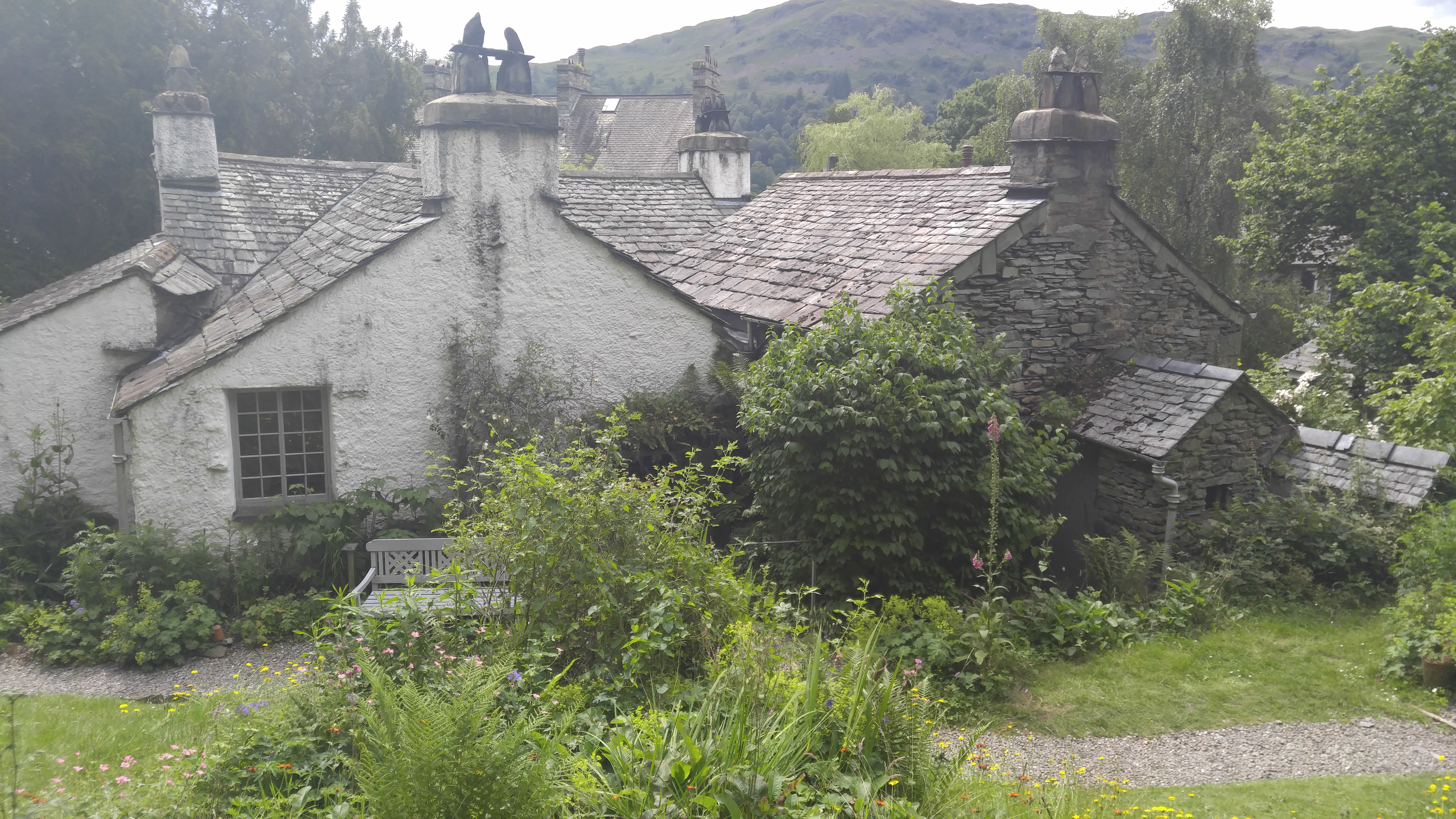
Dove Cottage copyright Donna Hatch
Another common practice was to name one’s house after trees or plants, or even animals frequently seen in the area. Quaint names include Rose Cottage, Birch Park, Dove Cottage (pictured), Fox Hollow, Robins Nest, and Squirrels Leap have cropped up.
Here are some hints to help you name your British house:
How big is it? A cottage, a lodge, a manor, a mansion?
What is your family name? Or, if you had a title, what would it be?
What do you see from the house? A valley, a park, a woods, a river?
What
color is the house? Does it have colored gables or shutters?
Do plants
or trees grow nearby? If so, what type?
How
would you describe the weather in the area? Sunny? Windy?
Are local animals often seen in the area?
Was
the building used for something else before it became a home such as an inn, a bakery
or an abbey?
If I
were to name my house, it might be something like Crepe Mytle End, or White
Lodge, or Sunnyside.
What would you call your house?
During the Regency era there were very strict rules for courting couples. They could never be alone together unless they were chaperoned, were betrothed, were in an open carriage, or on horseback. With all these strictures, our modern sensibilities make us wonder how they ever found time to get to know one another. There were, however, several outings the couple could indulge in and not create a scandal.
A gentleman could, in all propriety, accompany a young woman to several public sightseeing landmarks without censure. Places such as the Tower of London, Hampton Court, Hyde Park, or the British Museum to see the Elgin Marbles. As long as the couple were in full view of the public, they could walk and talk together and preserve the proprieties.
Carriage rides were a very popular way for a couple to indulge in private time together while courting. The carriage had to be open, but could also be a sporty curricle or a high-perch phaeton (the sports cars of the Regency period). Rides were usually taken in Hyde Park during the most fashionable hours between 4:30pm and 7:30pm, the point being to see and be seen by everyone else in the ton.
One favorite outing was to go to Gunter’s Tea Shop, one of the most fashionable light eateries in London. Gunter’s was famous for
their ices and sorbets. Located in Berkley Square in Mayfair, it was another establishment where the ton came to see and be seen. The Georgian Index reports that it became popular to eat the ices outside. “Gunter's Tea Shop was the only establishment where a lady could be seen eating alone with a gentleman who was not a relative without harming her reputation. The ladies would remain seated in the carriages in the shade of the Maples. Their gentlemen escorts would step down from their equipages and come round to the passenger side of the curricle or barouche and lean against the Square's railings sharing the lady's company and the treat.”
Another outing, also very popular and a bit daring, was a trip to the Vauxhall Pleasure Gardens. This was a vast park of several acres of land that had different kinds of entertainments at night, from musical presentation to fireworks. Vendors sold various wares and although the best lit place in London at night, it still boasted several darker pathways down which a couple might stroll for a bit more private conversation. Usually ladies formed parties to attend Vauxhall insuring chaperones for a couple until they had agreed to a formal engagement.
These outings were an approved part of courtship during the Regency. In many of my Regency romances, my courting couples make use of these excursions as they try to get to know one another, as did countless real couples of the period. Check out this social whirl in Heart of Desire or any of my Handful of Hearts novellas, all on sale during the month of April for .99 each.
Although perhaps an unusual topic for romance novels, the Bubonic Plague or "Black Death" that swept through Europe during the Middle Ages, was a great agent of change both in the way people lived and in the way they viewed life. It has been used, my me and other romance authors, as a catalyst or conflict for heroes and heroines to cope with and rise above. With the current pandemic looming (of much less lethal proportions, thank God) I thought it would be interesting to look at the disease that in many ways changed the face of Medieval Europe.
The Bubonic Plague originated in China in 1330 and spread through trade routes to the west via the fleas that live on rats. When the rats died, the fleas moved to other hosts, usually human, and infected them. The first major outbreak of plague in Europe began in Italy in 1347. By 1348 it had spread to France and England and by 1349 had circled the globe, killing approximately one third of the population of Europe.
There were actually three bacterial strains of the plague infecting people during the 14th century outbreak. The first and the one usually associated with the outbreak was bubonic plague, an infection of the lymph nodes. Symptoms onset occurred usually 2-5 days after exposure and included: fever, chills, headache, muscle pain, seizures, and painful swelling of the lymph nodes (called buboes).
Mortality rate was approximately 50%. Treatments consisted of good diet, rest, and relocating to a non-infected area. If the swollen buboes burst, the patient often recovered.
One of the most prevalent images found regarding the bubonic plague is this one of a physicians’ costume during the epidemic. The beak contained herbs and flowers that the doctors inhaled to protect themselves. Flowers were considered a sovereign remedy for warding off the plague. According to Charles Mee Jr.’s article on the Black Death, people were encouraged to carry posies near their nose to “ward off the stench and perhaps the evil that afflicted them.”
Fear of the plague made parents forsake their children, husbands abandon their wives. Finally the only people willing to nurse the sick were the nuns and monks in holy orders. Their numbers quickly became decimated because they worked intimately with victims of the disease and then became victims themselves.
Not the usual stuff of romance novels perhaps, but a fascinating look into a major epidemic that changed the face of medieval Europe.
Shika, or Japanese deer are the illustrious dwellers of Nara
Nara or Heijo was Japan's first permanent capital established in the year 710. Before that date, the capital moved to a new location whenever a new emperor ascended to the throne.
However, as the influence and political ambitions of the city's powerful Buddhist monasteries grew to become a serious threat to the government, the capital was moved away to Nagaoka in 784 and a few years later to Kyoto, where it stayed for over 1,000 years.
The Todai-ji (the Great Eastern Temple) is Nara's most iconic temple (above). It was constructed in 752 and houses one of Japan’s largest statue of the Buddha – the 16 metre bronze Dainichi Buddha.
The 16-metre-bronze statue of Dainichi Buddha.
According to the records, more than 2,600,000 people helped to construct the Great Buddha and its hall. The project was so ostentatious that consumed most of the available bronze of the country and nearly bankrupted the economy.
The Buddhism entered Japan in the 6th century, transmitted from China and Korea. It became one of the main religions of the country but faced initially rejection from the conservative Shintoists.
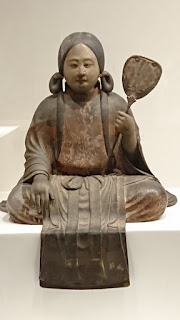
Prince Shotoku (574 – 622 CE) was the early champion of Buddhism. He served as regent under his aunt Empress Suiko (554 – 628 CE). The picture below is the oldest sculpted portrait of the prince currently known, showing him as an adolescent.
Valentine’s Day in Regency England was very different from the way we celebrate it today. People of all classes exchanged hand-made cards with hand-written verses. During the Victorian Era, Valentine’s Day cards became mass-produced, but in the Regency, such a gesture required more thought and care.
Cards sent were as varied as the senders. Some were made with gilt-edged paper, trimmed with lace–real lace, not paper lace since that had not yet been invented. They could be embossed or have gold overlay or even sequins. Those who could not afford such luxuries made them out of simple paper which was still an expensive commodity for the less affluent. Flowers seemed to be the most common decoration but cards were also decorated with hearts, birds, and even timeless cupids.
Those who fancied themselves poetic wrote their own verses but most probably copied verses from known poets, or even from books that provided special, Valentine’s Day messages. These books even provided replies for the lady to use to encourage or dash the hopes of her admirer. The verse in the card to the right says (if I deciphered the handwriting correctly):
I dream and my heart consuming lay On cupid’s burning shrine I thought he stole my heart away And placed it near to thine.
Here is a sad verse from a Valentine’s Day card from 1790:
My dear the Heart which you behold, Will break when you the same unfold, Even so my heart with lovesick pain, Sure wounded is and breaks in twain.
This seems to have been written by someone who had already been rejected but needed the recipient to know of his pain and broken-hearted devotion.
Other sources cite much more sordid Valentine verses, much to the horror of the parents whose daughters received such bawdy notes. I won't share those here lest I offend my readers' delicate sensibilities ;-)
Valentine’s Day in Regency England was a day to celebrate love, or at least interest, for all classes. What I find puzzling is that it was considered ill-mannered during the Regency to exchange letters or notes between unmarried ladies and gentlemen. However, this practice seems to have been largely ignored on Valentine’s Day. Reportedly, the post was inundated with mail on that day filled with Valentine’s Day cards exchanged between the young and young at heart. I found no mention of Valentine’s Day cards exchanged between married couples. They could have been, but that didn’t seem to be a common practice. But don’t tell my husband that
Author of Historical Romance and Fantasy, award-winning author Donna Hatch is a sought-after speaker and workshop presenter. Her writing awards include the Golden Rose, the International Digital Awards, the Readers' Choice Award, and the prestigious Golden Quill. Her passion for writing began at age 8 she wrote her first short story, and she wrote her first full-length novel during her sophomore year in high school, a fantasy which was later published. In between caring for six children, (7 counting her husband), her day job as a docent for a one-room schoolhouse, and her many volunteer positions, she still makes time to write. After all, writing IS an obsession. All of her heroes are patterned after her husband of over 20 years, who continues to prove that there really is a happily ever after.
For Valentine’s Day, I thought a post on Regency sweets might be appropriate, as sweets are the most popular love offering in our day and age. They were also quite popular in the early 1800s.
Sweetmeats (meaning “sweet food’) were immensely popular in the Regency period, and one of the few gifts a gentleman could, without fear of reproach, give to a lady to whom he was not betrothed. Apparently the theory was that as candy was perishable, it left no obligation on the lady to accept the gentleman’s advances.
Regency sweets came in a variety of shapes and flavors, as do ours today.
Chocolate—A great favorite of the Regency period. Whether it was consumed as drinking chocolate, or eaten as small tabs of bittersweet chocolate covered in nonpareils, chocolate was enjoyed all through the era.
Licorice—originally used as a medicine, licorice was improved upon by the addition of sugar, then sold in bags of lozenges as a candy. It was also used in Pontefract Cakes, where a disc of licorice was sweetened and stamped with a castle.
Marzipan—this sweet treat began in the late Middle Ages in England and was made from ground almonds, sugar, and rose water. It could
be molded to look like anything at all—food, fruit, nuts, people, castles. The results were often spectacular.
Lemon drops—made by simply boiling citric acid with sugar, allowing to cool, and fill “drop” molds.
Barley sugar candy—one of the oldest candies made, barley sugar candy is created by boiling barley water and sugar until it has thickened. Originally created by French nuns.
Sugar plums—weren’t necessarily plums at all, but could be any combination of dried fruit layered with thick sugar until a hard shell formed.
Turkish Delight—another confection based on a gel of starch and sugar. Usually chopped dates, pistachios, and hazelnuts are bound by the gel and often cut into squares and dusted with powdered sugar.
Peppermint sticks—yep, just like the ones we have now as a cane at Christmas. Peppermint oil and sugar boiled together. It’s origin is German!
In addition to these candies, of course, are all manner of sweet cakes, pies, mysterious things like flummery, and ices (ice cream).
If you’re interested in celebrating Valentine’s Day a la the Regency period, try your hand at creating some of these delicious, interesting, or downright awful sounding confections!
Happy Valentine’s Day!
References:
Carlyle, Christie. “Regency Era Sweets,” Facebook Post, October 11, 2017.
Hilden, L. A. “Sweets and Confections of the Regency Era,” Blog post, August 9, 2014.
Jane Austen Centre. “Visions of Sugar Plums,” Blog post, December 10, 2013.
Lambert, Tim. A Brief History of Sweets, 2019.
“Victorian Era Courtship Rules and Marriage Facts.” Victorian-era.org
Last August, I had the opportunity to ride side-saddle at Firefly Equestion in Utah. I've ridden astride a handful of time prior to this experience, which certainly helped, but in no way do I consider myself an experienced rider.
Firefly had two different types of side saddles--a Western, which has a lip that curved up at the back of the seat (the cantle) and an English, which doesn't curve. Both saddles had two pommels, or leaping horns, on the left side and a single stirrup.
Fun fact: the leaping pommel wasn't added until the mid-1830s. This addition increased security for the lady when she galloped or jumped. Prior to that time, the lady had to be a very skilled rider and exercise caution when jumping or riding at faster speeds.
When mounting my horse, I used a tall mounting block. My left foot went into the stirrup and my right leg swung over the far side of the horse as if I were going to ride astride. Once my rear was in the saddle and my left thigh was tucked up into the lower pommel, I swung my right leg back over the horse and placed it in the upper pommel. If I had been sitting in a chair, it felt like I had frozen in the middle of crossing my legs with the middle of my right calf hovering just in front of my left knee. The top pommel cupped my leg just behind my knee.
It's important to note that my hips were parallel with the horse's back, my shoulders back, and my rear as far back in the saddle as I could sit the entire time. (The lip in the Western side saddle would have been very helpful in this instance, if only to indicate where I was in relation to the edge of the saddle.) This position, as much for the horse's comfort as my own safety, distributed my weight more evenly across the horse's back and kept my balance centered on the horse instead of leaning toward one side or the other.
Once I was situated in the saddle, my riding instructor handed me a short riding crop which I held in my right hand. My hands went over the top of the reins instead of under. (Imagine you were forcing open an elevator door.)
Instead of squeezing my legs to start moving like I would if I were astride, I nudged the horse with my left leg and tapped his shoulder with the crop.
We started off with a walk while I adjusted to this style. Honestly, the hardest part for me was keeping my back and shoulders straight. I imagine that for Victorians, this was not nearly as difficult as it is for modern Americans. I also had a tendency to shove my foot forward in the stirrup instead of leaving the ball of my foot on the bar.
Once I was comfortable with a walk, we increased speed to a trot. This is where I really had a difficult time. Where a walk is a smooth motion, the trot is a lot bouncier and I, in my silky athletic pants instead of a natural-fiber riding habit, had a hard time staying back in the saddle. Every time I slid forward or off toward one of the sides, my horse would slow down. (I guarantee I would have ended up on the ground if it weren't for his good training.)
Unfortunately, my lesson ended at this point.
I was surprised at how much of a difference the correct posture made, but I would try it again in a heartbeat.
Welcome to our blog for readers and writers--or anyone, really, who loves history! We are historical romance authors. Very well, we confess; we're historical nerds! We are fascinated with ancient wedding traditions, Irish food, Roman Warfare, Regency Clothing, Scottish swords--you get the idea. Watch our blog for informative tidbits that just might figure in your next manuscript or deepen your appreciation for the next book you read, or even give you some useless trivia to spout at a party when you can't think of a thing to say. We welcome comments and followers, so chime in and enjoy the group!




 Posts


