Search This Blog

Friday, October 27, 2023

All Hallow's Eve and Jack O'Lanterns


by Donna Hatch

Halloween is even more popular than ever. In the United States, more Americans celebrate Halloween than Christmas. I have my own opinion on that, but really, what's not to love about love costumes, decorations, parties, and special treats?

 Origin of Halloween -- All Hallow's Eve

An ancient Celticic festival Samhain (a Gaelic word pronounced "SOW-en" or “SAH-win”) celebrated the end of summer's end, the harvest, and the new year, which, at the time, landed on November 1st. the Celts believed that during Samhain, the barrier between the living and the dead became thin enough that ghosts, monsters, and fairies walked the earth to steal souls. They also believed that ghosts of their ancestors could visit that night. The multi-day celebration included sacrifices, fires, dancing, drinking, and much revelry, as well as wearing disguises to hide from the souls wandering around. 

Eventually, with the rise of Christianity, the Roman Catholic Church replaced Samhain with All Saints’ Day or All Soul's Day, which celebrates the church’s saints on November 1. The day before All Saints' Day became All Hallows’ Eve. Many Samhain traditions have endured until today.

Carved Jack O'Lanterns

Ancient Celts invented Jack O'Lanterns. But since pumpkins are native to North America, so the Celts hollowed out and carved rutabagas, gourds, potatoes, beets, and even turnips. To make their faces glow, they put a candle or lit ember inside. These lit root vegetables guided their doorways to ward off evil spirits. 

The Celts also left doors and windows open to welcome in the spirits of their ancestors and set out food for them because, of course, ghosts get hungry. And apparently, only wicked, non-family ghosts were frightened away by glowing veggie faces. To the right are a few examples of the faces that artistic carvers can make from turnips.

Origin of the Name Jack O'Lantern
Photo by Andy Holmes on Unsplash

Although historians aren't positive about how a lit, carved vegetable became known as Jack O'Lantern, there are two prevailing theories. 

From about the 17th century, the term referred to a night watchman who carried a lantern and patrolled the streets to curtail crime. The British often called men whose names they didn't know by a common name like Jack. So, a nightwatchman whose name was unknown carrying a lantern was referred to as Jack with the Lantern or Jack of the Lantern or Jack O'Lantern.

The name's origin may have arisen from a legend about Stingy Jack who played tricks on the devil. As punishment, he was doomed to wander the earth as a spirit carrying a lit coal which he later put into a carved-out turnip. The story about Stingy Jack became a part of All Hallow's Eve and is often referenced when spooky, unexplained lights are sighted, sometimes called Spook Lights. 

Modern Jack O' Lanterns

Jack O'Lanterns today range from scary, to funny, to elegant to reflect the taste of the creator. So this Halloween spare a thought to your ancestors who have passed on. Who knows? They just might visit you.
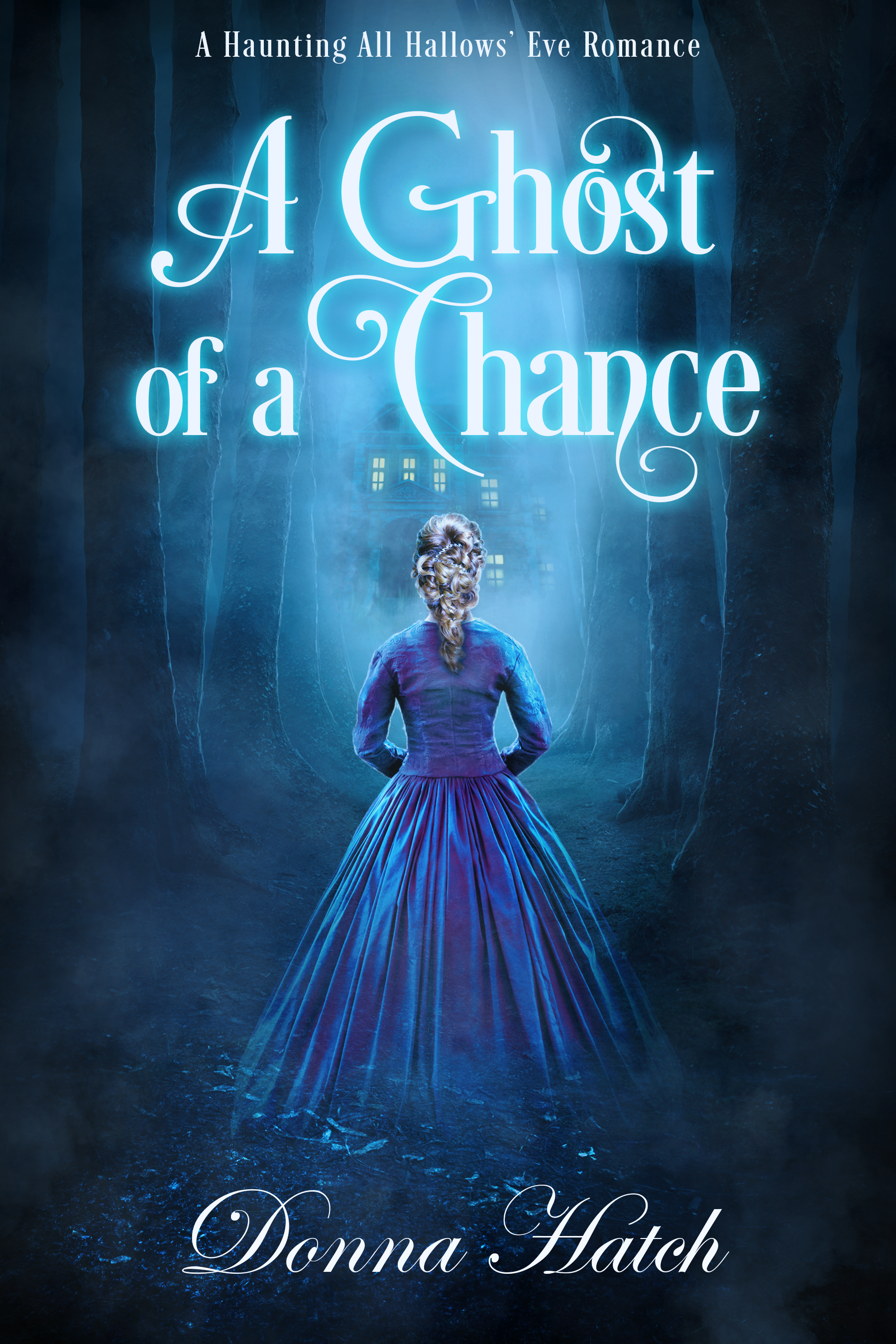
All Hallows Eve during Regency England, filled with ancient English customs, sets the scene for my newest short novel, A Ghost of a Chance.

A lost soul searching for hope...

After a devastating loss, a young lady throws herself into searching for her missing brother and taking solace in her musical composition. When a handsome and captivating stranger comes to town one All Hallows Eve, she dares to hope for more than her endlessly lonely existence.

A tormented war hero seeking redemption...

Unable to flee the memories of war, a retired cavalry captain spends his days helping the men who served under his command adjust to civilian life. Perhaps if he helps them all, he can atone for some of his past failures. When he stops for the night at a small English village celebrating All Hallows Eve, he meets an enchanting young lady unlike any other and suspects that what he needed all along was not only redemption but love.

They must find the courage to take a leap of faith and choose love over fear

It will take faith and valor to overcome the barriers between their worlds and let go of their past heartaches. As they discover love and happiness neither had imagined, they will have to delve into the shadow world between life and death to beg for another chance from the Angel of Death.

A Ghost of a Chance is available in ebook, Kindle Unlimited, and paperback.  

Sources:

https://www.merriam-webster.com/wordplay/the-history-of-jack-o-lantern

https://www.history.com/news/history-of-the-jack-o-lantern-irish-origins

https://time.com/5419385/why-jack-o-lanterns-halloween/

https://www.britannica.com/story/why-do-we-carve-pumpkins-at-halloween

https://worldpopulationreview.com/country-rankings/countries-that-celebrate-halloween    

https://www.history.com/topics/holidays/samhain#samhain-merges-with-halloween

Friday, October 6, 2023

Regency Ladies Fashion: pantaloons -- did they or didn't they?


I recently taught a workshop at a writer's conference on Regency Ladies Fashions. One attendee asked what ladies wore underneath their skirts. You should have heard the gasps when I told her, "Nothing." 

Now is a good time to revise and cross-post about this somewhat controversial topic.

Historians, researchers, and authors agree that ladies wore a shift, or chemise, over which they laced up stays (a type of Regency corset but more comfortable), and then a petticoat, which was basically a long slip or jumper. We also know they wore stockings that tied or buckled. Our modern-day sensibilities insist that the ladies who lived during the time of Jane Austen's heroines must have worn something underneath all that, right?

Read on, dear reader.

Drawers

We know drawers existed by 1806 because merchants advertised and sold them. However, these merchants did not cater to the upper classes; their clientele was the working class.  Some advertisements tried to bring them into fashion for the wealthy by listing them as being good for wearing while riding. However, they didn't understand the first rule of advertising: know your audience.

In 1811, Princess Charlotte wore them at least once, because she accidentally revealed them. However, many considered the garment shocking and openly criticized her for not only letting it show but wearing it at all.

Drawers and similar undergarments were a direct imitation of men's undergarments called "small clothes." As such, they were considered masculine and therefore vulgar for ladies. In addition, drawers had two entirely separate legs with strings that tied around the waist and left open in the middle. For decades, the only women who wore them were prostitutes.  Ladies of high society wanted nothing to do with this kind of garment.


In 1817, some fashionable ladies wore pantaloons, a longer, lace-edged variation of drawers that were meant to be seen below the petticoat. In English Women's Clothing in the 19th Century, by C Willet Cunnington, the author describes drawers as "frilled trousers" but goes on to state that the fashion disappeared almost immediately, adding, "On the whole however, it seems probable that most women did not wear any garment of this kind until the '30's" (meaning the 1830's).
Before you continue, I must warn you: the colored drawings below are a tad graphic, so please don't send me hate mail.

Risqué Regency Era Cartoons

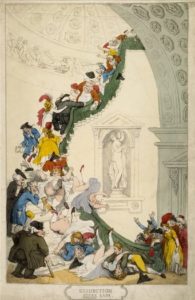
The lack of any garment underneath ladies' skirts was such common knowledge that even social and political cartoons of the day reflected this. Thomas Rowlandson, a famous illustrator and cartoonist, created watercolors of soldiers, wars, death and dying, the hunt, several humorous series, as well as some rather erotic pieces. I  have not included those in this post. You're welcome.

One of Rowlandson's pieces is called Exhibition Stare Case (pictured to the left). In this image, several people are tumbling down the stairs. Three of them are misfortunate ladies, positioned with their legs up, revealing naked thighs and bums. This suggests ladies did not wear drawers or pantaloons.

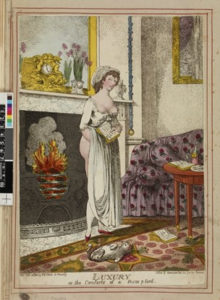
Other satirical cartoons by different cartoonists including Cruikshank and Gilray show pictures of women falling off horses or, in the case of the picture to the right, warming themselves in front of a fire. In all these drawings, women are wearing nothing underneath their skirts except stockings and shoes. (Don't you love the fat cat lying in front of her as if it has just expired?)

Obviously, back then, as today, political cartoons are only loosely based on fact. They're supposed to be absurd. However, so many of them reveal (no pun intended) the lack of ladies' undergarments that the combination begins to present a strong case against the practice, at least among the wealthier classes.

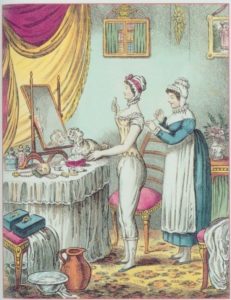
Another period drawing that addresses this is called "Progress of the Toilet." It's a set of three images published by James Gillray in 1810. His drawings are well-known to ridicule many practices of the Regency Era. Several of his creations mock the fashions of the period which dictated how the shapes of women should be altered to meet current standards of beauty.

The image to the left shows a woman wearing drawers. It is difficult to see, but she's wearing a chemise -- you can see the sleeves and the edge around the top of her stays -- which seems to be tucked into her drawers. The stays appear to be from earlier in the century when ladies wore Georgian stays, as evidenced by the little tabs on the bottom of the stays. But I digress. It's also possible the cartoonist showed drawers to further ridicule the complicated process of dressing for the day and even perhaps to poke fun at the drawers themselves. Unfortunately, I was unable to determine the exact date of the image. One source said this series was created in 1810 but I have not been able to verify that. I find it more likely that it was around 1817 during that blip when drawers were popular.

Pantaloons

In the 1820s, which was the Victorian Era, long pantaloons (also called pantaletes) arrived on the scene with more popularity. The term can be confusing because men wore pantaloons -- silk breeches that went to the knee -- for formal occasions until well into the 1820s until trousers became mainstream fashion.

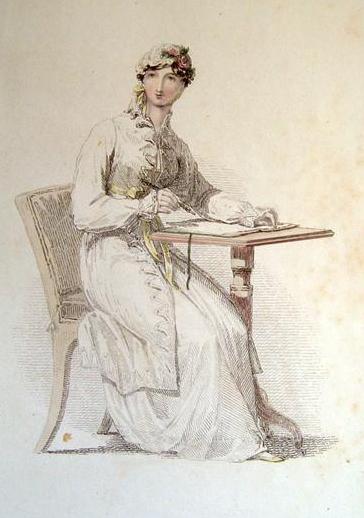
None of my books of Regency fashion prints show drawers or anything of the kind peeping out from underneath skirts -- not even those labeled "walking dress," "carriage dress," or "riding habit."

Conclusion

While some historians stubbornly claim that women wore drawers, there is too much proof to the contrary.  I suspect that just as today some men and women don't always wear underwear, there were those ladies during the Regency while most did not. Our modern-day sensibilities might make the idea of not wearing underwear sound a tad obscene. Just remember, they had far different viewpoints about a great many things during the Regency.

Sources:

English Women's Clothing in the Nineteenth Century by C. Willet Cunningham

Fashions in the Era of Jane Austen by Jody Gayles

http://www.janeausten.co.uk/corsets-and-drawers-a-look-at-regency-underwear/

https://janeaustensworld.wordpress.com/2010/11/06/ladies-underdrawers-in-regency-times/

http://www.fashion-era.com/drawers-pants-combinations-knickers-fashion.htm

https://englishhistoryauthors.blogspot.com/2011/11/regemcy-era-ladys-prodigious-layers-of.html

https://www.kristenkoster.com/a-primer-on-regency-era-womens-fashion/

Wednesday, September 7, 2022

Bathing in the Middle Ages by Jenna Jaxon

Last month I took a look at bathing and bathtubs in the Regency period. This month I’m going backward in time to examine bathing during the Middle Ages.

The first thing to affirm is that yes, people did bathe during the Medieval period, using several different methods.


A lot depended on your status in life as to how often you took a bath. The lowest classes who did manual labor likely bathed the least. They would probably not have had the means or money to fetch buckets of water, heat the water, and purchase a tub and then bathe in it. Such laborers and the poorer people would have availed themselves of a dip in a pond, lake, or stream during the warmer months. Otherwise, they may have taken wash pan baths, washing as best they could during the colder months.

Middle class people may have had enough money to own a tub and employ a servant to fetch and heat the water. They might also have had the fees to go to public bath houses (a holdover from Roman times). These houses were very popular but had a reputation for lewdness. The sexes weren’t always separated, and prostitutes were known to frequent them.

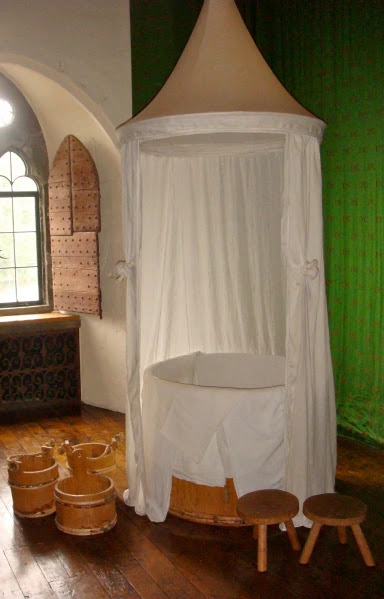
The nobility would have had a tub for the household to use (perhaps more than one, depending on the


size of the family). Tubs were a status symbol for the wealthy. They would be lined with linen fabric to protect tender skin from splinters if the tub was wooden, or to protect it from seams if the tub was made of metal.

Royal households would certainly have availed themselves of the bath. Documents show that Charlemagne loved taking baths and not just alone. He’d invite relatives, guests, and sometimes servants and attendants to bathe with him. King John of England took a bathtub with him when he traveled.


One additional note of interest: men usually bathed naked while women wore a shift or chemise, whether for warmth or modesty is difficult to tell.

So bathing, in all its various forms, was definitely a large part of life during the Middle Ages.


Resources:

Chase, Loretta. “Queen Caroline Takes a Bath.” Two Nerdy History Girls, July 11, 2011.

“Did People in the Middle Ages Take Baths?” Medievalists.net, April 2013.

Peardon, Keri. “Bathing in the Middle Ages.” Vampires, Ladies, and Potpourri, June 14, 2012.

Wednesday, August 3, 2022

Bathtubs in Regency England by Jenna Jaxon


At the end of the 18th century, attitudes toward bathing began to change. Beau Brummel, a Regency fashion plate, was an advocate of bathing often and he was a major Regency “influencer.” About that same time, in 1791, John Wesley gave a sermon “On Dress” in which he made the acclamation, “Cleanliness is next to Godliness.” People took these and other ideas on cleanliness into consideration, making the Regency period of transitioning into good bathing habits.


Basin and Ewer

Actual bathtubs seem to have been rare and in the lower classes--all but non-existent. Instead, they used a basin and  a ball of soap to clean themselves, rather than an immersion, although in summer lakes and ponds served as natural bathtubs. For the middle classes, the basin and ewer were also standard equipment, although the wealthier families who could afford a bathtub would likely have one of metal or wood.

The aristocracy would have certainly had bathtubs,

Shower-Bath at Scarborough

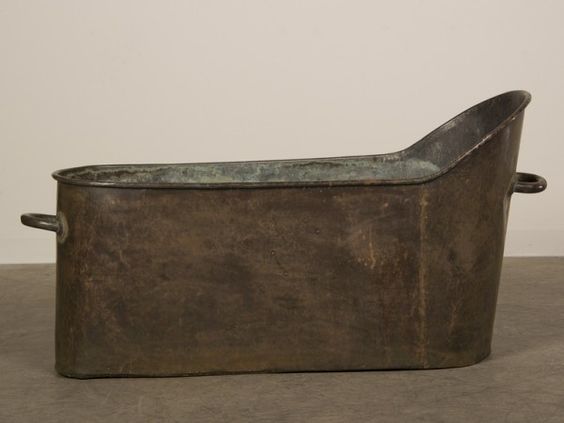
again of copper or wood, that could be set up in a chamber (often a bed chamber), filled by servants who would lug water from a well outside, into the kitchen to be heated, then lugged upstairs and poured into the bathtub. Little wonder none but the wealthiest could afford such a luxury. The tub was usually lined with linen fabric, to keep the bather from getting splinters from a wooden tub or keep from sticking to the surface of a metal tub. Water was often left near the fireplace to warm the water when it cooled or for rinsing off at the end of the bath.

Regency metal bathtub


Some members of the Regency upper classes actually possessed showers. The contraption was first noted around 1810, “around 12 feet high…a fancy bathing apparatus…[a] pump lifted water from tank

Regency Shower

at bottom through pipe to top tank, water could be used over and over again,” according to Life Magazine.

So during the Regency, people were beginning to take the business of cleanliness much more seriously and began to change their bathing habits accordingly.


RESOURCES:

Bourne, Joanna. “Keeping It Clean—Georgian and Regency Bathing Customs.” WordWenches Blog, August 3, 2011.

Chase, Loretta. “Taking a Shower in the 1800s.” Two Nerdy History Girls Blog, June 22, 2015.

Lahildin. “Staying Clean in Regency England.” October 17, 2014.

Life Magazine.

Vic. “A 19th Century Regency Era Shower.” Jane Austen’s World, November 11, 2010.


Wednesday, May 4, 2022

Joust in Time by Jenna Jaxon


Knights on horseback racing full tilt toward each other with lances fixed may be the most iconic image most of us have of the Medieval period, and for good reason.  Jousting was one of the most popular and dramatic entertainments people of all classes could enjoy at a time when life was uncertain.


Jousts were usually part of a tournament, held by royalty usually during the summer months of the year.  They were major events where knights were pitted against each other for honor, for glory, and for prize money.  They may had had their roots in Roman games at the Coliseum.


On the opening day of a tournament, which may have lasted from 3 to 5 days, there was a formal procession out to the lists (the barriers that defined the field of combat).  This procession could be quite elaborate.  In my medieval romance Time Enough to Love, the knights and their ladies are dressed in costumes as members of King Arthur’s Round Table and it was a great honor to be chosen to ride. I modeled this procession after an actual procession in which 25 ladies on horseback rode beside their knights who walked to the lists (at least a couple of miles) in full armor while tethered to the ladies by silver chains.  King Edward III, at whose court the major action of the first half of the book takes place, had in fact given a grand tournament in 1344, which gave me the idea for one in my book.

Once on the field, the spectators were seated in a grandstand called a berfrois, built a story above the lists. Knights were assigned to brightly colored tents called pavilions, where they rested, waited, and donned their armor, with assistance from their squire, in preparation for the joust.  As a side note, the armor typically worn weighed about 60 pounds, but was so well-articulated that the combatants had much more mobility than we would believe.


The horses used by knights were a special breed, called destriers, who could manage the great weight of knight and armor and still maneuver on the field.  The horses were draped with a cloth called a comparison that covered them from nose to tail, designed in the knight’s colors and emblazoned with his heraldic design.

Of course, as with any contact sport, the potential for injury and death in jousting was great. The most famous death occurred when King Henry II of France was killed when a lance broke on his helmet and a wooden splinter pierced his eye and brain.  Oddly enough, the almost exact same thing happened in January 2011 when a jousting re-enactor was killed when a lance splintered on his helmet and a large piece of it pierced his eye and brain. 

With such a rich heritage of jousting, is it any wonder that I incorporated a joust and as many details of it as possible into Time Enough to Love?  You’ll find the procession—which becomes a serious conflict in the first part of the book—the joust itself, and a stunning injury that threatens the happiness of the hero and heroine.

If you love the color and pageantry of the Middle Ages, you’ll love Time Enough to Love.

Wednesday, April 6, 2022

Hard Day's Knight by Jenna Jaxon


My medieval novel, Time Enough to Love, is the story of knights in the service of King Edward III of England.  Knights are perhaps the iconic image most readers have of the period. The men didn’t, however, spring fully ready at birth for this way of life.  There were years of training and hard work that went into becoming a knight.


After the fall of the Roman Empire, old Roman families became rulers of their own land holds, usually a castle and a certain amount of land. These lords depended on the strength of their retainers, arms-bearing men who swore fealty them and lived within their households.  This is the beginning of the knightly social class who became defined as warriors on horseback.

In return for their service, the lord would usually give the knight a small parcel of land or fief, with authority over the peasants who worked the land. This authority led to the knight’s elevation into the ranks of the nobility.

Training to be a knight began actually at birth.  Male children who were not destined for Holy Orders, began learning at his parents’ home what is expected of a knight, good manners, and the code of chivalry. Most knights came from noble families as the training and equipping of a knight was expensive, but any free man could become a knight. At age seven, the young boy would be taken to a different castle and serve the liege lord as first a page and then by about age fourteen a squire.

Pages were considered boys while squires were young men who had arrived at puberty. Growing up in the service of the lord, these young men learned everything about becoming a knight from religion to manners to practical experience. At age fourteen they rose in rank to squire and tended to the knight directly.   They gained experience hawking and hunting by both watching and practicing these skills.  They were also taught to use knightly weapons such as the sword and the lance.

Usually at age twenty-one, although sometimes earlier, the squire, after learning how to comport


himself in both combat and chivalry, underwent the ceremony of Knighthood, and was knighted by having a sword tapped on either shoulder, and bidden, “Arise, Sir Knight.”

Knights as the warrior class adopted a set of idealized behaviors known as chivalry to be followed both on and off the battlefield.  These behaviors included being a ferocious fighter, a devout Christian concerned with the well-being of the weak and helpless, a charmer who loved to dance and flirt with ladies, and a man who would allow no stain on his honor.


Although there was no standard of chivalry to which the knight was held, there did arise, in literature, a standard of sorts where the treatment of noble women were concerned.  A knight was expected to honor and serve his lady, whoever he might choose her to be.  She could be the lady of the castle where he received his training or a lady who he esteemed from afar but never met or a lady he was destined to marry.  Whatever their relationship, the knight was bound to do whatever the lady bid him do. Many stories of King Arthur and the Round Table, especially those with Lancelot as the central figure, illustrate this idea of devotion to the lady.

Wednesday, March 2, 2022

Origins of St. Patrick’s Day by Jenna Jaxon

I seem to be writing about holidays all this year so far, but I love everything Irish, so I can’t resist talking about St. Patrick’s Day!


St. Patrick was a citizen of Roman Britain, born  on March 17, 387, who was kidnapped and brought to Ireland at about the age of 14-15 as a slave to work as a shepherd. After several years in captivity, Patrick escaped and fled back to Britain and was reunited with his family. He became a Christian and entered the priesthood. He was ordained a bishop and sent back to Ireland to preach the Gospel in a land of Druids and pagans. In this he was very successful, converting thousands in Ireland and establishing churches across the land. He wrote an autobiography called The Confessions in which he wrote of his life and his love for God. His only other writing is a Letter to Coroticus, a “denunciation of British mistreatment of Irish Christians.”

Patrick was a humble, gentle man who preached and ministered to the Irish for forty years, at last dying in Saul on March 17, 461. He is buried in Down Cathedral, Downpatrick where, in 1990, a grave marker was erected for him.

After his death, legends of Patrick’s miracles arose. First of these was that he drove all the snakes out of


Ireland and into the sea. Another is that he converted many people by explaining the concept of the Holy Trinity (three persons in one God) using the three leaves of the shamrock (three lobes on one stalk). He also claimed to have raised men from the dead (33 to be exact).

Beginning around the 7th century, Catholics in Ireland began venerating St. Patrick, although he was never formally canonized by the Catholic Church. In the 1630 the Feast of St. Patrick was added to the Catholic breviary or book of prayers. And by the end of the 17th century, Irish Catholics were celebrating the Feast of St. Patrick on March 17 by wearing crosses, ribbons, or shamrocks to honor him and his teachings of Christianity.


A small celebration of the day was first held in Boston, Massachusette in 1737. The first major celebration of St. Patrick’s Day, however, occurred in America, in New York in 1762 when Irish soldiers in the British Army marched in a parade on March 17, playing instruments and wearing their regimental colors proudly.

The color of St. Patrick, now traditionally green, was originally blue. It changed because the color blue became associated with English rule over Ireland and the color green became associated with rebellion, one symbol of which was the shamrock.

Today’s celebrations include huge parades in New York, Chicago, and Savannah. Chicago goes so far as


to dye their river green for the day. 


Traditionally, in Ireland, Irish bacon, cabbage, and potatoes are served. When thousands of Irish came to America in the 1850, they found the bacon in America to be very different from their native bacon. But they found the corned beef sold in delicatessens to be a cheap and delicious substitute, so today the meal for St. Patrick’s Day is Corned Beef and Cabbage with potatoes. I serve it (or at least eat it) every St. Patrick’s Day!


May the luck of the Irish be with you this March 17!


Sources:

Catholic Online. “St. Patrick.” N.d.

History.com. “History of St. Patrick’s Day.” March 16, 2021.

History Extra. “A brief history of St. Patrick’s Day.”

O’Raifeartaigh, Tarlach. “St. Patrick: bishop and patron saint of Ireland.” Brittanica. N.d.

Wednesday, February 2, 2022

Victorian Valentines by Jenna Jaxon

As with many things, the Victorians gave us most of the traditions we use in our celebration of Valentine’s Day. The most prevalent tradition, sending and receiving Valentine’s cards, can be laid at the doorstep of a member of the British postal system, Rowland Hill, who came up with the idea that letters or cards should be charged by their weight rather than by the distance they traveled. Thus the penny post was born and mailing letters and cards suddenly became affordable for all classes.


The first penny stamp was created in 1840 and with it the tradition of sending Valentine cards was born. By 1841 more than 400,000 Valentine cards were sent in England; by 1870 the number had grown to 1.2 million.

Victorian Valentine’s Day cards were originally full sheets of paper, decorated with pictures and messages, then folded and sealed with wax in order to mail them. (Remember, envelopes did not come into practical use until 1845 when they could be mass produced.) Victorians could purchase ready-made cards or they could create their own.


The DIY Valentine cards were made with different materials that could be purchased at the stationer’s:  paper, bits of mirror, seashells, lace, silk or foil appliques, ribbons, seeds, and paste jewels, as well as ready made sentiments like “Be Mine” or “True Love.” Ladies and gents would take the materials home, assemble the cards, and send them out to arrive on Valentine’s Day, February 14. They grew to be more and more elaborate as the century progressed.

Here are some pictures of Victorian Valentines:


I hope you have a very Happy Valentine’s Day!


References:

5-Minute History. “Valentine’s Day in the Victorian Era.”

Gilbert, Sarah. “Victorian Valentine’s Day cards—in pictures.” The Guardian, February 13, 2014.

Letter Jackets. “The History of Envelopes.” July 14, 2016.

Wednesday, January 5, 2022

Gaming Clubs and Gaming Hells during the Regency Era by Jenna Jaxon


Readers of Regency romances will swiftly acknowledge the frequency with which these historical novels have scenes set in gaming clubs or gaming hells. The aristocracy, gentry, and common workers alike enjoyed gambling and did it with some frequency during the period. It has been hypothesized by Author Pitt in his master’s thesis on gambling during the Regency period, that gambling, and wagers in particular, were a means of fighting boredom. So there is little wonder that both gambling clubs and gambling hells were frequented often by people of all walks of life in Regency London.


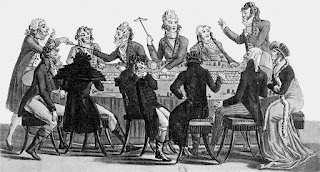
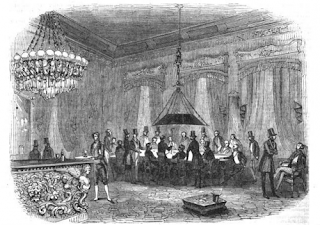
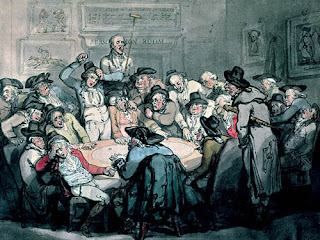
Gaming clubs were establishments frequented by the aristocracy, exclusive and with strict guidelines for behavior. The most exclusive of the time were The Cocoa Tree, White’s, Brook’s, and Almack’s. They were located in St. James and were considered the poshest of the gaming establishments. These were called “golden hells” and catered to the upper crust. These were in direct contrast to the gaming hells or “copper hells” patronized by the lower classes. The “golden hells” were just as apt to use gambling and outrageous wagers. The wagers were entered into a “betting book” so the participants didn’t forget the terms and amounts wagered. One remarkable wager found on the books states, “April 2nd, 1809. Mr. Howard bets Mr. Osbon Ten guineas that Lord Folkestone does not marry Miss Taylor before this day twelve month."


Gaming hells were for the lower, less genteel clientele. Their likes frequented clubs in a rougher part of London, which admitted people of all walks and stations of life, and both genders in some cases. Ladies were not allowed in the gambling establishments of the wealthy, as they were considered gentlemen’s clubs and off limits to ladies.


The types of games played were split down class lines as well. The aristocratic clubs played card games that required some skill to win, such as Whist (the forerunner of Bridge), piquet, Vignt-et-Un (which we know as 21), and Faro. Gaming in the “copper hells” relied mostly on games of chance, such as Hazard, a dice game that was an early form of Craps which required no skill and lots of luck.


Next month I will follow this post on gambling in general with a specific look at one of the more notorious gambling houses of the later Regency period: Crockford’s.


References:

Gaston, Diane. “Gambling in Regency England.” Harlequin EverAfter, Feb. 14, 2011.

Pitt, Arthur. “A Study of Gamblers and Gaming Culture in London, c. 1780-1844: emerging

strategic reasoning in a culture of conspicuous consumption.” M.A. Thesis, August 2012.

Rees, Luke. “Gambling in London’s Most Ruinous Gentlemen’s Clubs.” London’s Historians’

Blog, June 5, 2014.

Regency Reader. “Regency Hot Spots: Hells for Gaming Part One.” September 17, 2009.

Thursday, December 9, 2021

Traditional Victorian Christmas Dishes by Jenna Jaxon

One of my favorite Christmas movies is the 1970 musical Scrooge with Albert Finney. The production values of the film are wonderful—as you watch it you truly feel transported into the Victorian London of Charles Dickens. In one sequence Bob Cratchit is heading home, buying Christmas presents, food and drink for the family’s Christmas celebration the following Christmas Day. 

That journey has always fascinated me and made me think about how and what the Victorians ate at Christmas. Depending on class and location, Christmas food traditions varied quite a bit, although there is also a lot of agreement on what should be eaten
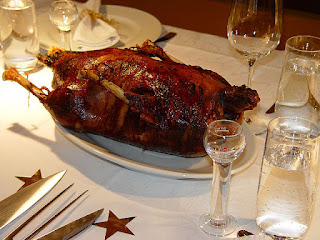
for the holiday feast, generally the most meal extravagant of the year. The centerpiece was usually either a standing rib of beef with Yorkshire pudding in the households of the North, while the roasted goose with sage and onion stuffing graced the tables of the South.


Another tradition was to serve a rum punch, apparently a favorite Christmastide ritual for Charles Dickens. The making of the punch was quite a production, and Dickens would explain each step to his guests as they watched the punch being concocted. The drink is made in a large fire-proof punch bowl, where you combine lemon peel and sugar, dark rum and cognac, stir well, then take a spoonful of the mixture and light it on fire and return to the punch bowl to set it alight. Dickens would then lift out fiery lemon peels for the guests to admire. Afterwards, the flames are extinguished by a metal tray placed over the punch bowl. Nutmeg was then grated over the punch and ladled out to the guests. 

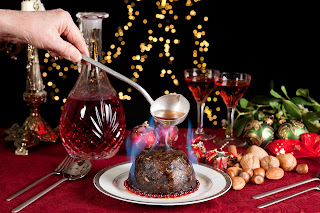
And last but not least was the Christmas or Plum pudding. Traditionally, this pudding was begun on the Sunday before the beginning of Advent, called Stir-up Sunday. If the household was to have good luck, the Christmas pudding must be begun on this day and left to ripen until Christmas Day. God’s blessing would only be bestowed on those who started their puddings on this day. For good fortune, the entire household should help with stirring the pudding with a wooden spoon and only clockwise and only East to West to honor the journey of the three kings. Once all the ingredients are assembled—raisins, currants, sultanas, dates, citrus peel, almonds, spices, cake crumb or breadcrumbs, brown sugar, butter, brandy or tum, and stout—the pudding is boiled or steamed for six hours, then removed from the pudding basin and wrapped with foil and a pudding cloth. It is then aged for about two months. On Christmas Day it is boiled for another four hours, then unmolded onto a platter. A ladle of brandy is heated then poured over the pudding and set alight for a dazzling desert.
There are many other traditional foods the Victorians ate at Christmas, but I thought these three would give a good idea of how the Victorian chose to celebrate the Season with fabulous food. 

I sincerely hope everyone has a warm and wonderful holiday season with your own special traditions and food. 

Sources: 

Burns-Booth, Karen. “Stir-Up Sunday, Traditions and My Traditional Victorian Christmas Pudding             Recipe.” Lavender and Lovage: Food and Travel from Home and Abroad, November 24, 2012.

Graham, Colleen. “English Christmas Punch.” The Spruce Eats Newsletter. May 13, 2021. 

Wondrich, David. “Holiday Punch—Plus a Cozy Fire.” Esquire, December 11, 2012.

Friday, December 3, 2021

Traditional Regency Christmas

by Donna Hatch

www.donnahatch.com


There's nothing quite like the glimmer of a Christmas tree, brightly wrapped packages, and a yule log burning in the fire to invoke wonder and excitement. But you may be surprised to know that many Christmas traditions are quite new--at least in England. Many English Christmas customs we think are ancient actually sprang up as early as the Victorian Era.

Regency Christmas traditions varied widely from region to region and even family to family. Generally, the upper classes of Regency England didn't treat Christmas as a special day beyond a church service and the exchange of small, mostly hand-made gifts within the family. Ordinary household items such as pen wipers and fire spills seem to have been common gifts, as well. The middle classes made a bigger event out of Christmas than their so-called "betters." Lucky them!

The reason why Christmas became so understated is largely due to Thomas Cromwell, who served as Chief Minister during the reign of King Henry VIII. Cromwell and his cronies virtually stamped out Christmas celebrations due to their origins—pagan licentious superstitions which often resulted in drunken brawls and even vandalism. Although I seldom approve of the destruction of any holiday, I can’t really blame him for his disapproval of that sort of misbehavior.


Fortunately, the Restoration revived Old Christmas into a new, toned-down version of its former bawdy revelry to one of quiet worship and time together with family. During the Regency, more and more celebratory customs cropped up. I suspect many families had practiced some of those customs all along secretly. Yorkshire is an area that seemed to hold on the most tightly to the Old Christmas traditions and enjoyed them openly when it became acceptable.


While researching English Christmas customs, I found journal entries and letters describing family events at the Big House, many of which I incorporated into my newest novel, Christmas Secrets. I exercised my creative license to have the local tradition include a ball at the Great House, gathering greenery including a mistletoe "kissing ball," the Yule Log, and singing carols, along with other fun aspects of the season on Christmas Eve.

Largely thanks to Queen Victoria's husband bringing his German traditions with him to England, which spread to the United States, Victorian Christmas customs grew into the ‘traditional’ Christmas we all know and love, complete with carolers, a wider variety of gifts and recipients, Yule logs, Christmas puddings, cards, Christmas trees, many of the carols we sing today.

Travel in winter in England during the Regency was extremely hazardous, therefore it was rarely done. By in large, Christmas house parties had to wait until railroads made winter journeys more feasible, which happened after 1840. Of course, I and every other author I have read largely ignore this, although in some of my Christmas stories, I mention people not wishing to travel far due to the weather.


An odd custom that does date back centuries is telling scary ghost stories. This age-old tradition dates so far back that I couldn’t find its true origin. Aside from the traditional Christmas story, A Christmas Carol, I’m happy that telling ghost stories is no longer part of most family Christmas customs. Can you imagine getting a child to bed who is both excited about Santa’s presents and frightened of ghosts? Now that is scary!

In the mood for a little holiday romance? Check out my Christmas novel, Christmas Secrets, which features a ghost, and kiss, and a happily-ever-after.

Sweet Regency Christmas

Christmas Secrets

A stolen Christmas kiss leaves them bewildered and breathless.

A charming rogue-turned-vicar, Will wants to prove he left his rakish days behind him, but an accidental kiss changes all his plans. His secret could bring him together with the girl of his dreams...or divide them forever.

Holly has two Christmas wishes this year; to finally earn her mother's approval by gaining the notice of a handsome earl, and to learn the identity of the stranger who gave her a heart-shattering kiss...even if that stranger is the resident Christmas ghost.

Christmas Secrets is available in both paperback and ebook on Amazon. Better yet, it's FREE on Kindle Unlimited!


Wednesday, November 3, 2021

Bound for Eternity: The Custom of Scottish Handfasting by Jenna Jaxon

Handfasting as a means of joining a man and a woman in marriage has been known in the Celtic world since ancient times. It is believed to be part of the heritage Scotland owes to the Danish culture, where “the Danes [had] the option of ‘hand-vesten’ to show their commitment. Then a woman who lived publicly with a man and prepared his meals for three years became his lawful spouse.” Originally the handfasting ceremony was performed almost as a stop-gap measure, allowing the couple to live as man and wife for a year and a day as they waited for an official member of the clergy to arrive and bless the union in a regular marriage ceremony. Lacking a clergyman, the couple could swear their intention to marry, have their hands bound (preferably before witnesses), and they would be considered married.
The tradition of handfasting was a medieval form of marriage in use until the mid- 1700s, when it fell out of favor. Until then, the Roman Catholic Church, and somewhat later the Scottish Protestant Church, allowed that if a couple said the words, “I take you to be my wedded wife,” (present tense) or “I will take you to be my wedded wife,” (future tense). The couple’s right hands were bound with a strip of cloth, signifying that they were bound for eternity. If this ceremony was followed by sexual intercourse, the couple was considered married both in the eyes of the Church and the State. There need be no witnesses and no clergy present, although witnesses were encouraged. Interestingly enough, during the Regency period in Scotland, handfasting was actually still a legal means of marriage. Although the church changed its laws to ban the ritual, the civil law allowing handfasting as legal remained on the books until 1939 when the marriage laws were reformed by the Marriage Act (Scotland) of 1939. After that, handfasting was no longer recognized as a legal form of marriage. In my soon to be released romance novel, The Widow Wore Plaid, which is set in Scotland, I had to research the legalities and technicalities of a
handfast marriage, as my hero and heroine consider the merits of it while under duress. The Widow Wore Plaid is currently on pre-order on Amazon and other e-book retailers. Argyll-Bute Council. “Handfasting Ceremony.” 2018. The Scotsman. “The Origins of Handfasting at Scottish Weddings—When Scots ‘married’ for a year and a day.” Feb. 14, 2019.

Friday, October 15, 2021

 Early in my writing career, the best piece of writing advice I ever got—right behind “be persistent”—was “write what you love.” So I did.  I wrote everything because I loved everything, but eventually settled on historical romance.

I’ve always loved historical fiction. As a child, I devoured Anne of Green Gables, Little Women, the Little House books, The Secret Garden and A Little Princess. Later I discovered Jane Eyre, the Jane Austen novels, and other historical classics. But again, I craved more romance. Fortunately for me, historical fiction was a hot market. The hard part was finding a book clean enough for me because I don’t like to read hot sex scenes. Once I discovered traditional Regency romances, which were generally very clean, sweet romances, I was in heaven. It was not to last, however.

Historical fiction's popularity waned, and for about a decade, sales across the board plummeted.  Perhaps readers tired of hot, sexy romance novels referred to as “bodice rippers” and "clean and wholesome" romance novels had not yet become a category. Instead, they were termed Traditional Regencies, which enjoyed success for a while, but they, too, fell out of popularity. The worst blow came when I learned two major traditional Regency romance publishers closed their doors. The news broke my heart, not only because I loved reading them, but because I’d written a sweet, traditional Regency romance novel that I’d been hoping they’d publish. For a long time, people called historical romance—and Regency romance in particular—a “dead” market. Sob!

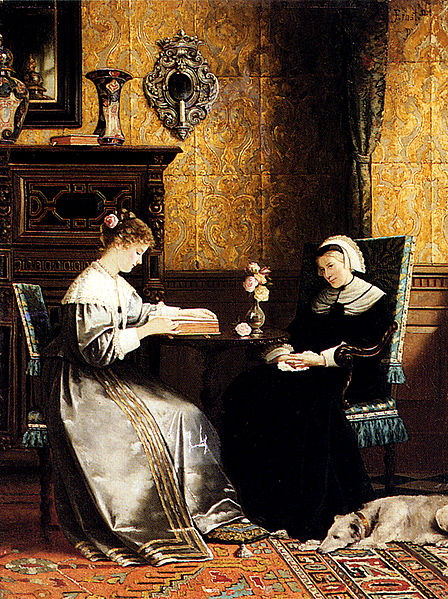
Reading_A_Book by painter Ernst RudolphGood news! Historical Romance novels, specifically Regency Romance novels, have regained popularity. Sales are skyrocketing for all historical romance, both on the hotter side and those sweeter, more traditional romances such as what we expect from Jane Austen era novels or Georgette Heyer. Personally, I love a clean romance, and if it’s a clean historical romance—even better!

As a historical author, I had to wonder; why the return of the historical romance?

I think there are many reasons. One is with all the recent movies based on famous books such as all the Jane Austen's, North and South with the dreamy Richard Armitage, and many other historical novel adaptations, especially Jane Austen adaptations, a whole new generation of fans have been converted to historical stories--historical romances in particular.

Another reason I believe historical romance novels have regained popularity is because most people read either to relax or escape (and escaping is part of relaxing, don’t you think?).  We crave a true escape from the modern world with all our troubles that only a journey into new world can provide. Maybe it’s the fantasy element of vicariously living the life of the very rich, wearing beautiful gowns, having handsome heroes vie for our favor or even dueling over our honor.

In Regency England, manners were very formal. There was a protocol to everything from how many sets a lady could dance with a gentleman in one evening (two), to what to wear while walking (a walking gown).

I love the way people in Regency England spoke so eloquently. They also prized wit and they excelled in using the understatement. As a historical author, I try to bring that out in every historical novel I write.

Regency men were civilized and treated women with courtesy. When a lady entered the room, gentlemen stood, doffed their hats, curtailed their language, offered an arm, bowed, and a hundred other little things I wish men still did today. But they were also very athletic; they hunted, raced, fenced, boxed, rode horses. They were manly. Strong. Noble. Resolute. Honorable. And that is why I love them!

I hope that historical romance is a here-to-stay market.

What do you love best about historical novels or historical romance?