Search This Blog

Showing posts with label 19th century letter writing. Show all posts

Friday, February 9, 2018

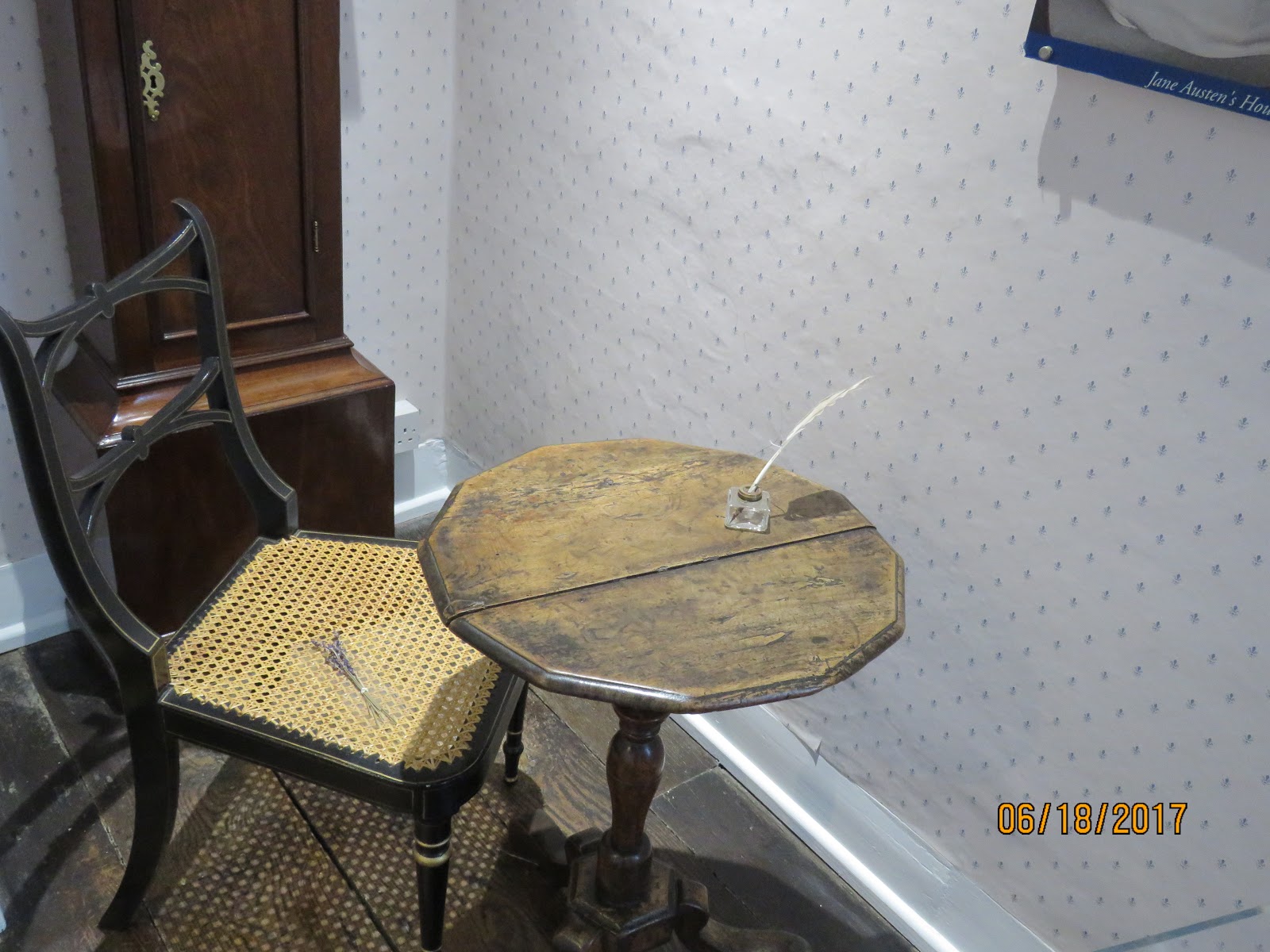
Jane Austen's writing table, copyright Donna Hatch
by Donna Hatch
www.donnahatch.com

In a time before phones, email, text messages, and social media, Regency ladies and gentlemen had only one way of keeping in touch with friends and family too far distant to see frequently; they wrote letters. The upper classes took their writing very seriously, and often wrote long, detailed letters to family and friends. Many also wrote religiously in their journals. And, of course, poets and authors needed reliable writing instruments.

Necessary writing tools included a quill pen, an inkstand or inkwell filled with ink, a pen knife, and sand or blotters. Often these implements were stored together in a little box inside a desk.

Looking at the process through the lens of our modern eye, it is easy to overlook the pen knife. Yet it is as essential as the pen and ink for anyone who wanted to write. Quill pens, which were usually goose quills (but could also be from peacock, swan, or even crow feathers) always needed sharpening, trimming, and shaping, just as today's pencils need sharpening. They could also be used to sharpen the pencil, which had only been in use since the 1700's, as opposed to the quill pen that people had been using for two centuries.

Cutting a quill pen took a great deal of skill. The nib had to be carefully shaped in order for the hollow core to hold the correct amount of ink, and then be released smoothly as the writer pressed on it. I found detailed instructions about how to sharpen a quill here

Many quills were kept together in a little box. I suspect if one planned to do a lot of writing, one sharpened the quills all at once, then in the course of their writing, simply set aside a flattened or misshapen quill and picked up another  from the box without losing the rhythm of writing. 

In Pride and Prejudice, the proud yet fawning Caroline Bingley offered to mend Mr. Darcy's pen, adding that she mended pens "remarkably well."


Quills and inkwell (Photo credit: studentofrhythm)
Pen knives could be ornate, made of expensive materials such as agate or ivory or mother-of-pearl. They were often gilded or encrusted with precious metals and even jewels. These were purchased from a jeweler. Plainer styles which came from the stationers had wooden handles and were merely sanded and polished, without adornment. 

For hundreds of years, pen knives had a blade that was fixed in the handle. During the 1700's pen knives could be folded, like today's pocket knife.

In Jane Austen's Mansfield park, Fanny Price's two younger sisters fight over a silver pen knife which had been a gift from the godmother of a dead sister. The sister had handed the knife to Susan before she died.

Pen knives had other uses. Many new few books were uncut at top and front. They had to be sliced open so one could read the book. A sharp knife was needed to keep the pages from tearing. I suspect the wealthy had a knife specifically used for this purpose, and did not double up using the precious pen knife, but the average person probably had to made do with an all-purpose knife.

Pen knives were as important to a Regency household as pencil sharpeners are to an elementary student today. 


Jane Austen's Chawton House Museum, copyright Donna Hatch
Above is a photo I took while visiting the home of Jane Austen in Chawton, now a museum. I can so easily imagine picturing her here writing her novels and her letters, can't you?

Here is a photo of the house where she lived so happily with her mother and beloved sister, Cassandra, and did so much writing.

I found the images of pen knives that you may wish to view here, and here.


Sources:


Wednesday, July 5, 2017

The Art of Letter Writing in Regency England, Part II

After finishing the second book in my Widow’s Club series, I wanted to share my research on letters, letter writing, and the post during the Regency. My characters wrote a lot of letters (as did most gentlemen and ladies of the Regency) Since I wanted to share some of the more interesting things I found out about the art of letter writing during the era, I devised a short series of posts on this topic, and this month I’m focusing on quill pens.
Quill pens were the only writing implement available during the Regency era. Steel nib pens don’t arrive on the scene until the 1830s, so quills were necessary for writing not only letters but novels and other documents as well. The most popular bird feathers for quills were the swan, the crow, and the goose. Swan quills made a very broad stroke; crow feather quills made a very fine line and were often used by ladies who wanted to write an elegant hand in their letters. But goose quills were by far the most popular feathers for making quills. If you want to learn how the very long process of making a quill was accomplished, please see Kathryn Kane’s article “The Quill—The Regency Pen” for all the details. Suffice it here to say that one goose could produce 20 quills per year. With quills being the sole source of pens, most of the quills used in England during the Regency were imported from the Norse countries of Norway and Iceland, from The Netherlands, Germany, Poland and Russia. After the protracted processing, the quills were sold in stationer’s shops in lots of twenty-five or fifty. As the nibs wore down, the writer had to re-cut the quill with their own pen knife. Once it had been cut sufficiently up the barb, it was discarded and a fresh quill taken up. Jane Austen penned her novels with a goose quill, as did other Regency writers such as Charlotte and Emily Bronte. And while I wouldn’t suggest writing anything substantial with one now (even though I do write my first drafts long hand now even I, a hard core historian, would not attempt to pen my novels this way), I may just try letter writing with a pen—by candlelight—to give me that certain connection to my period, to go deeper into the experiences of my hero and heroine, and revel once more in the world of the past.

Wednesday, June 7, 2017

The Art of Letter Writing in Regency England, Part I

I’ve just finished writing the second book in my Widow’s Club series and I ended up doing a fair amount of research on letters, letter writing, and the post during the Regency as my characters wrote a lot of letters as an integral part of the plot. Since I wanted to share some of the more interesting things I found out about the art of letter writing during the era, I’ve devised a short series of posts on this topic, starting with envelopes.
The number one thing I found out, that I absolutely did not know, is that envelopes come much later than the Regency. Envelopes do not come into common usage until about 1840, so Regency writers had to find other methods for ensuring the privacy of their letters. They could have enclosed the letter in a separate piece of folded paper, but the extra sheet would have added quite a bit of money to the postage (calculated by weight), which was then paid by the recipient, not the writer of the letter. Many people chose instead to use one sheet of paper (foolscap, post, and pott were popular), folded in half to form four pages of writing surface. They would write and often cross write over three of these pages, leaving the fourth page blank. The paper was then folded so this fourth page formed the envelope to keep out prying eyes and sealed. Sealing a letter could be accomplished by one of two means. Least expensive was to use a pre-formed wafer made from flour and gum that the writer licked and stuck to the paper to create a seal. The other method was to use sealing wax. I have, in my youth, used sealing wax on my letters to
friends and after this bit of research plan to find and use them again, as they give quite an elegant look. In the Regency, the letter writer would melt the end of a stick of sealing wax (which had no wick), then snub the pliable resin onto the envelope and press it with a seal or signet ring to insure against tampering. Sealing wax, I discovered, came in only three colors during the Regency era. Red was the most favored color and could be used at any time. Green was used by the Office of the Exchequer, the courts, and the Church. And black was used by those in mourning or to inform others of a death. Letter writing was absolutely a romantic part of previous eras and an art that I think we should bring back into our lives today. Next time I'll tell you what I learned about that most romantic of writing implements--the quill. Sources: “A Touch of Quill and Ink: Regency Letter Writing,” by Maria Grace “Anatomy of a Regency Letter,” from Lady Smatter, Her Reputation for Accomplishment