Search This Blog

Showing posts with label Donna Hatch. Show all posts

Friday, October 27, 2023

All Hallow's Eve and Jack O'Lanterns


by Donna Hatch

Halloween is even more popular than ever. In the United States, more Americans celebrate Halloween than Christmas. I have my own opinion on that, but really, what's not to love about love costumes, decorations, parties, and special treats?

 Origin of Halloween -- All Hallow's Eve

An ancient Celticic festival Samhain (a Gaelic word pronounced "SOW-en" or “SAH-win”) celebrated the end of summer's end, the harvest, and the new year, which, at the time, landed on November 1st. the Celts believed that during Samhain, the barrier between the living and the dead became thin enough that ghosts, monsters, and fairies walked the earth to steal souls. They also believed that ghosts of their ancestors could visit that night. The multi-day celebration included sacrifices, fires, dancing, drinking, and much revelry, as well as wearing disguises to hide from the souls wandering around. 

Eventually, with the rise of Christianity, the Roman Catholic Church replaced Samhain with All Saints’ Day or All Soul's Day, which celebrates the church’s saints on November 1. The day before All Saints' Day became All Hallows’ Eve. Many Samhain traditions have endured until today.

Carved Jack O'Lanterns

Ancient Celts invented Jack O'Lanterns. But since pumpkins are native to North America, so the Celts hollowed out and carved rutabagas, gourds, potatoes, beets, and even turnips. To make their faces glow, they put a candle or lit ember inside. These lit root vegetables guided their doorways to ward off evil spirits. 

The Celts also left doors and windows open to welcome in the spirits of their ancestors and set out food for them because, of course, ghosts get hungry. And apparently, only wicked, non-family ghosts were frightened away by glowing veggie faces. To the right are a few examples of the faces that artistic carvers can make from turnips.

Origin of the Name Jack O'Lantern
Photo by Andy Holmes on Unsplash

Although historians aren't positive about how a lit, carved vegetable became known as Jack O'Lantern, there are two prevailing theories. 

From about the 17th century, the term referred to a night watchman who carried a lantern and patrolled the streets to curtail crime. The British often called men whose names they didn't know by a common name like Jack. So, a nightwatchman whose name was unknown carrying a lantern was referred to as Jack with the Lantern or Jack of the Lantern or Jack O'Lantern.

The name's origin may have arisen from a legend about Stingy Jack who played tricks on the devil. As punishment, he was doomed to wander the earth as a spirit carrying a lit coal which he later put into a carved-out turnip. The story about Stingy Jack became a part of All Hallow's Eve and is often referenced when spooky, unexplained lights are sighted, sometimes called Spook Lights. 

Modern Jack O' Lanterns

Jack O'Lanterns today range from scary, to funny, to elegant to reflect the taste of the creator. So this Halloween spare a thought to your ancestors who have passed on. Who knows? They just might visit you.
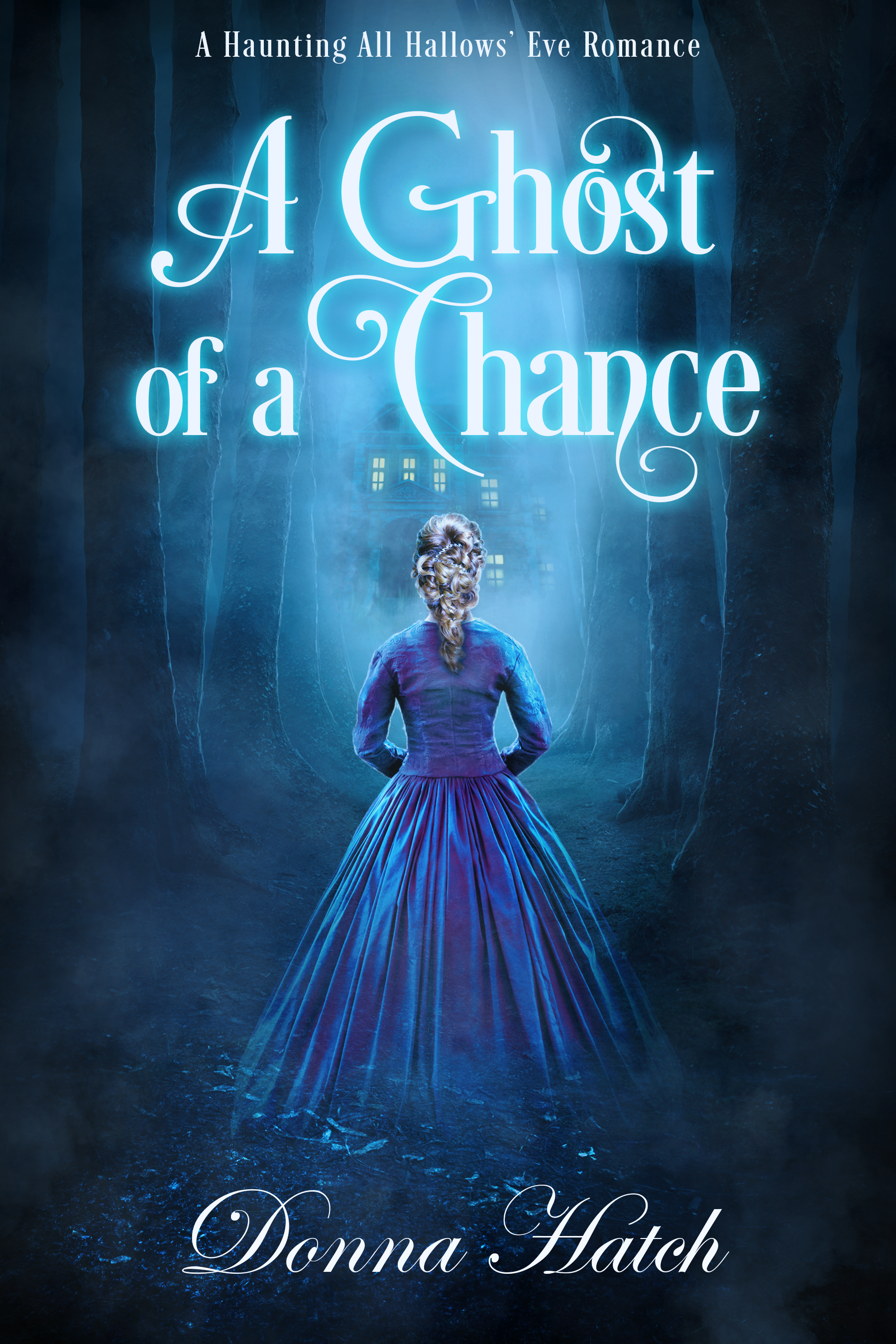
All Hallows Eve during Regency England, filled with ancient English customs, sets the scene for my newest short novel, A Ghost of a Chance.

A lost soul searching for hope...

After a devastating loss, a young lady throws herself into searching for her missing brother and taking solace in her musical composition. When a handsome and captivating stranger comes to town one All Hallows Eve, she dares to hope for more than her endlessly lonely existence.

A tormented war hero seeking redemption...

Unable to flee the memories of war, a retired cavalry captain spends his days helping the men who served under his command adjust to civilian life. Perhaps if he helps them all, he can atone for some of his past failures. When he stops for the night at a small English village celebrating All Hallows Eve, he meets an enchanting young lady unlike any other and suspects that what he needed all along was not only redemption but love.

They must find the courage to take a leap of faith and choose love over fear

It will take faith and valor to overcome the barriers between their worlds and let go of their past heartaches. As they discover love and happiness neither had imagined, they will have to delve into the shadow world between life and death to beg for another chance from the Angel of Death.

A Ghost of a Chance is available in ebook, Kindle Unlimited, and paperback.  

Sources:

https://www.merriam-webster.com/wordplay/the-history-of-jack-o-lantern

https://www.history.com/news/history-of-the-jack-o-lantern-irish-origins

https://time.com/5419385/why-jack-o-lanterns-halloween/

https://www.britannica.com/story/why-do-we-carve-pumpkins-at-halloween

https://worldpopulationreview.com/country-rankings/countries-that-celebrate-halloween    

https://www.history.com/topics/holidays/samhain#samhain-merges-with-halloween

Friday, March 9, 2018

Poet William Wordsworth

by Donna Hatch
www.donnahatch.com

William Wordsworth was a poet whose life spanned the Georgian, Regency, and Victorian Eras. He and his beloved wife, Mary, and three children lived in Rydal Mount during much of his years as a poet. The Lake District where he made his home inspired many of his poems.


I was fortunate enough to visit Rydal Mount during a trip to England in June of 2017. Thought Wordsworth never owned this home, he rented it for many years. The home itself is lovely and beautifully furnished, but it was the gardens that really captured my attention. The Wordsworths loved gardening and created a lush, vibrant retreat in their four acre property, which William designed. He also designed the gardens for many of his friends and neighbors.

One garden is named "Dora's Field" which they gave to their only daughter. After her death at the early age of 43, William and Mary planted daffodils in the field to commemorate her life. The offspring of those bulbs survive today. In the spring, Dora's Field is filled with golden, cheerful daffodils.  Unfortunately, daffodils have a short blooming season and they were done by the time I visited.

One of my mother's favorite poems, which she taught me when I was child, is one of his.
I Wandered Lonely as a Cloud, By William Wordsworth

I wandered lonely as a cloud
That floats on high o'er vales and hills,
When all at once I saw a crowd,
A host, of golden daffodils;
Beside the lake, beneath the trees,
Fluttering and dancing in the breeze.
Continuous as the stars that shine
And twinkle on the milky way,
They stretched in never-ending line
Along the margin of a bay:
Ten thousand saw I at a glance,
Tossing their heads in sprightly dance.
The waves beside them danced; but they
Out-did the sparkling waves in glee:
A poet could not but be gay,
In such a jocund company:
I gazed—and gazed—but little thought
What wealth the show to me had brought:
For oft, when on my couch I lie
In vacant or in pensive mood,
They flash upon that inward eye
Which is the bliss of solitude;
And then my heart with pleasure fills,
And dances with the daffodils.

Friday, December 16, 2016

Christmas Wassail

20161202_141654by Donna Hatch

Remember the holiday tune "Here we come a-wassailing?"
Here we come a-wassailing among the leaves so green;
Here we come a-wand'ring so fair to be seen.
Love and joy come to you, And to you your wassail too;
And God bless you and send you a happy New Year.  And God bless you a happy New Year.

Ever wonder what "a-wassailing" means?
it means to sing for some wassail. I guess it's kinda like singing for your supper, only the carolers go from place to place hoping for a nip of the traditional hot beverage.

One of my winter and holiday favorites is Wassail, also know as spiced hot apple cider. It's one of those things it's hard to get wrong. All the recipes I've tried are yummy and satisfying. Some include citrus such as lemon and orange. Traditionally, it contains alcohol such as wine or rum or even ale, but I don't drink alcohol so I make it without.  No matter how you make it, wassail is a comfort for cold winter nights as well as a solution for a sweet craving. A few years ago, a friend shared with me her trick: apricot juice. It adds a richness and complexity other recipes don't have.

wassailHere it is:
1 large jug of apple cider
1 can of apricot juice
3 cinnamon sticks
4 nutmeg cloves
a dash of nutmeg
a dash of allspice
Optional: orange or lemon slices

All of these can be adjusted according to taste so you may want to experiment.

Simmer for at least an hour but you can simmer all day. It does get stronger and stronger so after several hours, you may want to tone it down with a bit more apple cider. It makes the house smell heavenly!
mistletoe-magic2In my Christmas novella, Mistletoe Magic, the heroine adores the wassail her friend’s mother makes and will go to great lengths to get the recipe...as well as take advantage of the mistletoe at the annual Christmas ball.


Note: The Colonial Williamsburg blog has lots of fun history behind this traditional drink.

Wednesday, October 5, 2016

Affaires of Honor and Regency Dueling

by Donna Hatch
www.donnahatch.com

In England, dueling was part of a long-standing code of honor, far beyond mere tradition. Gentlemen took their dueling very seriously; they would rather die than be dishonored. Does your heart go pitter patter just at the sound of that? I admit, at time, mine does. How many man that honorable do you know? Okay, maybe we'd call it misplaced pride, or an overdeveloped sense of vengeance, but hey, that was a different world with a different set of rules. And yeah, I'm glad they don't do it these days.

By the Regency Era, dueling was outlawed. However, duels still happened more frequently than many people knew. The problem was, because courts were made up of peers, they were reluctant to charge another peer with murder as a result of a duel. There is a case where one nobleman was charged with murder and tried, but used the defense that his behavior was gentlemanly and honorable, meaning that he acted within the proper code of conduct. He was acquitted by his peers.

If they were socially equal, or at least similar, the gentleman who was offended would tell the man who’d wronged him that he should choose his “second,” a close friend or family member who would look out for his best interests. If he was really incensed, he might slap him with his glove, but that was considered extreme and beneath gentlemanly behavior, as it was the ultimate insult and probably resulted in a fight then and there.

The procedure for issuing a challenge was very specific. A gentleman never challenged a social inferior. For instance, a gentleman of significance with ties to the aristocracy or nobility would never challenge a commoner, such as a blacksmith or a farmer. Also, if there was a significant age difference, the duel would not be extended.

After the verbal challenge – or perhaps warning would be a better word – was issued, depending on the severity of the offense, the other might have a choice; he could either apologize, or he could accept. Sometimes, the apology would not be accepted, often if there were a third person who’d been wronged such as a lady's honor. (Okay, call me crazy but that almost makes me want to swoon.)

The next day, supposedly after heads had cooled, the wronged man who wished to duel would send his “second” with a written letter challenging the duel. The other may chose to apologize or accept the challenge. If accepted, he would choose swords or pistols and name the time and the place. In my humble opinion, swords was a more more gentlemanly way to duel. If they used pistols, they only used one shot which seems too much like cold-blooded murder. I'm sure they didn't always shoot to kill, but there was some unwritten rule about the shot purposely going wide and that being bad form. *shrug*

When the allotted day arrived, they met, probably in a remote place where they wouldn’t be caught by the law, and the seconds inspected the weapons to be used. A final opportunity for an apology could be given. If not, the seconds decided if the duel should be fought to (a) first blood, or (b) until one can no longer stand, or (c) to the death. Once that was decided, the opponents dueled and the seconds watched to insure that nothing dishonorable happened.
If during a duel fought by swords, one of the duelers becomes too injured to continue, occasionally the second would step in and duel. Sometimes, the seconds were hot-headed or very angry (loyal?) and ended up dueling each other as well. To my knowledge, this never happened is the duel were fought with pistols.

As horrible as it sounds to our modern selves, these gentlemen took their honor very seriously, and considered death preferable to living with the label of a coward, a label that would follow them and their families for years.
And, maybe it’s me, but there a certain romance about a gentleman brave enough and protective enough to be willing to risk death defending my honor from another man who’d besmirched it.

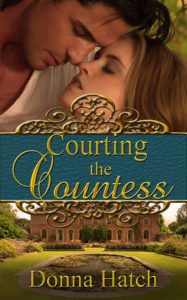
A duel largely part of what leads to all the trouble for my hero in my Regency Romance novel, "Courting the Countess" and causes events he wishes desperately he could change, especially when the duel goes awry and causes pain to an entire family.
I'm sure glad my husband isn't likely to try dueling...


When charming rake Tristan Barrett sweeps Lady Elizabeth off her feet, stealing both her heart and a kiss in a secluded garden, her brother challenges Tristan to a duel. The only way to save her brother and Tristan from harm—not to mention preserve her reputation—is to get married. But her father, the Duke of Pemberton, refuses to allow his daughter to marry anyone but a titled lord. The duke demands that Elizabeth marry Tristan’s older brother, Richard, the Earl of Averston. Now Elizabeth must give up Tristan to marry a man who despises her, a man who loves another, a man she’ll never love.

Richard fears Elizabeth is as untrustworthy as his mother, who ran off with another man. However, to protect his brother from a duel and their family name from further scandal, he agrees to the wedding, certain his new bride will betray him. Yet when Elizabeth turns his house upside down and worms her way into his reluctant heart, Richard suspects he can’t live without his new countess. Will she stay with him or is it too little, too late?

Order now on Amazon for Kindle.

Friday, September 30, 2016

London Season in Regency England

by Historical Romance Author Donna Hatch
www.donnahatch.com

If you've ever read a Regency or Victorian Romance novel, or even any British historical novel set in the 18th or 19th century, you've probably come across the word "Season" (capitalized). Season does not refer to winter or spring but rather to the social whirl among the upper crust of British society during the spring. The Season originally began as a way for the families of men serving in Parliament to amuse themselves while staying in London, and so it remained for generations. Most families did not travel to and from their country estates to London during the autumn or winter months due to the difficulty of travel. However, after Easter, they seemed to be ready for society.

The dates which Parliament met varied from year to year. According to noted Regency researcher and author, Regina Scott, the dates parliament met were as follows: Parliament was in session during the following times:
  • 1 November 1810 to 24 July 1811
  • 7 January 1812 to 30 July 1812
  • General election: 5 October to 10 November 1812
  • 24 November 1812 to 22 July 1813
  • 4 November 1813 to 30 July 1814
  • 8 November 1814 to 12 July 1815
  • 1 Feb 1816 to 2 July 1816
  • 28 January 1817 to 12 July 1817
  • 27 January 1818 to 10 June 1818
  • General election: 15 June to 25 July 1818
  • 14 January 1819 to 13 July 1819, before the 16 August 1819 Peterloo Massacre
  • 23 November 1819 to 28 February 1820 (special session because of the massacre but ending early because of the death of George III)
  • General election: 6 March to 14 April 1820
  • 21 April to 23 November 1820 (including a special session beginning the third week of August for the trial of Queen Caroline).
Parliament always went into recess for Lent, which precedes Easter, a time when the members of Parliament, also referred to as MPs, retreated to their country homes. When they returned to London after Easter, they often brought their families, especially if they had sons and/or daughters of marriageable age to participate in what was often referred to as the "marriage mart."

The focus was not always to find a spouse. Some families simply came to renew acquaintances and amuse themselves after wintering in the country. Regardless, the ton descended on London en masse. Activities varied but popular amusements were dinner parties, balls, musicales, attending the theater or the opera, visiting museums, going riding in the park, visiting private zoos, and riding in hot air balloons, to name a few.

Almack's Assembly Rooms
There were also the coveted vouchers for weekly balls at Almack's Assembly Rooms where the Patronesses kept a tight rein over who would and would not be granted entrance based on family connections and behavior. Young ladies wishing to dance the scandalous waltz had to first receive permission from the Patronesses. According to Regency researcher and author Candice Hern, the Patronesses were, Lady Jersey, Lady Cowper, Countess Leiven, Mrs. Drummond-Burrell, Lady Castlereagh, Lady Sefton, and Princess Esterhazy.

The Season in London was also a crucial event for the working class. People arriving in London needed servants for their London homes because they typically transported very few of their servants from house to house. If a family did not own a house in London, they rented a townhouse. They also shopped. A lot. Ladies absolutely had to have fine gowns as well as shoes, hats, gloves, reticules—you name it. The wealthy also went to the theatre and opera, which meant more performers were needed. As you can imagine, the cost to attending a Season in London was staggering, but most considered it a worthwhile investment if their children got married to a good match.

In short, much of the prosperity of London depended on the Season and the beau monde who peopled it. Merchants and craftsmen earned a living, and the wealthy amused themselves and secured the future of their line. It seems to have worked pretty well for most.
The London Season plays a major role in my upcoming book, Heart Strings, but not in the usual way.
When forced to choose between marrying a brutish oaf or becoming another man’s mistress, Susanna flees to London with dreams of becoming a professional harpist. Entangling herself with a handsome violinist who calls himself Kit may be more problematic than sleeping in the streets.
With peril lurking in the shadows, Susanna’s imminent danger not only forces Kit to choose between his better judgment and his heart, but he must also embrace the life to which he swore he would never return.
Heart Strings is available now for pre-order Kindle and paperback.


Friday, December 18, 2015

The Cato Street Conspiracy, a Source of Inspiration


The Cato Street Conspiracy

The murder plot in my newest Regency Romance, The Suspect’s Daughter was inspired by a true event in England known as the Cato Street Conspiracy.

The early 1800’s in England was a time of social and economic upheaval. Upon the ending of the long-term Napoleonic wars, unemployed career soldiers and sailors flooded the workforce. Industrial change was taking England from a largely agricultural country to one of large industry. Many of the working class were hungry and feeling oppressed. Riots erupted which the government crushed. Laws grew more and more restrictive.

In 1820, a group of ten Londoners decided the government needed to be overhauled, and came up with a radical and brutal idea. They planned to storm a house where the prime minister and his cabinet would be having dinner, shoot and behead the leaders, and then parade around the slums with the heads.

Thankfully, this mass murder was averted largely in part due to an undercover government agent whom some believe was a Bow Street Runner. I never learned his name. Government agents stormed the meeting, which was held in a flat on Cato Street, and arrested the conspirators. But the radicals didn’t go peacefully. They fought back, killing one of the officers.
Newgate Prison

The conspirators were tried for high treason. Five were transported, and the rest were hanged at Newgate Prison (pictured) and then beheaded. I guess they authorities wanted to be thorough.

Though the events are different in my story, and the characters are fictitious, the case inspired the conspiracy plot (with my own spin, of course) in my newest Regency Romance, The Suspect’sDaughter, book 4 of the award-winning Rogue Hearts Series, with Grant Amesbury as the hero.


The Suspect’sDaughter, book 4 of the Rogue Hearts Series

Determined to help her father with his political career, Jocelyn sets aside dreams of love. When she meets the handsome and mysterious Grant Amesbury, her dreams of true love reawaken. But his secrets put her family in peril.

Grant goes undercover to capture conspirators avowed to murder the prime minister, but his only suspect is the father of a courageous lady who is growing increasingly hard to ignore. He can’t allow Jocelyn to distract him from the case, nor will he taint her with his war-darkened soul. She seems to see past the barriers surrounding his heart, which makes her all the more dangerous to his vow of remaining forever alone.

Jocelyn will do anything to clear her father’s name, even if that means working with Grant. Time is running out. The future of England hangs in the balance...and so does their love.
The Suspect’sDaughter, is available from Amazon

Friday, March 20, 2015

Spotlight on Regency Fashion: the pelisse

By Donna Hatch

Ladies in Regency England had more reasons to change clothes than the modern-day woman would ever believe. They had special clothes for relaxing at home, walking, riding, going for a drive in a carriage, afternoon gowns, evening gowns, ball gowns, etc. And the number of accessories is even more mind-boggling.

But one of the Regency ladies' fashion accessories was practical as well as fashionable. It was the pelisse. Generally lightweight, Regency ladies wore this long over-garment to protect her clothes from dust and dirt. Since many roads were unpaved, walking and riding in a carriage produced dust and dirt that would sully a gown. And since fashionable ladies often wore white or light colors as a status symble, keeping clothing clean in a not-so-terribly clean environment must have proved challenging. Big cities such as London were even dirtier with all the soot polluting the air from burning coal.

Wearing a pelise became an indespensible part of fashion, as well as a necessary garment, outside one's home. Though pelisses didn't generally take the place of a warm coat or cloak, they also added a layer of warmth in the event the weather took a sudden turn.

I have additional pictures of pelisses and gowns on my Pinterest Regency and Jane Austen Page.


Donna Hatch is a noted Regency researcher, enthusiast, and historical romance author. You can visit her website at www.donnahatch.com
Like her author page on Facebook
Follow her blog at www.donnahatch.com/blog

Friday, January 16, 2015

Regency Sun Protection

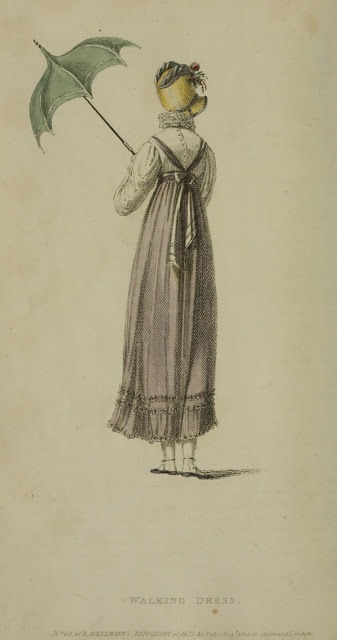
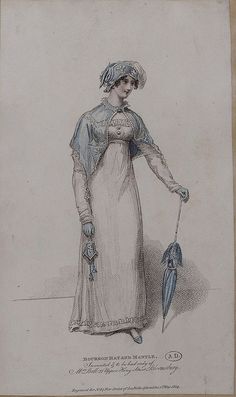
Regency fashion plate, parasolby Donna Hatch

Unlike the sun-kissed tans admired by some women today, (and let's face it, chalk-white legs just aren't coveted) a pale complexion was a fashion statement during much of England's history. Since laborers often worked long hours outside, their skins got tanned and weathered from exposure to the sun and the elements. A lady with a creamy complexion loudly proclaimed, without uttering a word, that she was wealthy enough not to have to spend a great deal of time out of doors. But since a lady's skin could become unfashionably brown simply by walking outside, even with the protection of a hat or bonnet, she had to take measures to protect her skin from the sun.

During previous eras, ladies and gentlemen of the upper classes powered their faces to maintain a pale complexion.  But by the Regency Era, people abandoned the powder, rouge, lipstick, and powered wigs, as well as ostentatiously ornate clothing, in favor of a more natural, comfortable look. They also started bathing on a regular basis, which I think is not a coincidence.

Regency fashion plate and parasol
What was a lady to do if she wanted to spend time outside but keep her skin alabaster white without the use of powder? Sunscreen, obviously, was not the answer, since it had yet to be invented. Bonnets and hats certainly helped but there were times when those failed to protect a lady's face from all angles of the sun.

Enter the parasol. Made of natural fabrics such as cotton and silk and often embellished with lace, these functional little beauties became so popular in England early in the 19th century that they became part of a fashionable ensemble.  Depending on how they were made, they could even protect a lady from a light rain.

Winter Collection, 6 historical short storiesSo the next time your Regency lady goes for a walk, make sure she brings her bonnet and parasol to keep her face un-freckled and white, and her gloves to protect her hands, lest she fall under criticism of becoming "brown." Horrors!

For more pictures, feel free to check out  my Regency Accessories Pinterest Board with lots of images and fashion plates of parasols, fans, shoes, and other fun Regency accessories.

Laura Boyl on Jane Austen Center has some lovely pictures of ladies and children carrying parasols.

Louise Allen, on her blog, History of Costume, has a great collection of pictures as well as how the "correct" way to hold a parasol evolved.

Sources:
http://janeaustenslondon.com/tag/history-of-costume/
http://www.janeausten.co.uk/parasols/

Friday, August 1, 2014

Regency Lady's Companion

by Donna Hatch

Lady's companions play an indispensable role in the proper English lady’s life in Regency England. They act as the guardian of a young lady and her reputation, which can be so easily sullied by even the appearance of untoward behavior. Even the simple act of walking around without a proper chaperon could call into question a lady’s reputation. A mother or father, of course, are preferred guardians. But if a parent is unavailable, a companion is the perfect solution.

A lady’s companion is an overlooked and under-appreciated member of the household. She can be a relative, or a poor relation, perhaps a widowed or maiden aunt who is relying upon the kindness of her family. She must be older than the lady—younger companions simple wouldn’t do for a gently bred young lady.  I have heard of younger companions for old spinsters who are no longer considered marriage material, but young companions are probably more for companionship and help, than truly to guard the reputation of an older lady.

They not be related at all.  They may simple be a member of the gentry, usually educated and have good manners. Since there were paid companions, they could have been ladies whose family has fallen upon hard times which has forced them to find employment. Because there were few acceptable employment options for a member of the gentry or aristocracy, becoming a teacher, a governess, or if they were older, a paid companion were their most likely occupations.

A maid or other lower born servant is never a proper companion. They can be too easily bullied or bribed to disappear and thus no be a reliable guardian for a young lady’s virtue.

So the next time you read in a Regency romance novel about a companion, spare them a kind thought for their vital role to the fragile reputation of their young charges.

Friday, March 1, 2013

The Language of Fans

by Historical Romanced Author Donna Hatch
www.donnahatch.com

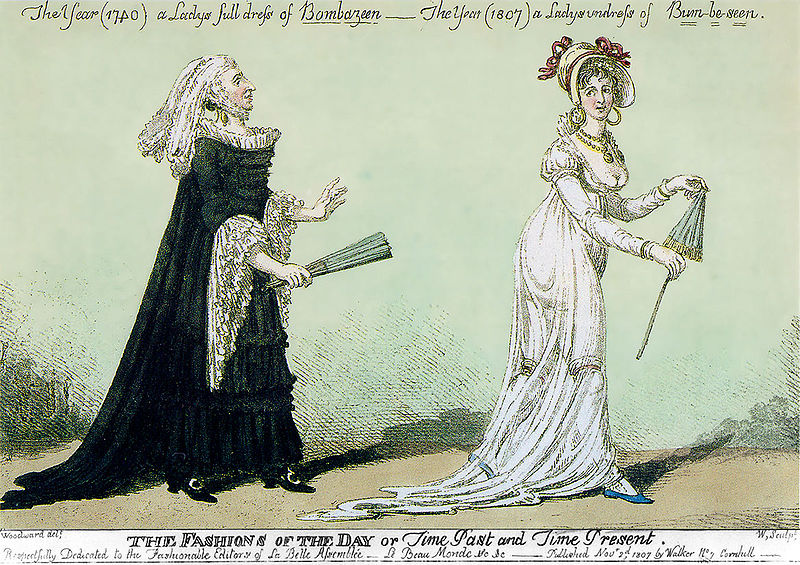
File:1807-pseudo1740 Fashion-contrast Bombazine-pun.jpgFans have been used as both a fashion accessory and a useful tool of staying comfortable for hundreds of years. Nearly every culture has a fan of some sort and the Regency Era, the time period in which I base all my romance novels, is no exception.


Unfortunately, the sources I read don't agree on what each action means. For example,  according to one source,* to fan slowly means "I am married." But according to another** to fan slowly means, "Don't waste your time; I'm not interested."

Likewise, according to one***, fanning oneself quickly means "I am married." But yet another ****says the same action means" I love you so much."

Shrug.

Also, the modern reader might wonder why go to all the trouble of learning such an elaborate language? But I think it might work well for the very shy, the very tongue-tied, or the person who needs to get the message across but fears coming on too strong. Also, telling a man she's not interested in him might be easier to say in fan language than in speaking. How many times have you told a guy who asked you out that you were busy when you really wanted to tell him to buzz off?

So, unless I can make friends with Dr. Who and jump into his time machine to find out what, exactly, these gestures really meant during the Regency Era, we may never know. Still, here are a few hand signals on which my sources seem to agree:

Touching right cheek: yes
Touching left cheek: no
Touching finger to tip of fan: I wish to speak with you.
Running fingers through the fan's ribs: I want to talk to  youResting the fan over the heart: my love for you is breaking my heart
Resting fan NEAR the heart: you have won my love
Resting fan on lips: I don't trust you.
Twirling in left hand: we are watched
Twirling in right hand: I love another
Open and shut: you are cruel
Open wide: wait for me
Presented shut: do you love me?
With handle to lip: Kiss me
In right hand in front of face: Follow me
Drawing across the cheek: I love you
Placing on left ear:  Leave me alone
Placing closed fan to the right eye: When may I see you?
Covering left ear with open fan: Do not betray our secret.
Changing fan to left hand: I love another.

So far, all the heroines in my Regency Romance novels have done with a fan is to keep cool or use it as a shield behind which they speak quietly to another. I admit, however I'm intrigued by the subtle, demure way a woman might have communicated to a man without speaking a word. She'd just have to time it when he's looking and not one else is, or her secret feelings would no longer be secret.


Sources:
*http://www.allhandfans.com/handfans/levels/language_of_the_fan.htm
**http://myhandfan.com/language.htm,
***Minute Company
****myhandfan.com