Search This Blog

Showing posts with label Servants. Show all posts

Friday, May 6, 2016

English House Servants

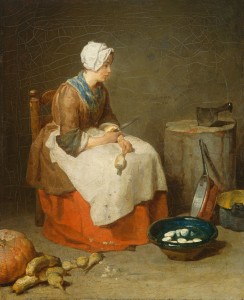
By Jean-Baptiste-Siméon Chardin - Visipix.com
by Donna Hatch
www.donnahatch.com

Servants were an indispensable part of running any Big House throughout the ages, including those in existence in Regency England. Manor houses and castles where the upper classes lived were huge and required an army of servants to keep them clean and well-maintained. Also, the owners themselves required a great deal of help from their staff. 

According to  The Victorian Domestic Servant, the Duke of Bedford had 300 servants in his employ, and the Duke of Portland employed 320. To be sure, not all Big Houses had quite so many, and upper class people who lived in more modest houses employed far fewer servants. However, all seemed to have servants.

In Jane Austen's Sense and Sensibility, the Dashwood ladies had to count every penny once they were removed from their home, but they still had two servants to help them while they lived in their humble cottage. The care of clothing alone, not to mention cooking or cleaning, was a major undertaking in those days, and gently bred ladies certainly would have lacked those skills. Even members of the gentry who considered themselves poor probably had at least a maid of all work who did everything--cleaning fireplaces, laundry, dishes, dusting, sweeping, scrubbing floors, etc. and was still expected to wait on the ladies in the home. Single gentlemen who lived alone in their bachelor's rooms had at least one male equivalent of a maid of all work, often referred to as a valet (though his tasks would have been more varied than if he were a valet for a lord in a Big House). This all-around male servant was often simply referred to as a "boy" or a "man."
Servants' duties mostly took place out of sight. It was good form for a servant to be silent and invisible, which is why so many houses have secret passageways--they were usually servants' stairways and corridors. Servants arose hours before their masters and worked late into the night. They were also at the mercy of their employers and were called upon to work in any kind of weather, at any hour of the day, with few personal days off, and often had poor accommodations.
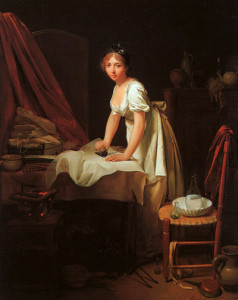
servantClasses existed in the world of servants from the top which included the head butler, head housekeeper, and chef, right down the to very bottom to the scullery maid and 'tween stairs maid. They all knew where they fit in that hierarchy, just as businesses have a hierarchy from the president down to the janitor. Ladies' maids were high on that ladder, often dressed well and had only to serve their lady's personal needs, dress her, and style her hair. In some houses, the lady's maid was also charged with caring for her lady's clothing, but most houses sent the laundry out to a laundress. The footman was also a coveted position. His main role was to be young and handsome, wear livery (a costly uniform), and open doors as well as run the occasional errand such as carrying his lady's packages on a shopping expedition.

Most servants were unmarried. Employers didn't want servants distracted by spouses or children. Since servants must be at their lord and lady's beck and call, they slept in the servants' quarters, usually in the upper floors or attic, or on a pallet in the kitchen floor, and could be dragged out of bed without a second thought if their lord had need of them. Essentially, servants were married to their jobs. Some male house servants married, but they had very few days off a month when they could go home. Outdoor servants, however, such as stable hands, gardeners, and gamekeepers usually stayed in their own little cottages somewhere on the grounds. It was fairly common for these servants to be married and have families.

Female servants who wanted to marry did so with the understanding that their position in the house was forfeit.  Occasionally, the head housekeeper and butler were a couple, but she only joined the staff after her children were raised.

A servant's pay was meager, the hours long, and the work often back-breaking, but there was never a shortage of applicants--after all, house servants had a place to sleep and regular meals, not something they could obtain from most other jobs such as those in a factory. In addition, their tasks usually had little to no risk of danger, also unlike factory jobs.
I admit, having a chef and maid of all work sounds very appealing, doesn't it?

For further reading, I recommend:
The Victorian Domestic Servant by Trevor May
Novels told from a servants' point of view which are well-written and carefully researched are:
Longbourn by Jo Baker
Maid to Match by Deeanne Gist
Eng

Friday, January 9, 2015

Dealing with Servants


     "What wretches are ordinary servants that go on in the same vulgar Track ev'ry day! Eating, working and sleeping! But we, who have the Honour to serve the Nobility, are of another Species. We are above the common Forms, have Servants to wait upon us, and are as lazy and luxurious as our Masters."
     So is quoted a duke's servants in James Townley's 1775 High Life Below Stairs. The English class system extended through the upper ranks and well into lower orders, with its own complications of hierarchy. But even as the industrial revolution broke down class system by creating a new class of rich merchants, the upper class required their servants. And the larger the house and estate, the more staff required for its maintenance.
     In the country, an estate needed the following, in order of their own precedent:
     -A land steward to manage the estate, collect rents and settle disputes between tenants.
     -A house steward or housekeeper to supervise indoor staff for two hundred pounds a year, and some houses might have both a house steward and a housekeeper who served under him.
     -A valet for the master of the house, and a lady's maid for the lady of the house, whose wages might be anything from twenty to two hundred, depending on if they were in demand in London, or stuck in the countryside without opportunity.
A master of horse or stable clerk to supervise the stables, including livery servants who worked outdoors, coachmen and stable lads, for around sixty pounds a year in salary.
A butler, a cook, a head gardener, who earned twenty to forty pounds year.  This might include a wine-butler, and also a porter or major domino who supervised the comings and goings at the house, and a groom of chambers, who looked after the furniture in the house.


     In the lower male ranks came other coachmen, footmen, running footmen, grooms, under-butlers, under-coachmen, park-keepers, game-keepers, yard boys, hall boys, footboys. In the lower female servant ranks came nannies, chambermaids, laundry maids, dairy maids, maids-of-all-work, scullery maids. In town such staff might earn as much as ten to twenty pounds a year, with men being paid more. In the country, salaries were half that or even less.
     In the no-mans land between servant and master existed those creatures who might be of upper or lower class, but who did not quite fit into either, the governess, tutor and dancing master.
     A large estate might require as many as fifty indoor servants, and twice that or more in outside labor to deal with the estate's lawns, animals, produce, beer-making, dairy and so on. An estate acted very much like its own village, with squabbles between servants, gossip, flirtations, jealousies, and structure. All of which had changed little from feudal times.
     However, the world was changing. New factories, new roads and lower costs of transportation make even the servant class more mobile. And keeping a good staff began to be an issue.

     To hire staff, the lady of the house--or the housekeeper or house steward--might advertise in The London Times or the Morning Post. The custom of 'Mop Fairs' where servants might parade and find new positions also existed through the 1700's and into the 1800's.  "Females of the domestic kind are distinguished by their aprons, vs. cooks in coloured, nursery maids in white linen and chamber and waiting maids in lawn or cambric," writes Samuel Curwen of such a fair at Waltham Abbey in 1782. Such a fair included strolling, stalls, and full public houses, with a good bit of drinking. It was for many servants a holiday.
     Dress very much told of a person's status, both as in the world upstairs and below. The upper servants dressed in livery and uniforms provided by the house, while lower servant were expected to wear plain and ordinary.
     The cost to hire, feed, and dress an extensive staff could be considerable. Wages tended to be higher as well in a richer house. And servants could expect to be left tips--or vails--by visiting guests. A vail might be as much as a month's wages left by a departing guest, the amount determined by the status of the guest and the rank of the servant.
While a cook might earn fourteen to twenty pounds, in a rich house, this might be as much as forty to fifty pounds a year. Or, if in demand and talented, a chef might earn more, as did the Earl of Sefton's chef, Ude, who made three hundred guineas a year.
     On 400 pounds a year, a family might expect to afford two maids, one horse and one groom. Not in Front of the Servants reports that, "Between 1776 and 1802 the Reverend James Woodforde found that on three hundred pounds a year it was possible to have the following staff: a farming man, who also helped about the house on occasion, a footman, a yard boy, an upper maid (who did the cooking) and an undermaid."
     On 1,000 pounds a year income, that family could then keep three female servants, a coachman, a footman, two carriages, and a pair of horses. It took around 5,000 a year--the income of most wealthy gentry--to keep thirteen male servants, nine female staff, ten horses and four carriages.
     Coupled with the expense of a staff came its management. While on many country estates, servants came from the local lower orders and might well be born on the estate and look to live and die there, in town servants looked for opportunities to advance. Servants in town could register with agencies, but they would need to bring with them good references.
     However, as noted by a Portuguese visitor to England in 1808, "servants 'are not to be corrected, or even spoken to, but they immediately threaten to leave their service.'"
     As with any group, problems arose. Servants gossiped, stole from the pantry and even from a careless master's closet, and then there was the issue of upper class males and lower class females.
     "If you are in a great family, and my lady's woman, my lord may probably like you, although you are not half so handsome as his own lady." So wrote Jonathan Swift in his Directions to Servants in 1745. He went on to advise that any lady's made at least make certain that she is paid for "the smallest liberty." The attitude prevailed well into Victorian times that the maids of a house provided opportunity for gentlemen, for such girls were beyond any thought of marriage. Such activities came to be frowned upon rather than winked at, but continued. A very few gentlemen took the shocking step to marry their housekeeper, but such alliances meant ostracism from society for such couples. And servants themselves were shocked by such a mixing of class for they often could be even greater snobs than were their upper class masters.
--------------

Shannon Donnelly’s writing has won numerous awards, including a RITA nomination for Best Regency, the Grand Prize in the "Minute Maid Sensational Romance Writer" contest, judged by Nora Roberts, RWA's Golden Heart, and others. Her writing has repeatedly earned 4½ Star Top Pick reviews from Romantic Times magazine, as well as praise from Booklist and other reviewers, who note: "simply superb"..."wonderfully uplifting"....and "beautifully written." She is also the author of the Mackenzie Solomon, Demon/Warders Urban Fantasy series, Burn Baby Burn and Riding in on a Burning Tire. She is currently working on her next Regency romance, Lady Chance.