Search This Blog

Showing posts with label 18th century. Show all posts

Friday, February 14, 2020

Valentine's Day in Regency England

by Donna Hatch, www.donnahatch.com
Happy Valentine's Day! 
Valentine’s Day in Regency England was very different from the way we celebrate it today. People of all classes exchanged hand-made cards with hand-written verses. During the Victorian Era, Valentine’s Day cards became mass-produced, but in the Regency, such a gesture required more thought and care.
Cards sent were as varied as the senders. Some were made with gilt-edged paper, trimmed with lace–real lace, not paper lace since that had not yet been invented. They could be embossed or have gold overlay or even sequins. Those who could not afford such luxuries made them out of simple paper which was still an expensive commodity for the less affluent. Flowers seemed to be the most common decoration but cards were also decorated with hearts, birds, and even timeless cupids.
Those who fancied themselves poetic wrote their own verses but most probably copied verses from known poets, or even from books that provided special, Valentine’s Day messages. These books even provided replies for the lady to use to encourage or dash the hopes of her admirer. The verse in the card to the right says (if I deciphered the handwriting correctly):
I dream and my heart consuming lay
On cupid’s burning shrine
I thought he stole my heart away
And placed it near to thine.
Here is a sad verse from a Valentine’s Day card from 1790:
My dear the Heart which you behold,
Will break when you the same unfold,
Even so my heart with lovesick pain,
Sure wounded is and breaks in twain.
This seems to have been written by someone who had already been rejected but needed the recipient to know of his pain and broken-hearted devotion.
Other sources cite much more sordid Valentine verses, much to the horror of the parents whose daughters received such bawdy notes. I won't share those here lest I offend my readers' delicate sensibilities ;-)
Valentine’s Day in Regency England was a day to celebrate love, or at least interest, for all classes. What I find puzzling is that it was considered ill-mannered during the Regency to exchange letters or notes between unmarried ladies and gentlemen. However, this practice seems to have been largely ignored on Valentine’s Day. Reportedly, the post was inundated with mail on that day filled with Valentine’s Day cards exchanged between the young and young at heart. I found no mention of Valentine’s Day cards exchanged between married couples. They could have been, but that didn’t seem to be a common practice. But don’t tell my husband that ðŸ˜‰
If you’d like to learn more about the history of Valentine’s Day, check out my post: Will the Real Valentine Please Step Forward.
There are some beautiful Regency Valentine’s Day cards on auction here:
Sources:
Ruth Axtell’s Reflections on Valentine’s Day at the Christian Regency blog
Susan Holloway’s Father Warns Against Depravity on Two Nerdy History Girls 

Author of Historical Romance and Fantasy, award-winning author Donna Hatch is a sought-after speaker and workshop presenter. Her writing awards include the Golden Rose, the International Digital Awards, the Readers' Choice Award, and the prestigious Golden Quill. Her passion for writing began at age 8 she wrote her first short story, and she wrote her first full-length novel during her sophomore year in high school, a fantasy which was later published. In between caring for six children, (7 counting her husband), her day job as a docent for a one-room schoolhouse, and her many volunteer positions, she still makes time to write. After all, writing IS an obsession. All of her heroes are patterned after her husband of over 20 years, who continues to prove that there really is a happily ever after.

Friday, September 20, 2019

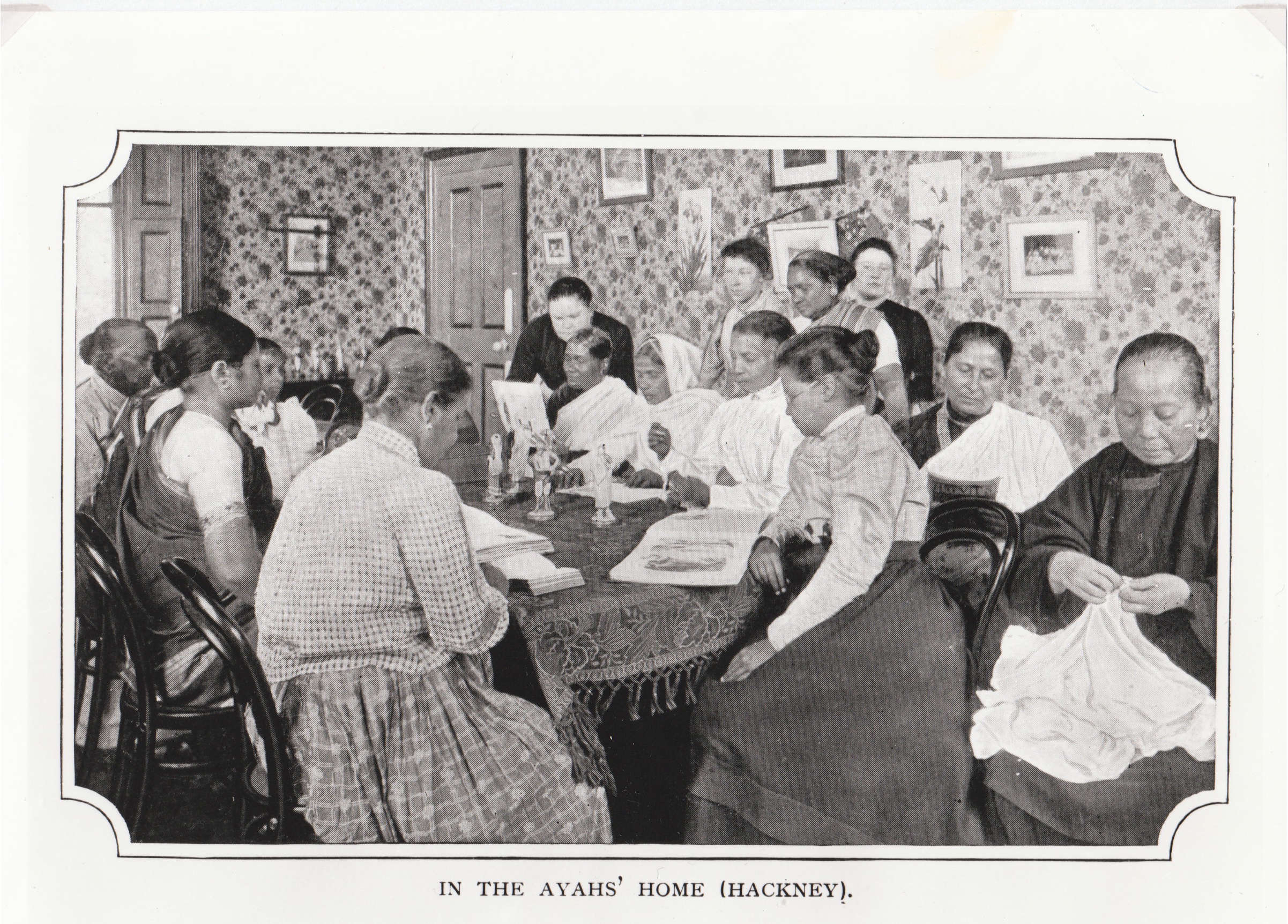
The Ayahs of London

How many of us have read and/or watched either The Secret Garden or A Little Princess? Both are about young British girls who grew up in India and were brought back to England/the United States.
In one scene where she's told to get dressed, Mary Lennox admits she's never done it herself since her ayah always dressed her. As a kid, I kinda picked up that an ayah was a servant, but I didn't understand that ayahs were Indian nursemaids. I'm not entirely sure what happened to Mary's ayah, but I'm assuming that she either died in the same epidemic as Mary's parents, or she decided to stay in India.

Sara Crewe most likely had an ayah as well (I don't remember any mention of one), but since she was headed off to boarding school, she didn't need one.

In both of these instances, their families didn't bring their ayah back to England with them, but it was surprisingly common for British families to bring their servants, especially ayahs, with them. "As travelling nannies [ayahs] formed the most valuable adjunct to the whole life style of the Raj between Britain and India. Essential for the memsahib's [an upper-class white woman] household in India, they were considered indispensable for the long voyage home -- either the trusted family ayah or an experienced travelling ayah. Once on board, the ayah took complete charge of the children, the baggage, and the memsahib. Good ayahs were not only meant to be clean, honest and trustworthy with children, but capable as nurses and excellent sailors too." (Visram p 29)

Unfortunately, many of the ayahs were abandoned once the family reached England. Left without money, resources, and frequently with little English-language skills, these ayahs would try to find new employment either in England or on a return trip back to India. Theoretically, their previous employers had already paid for their return tickets when they paid a small fee to bring them in the first place, but often the ayahs didn't have access to that ticket or the money from the fee.

While waiting, they would live in "squalid lodging houses" that were overcrowded and sparsely furnished. Records show that it wasn't uncommon for a lodging home to have anywhere from 20 to 60 women living in the same home at the same time. And these were the ones fortunate enough to pay the 16 shillings/week's rent. Others had to resort to begging.

There were several half-hearted (and a smattering of more sincere) attempts throughout the mid-19th century by various societies and the East India Company to improve conditions for these ayahs.

One such effort was the Ayahs' Home in London. It's unclear exactly when the Ayahs'  Home started (one record indicates it was as early as 1825) but there definitely was one established in 1891 at 6 Jewry St, Aldgate in East London. Initially the Home was run by a committee of volunteer women. In 1900, the London City Mission took over and moved the Home to King Edward's Road. Its mission remained the same: to provide refuge and find return employment for abandoned Indian ayahs and Chinese amahs.

The Home would usually receive the return tickets from employers who no longer wanted to employ their ayah and then sell the tickets to families looking to hire an ayah for trips back to India. They would then use the funds from the sale to pay for the ayahs' room and board until they returned. Of course, when the London City Mission took over running the Home, they used it as an opportunity to convert the ayahs to Christianity. While it wasn't an ideal solution, it was more effective than most to help these women.

Sources:
Ayahs, Lascars, and Princes: The Story of Indians in Britain 1700-1947 by Rozina Visram
https://www.thefridaytimes.com/ayahs-home-london-1921/
https://en.wikipedia.org/wiki/Ayahs%27_Home
http://www.open.ac.uk/researchprojects/makingbritain/content/ayahs-home
https://www.ourmigrationstory.org.uk/oms/a-home-for-the-ayahs-https://www.bl.uk/learning/timeline/item124195.html
https://www.andrewwhitehead.net/blog/the-ayahs-home-in-hackney
https://www.ststworld.com/ayahs-home-in-london-where-abandoned-indian-nannies-were-sent-to-live-out-the-rest-of-their-days/

Wednesday, April 17, 2019

Bugs and Worms in Colonial Households


Housewives in Colonial America had to endure the same challenges that modern families face, but their methods for dealing with vermin were very different, indeed. There were no supermarkets stocked with traps and repellent in those days, so homemade solutions were the only option.

Any parent can relate to the dread of a bedbug infestation. So how did our ancestors tackle the problem? Homemakers would begin by distilling wine and mixing the result with turpentine and dried henna. This concoction would be spread around the entire room where an infestation is suspected, including the lacing on the beds and the folds of the curtains. The mixture, it is claimed, would not harm nor stain the finest silk or damask.

Any home that has suffered the invasion of other crawling bugs could be treated with a mixture of wormwood and mustard seed. A solution was created by bruising the wormwood leaves and boiling the two ingredients in water for fifteen minutes before adding salt.
House flies could be eliminated by steeping hellebore flower in cow’s milk and sprinkling the liquid around the home.

The destruction of clothing from and moths and worms was prevented by drying the herb botris and sprinkling the dust upon all garments.

But what if worms invade the children? A toxic mix of red seaweed, mercuric sulfide, ground savine, and saffron was said to do the trick. Sadly, the mixture was likely as damaging to the children as it was to the worms.

 Some of the information was adapted from The British jewel; or, Complete housewife's best companion, London, Printed and sold by J. Miller, 1769.

Wednesday, July 19, 2017

18th Century Herbal Remedies by Katherine Bone!


Katherine, here to talk about some research I've been doing on herbal remedies. Throughout time, herbs have made the difference between life and death on the battlefield and in every day living before the age of antibiotics. It’s hard to believe that people in previous centuries died from simple ailments like colds, fevers, and sinus infections, all minor inconveniences we take for granted every day.

Several of the characters in my historical romance books have needed treatment from medical professionals. (I shiver thinking about a diagnosis which led to bleeding or the application of leeches when we know today that blood cells increased the ability to fight off disease.) Thankfully, medicine has come a long way during the 20th Century, and strides are being made in the 21st Century on a day-to-day basis. But since my books take place during the Napoleonic Wars, 1795-1815, my characters are limited to what was available to them at the time.

Here are just a few herbs I’ve discovered in my research, and their medicinal properties:

Adder’s Tongue: Well-known by country folk. Fresh leaves bring down swelling and limit inflammation. When gathered with morning dew, the leaves can be set in a room filled with fleas. Fleas are drawn to leaf and can then be cast out. Found growing in April and May. Seeds ripened in September.

Archangel/Dead Needle: Heals ulcers and fresh wounds and keeps them from spreading. Helps draw out splinters and soothes burns. Bruise herb with salt, vinegar and hog’s grease. Found almost everywhere, but prefers wet ground.

Bifoil: Sweet herb used for wounds, new and old. Found in woods and copses.

Bird’s Foot: Small herb that cures ruptures. Ingest as a drink or apply to surface. Good when ingested to break up kidney stones. Best used as ointment or plaster on wounds. Found on heaths and untilled land.

Blessed Thistle/Carduus Benedictus: Cures sores, boils, and itch. Drink concoction.

Borage and Bugloss: Well-known to gardeners. Leaves and roots used in fevers to defend the heart and expel poison or venom. Juice is made into a syrup and is used with other cooling, opening, cleansing herbs to open obstructions and cure yellow jaundice, and mixed with fumitory, to cool, cleanse and temper the blood. Found in the wild and grows plentifully near London between Rotherhithe and Deptford by the ditch.

Colewart/Herb Bonnet: Wholesome herb. Good for chest or breast disease, pains, stitches in the side, and expels crude and raw humors from the stomach. Congeals blood resulting from falls and/or bruises. Good for healing wounds. Roots are boiled in wine and imbibed. The herb is also good for washing and bathing wounds to remove infection. Found in the wild, under hedges, and pathways in shadowy fields.

Devil’s Bit: Grows two feet high with narrow, smooth, dark green leaves. Herb or root is boiled in wine and ingested for plague, disease and fever, and poison. Add honey of roses for swelling. Eases a woman’s pain during menses, helps resolves gassy issues, and expels worms. Found in wild dry meadows and fields about Appledore, near Rye, in Kent.

Elecampane Root: Dried root made into powder and mixed with sugar is good for kidney stones, bladder issues, and stopping woman’s courses. Boil root in vinegar, beat afterward, and then make an ointment with hog’s suet or oil of trotters for scabs and itching. Heals putrid sores. Found in shadowy, moist ground in dry open borders and fields. Flowers end of June-July. Seeds ripe in August.

Foxglove: Used by Italians to heal wounds. Bruise leaves and bind wound. Juice used to cleanse sores. Combine sugar or honey to purse/cleanse body, and tough phlegm and to open liver and spleen. Found growing on dry sandy soil. Flowers July. Seed ripe in August.

One Blade Root: Half a drachm/powder of roots. Add to wine or vinegar. Good for poison and infection. Make a compound balsam for wounds and burns.

White Briony Root/Tetter Berries: Wild, rampant in hedges. Leaves, fruit, and root, cleanse old sores, and combat running cankers, gangrenes, and tetters (Called Tetter Berries by country folk) Use powder of dry root. Apply to skin of broken bones, foul scars, scabs, mange, and gangrene.

Wood Betony: Bruise the green herb and apply to wound, or make a juice and ingest. Good for any wound in the head or body. It will heal and close up veins or cuts, and mend splinted broken bones. Found in the woods and shady places.

Or if you’re Cornish, you might prefer to try these remedies:

Mundic ore: Miners applied Mundic to a cut and always washed an injury in water that ran through mundic ore.

Chamomile: Dry flowers and make into a tea to cure an upset stomach.

Mustard: Boil mustard with a pint of beer to cure rheumatism.

Dock Leaf: Rub dock leaf over the stings of nettles.  

Boosening: The cure for madness is to immerse a person in water to the point of drowning, and then repeat.

I pray we never have to resort to picking herbs to combat disease and discomforting ailments. But if we do, I’d like to have these herbs in my garden. Wouldn’t you?

Resources:


Culpeper’s Complete Herbal by Nicholas Culpeper


Are there any herbal remedies you’d like to add?


Friday, October 28, 2016

Princesses: The Six Daughters of George III


©Cheryl Bolen

In the century and half since the last princess died, no one has ever before had the fortitude to chronicle the lives of the six daughters of George III (1738-1820) and his wife Charlotte of Mecklenburg-Strelitz (1744-1818). Until Flora Fraser.

Fraser is the author of the 2006 book, Princesses: The Six Daughters of George III.

One of England’s premier biographers of the late Georgian era, Fraser (Beloved Emma) first became acquainted with the princesses when doing archival research for her biography (Unruly Queen) of their sister-in-law, the Prince Regent’s wife, Princess Caroline.

"Given other circumstances, the letters of these six royal sisters might have been filled only with Court gossip, pomp and fashion," Fraser writes. "Instead their correspondence makes harrowing reading, revealing the humility with which they met pain and horror, the tenacity with which they pursued their individual dreams, and the stratagems they devised to endure years of submission and indignity."

The circumstances which catapulted their lives onto a sorrowful trajectory, of course, were the intermittent bouts of the king’s insanity which commenced a nine-year regency after he was declared incompetent to rule.

His first occurrence of the illness was in 1788; it was another 23 years before the regency became official. Sadly, it was during those years the princesses came of age, only to be denied the opportunities for gaiety and marriage. The king’s illness turned a concerned mother into a domineering tyrant who deprived the princesses of any hopes for happiness.

During those years, the princesses were forced to forgo personal pleasures or aspirations for matrimony for fear it would incite another relapse in the father who was so excessively fond of his daughters.

To a one, all the princesses wished to marry, to have their own homes, to have children. Most of them would be denied these simple pleasures.

The king himself said in 1805 — when the Princess Royal was 39 and the youngest princess, Amelia, 22 — "I cannot deny that I have never wished to see any of them marry: I am happy in their company, and do not in the least want a separation."

When he spoke those words, "Royal," as the eldest sister was always called, was the only sister to have married. Her father had refused many offers for her hand, a fact that embittered her. She finally succeeded in marrying a widow, the Hereditary Prince of Wuttemberg, when she was thirty.

She was thrilled to escape "The Nunnery," a title the princesses themselves dubbed their residences at Kew Palace and Windsor Castle. She never regretted the decision to marry. While she never bore a live child, she was an indulgent mother and grandmother to her step-children and may have been the happiest of the sisters.

None of the sisters would ever become a mother, though the fourth princess, Sophia (1777-1848), gave birth secretly to an illegitimate child sired by her father’s equerry, who was more than thirty years older than she. She never married.

Amelia died of tuberculosis at the age of twenty-seven, which many think contributed to her father’s final fall into hopeless insanity. Even on her deathbed, her family would not allow Amelia to marry the young officer she had been in love with for eight years.

Her sister, Princess Augusta (1768-1840), also fell in love with a military man, Gen. Sir Brent Spencer. When she was 43 she wrote a letter to the regent that begged to be allowed to marry the man who had shared her "mutual affection" for twelve years. Request refused, she died a spinster.

Princess Mary had more luck. She demanded the regent allow her to wed her cousin, the Duke of Gloucester, whose father was her father’s brother. The regent reluctantly agreed. At age forty, she finally married. While it is doubtful she was in love with her husband, she relished the first liberty she had ever tasted.

The sister who had most wanted to marry and had dreamed of bearing a child, Princess Elizabeth, finally was granted one of her wishes. At age forty-eight and well past child-bearing years, she married the Landgrave of Hesse-Homburg and had a happy marriage for eleven years.

Fraser’s research is meticulous, right down to the names of the royal wet nurses and the salary paid to them. Almost all of the research is original, delving into letters in collections, archives, and libraries across the globe, a feat that had to have taken several years.

For the casual reader, there are a few problems. First, it is difficult to chronicle six lives at once chronologically. We get a snippet of one sister, but the narrative thread drops while there is an awkward transition to another sister because of chronological constraints. Therefore, the book makes for dry reading and lacks dramatic structure.

For the historian, this work is a gem.—Cheryl Bolen’s Christmas novella, ExSpinster by Christmas, releases on Nov. 15.


http://kindlel.ink/Ex-Spinster

 
http://nookl.ink/Ex-Spinster


Friday, January 9, 2015

Dealing with Servants


     "What wretches are ordinary servants that go on in the same vulgar Track ev'ry day! Eating, working and sleeping! But we, who have the Honour to serve the Nobility, are of another Species. We are above the common Forms, have Servants to wait upon us, and are as lazy and luxurious as our Masters."
     So is quoted a duke's servants in James Townley's 1775 High Life Below Stairs. The English class system extended through the upper ranks and well into lower orders, with its own complications of hierarchy. But even as the industrial revolution broke down class system by creating a new class of rich merchants, the upper class required their servants. And the larger the house and estate, the more staff required for its maintenance.
     In the country, an estate needed the following, in order of their own precedent:
     -A land steward to manage the estate, collect rents and settle disputes between tenants.
     -A house steward or housekeeper to supervise indoor staff for two hundred pounds a year, and some houses might have both a house steward and a housekeeper who served under him.
     -A valet for the master of the house, and a lady's maid for the lady of the house, whose wages might be anything from twenty to two hundred, depending on if they were in demand in London, or stuck in the countryside without opportunity.
A master of horse or stable clerk to supervise the stables, including livery servants who worked outdoors, coachmen and stable lads, for around sixty pounds a year in salary.
A butler, a cook, a head gardener, who earned twenty to forty pounds year.  This might include a wine-butler, and also a porter or major domino who supervised the comings and goings at the house, and a groom of chambers, who looked after the furniture in the house.


     In the lower male ranks came other coachmen, footmen, running footmen, grooms, under-butlers, under-coachmen, park-keepers, game-keepers, yard boys, hall boys, footboys. In the lower female servant ranks came nannies, chambermaids, laundry maids, dairy maids, maids-of-all-work, scullery maids. In town such staff might earn as much as ten to twenty pounds a year, with men being paid more. In the country, salaries were half that or even less.
     In the no-mans land between servant and master existed those creatures who might be of upper or lower class, but who did not quite fit into either, the governess, tutor and dancing master.
     A large estate might require as many as fifty indoor servants, and twice that or more in outside labor to deal with the estate's lawns, animals, produce, beer-making, dairy and so on. An estate acted very much like its own village, with squabbles between servants, gossip, flirtations, jealousies, and structure. All of which had changed little from feudal times.
     However, the world was changing. New factories, new roads and lower costs of transportation make even the servant class more mobile. And keeping a good staff began to be an issue.

     To hire staff, the lady of the house--or the housekeeper or house steward--might advertise in The London Times or the Morning Post. The custom of 'Mop Fairs' where servants might parade and find new positions also existed through the 1700's and into the 1800's.  "Females of the domestic kind are distinguished by their aprons, vs. cooks in coloured, nursery maids in white linen and chamber and waiting maids in lawn or cambric," writes Samuel Curwen of such a fair at Waltham Abbey in 1782. Such a fair included strolling, stalls, and full public houses, with a good bit of drinking. It was for many servants a holiday.
     Dress very much told of a person's status, both as in the world upstairs and below. The upper servants dressed in livery and uniforms provided by the house, while lower servant were expected to wear plain and ordinary.
     The cost to hire, feed, and dress an extensive staff could be considerable. Wages tended to be higher as well in a richer house. And servants could expect to be left tips--or vails--by visiting guests. A vail might be as much as a month's wages left by a departing guest, the amount determined by the status of the guest and the rank of the servant.
While a cook might earn fourteen to twenty pounds, in a rich house, this might be as much as forty to fifty pounds a year. Or, if in demand and talented, a chef might earn more, as did the Earl of Sefton's chef, Ude, who made three hundred guineas a year.
     On 400 pounds a year, a family might expect to afford two maids, one horse and one groom. Not in Front of the Servants reports that, "Between 1776 and 1802 the Reverend James Woodforde found that on three hundred pounds a year it was possible to have the following staff: a farming man, who also helped about the house on occasion, a footman, a yard boy, an upper maid (who did the cooking) and an undermaid."
     On 1,000 pounds a year income, that family could then keep three female servants, a coachman, a footman, two carriages, and a pair of horses. It took around 5,000 a year--the income of most wealthy gentry--to keep thirteen male servants, nine female staff, ten horses and four carriages.
     Coupled with the expense of a staff came its management. While on many country estates, servants came from the local lower orders and might well be born on the estate and look to live and die there, in town servants looked for opportunities to advance. Servants in town could register with agencies, but they would need to bring with them good references.
     However, as noted by a Portuguese visitor to England in 1808, "servants 'are not to be corrected, or even spoken to, but they immediately threaten to leave their service.'"
     As with any group, problems arose. Servants gossiped, stole from the pantry and even from a careless master's closet, and then there was the issue of upper class males and lower class females.
     "If you are in a great family, and my lady's woman, my lord may probably like you, although you are not half so handsome as his own lady." So wrote Jonathan Swift in his Directions to Servants in 1745. He went on to advise that any lady's made at least make certain that she is paid for "the smallest liberty." The attitude prevailed well into Victorian times that the maids of a house provided opportunity for gentlemen, for such girls were beyond any thought of marriage. Such activities came to be frowned upon rather than winked at, but continued. A very few gentlemen took the shocking step to marry their housekeeper, but such alliances meant ostracism from society for such couples. And servants themselves were shocked by such a mixing of class for they often could be even greater snobs than were their upper class masters.
--------------

Shannon Donnelly’s writing has won numerous awards, including a RITA nomination for Best Regency, the Grand Prize in the "Minute Maid Sensational Romance Writer" contest, judged by Nora Roberts, RWA's Golden Heart, and others. Her writing has repeatedly earned 4½ Star Top Pick reviews from Romantic Times magazine, as well as praise from Booklist and other reviewers, who note: "simply superb"..."wonderfully uplifting"....and "beautifully written." She is also the author of the Mackenzie Solomon, Demon/Warders Urban Fantasy series, Burn Baby Burn and Riding in on a Burning Tire. She is currently working on her next Regency romance, Lady Chance.