Search This Blog

Showing posts with label Christmas customs. Show all posts

Thursday, December 9, 2021

Traditional Victorian Christmas Dishes by Jenna Jaxon

One of my favorite Christmas movies is the 1970 musical Scrooge with Albert Finney. The production values of the film are wonderful—as you watch it you truly feel transported into the Victorian London of Charles Dickens. In one sequence Bob Cratchit is heading home, buying Christmas presents, food and drink for the family’s Christmas celebration the following Christmas Day. 

That journey has always fascinated me and made me think about how and what the Victorians ate at Christmas. Depending on class and location, Christmas food traditions varied quite a bit, although there is also a lot of agreement on what should be eaten
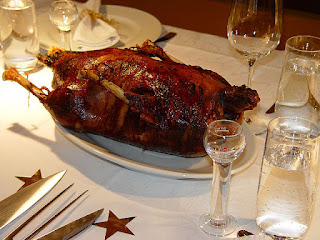
for the holiday feast, generally the most meal extravagant of the year. The centerpiece was usually either a standing rib of beef with Yorkshire pudding in the households of the North, while the roasted goose with sage and onion stuffing graced the tables of the South.


Another tradition was to serve a rum punch, apparently a favorite Christmastide ritual for Charles Dickens. The making of the punch was quite a production, and Dickens would explain each step to his guests as they watched the punch being concocted. The drink is made in a large fire-proof punch bowl, where you combine lemon peel and sugar, dark rum and cognac, stir well, then take a spoonful of the mixture and light it on fire and return to the punch bowl to set it alight. Dickens would then lift out fiery lemon peels for the guests to admire. Afterwards, the flames are extinguished by a metal tray placed over the punch bowl. Nutmeg was then grated over the punch and ladled out to the guests. 
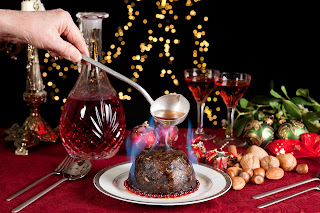
And last but not least was the Christmas or Plum pudding. Traditionally, this pudding was begun on the Sunday before the beginning of Advent, called Stir-up Sunday. If the household was to have good luck, the Christmas pudding must be begun on this day and left to ripen until Christmas Day. God’s blessing would only be bestowed on those who started their puddings on this day. For good fortune, the entire household should help with stirring the pudding with a wooden spoon and only clockwise and only East to West to honor the journey of the three kings. Once all the ingredients are assembled—raisins, currants, sultanas, dates, citrus peel, almonds, spices, cake crumb or breadcrumbs, brown sugar, butter, brandy or tum, and stout—the pudding is boiled or steamed for six hours, then removed from the pudding basin and wrapped with foil and a pudding cloth. It is then aged for about two months. On Christmas Day it is boiled for another four hours, then unmolded onto a platter. A ladle of brandy is heated then poured over the pudding and set alight for a dazzling desert.
There are many other traditional foods the Victorians ate at Christmas, but I thought these three would give a good idea of how the Victorian chose to celebrate the Season with fabulous food. 

I sincerely hope everyone has a warm and wonderful holiday season with your own special traditions and food. 

Sources: 

Burns-Booth, Karen. “Stir-Up Sunday, Traditions and My Traditional Victorian Christmas Pudding             Recipe.” Lavender and Lovage: Food and Travel from Home and Abroad, November 24, 2012.

Graham, Colleen. “English Christmas Punch.” The Spruce Eats Newsletter. May 13, 2021. 

Wondrich, David. “Holiday Punch—Plus a Cozy Fire.” Esquire, December 11, 2012.

Wednesday, December 2, 2020

Celebrating a Regency Christmas by Jenna Jaxon

One of the problems of writing a Christmas story set in the Regency period is the fact that during about the early years of the nineteenth century, Christmas was celebrated almost not at all. Between 1811 and 1820 people seemed to not wish to commemorate the season very much at all. However, if one digs really deeply, you can find a few distinctive traditions that were observed during this most wonderful time of year.
The season itself was very different from our own, which now begins the day after Thanksgiving in the United States and is in full swing by December 1. In the Regency Christmastide began on Christmas Eve. This was the traditional day for going out into the woods (or to a shop in the city) to gather greenery to decorate the house with. Holly, rosemary, bay, laurel, and mistletoe were the traditional fresh greens brought in and either hung up (as in mistletoe) or draped around windows or mantlepieces. Mistletoe, then as now, was hung up all over the house waiting for couples to meet and kiss underneath it. The tradition was for each kiss, one of the white balls was plucked from the mistletoe ball. When no balls remained, that particular bough was finished. The Christmas tree, sadly, did not come into being until the Victorian age. One practice that most sources agree on was that it was a time for families to gather together with neighbors and friends. There
are many references to a big dinner on Christmas day that one either held in one’s home or was invited to dine with another family. The dinner was filled with rich meats like roast beef, venison, goose, pheasant, and swan or peacock. Bread based stuffing and vegetables such as potatoes, squash, and carrots rounded out the meal. The Christmas pie (mincemeat) and Christmas pudding were staples of the dinner as well. Charity was another tradition during the season. Those more fortunate were sure to celebrate it by sharing with those less fortunate. Gifts of food and drink and money were given to the poor. Wassailers and mummers paraded through towns performing songs or skits in exchange for foodstuffs and money. The day could also end with parlor games such as charades, blindman’s bluff, any number of card games, and the infamous Snapdragon. For this last, raisins were soaked in brandy, then the dish was lit on fire and everyone had to grab a raisin and eat it without getting burned. Obviously, you do NOT want to try this at home!
The celebration continued through Epiphany or Twelfth Night, on which day all the greenery had to be taken out and burned to avoid bad luck throughout the year.
While writing six Regency Christmas tales, I’ve incorporated quite a few of these traditions including bringing in the greenery, parlor games, Christmas dinner, and of course, kissing under the mistletoe. My current release, It Happened Under the Mistletoe and other Yuletide Tales, contains five Christmas novellas in which mistletoe is prominently featured. The anthology is available on Amazon and Smashwords for just .99, a Christmas gift from me to you. Here’s wishing everyone a very happy holiday season! Sources: Beverley, Jo. Christmas Traditions in the Regency. Hoppe, Michelle J. The Regency Christmas Feast, 1999. Rowland, Jane. Regency Christmas Games. Austen Authors, December 12, 2018.

Friday, December 7, 2018

Those Wassailing Wastrels! - 12th Night Traditions

Wassailing Engraving


Here we come a-wassailing
Among the leaves so green;
Here we come a-wand'ring
So fair to be seen.

There is nothing sinister in those words, one would think. For most people, this is a quaint, old-fashioned Christmas carol with lyrics that most people don't understand. In some places, "wassailing" has been changed to "Christmas-ing" or "singing" or "caroling." Changing that one word actually make the song make even less sense, believe-it-or-not. 

The word "wassail" is an ancient word, though there is some disagreement about where it began, we can find mention of it as far back as the 1300's. It started out as a word of greeting - a salutation of health, especially used when people were in their cups (or wanted to be). According to Historic-UK.com, "Anglo-Saxon tradition dictated that at the beginning of each year, the lord of the manor would greet the assembled multitude with the toast waes hael." 

You can even find the word mentioned in Shakespeare's Hamlet, when the depressed prince is muttering about the king. "The king doth wake to-night, and takes his rouse,/Keeps wassail, and the swaggering up-spring reels..." (Act I, Scene IV)

Later, in about the 1700's in England, wassailing meant a specific activity: caroling house to house and begging for food, money, or entertainment. 

Wassailing could get rough, likely depending on the culture of the neighborhood and the sort of group one got together for the event. Modern evidence has found that young men might get together and carouse, more than carol. 

From the above carol, here's another verse: 

Bring us out a table
And spread it with a cloth;
Bring us out a mouldy cheese,And some of your Christmas loaf


And who can forget the carol with the lines, "O bring us a figgy pudding" and "we won't go until we get some." Yes, wassailers could come demanding what they thought their due - more alcohol, coins, and food. If they didn't get what they wanted, some groups were noted to resort to vandalism of the house that would not provide. But that brings us to this part of our song:

We are not daily beggars
That beg from door to door;
But we are neighbours' children,
Whom you have seen before.

On the whole, though, wassailing was a tradition wherein the poor of the neighborhood could come together and ask, in a socially acceptable manner, for a hand-out. In return, they would leave their blessing upon the house that offered charity. 

The refrain from our song: 

Love and joy come to you,
And to you your wassail too;
And God bless you and send you a Happy New Year
And God send you a Happy New Year.

Generally speaking, people would go "wassailing" usually on Twelfth Night. We could write several articles alone on the traditions surrounding that portion of the Christmas holiday season. 

Sometimes in the middle of the 19th century, wassailing and caroling merged. They were two separate events, one meant to edify the listeners and the other meant as a way to go about begging. In North America, however, it's not uncommon to offer carolers a special treat when they grace your doorstep. 

It's an interesting tradition, and while singing Christmas songs and hymns at the doors of our neighbors has been going on for several centuries, there was some fear that the tradition would die out - in 1822 a gentleman named William Hone wrote: "Carols begin to be spoken of as not belonging to this century and yet no one, that I am aware of, has attempted a collection of these fugitives." Hone printed a list of 89 carols, but neglected to include lyrics or music. Many of those carols are now lost to time. 

If you find yourself curious about the wassail songs of old, many are listed (with links for listening) on Hymns and Carols of Christmas. Link below.

So next time you hear carolers, be friendly and warm, appreciate their music, and be grateful you didn't live in an age when a wassail meant feeding a crowd of people in order to avoid having your house and kitchen ransacked. :-)

Sources:
Historic UK: Wassailing
Etymology Online
Hymns and Carols of Christmas
Kentucky New Era
Wikipedia Article with Great Sources
Wikipedia on Twelfth Night
Recipe for Wassail (Yup, it was a special drink too.)


Sally Britton is the author of six historical romance titles, set in the Regency time period. All six can be found on her author page at Amazon.com. Sally regularly discusses writing, research, and her work on her Facebook reader group - and all are welcome to join.

Wednesday, December 5, 2018

The Victorian Christmas

One thing I have bemoaned time and again is the lack of Christmas traditions in Regency England. During the Regency Christmas celebrations were usually quiet family affairs that included going to church on Christmas Day, some greenery for decorations (including mistletoe but not a tree), a Yule log, and perhaps a present or two for children.

Once Queen Victoria ascended the throne, however, Christmas began to be much more merry and bright.

One of the first traditions to emerge that continues until today, is the Christmas card. This tradition was begun by Sir Henry Cole, an assistant at the newly founded Public Record Office (Post Office). He had an artist friend create cards, advertised as “Christmas Congratulations Cards” that sold for a shilling each. The cards could be sent for a penny and by the 1860s were cheap enough for most people of the middle class to send.

Victoria and Albert began another wonderful custom—the Christmas tree. A German tradition brought to England by George III’s wife, Queen Charlotte, the Christmas tree didn’t catch on until Victoria’s consort, Prince Albert (also German) began celebrating the yuletide with a
decorated tree. When the Illustrated London News published an engraving of Victoria and Albert and their children gathered around a Christmas tree in 1848, the popularity of the Christmas tree rose sharply. Technological advances enhanced the tradition by providing hundreds of different types of sparkly ornaments to hang on the tree, along with homemade sweet treats, small presents, and candles.

Another near and dear Christmas tradition arose in t e 1860s: The Christmas cracker. These little tubes, stuffed with small trinkets and candies, made a resounding “bang” when pulled apart and quickly became a staple of the season.

The emphasis placed on family by the Victorians lead to the traditional Christmas dinner, with all the family gathered around the table. Food was the centerpiece of the Victorian Christmas dinner and included roast goose with sage and onion stuffing (in the South), standing rib of beef (in the North), Yorkshire pudding, oysters, ham, turkey, potatoes, mince pies, plum pudding. The making and serving of the Plum Pudding was quite a ritual that began several days before Christmas and culminated with the cooking, cutting, and eating of it.
After dinner people continued to celebrate with presents, singing, shooting off firecrackers, and playing games.

All in all a much merrier time was had by all during the Victorian period.

Merry Christmas to all! God bless us, everyone!

References:
“The History of Christmas Cards.”
“Victorian Christmas Traditions,” from Christmas at the V & A.
“Common Victorian Times Christmas Food: roasted goose and pudding.” The Victorian Era Facts about Queen Victoria, Society and Literature. Victorian Era Organization.

Friday, December 8, 2017

English Christmas Ghosts and Winter Tales

by Donna Hatch
www.donnahatch.com

An odd Christmas custom that dates back centuries is telling scary ghost stories. Have you noticed in the popular Christmas Song, "The Most Wonderful Time of the Year" the verse that says: "Tales of the glories and scary ghost stories of Christmases long, long ago" and wondered over it?

Telling ghost stories is an age-old tradition that many claim cropped up in the Victorian Era, including the traditional Christmas story, A Christmas Carol. However, this custom dates farther back than that.

Washington Irving penned a novel in 1819 called  The Sketch Book of Geoffrey Crayon, Gent. The hero in the story visits friends in an English country house during Christmas season in a section entitled Old Christmas. While visiting Bracebridge Hall, our hero basks in the hospitality of the squire and a traditional English Christmas, which includes telling scary "winter tales." Winter tales have long included tales of ghosts, witches, monsters, and other creatures of darkness.

In A Natural History of Ghosts: 500 Years of Hunting for Proof the author, Roger Clarke, tells of a popular story claiming that shepherds saw ghostly civil war soldiers battling in the skies just before Christmas 1642.


Even earlier,  the Bard, William Shakespeare penned a collection of scary stories entitled Winter Tales." This romance weaves a tale of tangled identities and apparent death and revival. This suggests that telling weird or bizarre stories whilst gathered around a winter's evening fire was a wide-spread tradition long before the Bard's time.

A predecessor of Shakespeare, Christopher Marlowe wrote a play entitled The Jew of Malta  in 1589 in which a character Barnabus states:

Now I remember those old women's words,
Who in my wealth would tell me winter's tales,
And speak of spirits and ghosts that glide by night


Since traditions such as this have roots in pagan practices dating back to medieval times, I assume winter tales including ghost stories have been a Christmas tradition since the days of cloak and dagger. But at the very least, the practice of telling ghost stories at Christmas has been in practice since the 1500s.

However, I’m happy that telling ghost stories, except for watching the movie or reading the book, A Christmas Carol, is no longer a major part of American Christmas customs. Can you imagine getting a child to bed who is both excited about presents and frightened of ghosts? Now that is scary!

Still, this practice of telling ghost stories is a plot point that works well for my Christmas novel, A Christmas Secret.

Holly has two Christmas wishes this year; to finally earn her mother’s approval by gaining the notice of a handsome earl with an impeccable reputation, and learn the identity of the stranger who gave her a heart-shattering kiss…even if that stranger is the resident Christmas ghost.

Christmas Secrets released November 9, 2017 and you can download it and read it instantly here
 on Kindle!


Sources:
http://www.hypnogoria.com/html/ghoststoriesforchristmas.html

https://www.deseretnews.com/article/705363363/Telling-ghost-stories-is-a-lost-tradition-on-Christmas-Eve.html

https://www.theguardian.com/books/2013/dec/23/ghost-stories-victorians-spookily-good

http://theconversation.com/why-ghosts-haunt-england-at-christmas-but-steer-clear-of-america-34629

https://www.gothichorrorstories.com/classic-gothic-ghost-stories/christmas-ghost-stories-the-ghost-of-christmas-past-goes-further-back-than-you-might-realize-2/

Friday, December 4, 2015

Kissing Under the Mistletoe

Mistletoe
by Donna Hatch

The fun holiday tradition of kissing under the mistletoe evolved over time, and like most holiday customs, has pagan origins. Ancient Celtic druids saw the mistletoe blooming even in the middle of winter and thought it contained magical properties of vitality. Some sources claim they thought the mistletoe was the spirit of the tree showing signs of life while the rest of the tree remained dormant and dead-looking. They completely missed that it is a parasite living off of trees. Since they thought it had such amazing powers, they used it as a place to conduct fertility rituals, and later as a gathering place to negotiate peace between hostile parties. Husbands and wives made up under the mistletoe as a way of sealing their renewed love and commitment to peace within the marriage.

Eventually, people moved sprigs of the plant inside. In some locales of Europe and Great Britain, guests kissed the hand of their host under a sprig of mistletoe as they arrived. Later, the working classes and poor classes developed a custom of a maiden standing under the mistletoe, waiting for a kiss from a young man. They were expected to marry her within a year. English maidservants willing to accept a kiss from a gentleman in exchange for money stood underneath the mistletoe indicating her willingness. The practice of kissing under the mistletoe worked its way up to the upper classes, becoming more of a parlor game or an excuse for behavior not normally condoned among unmarried ladies and gentleman.

Today the custom of kissing under the mistletoe exists in most of  Europe, Canada and America. 

Holly
Mistletoe is sometimes mistaken with holly but they are very different. Mistletoe (pictured above) has soft, pale green smooth leaves and white berries; holly (pictured to the right) has bright green ragged-edged leaves and red berries.

In my newest Regency Romance, The Suspect's Daughter, my bold and determined heroine does not need the help of mistletoe to kiss the elusive man of her dreams.

The Suspect's Daughter, book 4 of the award-winning Rogue Hearts Series:

Determined to help her father with his political career, Jocelyn sets aside dreams of love. When she meets the handsome and mysterious Grant Amesbury, her dreams of true love reawaken. But his secrets put her family in peril.

Grant goes undercover to capture conspirators avowed to murder the prime minister, but his only suspect is the father of a courageous lady who is growing increasingly hard to ignore. He can’t allow Jocelyn to distract him from the case, nor will he taint her with his war-darkened soul. She seems to see past the barriers surrounding his heart, which makes her all the more dangerous to his vow of remaining forever alone.


Jocelyn will do anything to clear her father’s name, even if that means working with Grant. Time is running out. The future of England hangs in the balance...and so does their love.

The Suspect's Daughter is available  now on Amazon

Sources for Mistletoe post:


Friday, December 19, 2014

The Origin of Hanging Stockings at Christmas

The origin of hanging stockings by the fire for Santa Claus, or St. Nicholas, to fill is difficult to pinpoint. Like so many traditions, the true origin can be traced back to more than one source, all based on folklore and legend with so many variations, we may never know how it all really started. But there are some fun stories.

Possibly as far back as the Third Century A.D., there was a happy family whose father was either a nobleman or a merchant, depending on who tells the story. Anyway, the mother of this family died, leaving the father so distraught that he absentmindedly made some poor investments which ultimately led to the family's ruin. The family had to leave their comfortable home and move to a humble cottage where his three daughters (have you noticed three seems to be a preferred number for stories?) took over all the cooking, cleaning, laundry, and other household chores. The father worried his daughters would never marry well without a dowry to offer a new husband. This painted a bleak picture of their futures.

Into this sad tales steps a kindly bishop named Nicholas. He had a particular sympathy for the downtrodden and a pure love toward children. Nicholas had been traveling, teaching people about God and bringing hope, and sometimes gifts of food or money, to those who needed them. Nicholas stumbled upon the plight of this man and his daughters and was moved by compassion. According to some accounts, Nicholas waited until the family slept, slipped down the chimney, and placed a bag of coins on the fireplace mantle. As Nicholas climbed back up the chimney, the bag of coins tipped over, rolled off the mantle and fell into one of the stockings that the daughters had left along with other laundry drying by the fireplace. In the morning, when the family arose, they found the bag of coins. They rejoiced, for now they had enough money for the eldest daughter's dowry. She promised to marry a good man and take care of her father in his old age.

Duringt this time, Nicholas covertly peeked into the window. When he saw the joy and hope he'd brought to the family, he returned the following night, bringing another bag of coins. This second bag of coins provided a dowry for the second daughter.

The third night, the father, suspecting their unknown benefactor would return again, waited up for him. When Nicholas arrived with the third bag of coins, the father fell down at the feet of the bishop and thanked him for his generosity. This bishop later became sainted for this and many other acts of charity. We know him today as Saint Nicholas.

Some accounts say Nicholas came in through the door instead of down the chimney; others say he tossed the coins in through the window, either with accurate enough aim for the coins to land in one of the hanging stockings, or with bad enough aim that they fell off the mantle, which was his original target, and into a stocking. The stories also vary in that some claim he visited the family only once and others that he came three times. It is also suggested that the bag of coins was actually a large golden ball. This may have prompted the custom of children getting oranges in their stockings, in remembrance of that golden ball, or perhaps of the ball-shaped bag of coins.

In Norse folklore, a god named Odin, who rode a mighty horse named Sleipnir, visited children's houses on Christmas Eve. If the children left their boots filled with hay, sugar, or carrots for Sleipnir, Odin left candy and gifts for the children to thank them.

The Dutch have a similar tradition. As far back as 16th Century Holland, Sinterklaas arrived by ship and rode a white horse (or a reindeer, again depending on who you believe). The children left a treat for him near the hearth and placed their shoes called clogs by the fireplace filled with hay and carrots for his horse (or reindeer). Sinterklaas left treats in the children's shoes.

Eventually, legends and customs merged, changing the custom of hanging stockings instead of boots or shoes.

In the famous poem " 'Twas the Night Before Christmas" the Christmas stocking is mentioned twice. Near the very beginning of the poem, it says, “The stockings were hung by the chimney with care” and, again, near the end: “He spoke not a word, but went straight to his work, And filled all the stockings then turned with a jerk."

So this Christmas, when you hang your stockings, spare a thought for a kindly bishop who helped those in need.

In my short Christmas story, there aren't stockings or gifts under a tree, but two lovers torn apart by war and heartache, get the best gift ever...a second chance.

A CHRISTMAS REUNION, the Gift of a Second Chance, pictured to the left, is available on Amazon, Barnes & Noble, The Wild Rose Press, and everywhere digital books are sold.

Or, if you're in the mood for a collection of short historical stories, all by different authors including yours truly, and which take place during the winter (some take place during Christmas), try A TIMELESS ROMANCE ANTHOLOGY: Winter Collection pictured to the right. In my short romantic tale,  A Winter’s Knight  a young lady’s fascination with a murdering earl and his dark castle lands her in the heart of an ancient and terrible  secret.  It  will  take  more  than a Christmas kiss underneath the mistletoe to break the curse and find a happily ever after.This collection is available in both print and ebook on Amazon.


Wednesday, December 8, 2010

Mistletoe--A Plant For All Seasons


Christmas wouldn't be Christmas without mistletoe. In the dark, cold days of a northern winter, the evergreen mistletoe, with its glossy green leaves and white berries, promises spring will return.

But mistletoe has other faces. In ancient Britain, the Druids considered mistletoe a sexual symbol. The white berries' juice resembles semen and the Druids deemed the plant itself an aphrodisiac. By extension, mistletoe became associated with love and marriage.

The tradition of kissing may come from the Nordic legend of the death of the sun god, Balder. Loki, the god of mischief, killed Balder with a sprig of mistletoe. The tears of Balder's mother, Frigga, returned Balder to life. In gratitude, Frigga kissed everyone under the mistletoe, transforming the plant's reputation from death to life. Or new life, as in fertility.

A lesser known aspect of mistletoe labels it the plant of peace. Enemies meeting under the mistletoe laid down their arms and declared a day of truce. This time provided them an opportunity to talk out their differences instead of resorting to violence. In Mistletoe Everywhere (buy link here), my Regency Christmas comedy, I use mistletoe's role as the plant of peace to bring my two estranged lovers back together.

Promise of spring, fertility symbol and plant of peace--truly a plant for all seasons. Which face of mistletoe do you prefer?

Thank you all,
Linda

Wednesday, December 23, 2009

Mistletoe


A Regency Christmas story wouldn't be complete without the hero and heroine celebrating their love with a kiss under the mistletoe. Long a symbol of fertility, mistletoe, with its glossy green leaves and white berries, has become a Christmas symbol of love and marriage.

Mistletoe is an evergreen, a spot of life in the brown, dormant landscape of a northern winter. At this low point of the year, Regency people decorated their houses with mistletoe, along with other seasonal greens such as Christmas rose (Hellebore), evergreen boughs, holly, ivy, hawthorn, laurel, rosemary, and bay, as a reminder that spring would return.

In England, mistletoe, which is a parasite, grows most often on apple trees, but also on blackthorn, hawthorn, lime, poplar, rowan and willow. Although its range extends from Devon to Yorkshire, the plant grows mainly to the south and west, and is particularly abundant around London.

Some of the myths surrounding mistletoe originated with the Druids, who deemed the plant a sexual symbol--the juice from the white berries resembles semen--and, by extension, an aphrodisiac. As part of their winter solstice ceremonies, they cut mistletoe from oak trees, providing a link to the later holiday of Christmas.

The origin of kissing under the mistletoe may derive from the Norse legend of the death of the sun god, Balder, killed by a sprig of mistletoe hurled by his enemy Loki. When Balder's mother, Frigga, the goddess of love, cried over her son, her tears resurrected him. In gratitude, she kissed everyone who came under the mistletoe.

A lesser known legend declares mistletoe the plant of peace. Enemies meeting under the mistletoe had to embrace and declare a truce until the next day. This goodwill and embrace may also be the source of the kiss under the mistletoe.

Regency people used mistletoe in the form of a kissing bough--a simple arrangement of mistletoe decorated with ribbons and hung over a doorway or entrance. The gentleman would kiss his lady and then pluck a white berry and present it to her, perhaps as a symbol of the child he could give her. When all the berries were gone, that sprig of mistletoe could no longer be used to steal kisses, although many people disregarded the berries' absence.

Now, for my latest news. The Wild Rose Press has just contracted my Regency Christmas novella, Mistletoe Everywhere, which incorporates the myth of enemies, in this case, the hero and heroine, declaring a truce under the mistletoe. Short blurb: A man who sees mistletoe everywhere is mad--or in love. More info here.

My Christmas present. Thank you, Wild Rose Press.

Merry Christmas and Happy New Year to all.

Linda