
Almost all Regency gentlemen gambled, drank, played hard, hunted, went
shooting and generally indulged in excess, carnal and otherwise, following a
tone set very much by the Regent. The
Prince turned 49 in 1811 when he became Regent of England, putting him past the
age where either “young” or “blade” could be aptly applied to him, but there
were other men gentle by birth—though not necessarily by manner—who looked to
belong to certain distinct fashionable sets which excelled in specific areas.
It can be difficult to tell the difference between these different set,
and quite often a gentleman had overlapping interests. There were rakes who were good enough
sportsmen to be called “Corinthians,” and Corinthians who also belonged to the
dandy set by virtue of the care they took with their dress.
Lord “Beau” Petersham was one such man.
Born in 1780, Charles Stanhope, Viscount Petersham, later became the
Earl of Harrington in 1829. He was said
to resemble Henry IV, and he emphasized this by growing a small, pointed beard.
He designed his own clothes and made famous the Petersham overcoat and the
Harrington hat. He was also noted for his brown coach, clothing, and servant's
livery—a color said to have been chosen for his devotion to a widow named
Brown. However, in 1831 he married a
Covent Garden actress named Maria Foote who was seventeen-years his junior. His
was also noted for his snuff and tea mixes, and Gronow said of his sitting-room
that, "...all round the walls were shelves, upon which were placed
tea-canisters, containing Congou, Pekoe, Souchong, Bohea, Gunpowder, Russian,
and many other teas, all the best o the kind; on the other side of the room
were beautiful jars, with names in gilt letters, o finnumerable kinds of
snuff...."
Petersham owned a snuff boxes for each day of the year and according to
Priestley in The Prince of Pleasure, took care to "...choose one
that suited the weather, not risking a cold by using a light snuffbox in an
East wind."
Lords Alvanley and Sefton were other examples of dandies who also had
sporting interests.
William Arderne, Baron Alvanley, was famous for his wit, his dinner
parities, his dress and his eccentricities.
He insisted that an apricot tart be on the sideboard, no matter the time
of year, after he was served a cold one that he liked. He also put out his
candle by throwing it across the room—with his valet wisely remained alert in
case it should start a fire and have to be put out. A hard rider to hounds,
Alvanley was one of the best liked men of his set.
Lord Sefton, William Philip Molyneux, was a cousin to Petersham. Society
wits dubbed him “Lord Dashalong” for his driving style, and his matched bays
were quite famous. He rode in
steeplechases and was so fond of coursing greyhounds against each other as a
sport that he devoted part of his estate to raising rabbits for the chase.

Even with examples of gentlemen who had diverse interests, there are
still distinctions that can be made between these various sets. Byron is quoted as having said, "I like
the Dandies, they were always very civil to me." This shows that while the distinctions
between these sets were fine, they existed.
To see this illustrated, one can look at the most famous of dandies, George
Bryan “Beau” Brummell who led the dandy set for a number of years. As Captain Gronow states, “All the world
watched Brummell to imitate him, and order their clothes of the tradesman who
dressed that sublime dandy.” He also
reports that, “The dandy's dress consisted of a blue coat with brass buttons,
leather breeches, and top boots; and it was the fashion to wear a deep, stiff
white cravat, which prevented you from seeing your boots while standing.”
In Life in Regency and Early Victorian Times, Chancellor marks the
world of the dandies as "...that portion of St. James's, bounded by
Piccadilly and Pall Mall, St. James's Street and Waterloo Place, was the ne
plus ultra of fashionable life..."
Obviously with a mention of Waterloo Place, this puts this area a touch
later than the Regency, but St. James's did mark the center of the fashionable
gentleman's world.
Brummell was on terms with the Prince Regent, and his closest friends
included the Dukes of Rutland, Dorset, and Argyll, Lords Sefton, Alvanley, and
Plymouth. As Gronow states, “In the
zenith of his popularity he might be seen at the bay window of White's Club,
surrounded by the lions of the day, laying down the law, and occasionally
indulging in those witty remarks for which he was famous.”

Wit was as much a hallmark of the dandy as were his clothes—indeed,
everything about the dandy had to bespeak style, including his dress, his
manners, and his furniture. Understated
elegance was what Brummell strove for and
he is quoted as saying, "If John Bull turns round to look after you, you
are not well dressed; but either too stiff, too tight, or too
fashionable."
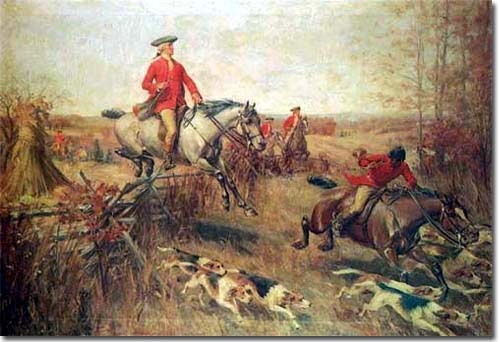
As a gentleman, Brummell rode to hounds, following that sporting
fashion. But it is reported that he
never rode past the first field for he did not want to stain his white boot
tops with mud, and so retired to the nearest inn. This is what sets him as a true dandy, caring
more for his appearance than anything. A
true Corinthian would have distained such a poor showing, for, in general,
Corinthians sought to excel in the sporting world.
Shakespeare has his Prince Hal proclaim in Henry IV, “They take it
already upon their salvation, that though I be but prince of Wales, yet I am
king of courtesy; and tell me flatly I am no proud Jack, like Falstaff, but a
Corinthian, a lad of mettle…”
A lad of mettle was what the Regency Corinthian sought to prove
himself.
Bartleby’s defines a Corinthian as “A gentleman sportsman who rides his
own horses on the turf, or sails his own yacht. A member of the pugilistic
club, Bond Street, London” which references the Pugilistic Club formed in 1814
as the meeting-place of the aristocratic sporting element, often called “The
Fancy.”
The Corinthian was, above all, a sporting man. He drove his own horses, boxed, ride to hounds,
shot and strove to be among the elite of this group would undertook these
expensive as well as athletic endeavors.

Military men, too, might aspire to sporting excellence. Wellington was
said to have a “bad seat” on a horse, but he certainly loved to hunt. His officers could keep packs of hounds, and
while foxes might be scarce in Spain and Portugal, there were rabbits enough to
hunt. Winter was also the time when the army had to wait out the winter before
a spring campaign, and as Harry Smith wrote in his autobiography, “At
this period of the year (February, March) the coursing in this part of Spain is
capital, and by help of my celebrated dog Moro and two other excellent ones, I
supplied the officers' mess of every Company with hares for soup.” Smith
kept greyhounds to chase the hares, a sport far older than fox hunting, and his
life is superbly fictionalized in Georgette Heyer’s The Spanish Bride.
There were more than a few Corinthians who also excelled at excessive
dissipation, and who could be called rake, or “rake-hell,” or “rake shame.” It
took more than a little womanizing for a Regency gentleman to earn the status
of rake. Prostitutes were so numerous
that guidebooks were put out to describe the women, their specialties, and what
they might not do. Most gentlemen kept a
mistress, and even titled married women considered discreet affairs the norm.
But a gentleman who went beyond conventions, who preyed upon young women, or
even children, or who undertook perversions, was deemed unacceptable. These
rakes ignored convention and morality.
Two such examples of this are Lord Barrymore and the Duke of
Queensberry.
Born in 1768, Richard Barry became the Earl of Barrymore in 1773. He took to living to please himself, and
earned the nickname “Hellgate.” His brother, Henry Barry, became
"Cripplegate" for his crippled foot, and his other brother, the
Honorable Reverend Augustus Barry, was called “Newgate” because that was the
one gaol he had kept clear of. His
sister, who became Lady Milfort, was called "Billingsgate" for the
foul language she used.
Barrymore rode his own horses in races, then went deeply into debt
building his racing stables and gambling on his horses. It is said that he was
a whip equal in skill to any professional coachman. He also organized boxing matches, bet on
them, and was accounted a good boxer himself.
In 1792 he married Miss Goulding, niece of the notorious Sir John Lady
and Letty Lade—a woman who had been the mistress of the highwayman known as
"Sixteen String Jack." Sir John was not a respectable person, but he
was a noted whip, and had driven a coach and four round the tiny horse sale
yard at Tattersalls—a remarkable feat.
Instead of marrying to settle down, Barrymore had to make a scandal of
even this. He received permission from
Sir John to marry Lade’s niece, but Barrymore decided to elope with his bride
anyway, setting Society to talking about such disgraceful behavior.
While Lord Barrymore lived up to the image of a dissolute and dashing
young blade, the Duke of Queensberry, known as "Old Q" for the
initial he had painted on his carriage instead of his crest, was more the
classic old rake. He also was a noted race-horse owner, gambler and driver,
traits of a true Corinthian.
William Douglas had become the Earl of March in 1731, and then inherited
the dukedom of Queensberry in 1786 when his cousin died. Fabulously wealthy, he never married. He adored young Italian opera singers, and
was said to have been a member of the notorious “Hellfire Club.” Like a true rake, he neglected his estates of
Drumlanrig, Dumfries, and Galloway, and lived for his own pleasure.
While Georgian, the Hellfire Club is worth a brief mention in that gossip
made it a standard (abet a low one) for scandalous debauchery. It was not actually called the Hellfire Club
by its members. Started in 1746 by Sir
Francis Dashwood, its name, like its members and its activities, were kept
secret. It was called either The Friars
of St Francis of Wycombe, The Monks of Medmenham, The Order of Knights of West
Wycombe, or The Order of the Knights of St Francis. Stories held that members included the Earl
of Sandwich, the son of the Archbishop of Canterbury, William Hogarth, the Earl
of Bute, the Marquis of Granby, and even the Prince of Wales, and that they
indulged in everything from orgies to Satan worship. What they really did is unknown, but it is
very likely that they held orgies with prostitutes and probably performed
invented Pagan ceremonies that were relatively harmless.
By the Regency, Dashwood and his club had been replaced by other
clubs—some every bit as scandalous.
There were numerous gentlemen’s clubs in Regency London, and a
gentleman’s clubs also denoted his status within each set. Some clubs were founded for the purpose of
eating, some for drinking, some for wit and society, some for debauchery, some
for gambling, some for sports. Many of
them had whimsical rules, such as a club founded by Lord Barrymore which ruled
that "if any member has more sense than another he be kicked out of the
club."

Most gentlemen belonged to several clubs. Waiter’s was considered the
domain of the dandy, but closed in 1819 after becoming infamous as a place
where too many gentlemen were ruined with deep play (which was also suspected
of being rigged play). White’s was
considered the most exclusive, and was where Beau Brummell held court in the
famous bow-window with Lord Alvanely, the Duke of Argyle, Lord Worcester, Lord
Foley and Lord Sefton. Opposite White’s stood Brooks’s, a club that, through
its patronage by Whig families, became known as the place for liberals. Members included the radical and the
artistic, such as Edmund Burke, Sir Joshua Reynolds, David Garrick, Horace
Walpole, Edward Gibbon, Richard Sheridan, and the Prince of Wales. Finally, a sporting minded gentleman might
join Boodle’s with its focus on heavy gambling, or The Marylebone Cricket Club
which played at Lord’s, or might aspire to the Bensington Driving Club, founded
in 1807, or the more elite Four-Horse Club.
The Four-Horse club met in George Street, Hanover Square, and drove to
Salt Hill to dine. Members had be noted
whips, drove four horses attached to a barouche carriage and had the right to
wear the yellow-striped blue waistcoat and black spotted neckerchief insignia
of the club. Membership was so exclusive
that the club counted only around thirty members or so, and included Lords
Barrymore, Sefton, Worcester and Fitzhardinge, Sir John Lade, Sir Henry Peyton,
Sir Bellingham Graham as well as other noted whips.
M. Simond, writing about his visit to England in 1810, might well have
been writing of the Four-Horse club when he said, "I have just seen the
originals of which Matthews gave us a faithful copy a few days ago in Hit or
Miss—the very barouche club; the gentlemen-coachmen, with half-a-dozen
great coats about them—immense capes—a large nosegay at the button-hole—high
mounted on an elevated seat with squared elbows—a prodigious whip—beautiful
horses, four in hand, drive in a file to Salthill, a place about twenty miles
from London, and return, stopping on the way at the several public houses and
gin shops where stage-coachmen are in the habit of stopping for a dram, and for
parcels and passengers; the whole in strict imitation of their models and
making use, as much as they can, of their energetic professional idiom."
For boxing, there was Daffy's Club, which The London Spy reported
was held at Tom Belcher's at the Castle Tavern in Holborn. Boxing matches were also held at Fives Court
in St. Martin's Street.
Just as each set had its customary haunts and clubs, slang terms also
defined a gentleman’s interests. Some
dandies, such as Sir Lumley “Skiffy” Skeffington spoke with a lisp. (Many in the liberal Devonshire set also
copied the Duchess of Devonshire’s lisp to denote their status as Whigs.) With his lisp and his appearance as “a thin
pallid little man with sharp features and rouged cheeks, and the atmosphere of
a perfume shop," Skeffington was almost the archetype of a dandy. He wore
colored satin suits, penned plays and was said to spend eight hundred pounds a
year on his clothes. Actually, while
Skeffington was a friend of Brummell's and the Regent, he was actually too
fashionable to meet Brummell's standards for understated taste.
The Corinthian, in turn, adopted boxing terms or the slang of the
coachman on the road. It should be noted
that are differences between London “thieves cant” often used by the young
bucks about town, and the language of the Fancy.
As examples, Pierce Egan's Life
in London; or, The Day and Night Scenes of Jerry Hawthorn, Esq., and his
elegant friend, Corinthian Tom, accompanied by Bob Logic, the Oxonian, in their
Rambles and Sprees through the Metropolis shows his heroes—Tom and
Jerry—using the slang of the Fancy as Tom shows his country cousin Jerry about
town. Egan calls his hero "one of
the fancy, but not a fancy man...” And
said of him that while he was as home waltzing at Almacks, he was not a dandy.
Egan also published Boxiana as a serial put out between 1811 and
1813, and he was a well known figure in the sporting world. Captain Grose’s Dictionary of the Vulgar
Tongue provides a reference to the thieves cant used by the London
underworld, and which might be employed by a young gentleman going slumming in
brothels or gaming hells.
In addition to imitating the lower classes of London, young gentlemen
looked to imitate the professional coach driver who handled the mail and stage
coaches. They might done a “Benjamin” (the
greatcoat worn by coachmen) while seeking to “handle the ribbons” (hold the
reins), and “spring the team” (put a team into a canter); “feather it” (drive
very close to obstacles), managing both the “leaders” and the “wheelers” (the
front pair and rear pair of a four horse team) over a “stage” (the distance
between one change of teams and the next—usually 10 to 20 miles).
For others, it was not the professional coachman but the professional
boxer who became the hero to emulate.

Fist fighting begun to replace sword or cudgel sports during George I’s
reign. Though it was illegal, betting
made it enough of an attraction to draw nobility as well as common folks. The first official champion of England was
James Figg, who was also an expert swordsman and who later opened a School of Arms.
Later, Jack Broughton, who was champion of England from 1734 to 1750,
invented the “mufflers” or boxing gloves that were used for practice only since
all prize-fights were fought with bare fists.
Called “the father of British pugilism” Broughton drafted the rules that
were used before and during the Regency.
(It was not until 1866 that the Queensberry Rules were developed by the
8th Marquis of Queensberry and John G. Chambers.)
Broughton’s rules outlawed hitting below the belt, striking an opponent
who was down (which included being on his knees). Wrestling holds were allowed
only above the waist. Every fighter had
a gentleman to act as umpire, with a third to referee disagreements. When a
fighter was knocked down, he had 30 seconds to get up—or have help getting
up—and then he had to be placed at the corner of a 3-foot square that was drawn
in the center of the ring.
As was common for retiring champion boxers, when John Jackson retired
after willing the champion title in 1795, he opened the Bond Street School of
Arms at Number 13. Jackson won the championship in a hard-fought match with
Daniel Mendoza, but it was his school which brought him fame.
Jackson, known as “The Gentleman,” was friends with fencing instructor
Henry Angleo, who had a school next door and who urged his students to
alternate with lessons from Jackson—which made sense for Jackson advocated
footwork and the science of targeting a hit.
Everyone went to Jackson’s, even Lord Byron, the lame poet. When tasked with keeping such low company
Byron insisted that Jackson’s manners were “infinitely superior to those of the
fellows of the college whom I meet at the high table.” That no doubt contributed Jackson’s nickname
and his success.

Other boxing champions of the Regency era included: Jack Bartholomew,
champion from 1797 to 1800. Jem Belcher
who often wore a blue scarf marked with white spots and blue centers around his
neck, which became known as the Belcher neckcloth, and soon sporting mad young
bucks were wearing any scarf of garish color with spots. “Hen” Pearce, “The Game Chicken,” who held
the title from 1803 to 1806 when he retired.
John Gully who won the championship in 1807 and retired in 1808 to open
a racing stable. And Tom Cribb became the champion in 1808, winning a famous
bout against African-American Tom Molineaux on December 18, 1810. Cribb went on
to hold the champion title until 1822.
As an interesting footnote, Tom’s less famous brother, George had about
five fights, and lost all of them—some men simply were not cut out to be
Corinthians, dandies, or rakes.




 Posts
Posts


