
The Cornish are descendants of Druids, Celts, and the Welsh,
ancestors typically referred to as the ‘old ones’ with a fifteen hundred year history
of mining ore, copper, and tin. Living and working in harsh conditions—influenced
by Welsh saints who settled throughout Cornwall, and later Methodist Evangelist
John Wesley—the Cornish were enthralled by supernatural folklore, tales of
ghosts and legend. Nights spent around a hearth of blazing furze and turf was
never wasted. Especially if a droll teller—a storyteller traveling hamlet to
hamlet across the moors to tell stories, play the fiddle, and sing old ballads about
Cornwall's past—ventured near.
“In Cornish
dialect a ‘droll’ is an oral story.” Visits
by a droll teller—or ‘old crowder’ because they attracted a crowd—happened but
once or twice a year as a means of keeping the old ways alive.
Our Cornish drolls are dead, each one;
The fairies from their haunts have gone:
There’s scarce a witch in all the land,
The world has grown so learn’d and grand.
~ Poet Henry Quick

In Cornish Folk Tales by Mike O’Connor, droll teller
Anthony James of Cury and his son traveled throughout Cornwall in the late 18th-
to early 19th Centuries to pass on legends and lore.
The Legend of
Tamara offers a theory on how Cornwall became
distinct from England. The tale also offers two interesting morals. The first,
beware those who live in darkness. Second, a warning to allow young people to make their own decisions.
The Legend of Tamara
"Once there was a
bad-tempered troll who lived high up on the moors in the north of Cornwall. This
troll had a beautiful daughter called Tamara. Now this old troll hated the
light, so he slept during the day and would only venture out of his cave at
night time. And Tamara, she was forbidden to go out during the day and only
allowed out after sunset. But you’ll soon learn about young women! You will
find they are independent and inquisitive, just like many other people, perhaps
more so. Well, Tamara was like that. One bright day, when her father was fast
asleep, she crept out of the cave to see what it was like.
As soon as she
came out of the cave she was enchanted by the bright light, the colours, the
reflections. There was the blue of the sky, the brilliance of the sun, the rich
green of the moors, the silver streams and the sparkling, shimmering sea. And
on the side of the hill there she found two young giants enjoying a friendly
wrestling match, and I can tell you she was even more enchanted by these two
strong, handsome young men.
And those two
young men were friendly and courteous. They introduced themselves as Davy and
Terry, and Tamara enjoyed their wit and their good company. She was fascinated
by their knowledge of the world that lay beyond her close horizons. So next day
she joined them again, and the next day, and the day after. And gradually she
realized she was falling in love, not only with her young giants, but with life
outside the cave, life in the light.
One day Tamara was
sitting in the sunshine on the hillside between her two young friends. She was
wondering which, if either, she preferred when she heard a howl of rage. She
looked towards the entrance of the cave and there was her father. The old troll
had woken and found that his daughter was gone. From the shadows of the cave
entrance he ordered Tamara to come back to the darkness at once. Tamara looked
at the dark cave and her angry father. Then she looked at the bright land
outside the cave and the two genial giants. Finally, weeping with fear, Tamara
refused to do what the old troll said. Then her father’s rage was so great that
he was almost incapable of speech. Finally, screaming with anger, he uttered a
great curse in a tongue no one else could understand.
Then Tamara felt
her blood run cold and her limbs become stiff. Tears began to flow from her
eyes as she realised that the curse was turning her into stone. Soon she was a
lifeless rock, but from that rock the tears still flowed. At the base of the
rock formed a pool of tears, tears that flowed forever, forming first a brook,
then a stream, then a river that flowed down to the sea.
Then Davy cried
out for the bad-tempered old troll to undo his terrible curse. At first the
troll refused. Davy was insistent. But then the troll admitted that the curse
could not be undone. So Davy threw himself to his full height and demanded that
he too should be cursed, so that he could suffer the same fate as his
sweetheart and share her course to the sea. So for a second time, and now
himself trembling with fear, the troll uttered his great curse. Then Davy too
felt his blood run cold and his limbs become stiff. Tears flowed from Davy’s
eyes as he was turned to stone by the troll’s curse. From that stone the tears
continued to flow. At the base of the rock formed a pool of tears, tears that
flowed forever, forming first a brook, then a stream, then a river that flowed
down to the sea; a river that joined with his beloved Tamara and flowed with her
to the sea, far away to the south.
Then Terry roamed
the hills seeking solace or diversion. But, wherever he went, he was haunted by
the memories of his brother and his friend. Eventually from far across the
moors he gave a great cry, demanding that he too should share the same fate.
And far away the old troll heard his cry borne on the wind and for the last
time uttered his terrible curse. In turn Terry heard the troll’s faint words on
the wind. Soon Terry felt his blood run cold and his limbs become stiff. Tears
flowed from his eyes as the third curse turned him to granite; a stone that
like the others wept an eternity of tears. At the base of the rock formed a
pool of tears, tears that flowed forever, forming first a brook, then a stream,
then a river. But he was far away across the moors, so his river did not flow
to the south and join Tamara and Davy. Instead his river flowed to the north,
eventually joining the Bristol Channel.
That’s how the granite
kingdom of old Cornwall defined its borderlands—three curses, three tears and
three rivers: the Tamar, the Tavy, and the Torridge. That’s what they call them
now."
Cornwall. Corn stems from the Iron Age
tribe Cornovii, later pronounced ‘Kernow’, possibly meaning people of the horn.
Wall comes from old English, ‘w(e)alh’ meaning foreigner. Corn Walum dates back
to 891 A.D.
From sunbathed paradise to Jurassic coastlines,
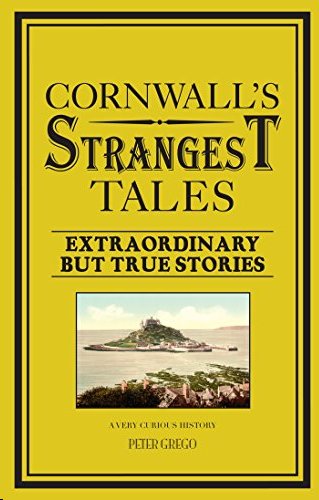
Cornwall according to Peter Grego in Cornwall’s Strangest Tales, Extraordinary but True Stories, is ‘a land of dream and
mystery’. A land of Arthurian legend, an unconquerable fortress where smugglers
reigned, where naval fleets sailed off to victory and folk tales spoken around a
hearth prevent the loss of the old ones.


 Posts
Posts


