Search This Blog

Showing posts with label Regency romance. Show all posts

Friday, October 27, 2023

All Hallow's Eve and Jack O'Lanterns


by Donna Hatch

Halloween is even more popular than ever. In the United States, more Americans celebrate Halloween than Christmas. I have my own opinion on that, but really, what's not to love about love costumes, decorations, parties, and special treats?

 Origin of Halloween -- All Hallow's Eve

An ancient Celticic festival Samhain (a Gaelic word pronounced "SOW-en" or “SAH-win”) celebrated the end of summer's end, the harvest, and the new year, which, at the time, landed on November 1st. the Celts believed that during Samhain, the barrier between the living and the dead became thin enough that ghosts, monsters, and fairies walked the earth to steal souls. They also believed that ghosts of their ancestors could visit that night. The multi-day celebration included sacrifices, fires, dancing, drinking, and much revelry, as well as wearing disguises to hide from the souls wandering around. 

Eventually, with the rise of Christianity, the Roman Catholic Church replaced Samhain with All Saints’ Day or All Soul's Day, which celebrates the church’s saints on November 1. The day before All Saints' Day became All Hallows’ Eve. Many Samhain traditions have endured until today.

Carved Jack O'Lanterns

Ancient Celts invented Jack O'Lanterns. But since pumpkins are native to North America, so the Celts hollowed out and carved rutabagas, gourds, potatoes, beets, and even turnips. To make their faces glow, they put a candle or lit ember inside. These lit root vegetables guided their doorways to ward off evil spirits. 

The Celts also left doors and windows open to welcome in the spirits of their ancestors and set out food for them because, of course, ghosts get hungry. And apparently, only wicked, non-family ghosts were frightened away by glowing veggie faces. To the right are a few examples of the faces that artistic carvers can make from turnips.

Origin of the Name Jack O'Lantern
Photo by Andy Holmes on Unsplash

Although historians aren't positive about how a lit, carved vegetable became known as Jack O'Lantern, there are two prevailing theories. 

From about the 17th century, the term referred to a night watchman who carried a lantern and patrolled the streets to curtail crime. The British often called men whose names they didn't know by a common name like Jack. So, a nightwatchman whose name was unknown carrying a lantern was referred to as Jack with the Lantern or Jack of the Lantern or Jack O'Lantern.

The name's origin may have arisen from a legend about Stingy Jack who played tricks on the devil. As punishment, he was doomed to wander the earth as a spirit carrying a lit coal which he later put into a carved-out turnip. The story about Stingy Jack became a part of All Hallow's Eve and is often referenced when spooky, unexplained lights are sighted, sometimes called Spook Lights. 

Modern Jack O' Lanterns

Jack O'Lanterns today range from scary, to funny, to elegant to reflect the taste of the creator. So this Halloween spare a thought to your ancestors who have passed on. Who knows? They just might visit you.
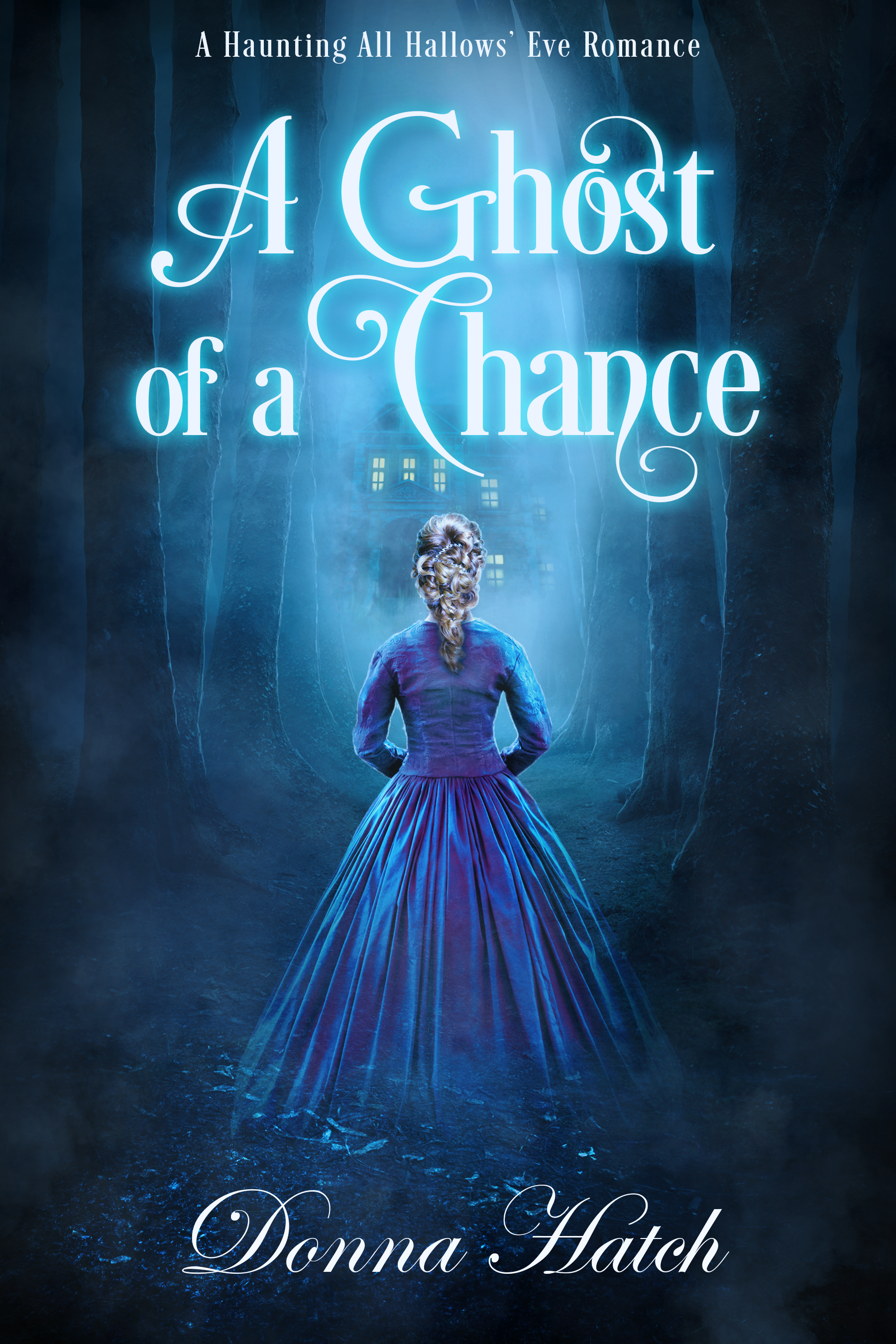
All Hallows Eve during Regency England, filled with ancient English customs, sets the scene for my newest short novel, A Ghost of a Chance.

A lost soul searching for hope...

After a devastating loss, a young lady throws herself into searching for her missing brother and taking solace in her musical composition. When a handsome and captivating stranger comes to town one All Hallows Eve, she dares to hope for more than her endlessly lonely existence.

A tormented war hero seeking redemption...

Unable to flee the memories of war, a retired cavalry captain spends his days helping the men who served under his command adjust to civilian life. Perhaps if he helps them all, he can atone for some of his past failures. When he stops for the night at a small English village celebrating All Hallows Eve, he meets an enchanting young lady unlike any other and suspects that what he needed all along was not only redemption but love.

They must find the courage to take a leap of faith and choose love over fear

It will take faith and valor to overcome the barriers between their worlds and let go of their past heartaches. As they discover love and happiness neither had imagined, they will have to delve into the shadow world between life and death to beg for another chance from the Angel of Death.

A Ghost of a Chance is available in ebook, Kindle Unlimited, and paperback.  

Sources:

https://www.merriam-webster.com/wordplay/the-history-of-jack-o-lantern

https://www.history.com/news/history-of-the-jack-o-lantern-irish-origins

https://time.com/5419385/why-jack-o-lanterns-halloween/

https://www.britannica.com/story/why-do-we-carve-pumpkins-at-halloween

https://worldpopulationreview.com/country-rankings/countries-that-celebrate-halloween    

https://www.history.com/topics/holidays/samhain#samhain-merges-with-halloween

Tuesday, December 12, 2017

Yorkshire

I was lucky enough to spend almost a year in Yorkshire back in my younger days, and I blame Disney for that. Due to having seen The Horsemasters at a young age (I think I was nine), I wanted to go to
England to a riding school. The Yorkshire Riding School outside Harrogate gave me my BHSAI (that's British Horse Society Assistant Instructor) certificate, and then I went on to live with a family, training a couple of hunters (horses for fox hunting, not folks with shotguns) and a carriage horse. But I think part of my fondness for Yorkshire also goes back to a grandmother who came from Sheffield.

Yorkshire became the setting for my first Regency romance--A Compromising Situation--both due to my familiarity with the region and it's romantic setting. There are the moors in the north, wild and harsh lands used in Wuthering Heights (and did you know that wuthering is a variant of whithering and comes from the Old Norse for strong wind--there's a strong Viking influence in Yorkshire). There are the vales with their green fields and stone walls and dottings of sheep. There are ruins everywhere, some of them dating back to well before the Normans even arrived, others the result of Henry VIII's dissolution of the abbeys. Yorkshire is the land of Robbin Hood--yes, I know, legend puts him in Nottingham, but Yorkshire historians say he was really a Barnsdale man from the area  between South and West Yorkshire near Doncaster. Yorkshire has always loved its rebels.

The area has seen its share of battles, both with Vikings for control of the land, and later when the north chose not to submit to William I and the Normans, and then on through the War of the Roses and even more uprisings. Castles rose and fell--do did great houses.

In the 1800s, Yorkshire was at the center of the Industrial Revolution, with manufacturing springing up in Manchester, Sheffield and Leeds. And, of course, revolution brought trouble in the Luddites who objected to the loss of income and jobs as machines replaced workers. 

The rich history of Yorkshire is in its houses, ruins, and even its land. You literally cannot step foot anywhere without being someplace where the history is close by. From the winding streets of York, to the rugged coastlines, to the now quiet battlefields. Folks are still digging up Roman relics, or even earlier tools and barrows that date back much further.

And those who hale from Yorkshire are a hardy lot, used to the cold winters and a rather hard life. The dialect can be hard to follow, and a bit bloody-minded (the saying is that a Yorkshireman is a Scotsman with all the generosity squeezed out):
'Ear all, see all, say nowt;
Eyt all, sup all, pay nowt;
And if ivver tha does owt fer nowt –
Allus do it fer thissen.
The translation for those not used to the Yorkshire dialect is: 'Hear all, see all, say nothing; Eat all, drink all, pay nothing; And if ever you do anything for nothing – always do it for yourself.'

But where would we be without Yorkshire pudding, and Terry's of York and the other chocolate companies that grew up in this area, and Wensleydale cheese, a cheese as delightful to say as it is to eat. There is also Betty's, one of the best tea room's in England, in York, Harrogate and other locations, which has been a tea house since 1919.)

Yorkshire also gives us the coach horse, the Cleveland Bay (from the Vale of Cleveland), the Great North Road (you have to go through Yorkshire to elope to Scotland), and some of the most beautiful of England's Great Houses--Castle Howard, Harewood House, and Barley Hall. And Yorkshire lays claim to many ghosts and things that do more than bump in the night, ranging from monks to lost Roman legions. And Yorkshire is a land where the folk tales seem to be close to those who live here, and the old ways are still observed. Perhaps it's because so much of the language also dates back to ancient times, to the Vikings who settled here.

In the Regency, Harrogate was a place to go to 'take the waters.' It was both a social scene for those not wanting the expense or bustle of London (or even Bath), but who wished good company and a touch of a more elegant era, for Harrogate had reached its most popular time in the Georgian era. And that is perhaps the real attraction of Yorkshire--the blend of old and new, which existed in the Regency era and and still exists. It's a place where it is easy to transport yourself back in time.


For additional reading:

http://englishhistoryauthors.blogspot.com/2012/07/a-glimpse-of-york-during-regency-era.html

https://regencyredingote.wordpress.com/2013/04/12/yorkshire-coach-horse-the-regency-aston-martin/

http://castlesandgardens.co.uk/historic-houses-gardens

https://janeaustensworld.wordpress.com/2009/10/01/yorkshire-coaching-inns-illustrated-by-joseph-appleyard/

http://www.viking.no/e/england/e-yorkshire_norse.htm

https://yorkshiremixture.wordpress.com/2012/01/09/hello-world/

https://www.bettys.co.uk

Tuesday, August 8, 2017

Regency Habits of Economy


     Farthing, guinea, crown, shilling and pence. To an American, the monetary system of 1800's England can seem a foreign language.  But a Regency housewife--a responsible, frugal housewife--had to know where the pennies went and how to keep household accounts.
     Maria Rundell in her book Domestic Cookery notes, "Instances may be found of ladies in the higher walks of life, who condescend to examine the accounts of their house steward; and by overlooking and wisely directing the expenditure of that part of their husband's income which falls under their own inspection, avoid the inconvenience of embarrassed circumstances." She goes on to state that a "great readiness at figures" is one of the most useful things a woman can know.

     So what did a woman know about money?
     The basic values were known by everyone, and included:
·         Half-farthing - eighth of a penny
·         Farthing - quarter of a penny (4 farthings to a penny)
·         Halfpenny (or haypence) - half of a penny, or 2 farthings
·         Penny (or pence) - twelfth of a shilling
·         Shilling (or Bob) - 12 pence, or one twentieth of a pound
·         Half-crown - 2 shillings, 6 pence
·         Crown - 5 shillings (60 pennies)
·         Pound (quid, or sovereign) - 20 shillings (240 pennies)
·         Guinea - 21 shillings (252 pennies)

     Gold coins had values of five guineas, sovereign, two guineas, guinea, and half-guinea, but gold was also in shortage and so there were not many of these coins minted in the late 1700's and early 1800's. Silver coins values were crown, shilling, sixpence, fourpence, threepence, twopence, and penny. Copper coins included the halfpenny and farthing.
     When noting expenditures pence would be marked as "d" for denarius or denarii from the Latin, and shillings written as "s" for solidus. Denarius has been a small value Roman coin, and twelve denarii made up one solidus. Solidus is also the name of the slash used in fractions, and so "/" was also used to mark shillings. The pound symbol '£' also came from the Latin word libra for pound. So six shillings could be marked as 6s or 6/ and six shillings and two pence could be 6s2d or 6/2.
     About now the American system of pennies, nickels, dimes, quarters, and dollars begins to seem wonderfully simple by comparison.
     Paper money existed in the 1800's as Bank Notes, but many preferred to deal with coins for the amount of copper, silver or gold minted equaled the face value. You actually had a guinea's worth of gold in your hand, a concept lost in our modern world in which coins are made of alloys.

     Today we regard ten pounds as pocket change, but in the 1800's that sum could be a year's wages. What £10 bought in 1800 would have cost £395.39 in 2002 (conversion from Economic History Resource.)
     Rapid inflation until 1812 also had prices rising drastically in England, but wages remained low. The cost of wheat alone went up from between 47/ to 54/ a quarter in the early 1790's to between 114/ to 160/ by 1800. England's population was also moving from the country, where food could be grown and household items made, to cities, where everything had to be bought.  As noted by Reay Tannahill in Food in History, "In 1800 Manchester had 75,000 inhabitants; fifty years later, 400,000....The number of people living in London multiplied by four in just over a century."
     A woman in 'embarrassed circumstances' might well have to focus only on how to stretch her pence for food. In the city she would have to buy meat scraps rather than full roasts. There would be no funds for luxuries such as butter. The cheapest bread would be coarse, adulterated with alum, which cost less than flour. She might be able to afford wool for knitting gloves and scarves and undergarments, and fabric to make clothes, or she might have to make do with purchasing used clothing from a street fair. Feathers to go inside pillows would come from the ducks and chickens she bought and plucked, if she could afford the luxury of a whole hen. Shoes would need to be bought, and tinkers paid to mend pots and sharpen knives. With the added expense of rent, anything such as costly tea would be a luxury, as would any servants or services.
     In the middle class, a woman could count on more luxuries. She would have staff to do the work, and could afford beeswax candles that did not drip (or smell of beef fat), and fine milled soap.  There would be funds for silk shoes at 10/, sarsnet for gowns at 7/ a yard, and a fancy cap for a pound and six. Entertainment could be had: 10/6 for the rent of an opera box, 5/ for a concert ticket, another 10/6 for a book seller subscription, and 2 guineas for ball subscriptions in Bath.
     Of course, there would also be the washer woman to pay, school fees for her children, coal and wood to buy to heat her house, servant's wages, money for charity, and coins to hand out as tips when she visited.
     For a woman of great income, all this jotting down of expenditures could be left to a house steward, a secretary, or a housekeeper. A woman with a rich family or husband might not even handle any money for items could be purchased on account, and bills would be sent to the father or family. However, there are numerous stories of servants who filled their pockets by padding the household account books, writing in more than was paid to the merchants and keeping the difference.
      Women could also loose fortunes at the gaming table. Georgina, Duchess of Devonshire, died with well over ten thousand pounds of gambling debt, which would have ruined a lesser family than the powerful Cavendish clan.

     Of course other costs could ruin a family. Coming of age parties might cost from £300 to £6,000. Board and tuition at Eton or Harrow cost between £175 to £250 a year. While a London season would demand at least £1,000 to rent a house in Mayfair and then another ten thousand or more for food, drink, a suitable wardrobe and parties.
With such budgets to handle, launching your children into the world could be rather like managing a small corporation. No wonder parents expected such investments would pay off with alliances that brought influence and money back into the family. No wonder, too, at the appeal of living quietly in the country where such demands were not made upon the purse.

In the country, a large estate was expected to produce. This mean not just income from farms let to tenants, but milk, butter and cream from a dairy, ale from the ale house, fruits and vegetables from gardens and hot houses, herbs from a kitchen or herb garden, meat from pigs, beef, pigeons in the dovecotes, eggs and meat from chickens, wild game from the woods, fish from the local streams, and even wool for weaving fabrics. All of this, of course, takes a huge staff for management, but it means that an estate could provide for itself.
The lady of the estate would be expected to know how to use her still room to dry herbs, create ointments, cures, cleansers, and more. These recipes were often included in the very popular cookbooks of the era.

A smaller manor might lack extravagant lands for hunting, but even a few acres provides land for farming, growing, and raising live stock. The smaller manor would also have staff to handle these outside chores: a groom, a gardener, a cook, and so on.
Produce from an estate also provides goods that can be sold, allowing for the purchase of luxury items such as chocolate, sugar, tea and coffee (all imports).
In this era when we purchase so much of what we need, we have to stop and remember this is a modern habit. Two hundred years ago the habit was really to grow and make what was needed. To mend and reuse. At one time, only the very rich could waste money on spending for every whim.

Wednesday, July 12, 2017

A Regency Road Reference


So often when writing a novel set in the Regency, a writer has to rely on references that come second, third, or even fourth-hand. We read diaries and letters that are often edited by children and grandchildren—meaning the children mention the scandal and decry it, but the grandchildren simply want to moralize or white-wash events. We scan biographies--some brilliant and some shabby beyond belief. And we read books written about the Regency. But sometimes a novelist needs more.

When writing about characters that live in the Regency, I’ve often needed to get into those character's heads. We need to see how they lived. We need first-hand experience. I've been known to read by candlelight—truly an eye-straining experience—brandish a sword, which came into handy in several novels, and even try a pen and ink to see what it's really like.

One book that offers a first-hand experience into the Regency is Cary's New Itinerary.

At the end of the eighteenth century, John Cary was commissioned by the Postmaster-General to survey all the principal roads in England. He did this by walking these roads, pushing a wheel connected to a counter, which kept a tally of the number of rotations and then produced an accurate mileage.

Between 1787 and 1831, Cary put his knowledge to use and published, among other books, the New English Atlas, The Travellers' Companion, the Universal Atlas of 1808, and Cary's New Itinerary. The maps and surveys have some of the most accurate and valuable data about the structure of the Regency world. They also provide an insight into how people traveled in the Regency. It was a terrific book that helped with my novella Border Bride, which had an elopement to Scotland, and several other stories ended up with travelers, and I needed the details to bring life into the books.


Published in 1815, the fifth edition of Cary's which I own goes on to explain that it is, "an Accurate Delineation of the Great Roads, both direct and cross throughout, England and Whales, with many of the Principal Roads in Scotland, from an actual admeasurement by John Cary, made by command of his Majesty's Postmaster General."

There's more detail provided at the front of the book in an ‘advertisement’ that's really more of a preface.

The information alone on roads and distances, with fold-out maps provided, has helped me sort out the practical problems that face any Regency writer—such as, how far is it really between London and Bath? And what roads might one take? However, Cary's offers much more.

Cary's divides into neat, organized sections. The man was obviously methodical. The first section lists the direct roads to London—as in all roads lead to this metropolis. The next section gives a list of principal places—i.e., larger towns, that occur along the cross-roads. A cross-road is a road that crosses one of the direct roads into London. At this point, you begin to see how London-centric this world really was. As someone living outside of London, it would be your goal to get to a major town, and then you could get to London. Cary, living in London, wrote his book for outward-bound Londoners, and that is how the book is organized.


The next section is as important to a Regency writer as it would have been to someone traveling in the Regency—it is a list of coach and mail departures. This includes the name of the London inn from which the coaches departed, the towns each coach passed through, the mileage, the departure time, and the arrival time. It's an utter godsend if you have to get your heroine to Bath at a certain hour on the coach. I can also picture Regency Londoners pouring over this information, planning short trips to the seaside, or to watering towns.

The next section lists all direct roads, as measured from key departure points in London, but this is not just a dry list of mileage. Descriptive notes are tucked into various columns to describe houses of note and distinctive sights. For example, if you're going to Wells from London, then, "Between Bugley and Whitbourn, at about 2 m(iles) on l(eft) Longleat, Marquis of Bath; the house is a Picture of Grandure, and the Park and Pleasure Grounds are very beautiful." This was an era in which slower travel meant taking the time to look at surroundings.


Another section provides a similar treatment for cross-roads, and not to be overlooked, Packet Boat sailing days are listed for England's various sea ports, just in case an intrepid traveler whishes to travel abroad.

Finally, Cary's provides an index to Country Seats, or as Cary's notes, "In this Index the Name of every resident Possessor of a Seat is given, as well as the Name of the Seat itself, wherever it has a distinctive Appellation." This is actually a list from the 1811 returns to Parliament, as noted in the book. In the Regency, this actually would have been a much used feature, for it would allow a traveler to look up and visit various great houses and country seats. It was a time, after all, when visitors expected the great houses to always be open for show, and to be gracious in their hospitality.


Overall, Cary's is not a book that will give you insight into the politics of the Regency, nor into the social structure of that world. However, between its worn covers lays the description of the Regency world that can put you back into that era, just as if you were traveling the roads of England.

Monday, June 12, 2017

Corn Laws, Enclosures, and Poor Harvests = Unrest in Britian


In fiction set in Regency England, there’s often some mention of the Corn Laws. These laws regulated the importing of grain (in England, corn refers to any grain). Corn Laws date back to the Twelfth Century, however, they became particularly important in the late 1700’s and early 1800’s due to both a population growth in Britain and blockades from the French during the Napoleonic Wars. 


In the 1700’s, wheat prices had fallen due to an influx of foreign grain. At the same time, the Enclosed Acts had been passed—this meant there was no longer any open land that anyone might farm. Added onto all of this were the Game Laws—the penalty for poaching “or even being found in possession of a net at night” was transportation. 

While the Enclosure Acts enabled landowners to extend their parks and fields, those without land lost their right to trap extra meat on open land. The poor were now in a precarious spot. 

The Corn Laws stated that no foreign wheat (the staple of the poor) could be imported until British wheat reached  a price of 80/- per quarter. At the same time, those who worked the fields did not see an increase in wages to match and increase in food prices.


Bad harvest hit England in 1795, again over 1799 to 1801, and then again in 1802 and yet again between 1812 to 1822. One bad harvest is one thing—almost every farmer knows to store grain to deal with a bad year, and large scale farms can always get credit to get past one rough season. But repeated reduction in production meant two things—higher prices of the most basic food stuffs, and those with low incomes had less money to spend on goods. Manufactures also suffered losses due to the bad years.


The years 1810–1811 had cold winters (1811 was the year the Thames froze sold, and it froze again in 1814), and then heavy rains often brought floods, particularly to the east, where the fens provided very bad drainage. Poor harvests were noted in 1809 to 1812, with rioting as “banks failed and export trade collapsed.” Along with this was the Luddite uprising, and in 1812 in Nottingham, “a riot, engendered by the prevailing famine, commenced in the morning.” But the fail harvest came in better than in the prior year, which helped with a temporary fall in grain prices.


With all this going on, it starts to seem reasonable why England feared there might be a similar revolution to the one that occurred in France. France’s revolution had been driven not just by a need for equality, but by poor crops and an increased population. England faced similar issues.


The winters of 1813 and 1814 were again cold and long, delaying the ability to plant. Frosts were reported in many districts that lasted on through May, and summer storms brought hail and rain, which caused extensive crop damage in Leicestershire and Nottinghamshire. By the end of August, the weather turned hot and farmers who had survived were able to get in their harvests. By October and November, early freezes and hard rains hit many areas of England and Scotland.


In 1815, the government attempted to fix corn prices, and, but the country saw unrest and riots in may of the hardest hit areas. In 1815, the national debt also stood at £834 million, but the Income Tax, enacted to pay for the war with France was eliminated, shifting the burden of payment to indirect taxation. Again, the poor were hit the hardest as tax fell onto good purchased. Those with money could afford this—those without had even less money. The end of the war in Europe finally meant that Britain could again freely import grain, but any import was more expensive than local produce—and the grain could only be imported based on what the Corn Laws allowed.


But 1815 again saw a hard winter, as did 1816. The Farmer's Magazine summarized 1816’s harvest as “uncommonly unpropitious” and comparing it with “the memorable year 1799”.


While hardy root crops that could survive frosts would provide some food, grains and cash crops failed. The Farmer's Magazine reported that many tenant farmers were unable to pay rents, and many landlords were unwilling to offer abatement. In Wales, the tax was collected in certain districts in goods rather than in coin.


Reports in Nottingham were that gentlemen who were well off would come to market and distribute food to those without.  At the same time, Britain was also having to deal with a large military force returning from Europe, most of whom had not been back home in a very long time. This provided an even larger workforce, but in some areas jobs were scarce or low paying. The smart soldiers stayed in the army and went on to other spots of unrest in the growing empire.


Another wet summer occurred in 1817, with crops reported as “bad” in Scotland, and then 1818 provided a long, hot, dry summer, with rains finally arriving in autumn, then back to cold in 1819 with late frosts in May, and wet again in 1820. The up and downs of the weather continued on through until the late 1800s. And it was the potato blight and famine in 1845 that finally brought about the end of the Corn Laws, which were repealed in 1846.