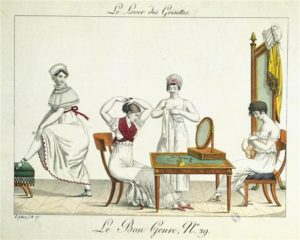
I recently taught a workshop at a writer's conference on Regency Ladies Fashions. One attendee asked what ladies wore underneath their skirts. You should have heard the gasps when I told her, "Nothing."
Now is a good time to revise and cross-post about this somewhat controversial topic.
Historians, researchers, and authors agree that ladies wore a shift, or chemise, over which they laced up stays (a type of Regency corset but more comfortable), and then a petticoat, which was basically a long slip or jumper. We also know they wore stockings that tied or buckled. Our modern-day sensibilities insist that the ladies who lived during the time of Jane Austen's heroines must have worn something underneath all that, right?
Read on, dear reader.
Drawers
We know drawers existed by 1806 because merchants advertised and sold them. However, these merchants did not cater to the upper classes; their clientele was the working class. Some advertisements tried to bring them into fashion for the wealthy by listing them as being good for wearing while riding. However, they didn't understand the first rule of advertising: know your audience.
In 1811, Princess Charlotte wore them at least once, because she accidentally revealed them. However, many considered the garment shocking and openly criticized her for not only letting it show but wearing it at all.
Drawers and similar undergarments were a direct imitation of men's undergarments called "small clothes." As such, they were considered masculine and therefore vulgar for ladies. In addition, drawers had two entirely separate legs with strings that tied around the waist and left open in the middle. For decades, the only women who wore them were prostitutes. Ladies of high society wanted nothing to do with this kind of garment.

In 1817, some fashionable ladies wore pantaloons, a longer, lace-edged variation of drawers that were meant to be seen below the petticoat. In English Women's Clothing in the 19th Century, by C Willet Cunnington, the author describes drawers as "frilled trousers" but goes on to state that the fashion disappeared almost immediately, adding, "On the whole however, it seems probable that most women did not wear any garment of this kind until the '30's" (meaning the 1830's).
Before you continue, I must warn you: the colored drawings below are a tad graphic, so please don't send me hate mail.
Risqué Regency Era Cartoons
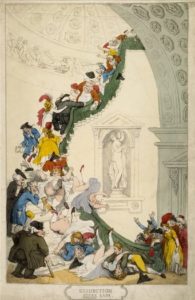 The lack of any garment underneath ladies' skirts was such common knowledge that even social and political cartoons of the day reflected this. Thomas Rowlandson, a famous illustrator and cartoonist, created watercolors of soldiers, wars, death and dying, the hunt, several humorous series, as well as some rather erotic pieces. I have not included those in this post. You're welcome.
One of Rowlandson's pieces is called Exhibition Stare Case (pictured to the left). In this image, several people are tumbling down the stairs. Three of them are misfortunate ladies, positioned with their legs up, revealing naked thighs and bums. This suggests ladies did not wear drawers or pantaloons.
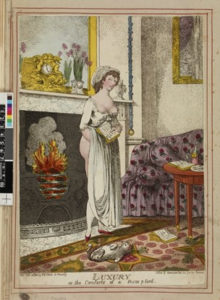 Other satirical cartoons by different cartoonists including Cruikshank and Gilray show pictures of women falling off horses or, in the case of the picture to the right, warming themselves in front of a fire. In all these drawings, women are wearing nothing underneath their skirts except stockings and shoes. (Don't you love the fat cat lying in front of her as if it has just expired?)
Obviously, back then, as today, political cartoons are only loosely based on fact. They're supposed to be absurd. However, so many of them reveal (no pun intended) the lack of ladies' undergarments that the combination begins to present a strong case against the practice, at least among the wealthier classes.
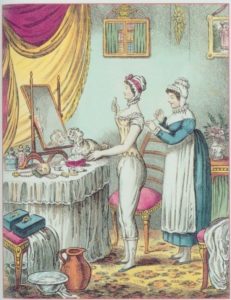 Another period drawing that addresses this is called "Progress of the Toilet." It's a set of three images published by James Gillray in 1810. His drawings are well-known to ridicule many practices of the Regency Era. Several of his creations mock the fashions of the period which dictated how the shapes of women should be altered to meet current standards of beauty.
The image to the left shows a woman wearing drawers. It is difficult to see, but she's wearing a chemise -- you can see the sleeves and the edge around the top of her stays -- which seems to be tucked into her drawers. The stays appear to be from earlier in the century when ladies wore Georgian stays, as evidenced by the little tabs on the bottom of the stays. But I digress. It's also possible the cartoonist showed drawers to further ridicule the complicated process of dressing for the day and even perhaps to poke fun at the drawers themselves. Unfortunately, I was unable to determine the exact date of the image. One source said this series was created in 1810 but I have not been able to verify that. I find it more likely that it was around 1817 during that blip when drawers were popular.
Pantaloons
 In the 1820s, which was the Victorian Era, long pantaloons (also called pantaletes) arrived on the scene with more popularity. The term can be confusing because men wore pantaloons -- silk breeches that went to the knee -- for formal occasions until well into the 1820s until trousers became mainstream fashion.
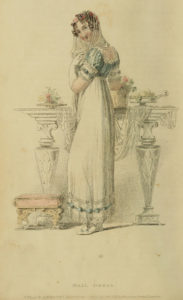
None of my books of Regency fashion prints show drawers or anything of the kind peeping out from underneath skirts -- not even those labeled "walking dress," "carriage dress," or "riding habit."
Conclusion
While some historians stubbornly claim that women wore drawers, there is too much proof to the contrary. I suspect that just as today some men and women don't always wear underwear, there were those ladies during the Regency while most did not. Our modern-day sensibilities might make the idea of not wearing underwear sound a tad obscene. Just remember, they had far different viewpoints about a great many things during the Regency.
Sources:
English Women's Clothing in the Nineteenth Century by C. Willet Cunningham
Fashions in the Era of Jane Austen by Jody Gayles
http://www.janeausten.co.uk/corsets-and-drawers-a-look-at-regency-underwear/
https://janeaustensworld.wordpress.com/2010/11/06/ladies-underdrawers-in-regency-times/
http://www.fashion-era.com/drawers-pants-combinations-knickers-fashion.htm
https://englishhistoryauthors.blogspot.com/2011/11/regemcy-era-ladys-prodigious-layers-of.html
https://www.kristenkoster.com/a-primer-on-regency-era-womens-fashion/


 The actresses playing the Dashwood women often wore an apron or pinafore over their dresses when picking herbs or working in the kitchen. I don't know how accurate this is, or if they only did so because they were not overly wealthy and had to be very careful with their clothing.


 Posts
Posts


