Search This Blog

Friday, February 28, 2014

London's Devonshire House--Gone


Though it was demolished 90 years ago, Devonshire House was one of London's most fabulous aristocratic homes for a couple of centuries. One of the things that set it -- and a handful of other aristocratic homes -- apart from typical town homes of the nobility was the plot of land that surrounded it. While many of London's grandest houses were terraced (what Americans might refer to as "row houses"), Devonshire House sat on three choice acres on Piccadilly, with a view of Green Park from the front and a view to the garden of Berkeley Square from the rear (across the gardens of Landsdowne House).
 
     Devonshire House in 1896
 
As with Melbourne House (now Albany), Burlington House, and Landsdowne House (all now significantly altered), Devonshire House was entered through gates large enough for a carriage to pass, and gardens and outbuildings were located within its walls.
 
This 1746 map shows the extensive gardens behind the Piccadilly mansion, stretching almost to Berkeley Square.

Today, the gates of Devonshire House have been relocated across Piccadilly to serve as an entrance to Green Park.
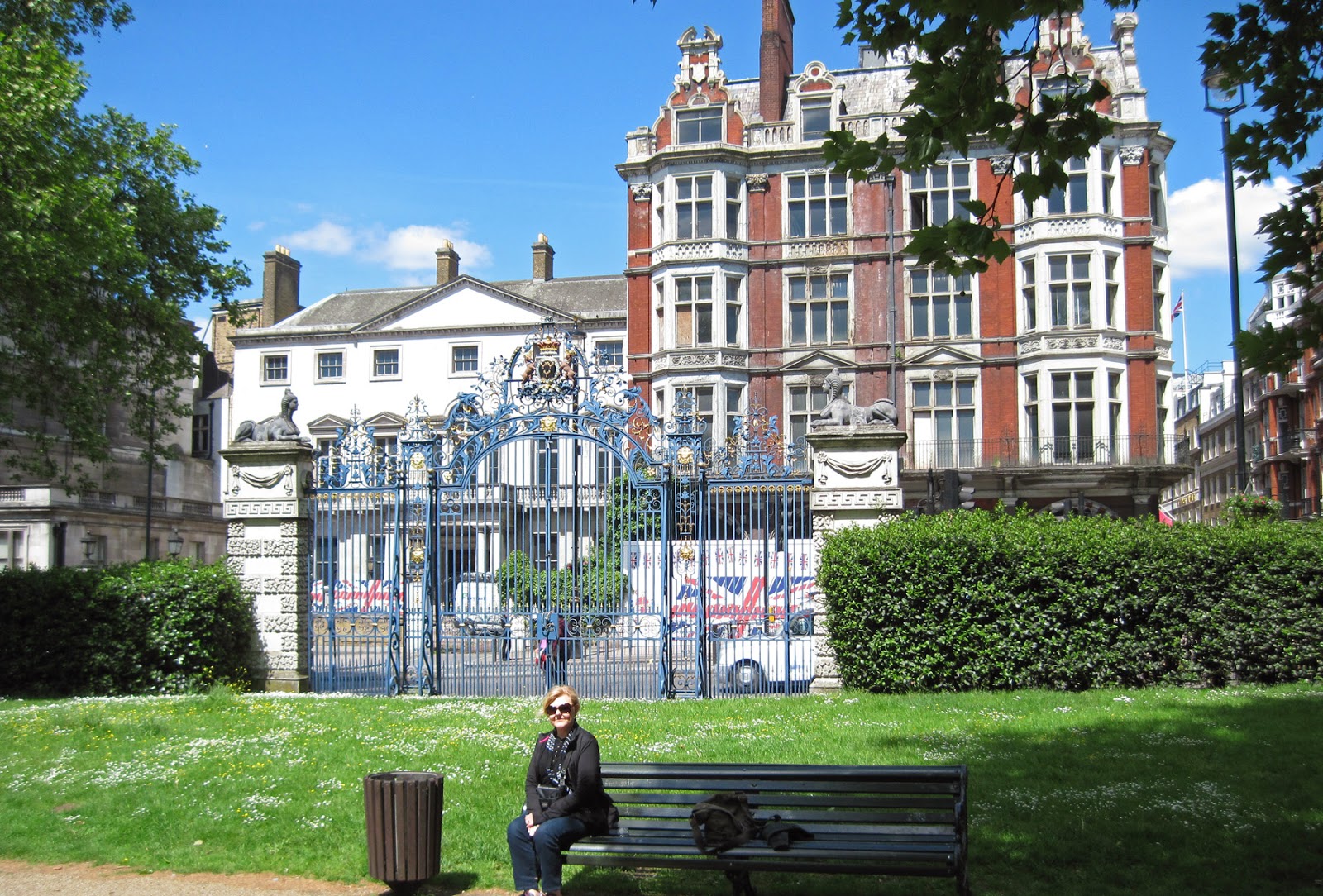
    Cheryl Bolen, with relocated Devonshire House Gates
(In the 2013 photo above, I'm seated within Green Park with the Devonshire House gates behind me.) A London underground ticket office now lies beneath what was once Devonshire House, and now the Ritz is across the street.
 
(In the photo above, taken from Green Park, the French-looking Ritz Hotel is on the right, abutting Green Park, and the office building that replaced Devonshire House in the 1920s is the larger building in the picture. The white structure in front of it houses ticketing for the Underground.)

Home to the Dukes of Devonshire, the Palladian house was completed in 1740 for the 3rd Duke, with William Kent serving as architect. This structure replaced the former Berkeley House, which burned. Berkeley House, bordered by Piccadilly and Berkeley Street, had been built in 1665-1673 by Lord Berkley and was later the residence of Charles II's mistress, Barbara Villiers, before the 1st Duke of Devonshire bought the classical mansion.

Though the exterior of Kent's Devonshire House was plain, the interiors were said to be sumptuous, with a 40-foot long library the highlight of the three-story house. It also housed what was said to be the finest art collection in England. Many of these paintings can now be found at the current duke's opulent country house, Chatsworth House.

Devonshire House was famed in the late 18th century as the nucleus of Whig politics, presided over by the duchess Georgiana, wife to the 5th duke. A hundred years later a grand dress ball to celebrate Queen Victoria's diamond jubilee was held there. Also during Victorian times, the house was altered by James Wyatt, who was one of the most fashionable architects in the late 19th century.

Following World War I, Devonshire House was abandoned in 1919 as the 9th Duke was the first to be required to pay high death duties. These amounted to £500,000 (approximately $16 million today). The 9th duke sold off much of his fine library, including a Caxton and many first editions of Shakespeare. In 1921, he sold Devonshire House and its three-acre garden for $750,000. The house was demolished in 1924, and an office building--also called Devonshire House--now stands on the site.--Cheryl Bolen. See www.CherylBolen.com for more articles.

Monday, February 24, 2014

Spring Holidays in Regency England

Spring is in the air--almost. It's certainly coming and spring holds many holidays for Regency England. But let's look first at the very important quarter days and the overall English calendar year.


The most ancient of calendars are based on solar and lunar events. This gives us, in England:

            * Winter solstice, also known as midwinter, Yule, or Alban

            * First cross-quarter day, also known as St. Bridgid’s Day, Imbolic, or Brigantia

            * Vernal equinox

            * Second cross-quarter day, also known as May Day, Walpurgis, or Beltaine

            * Summer solstice, also known as midsummer, or Samradh

            * Third cross-quarter day, also known as Lammas, or Lughnasadh

            * Autumn equinox, also known as Mabon

            * Fourth cross-quarter day, also known as All Hallows or Samhain

These dates were important for farming and rural life since they were based on the seasons; religious holidays were formed around these dates, including those of the church.

In March, Lady Day, March 25, was the traditional day for planting, and hiring farm laborers for such work. In the church calendars, this day was set as the Feast of the Annunciation, when the angel Gabriel visited the Virgin Mary to tell her about her upcoming role. This was also the traditional day for when yearly agreements might end or need renewal—it was the old day for the first day of the year. This made it one of the main quarter days.

The quarter days were when servants were hired, rents were due, and assizes were held in the Assizes Towns, over Assizes Week. Assize comes from the Old French and meant that judges travelled the seven circuits of England and Wales, setting up court.

The English quarter days (also observed in Wales and the Channel Islands) are:

March 25       Lady Day
June 24         Midsummer Day
Sept 29          Michaelmas
Dec 25            Christmas

Cross-quarter days that fall between the quarters, adhere to older Celtic holidays:

Feb 2              Candlemas
May 1             May Day
Aug 1             Lammas
Nov 1             All Hallows

In Ireland, prior to 5th century AD, the old Celtic quarter days were observed:

Feb 1              Imbolc
May 1             Beltaine
Aug 1             Lunasa
Nov 1             Samhain

The old Scottish term days, and the quarter days in northern England until the 18th century, were:

Feb 2              Candlemas
May 15          Whitsunday
Aug 1             Lammas
Nov 11           Martinmas

(For more information on quarter days and cross-quarter days, visit: http://www.almanac.com/content/quarter-days-and-cross-quarter-days.)

St. David's Day, the Welsh patron saint, came on March 1, and tradition held that all good Welshmen should wear a leak—a vegetable readily available from winter fare.

March also brought Lent, and very often Easter (in March or April).

EASTER

You may think that colored eggs and rabbits are modern inventions, but these are actually ancient traditions associated with Easter. (It’s only the chocolate Easter bunny and the bunny with eggs in its basket that are new.)

Eggs are associated with fertility and new beginnings. And the hare is also an ancient symbol used since the Middle Ages by the Church. In 1290, King Edward I of England actually ordered 450 eggs to be gold-leafed and colored for Easter gifts.

Pace Eggs are hard boiled eggs with patterned shells, and are traditional made in northern parts of England.

At Biddenden in Kent at Easter, the Biddenden Dole—bread, cheese, beer, and cake—is distributed. Since the late 1700’s, the cake given out bears an image of two women said to be the founders of this charity, a pair of Siamese twins who were born in 1100 and died within a few hours of each other at thirty-four.

Hot Cross Buns are also an old tradition in England. It is said they were made by Saxons to honor their goddess Eostre, with the bun represented the moon and the cross the moon's quarters. But at Easter, the cross symbolizes the crucifixion. They’re traditionally served warm on Good Friday.

In Shropshire and Herefordshire, Simnell Cakes made with saffron were made for the Easter season. But in many parts of England, the Simnell Cake is made at the end of Lent, the period of forty days before Easter (starting with Fat Tuesday and Ash Wednesday).

In the 17th century, Mothering Sunday, the fourth Sunday in Lent, became the day when those in service were allowed a day off to go and visit their mothers. Girls would bake their mothers a Simnell cake as a gift.

I’ll to thee a Simnell bring
‘Gainst thou go’st a mothering,
So that, when she blesseth thee,
Half that blessing thou’lt give to me
.’
            --Robert Herrick, 1648

In England, Maundy Thursday, is the beginning of Easter celebrations and commemorates the Last Supper. The name comes from the Latin, mandatum (relating to Jesus’ commands to his disciples).
Up to 1689, the king or queen would wash the feet of the poor in Westminster Abbey. Food and clothing were also handed out to the poor. Maundy coins—specially minted—were also given out to pensioners.

From the fifteenth century on, the amount of Maundy coins handed out, and the number of people receiving the coins, was tied to the years of the Sovereign’s life and given to celebrate specific events. The Yeomen of the Guards carry the Maundy money in red and white leather purses on golden alms trays on their heads.

Of course spring also meant a return to London for the start of the Season and all it's social whirl.

Friday, February 7, 2014

Pirate ships and the Queen Anne's Revenge

During the golden age of piracy, most pirate ships were of the smaller variety, such as the sloop and the schooner. These vessels were built for speed and could easily sail in shallow water—an advantage when evading larger warships that required deeper waters. However, when I wrote my pirate regency romance, The Guise of a Gentleman, I patterned my hero’s ship after the vessel sailed by the nefarious pirate, Blackbeard.
Blackbeard’s flagship was a 300-ton English frigate built in England in 1710 christened Concord. A year later, the French captured her, modified her for larger cargo capacity, and gave her a new name, La Concorde de Nantes.
About six year later, she was captured and found herself the property of the widely feared and certainly fearsome pirate known as Blackbeard. It is commonly believed that the true identify of Blackbeard was Edward Teach, although I've read enough experts who question this theory that no one appears sure who he really was. Regardless of his real name, the pirate Blackbeard added additional cannon, since he preferred to attack with the power of a warship rather than with stealth and speed preferred by most pirates. All these modifications changed her silhouette to more closely resemble ships built by the Dutch during that era. Once again, she was given a new name—this time, she became know as the Queen Anne's Revenge a feared name indeed. 

Different theories circulate as to the reason for this unusual name. It might have come from Edward Teach's reported years of service in the Royal Navy during a war known as the War of the Spanish Succession, which the American colonies called the Queen Anne's War, in which Blackbeard had served. Perhaps he felt some sympathy or loyalty to the last monarch of the Stuarts. After studying him, I doubt sympathy was in his nature; it was probably some kind of cruel joke.

While in command of the Queen Anne’s Revenge, Blackbeard terrorized the seas from the west coast of Africa to the Caribbean and he took 18 ships as his prizes. The Queen Anne's Revenge is the largest known, and certainly the most infamous, pirate ship that sailed the Spanish Main and played the staring role in the historical stage of piracy in the Americas. 

Because my hero, Jared Amesbury, was such a feared and well-known pirate in my Regency romance novel, The Guise of a Gentleman, I decided to pattern his ship after Blackbeard’s. In fact, Jared, known as Black Jack, and his crew spread many rumors of his cruelty to those to defied him to instill fear and inspire surrenders. Some of these atrocious tales which Jared invented were in fact those that Blackbeard and his crew reportedly committed. My hero never commits those acts he claims to have done, and, in fact, has a high code of honor regarding the treatment of prisoners and the protocol of boarding ships. After studying pirates, I doubt many pirates actually held to such high ideals. Still, pirates have always captured my imagination. Arrgh, matey!

Friday, January 31, 2014

Barbaric Practices in the Name of Medicine


"I was obliged to send for the Apothecary, who bled me very plentifully, but, tho' it made me faint, it has reliev'd me wonderfully. Tonight I feel languid and stupid." Those two sentences were written around 1800 by Lady Harriett Bessborough to her lover, Granville Leveson Gower. (A couple of days later, she came down with the chicken pox.)

As those of you familiar with the 18th and 19th century know, the aforementioned blood-letting was a common occurrence up until the 20th century. It was only one of the idiotic practices that were inflicted upon well-educated people by medical practitioners whose knowledge of  the human body--by today's standards--was nonexistent.

In my reading of journals and letters from the era, I'm quite often shaking my head in disbelief over the barbaric treatments subjected upon patients by apothecaries, physicians, surgeons, oculists, and dentists. Here are some of these bizarre treatments I've underlined in my readings.

Take Georgiana, Duchess of Devonshire, sister of Lady Bessborough. When her eye swelled up, the surgeons were summoned. Among these oculists was Senior Surgeon-Extraordinary to King George III.  One of these so-called learned men almost strangled her to death in an effort to flush the blood up to her head. They also "broke" her eye, rendering her deformed for the rest of her life.

Bear in mind, there was no anesthesia at the time; so, most of these procedures were done on patients who were awake.
 
One wonders how people survived at all. Of course, we know life expectancy was quite low, and many early deaths must be laid at the door of these quacks. These medical practitioners had no medical training. They studied astronomy, thinking that the human body's "humours" were affected by astronomy.

Another case of misguided doctoring occurred with the young son and heir of Lord Elgin (of Elgin Marbles fame). The sickly lad suffered from asthma, so it was recommended to have him drink mercury. His doting mother, thinking she was spurring her son to good health, kept dousing him with the toxic mercury.

Needless to say, the lad never inherited his father's title for he died young after suffering a lifetime of very poor health. (His father's title passed to a son from Lord Elgin's second wife, after he divorced the lad's Scottish heiress mother.)

In her memoirs Mary Elizabeth Lucy, the mistress of Charlecote Park, tells of a tumble she took as a girl around 1810. It loosened her teeth. Her concerned mother took her from their home in Wales to consult a dentist in Liverpool who was known to be very clever. He immediately recommend removing every tooth in her mouth, setting them in gold, and putting them back. He said if he didn't do that, all the teeth would drop out.

A panicky Mary Elizabeth entreated her mother not to allow the dentist to remove all her teeth. And at age 80, all her teeth were still intact.
 
Mary Elizabeth also tells of the three doctors who attended her daughter, who'd suffered an attack of tetanus. "They cut off all her beautiful hair, blistered her poor head and nearly her whole body and applied such hot bottles to her feet and legs that they made them perfectly raw." Remarkably, she survived that treatment, but her lifespan was less than half of her mother's.
 
Reading these accounts deglamorizes the life of the rich and famous of Georgian England and makes me ever so glad I was born when I was. -- Cheryl Bolen, whose newest Brides of Bath book, Love in the Library, released this week
 

Tuesday, January 28, 2014

Regency Recipes


Part of the fun for any book is in the details—the clothes, the settings, and the food. Yes, the food. In the Regency, the upper class had fabulous meals. French chefs were imported by those who could afford the cost, and for some it became a competition to see who could serve the finest delicacies. Dishes such as “curry of rabbits”, “fricando of veal”, or even sugar icing moulded into “The ruin of the Turkish mosque” were dishes designed to impress. However, there was also good English fare to be found, such as leg of mutton, pheasant, salmon, trout, ham, chickens, macaroni, and all types of puddings. But to be truly fashionable, the fare should be French—meaning sauces.
The old joke has always been that France is the land of one religion and a thousand sauces, while England is the land of a thousand religions and one sauce. There is a good bit of truth in that, for many a country squire likes his beef and ale, and quite a few ate little else (for breakfast, and dinner—lunch is a more modern invention). Today, English pub-grub can also bring this saying to mind, for very often the only sauce is either salad dressing or malt vinegar for your “chips”. However, there are good English restaurants (Rules has been serving in London since the late 1700’s and offers up perhaps one of the finest Dover soles I’ve ever had, with as delicate a sauce as you can find on either side of the English Channel). And Regency recipes can set your mouth watering.
Below are a few of the more “doable” recipes. Quantities back then were not standardized and often ask for “a good handful” or for items that are much harder to come by today. However, these are recipes you can make on your own.
FRENCH SALAD
        Maria Rundell’s book, Domestic Cookery by A Lady, became a best seller, with both recipes and household advice. Here is one of her recipes for a French Salad.
        "Chop three anchovies, a shalot, and some parsley, small; put into a bowl with two table-spoons-full of vinegar, one of oil, a little mustard, and salt. When mixed well, add by degrees some cold roast or boiled meat in very thin slices; put in a few at a time; not exceeding two or three inches long. Shake them in the seasoning, and then put more; cover the bowl close, and let the salad be prepared three hours before it is to be eaten. Garnish with parsley and a few slices of the fat."
        GOOSEBERRY PUDDING
        This recipe also comes from Mrs. Rundell. But the “pudding” is not anything like what we would call a pudding but is a baked dish (and quite tasty). If you actually wish to try this, you may want to start with gooseberry jelly. For the 'few crumbs of roll’ called for, think of this as something like a bath bun--a sweet roll. For biscuit, think cookie, something sweet to crumble into the dish.
        "Stew gooseberries in a jar over a hot hearth, or in a sauce pan of water till the will pulp. Take a pint of the juice pressed through a coarse sieve, and beat it with three yolks and whites of eggs beaten and strained, one ounce and half of butter; sweeten it well, and put a crust around the dish. A few crumbs of roll should be mixed with the above to give a little consistence, or four ounces of Naples biscuits.”
        YORKSHIRE CAKES
In setting The Cardros Ruby in Yorkshire, I opted for a place of rugged beauty, which also allowed the guest to be housebound by frost. The cook for the household is French, and so serves up a few exotic dishes, including a sorrel soup and beef ala royale. My father's mother came from Sheffield in South Yorkshire, and I felt quite at home on the rugged moors with its purple heather blooming or roaming the green Dales. This other recipe, therefore, that might well have been used in The Cardros Ruby. This recipe comes from Hanna Glass’s cookbook, published in 1765.
“Take two pounds of flour, and mix with it four ounces of butter melted in a pint of good milk, three spoonsfull of yeast, and two eggs: beat all well together, and let it rise; then kneed it, and make into cakes; let them rise on tins before you bake, which do in a slow oven.” 
To translate this to the modern era (and add in my grandmother's Yorkshire secrets), melt 4 oz of butter. Add the melted butter, a pint of milk, and a packet of self-rising yeast to two pounds of four. Add two eggs and mix well. Cover and let rise in a warm place. When dough has doubled in size, beat down by hand, and kneed (this is a perfect task to have your kids do—we did this for grandmother). Tear off fist sized pieces of dough, shape into round forms and lay on a baking sheet. Cover and let rise again (for 1/2 to 1 hour). Bake at 350 degrees until brown.

Friday, December 27, 2013

19th Century London at Dawn's Break


What were Londoners doing if they were not born into the class that was permitted to sleep late? Just after the break of dawn, shops – and, surprisingly, pubs (public houses) – opened. Here's an excerpt from Charles Dickens' Oliver Twist, which was published in installments beginning just after the Regency, in 1837. This short excerpt paints a vivid picture of the various conveyances and workers, including milk women.
                                                                      Milk woman
 

            In the Bethnal Green Road the day had fairly begin to break. Many of the lamps were already extinguished; a few country wagons were slowly toiling on toward London; now and then, a stage-coach, covered with mud, rattled by: the driver bestowing, as he passed, an admonitory lash upon the heavy waggoner who, by keeping on the wrong side of the road, had endangered his arriving at the office a quarter of a minute after his time.

            The public-houses, with gas-lights burning inside, were already open. By degrees, other shops began to be unclosed, and a few scattered people were met with. Then, came the struggling groups of labourers going to their work; then, men and women with fish-baskets on their heads; donkey carts laden with vegetables; chaise-carts filled with live-stockor whole carcasses of meat; milk-women with pails; an unbroken concourse of people, trudging out with various supplies to the eastern suburbs of the town,

            [In] the City the noise and traffic gradually increased; [and in] the streets between Shoreditch and Smithfield it had swelled into a roar of sound and bustle. It was as lilght as it was likely to be, till night came on again, and the busy morning of half the London population had begun.—Cheryl Bolen, whose newest Brides of Bath Regency novel will release on Jan. 27

Monday, December 23, 2013

London Shops


London Shops
             It seems almost obligatory when writing a Regency set in London, England, to include a shopping scene. After all, the Regency is associated with style, wealth, and fashion. So how can anyone ignore the shops those three things are in bold display. However, because this has been done so much, how do you make the scene fresh?  That’s where a little research can turn up gold nuggets.
            For A Dangerous Compromise, I needed a shopping scene, of course. It was set in London, after all. And characters need to do things—they cannot always be sitting in drawing rooms or going for drives. Now scenes cannot just be thrown into a book—every scene needs a reason to exist. And every scene needs conflict. But scenes also need to be set some place—and the more specific the place used, the more vivid the scene. If the setting adds to the scene, all the better. For this book,I found just the thing in the “Soho Bazaar” in Soho Square: 
            Lady Havers soon gave them all the background any of them could want on the bazaar.
            It had only just been opened that year by a Mr. Trotter to help the widows and daughters of men who had died in the recent wars, a noble cause that thrilled Lady Havers. The bazaar occupied the northwest corner building in the Square, and vendors sold their wares in stalls set up along two floors, offering gloves, lace, jewelry—almost anything that might be crafted for sale.
            It was, in short, a paradise for Lady Havers, whose eyes lit with a rapacious glow when they entered.
            And there it was—the setting in just a few sentences. A nice transition into the scene about to take place. The setting not only provided a backdrop for the heroine to have to deal with two men who are vieing for her attention, it also provided the contrast of vendors—folks who must earn their meager livings—with those who need never work. This layered in additional conflict, which went beyond that of the characters. And it was fresh. It also happens to provide a touch of historical detail that made the scene into something more than yet another shopping scene.
            The same issue cropped up again in Under the Kissing Bough. Again, we were in London—which is why it is often so much more fun to set a book in the countryside. This time I had an engaged couple, and they could hardly leave London without first shopping for the bride. With this being an arranged marriage, I knew the scene had to highlight the conflict of two people who don’t really know each other but who are going to be tied to each other for life. I needed a setting that would emphasis the heroine’s discomfort with the situation—and which would also provide an opportunity for these two to start to find a few things in common.
            This time, I found Schomberg House—a grand mansion that had been converted into shops and a place that sold refreshments. In other words, the ideal place to show that the heroine doesn’t much like all this fuss, but she’s going to be married to an earl’s son, and this gives me a place where these two could have a few minutes alone:
            It was but a few minutes' drive to Schomberg House, a handsome, four-story mansion, built for the Duke of Schomberg in the late sixteen hundreds, but now converted into shops that offered small furniture, drapery hangings, and refreshments to those worn out by their efforts in spending money.
Eleanor looked about her, hanging back a little from the others as they entered and mounted the staircase. She had not visited here before, but she knew from reading her London guidebooks that Thomas Gainsborough had lived and painted here until 1788. That such a famous artist had occupied the house awed Eleanor, and she stared about her, wondering what he had found to inspire him to greatness.
A deep voice pulled her out of her thoughts. "Miss Eleanor?"
She glanced up into Lord Staines's handsome face. Expecting to see a frown, relief eased into her when she saw that a smile softened his mouth instead.
He gestured to the baroque grandeur, the gilt and carved wood. "Are you lost in admiration?"
"Actually, I was wondering if grand rooms inspire grand thoughts. Or do they too often instead inspire grand ambitions, and grand arrogance?"
He cocked his head and his eyes took on a sparkle. "I was about to say we have even more impressive stairs at Westerley, but now I fear I would be inviting comparison to arrogance or ambition."
…A little shy of him, she put her hand on his arm. He led her forward, talking about the quality of the refreshments to be had and offering stories about the room, which had once served as the breakfast room of the house. He seemed to be going out of his way to be pleasant, and she began to relax a little.
Those little details—the few bits of description—added just what I wanted for this scene. But where do you get such wonderful little slices of history?
One of my main sources has been Allison Aldberg, with her books Shopping in Style and The Silver Fork Society.  Both books are rather hard to come by, but offer a look into the shops of Regency England.
In London, Smithfield Market, also called West Smithfield, was one of the main London markets for cattle, sheep, hay, straw, and horses. Hungerford Market, located between the Strand and the Thames, had been built in the time of Charles II as a market for vegetables. In 1829, it was noted, however, as 'never having caught on' and a print of that era shows a less than bustling market square. Fleet Market, next to Fleet Prison, opened in 1727 and remained active until the late 1820's. As noted in London in the Nineteenth Century, "This market consisted of two rows of shops, almost the whole length of it, with a passage between, paved with rag-stones." And, of course, one cannot overlook the shops of Bond Street, and Regent Street, the shops that would develop along Oxford Street, and the beauty of the Burlington Arcade which was built in 1819 and is still as lovely as ever.