Readers of Regency romances will swiftly acknowledge
the frequency with which these historical novels have scenes set in gaming
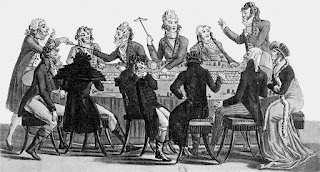
clubs or gaming hells. The aristocracy, gentry, and common workers alike
enjoyed gambling and did it with some frequency during the period. It has been hypothesized
by Author Pitt in his master’s thesis on gambling during the Regency period,
that gambling, and wagers in particular, were a means of fighting boredom. So
there is little wonder that both gambling clubs and gambling hells were frequented
often by people of all walks of life in Regency London.
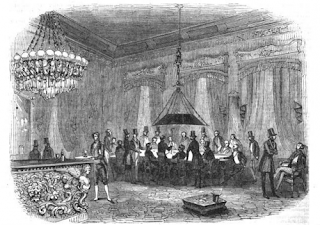
Gaming clubs were establishments frequented by the
aristocracy, exclusive and with strict guidelines for behavior. The most
exclusive of the time were The Cocoa Tree, White’s, Brook’s, and Almack’s. They
were located in St. James and were considered the poshest of the gaming
establishments. These were called “golden hells” and catered to the upper crust.
These were in direct contrast to the gaming hells or “copper hells” patronized by
the lower classes. The “golden hells” were just as apt to use gambling and
outrageous wagers. The wagers were entered into a “betting book” so the
participants didn’t forget the terms and amounts wagered. One remarkable wager
found on the books states, “April 2nd, 1809. Mr. Howard bets Mr. Osbon Ten
guineas that Lord Folkestone does not marry Miss Taylor before this day twelve
month."
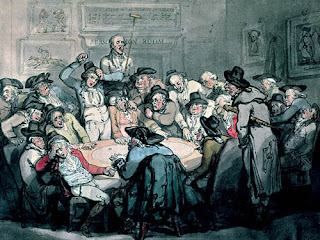
Gaming hells were for the lower, less genteel
clientele. Their likes frequented clubs in a rougher part of London, which admitted
people of all walks and stations of life, and both genders in some cases.
Ladies were not allowed in the gambling establishments of the wealthy, as they
were considered gentlemen’s clubs and off limits to ladies.
The types of games played were split down class lines
as well. The aristocratic clubs played card games that required some skill to
win, such as Whist (the forerunner of Bridge), piquet, Vignt-et-Un (which we
know as 21), and Faro. Gaming in the “copper hells” relied mostly on games of
chance, such as Hazard, a dice game that was an early form of Craps which
required no skill and lots of luck.
Next month I will follow this post on gambling in
general with a specific look at one of the more notorious gambling houses of
the later Regency period: Crockford’s.
One of my favorite Christmas movies is the 1970 musical Scrooge with Albert Finney. The production values of the film are wonderful—as you watch it you truly feel transported into the Victorian London of Charles Dickens.
In one sequence Bob Cratchit is heading home, buying Christmas presents, food and drink for the family’s Christmas celebration the following Christmas Day.
That journey has always fascinated me and made me think about how and what the Victorians ate at Christmas.
Depending on class and location, Christmas food traditions varied quite a bit, although there is also a lot of agreement on what should be eaten
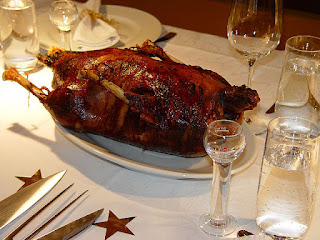
for the holiday feast, generally the most meal extravagant of the year. The centerpiece was usually either a standing rib of beef with Yorkshire pudding in the households of the North, while the roasted goose with sage and onion stuffing graced the tables of the South.
Another tradition was to serve a rum punch, apparently a favorite Christmastide ritual for Charles Dickens. The making of the punch was quite a production, and Dickens would explain each step to his guests as they watched the punch being concocted. The drink is made in a large fire-proof punch bowl, where you combine lemon peel and sugar, dark rum and cognac, stir well, then take a spoonful of the mixture and light it on fire and return to the punch bowl to set it alight. Dickens would then lift out fiery lemon peels for the guests to admire. Afterwards, the flames are extinguished by a metal tray placed over the punch bowl. Nutmeg was then grated over the punch and ladled out to the guests.
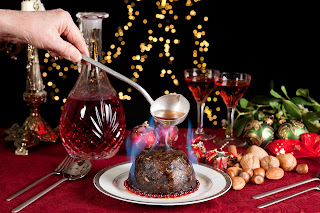
And last but not least was the Christmas or Plum pudding. Traditionally, this pudding was begun on the Sunday before the beginning of Advent, called Stir-up Sunday. If the household was to have good luck, the Christmas pudding must be begun on this day and left to ripen until Christmas Day. God’s blessing would only be bestowed on those who started their puddings on this day. For good fortune, the entire household should help with stirring the pudding with a wooden spoon and only clockwise and only East to West to honor the journey of the three kings. Once all the ingredients are assembled—raisins, currants, sultanas, dates, citrus peel, almonds, spices, cake crumb or breadcrumbs, brown sugar, butter, brandy or tum, and stout—the pudding is boiled or steamed for six hours, then removed from the pudding basin and wrapped with foil and a pudding cloth. It is then aged for about two months. On Christmas Day it is boiled for another four hours, then unmolded onto a platter. A ladle of brandy is heated then poured over the pudding and set alight for a dazzling desert.
There are many other traditional foods the Victorians ate at Christmas, but I thought these three would give a good idea of how the Victorian chose to celebrate the Season with fabulous food.
I sincerely hope everyone has a warm and wonderful holiday season with your own special traditions and food.
Sources:
Burns-Booth, Karen. “Stir-Up Sunday, Traditions and My Traditional Victorian Christmas
Pudding Recipe.” Lavender and Lovage: Food and Travel from Home and Abroad,
November 24, 2012.
Graham, Colleen. “English Christmas Punch.” The Spruce Eats Newsletter. May 13, 2021.
Wondrich, David. “Holiday Punch—Plus a Cozy Fire.” Esquire, December 11, 2012.
There's nothing quite
like the glimmer of a Christmas tree, brightly wrapped packages, and a yule log
burning in the fire to invoke wonder and excitement. But you may be surprised
to know that many Christmas traditions are quite new--at least in England. Many
English Christmas customs we think are ancient actually sprang up as early as
the Victorian Era.
Regency Christmas traditions varied widely from region to region and even
family to family. Generally, the upper classes of Regency England didn't treat
Christmas as a special day beyond a church service and the exchange of small,
mostly hand-made gifts within the family. Ordinary household items such as pen
wipers and fire spills seem to have been common gifts, as well. The middle
classes made a bigger event out of Christmas than their so-called
"betters." Lucky them!
The reason why Christmas became so understated is largely due to Thomas
Cromwell, who served as Chief Minister during the reign of King Henry VIII.
Cromwell and his cronies virtually stamped out Christmas celebrations due to
their origins—pagan licentious superstitions which often resulted in drunken
brawls and even vandalism. Although I seldom approve of the destruction of any
holiday, I can’t really blame him for his disapproval of that sort of
misbehavior.
Fortunately, the Restoration revived Old Christmas into a new, toned-down
version of its former bawdy revelry to one of quiet worship and time together
with family. During the Regency, more and more celebratory customs cropped up.
I suspect many families had practiced some of those customs all along secretly.
Yorkshire is an area that seemed to hold on the most tightly to the Old
Christmas traditions and enjoyed them openly when it became acceptable.
While researching English Christmas customs, I found journal entries and
letters describing family events at the Big House, many of which I incorporated
into my newest novel, Christmas Secrets. I exercised my creative
license to have the local tradition include a ball at the Great House,
gathering greenery including a mistletoe "kissing ball," the Yule
Log, and singing carols, along with other fun aspects of the season on
Christmas Eve.
Largely thanks to Queen Victoria's husband bringing his German traditions
with him to England, which spread to the United States, Victorian Christmas
customs grew into the ‘traditional’ Christmas we all know and love, complete
with carolers, a wider variety of gifts and recipients, Yule logs, Christmas
puddings, cards, Christmas trees, many of the carols we sing today.
Travel in winter in England during the Regency was extremely hazardous,
therefore it was rarely done. By in large, Christmas house parties had to wait
until railroads made winter journeys more feasible, which happened after 1840.
Of course, I and every other author I have read largely ignore this, although
in some of my Christmas stories, I mention people not wishing to travel far due
to the weather.
An odd custom that does date back centuries is telling scary ghost stories.
This age-old tradition dates so far back that I couldn’t find its true origin.
Aside from the traditional Christmas story, A Christmas Carol, I’m happy
that telling ghost stories is no longer part of most family Christmas customs.
Can you imagine getting a child to bed who is both excited about Santa’s presents
and frightened of ghosts? Now that is scary!
In the mood for a little holiday romance? Check out my Christmas novel, Christmas Secrets,
which features a ghost, and kiss, and a happily-ever-after.
Sweet Regency Christmas
Christmas Secrets
A stolen Christmas kiss leaves them bewildered and breathless.
A charming rogue-turned-vicar, Will wants to prove he left his rakish days
behind him, but an accidental kiss changes all his plans. His secret could
bring him together with the girl of his dreams...or divide them forever.
Holly has two Christmas wishes this year; to finally earn her mother's approval
by gaining the notice of a handsome earl, and to learn the identity of the
stranger who gave her a heart-shattering kiss...even if that stranger is the resident
Christmas ghost.
Handfasting as a means of joining a man and a woman in marriage has been known in the Celtic world since ancient times. It is believed to be part of the heritage Scotland owes to the Danish culture, where “the Danes [had] the option of ‘hand-vesten’ to show their commitment. Then a woman who lived publicly with a man and prepared his meals for three years became his lawful spouse.”
Originally the handfasting ceremony was performed almost as a stop-gap measure, allowing the couple to live as man and wife for a year and a day as they waited for an official member of the clergy to arrive and bless the union in a regular marriage ceremony. Lacking a clergyman, the couple could swear their intention to marry, have their hands bound (preferably before witnesses), and they would be considered married.
The tradition of handfasting was a medieval form of marriage in use until the mid- 1700s, when it fell out of favor. Until then, the Roman Catholic Church, and somewhat later the Scottish Protestant Church, allowed that if a couple said the words, “I take you to be my wedded wife,” (present tense) or “I will take you to be my wedded wife,” (future tense). The couple’s right hands were bound with a strip of cloth, signifying that they were bound for eternity. If this ceremony was followed by sexual intercourse, the couple was considered married both in the eyes of the Church and the State. There need be no witnesses and no clergy present, although witnesses were encouraged.
Interestingly enough, during the Regency period in Scotland, handfasting was actually still a legal means of marriage. Although the church changed its laws to ban the ritual, the civil law allowing handfasting as legal remained on the books until 1939 when the marriage laws were reformed by the Marriage Act (Scotland) of 1939. After that, handfasting was no longer recognized as a legal form of marriage.
In my soon to be released romance novel, The Widow Wore Plaid, which is set in Scotland, I had to research the legalities and technicalities of a
handfast marriage, as my hero and heroine consider the merits of it while under duress. The Widow Wore Plaid is currently on pre-order on Amazon and other e-book retailers.
Argyll-Bute Council. “Handfasting Ceremony.” 2018.
The Scotsman. “The Origins of Handfasting at Scottish Weddings—When Scots ‘married’ for a year and a day.” Feb. 14, 2019.
Friday, October 15, 2021
Early in my writing career, the best piece of writing advice I ever got—right behind “be persistent”—was “write what you love.” So I did. I wrote everything because I loved everything, but eventually settled on historical romance.
I’ve always loved historical fiction. As a child, I devoured Anne of Green Gables, Little Women, the Little House books, The Secret Garden and A Little Princess. Later I discovered Jane Eyre, the Jane Austen novels, and other historical classics. But again, I craved more romance. Fortunately for me, historical fiction was a hot market. The hard part was finding a book clean enough for me because I don’t like to read hot sex scenes. Once I discovered traditional Regency romances, which were generally very clean, sweet romances, I was in heaven. It was not to last, however.
Historical fiction's popularity waned, and for about a decade, sales across the board plummeted. Perhaps readers tired of hot, sexy romance novels referred to as “bodice rippers” and "clean and wholesome" romance novels had not yet become a category. Instead, they were termed Traditional Regencies, which enjoyed success for a while, but they, too, fell out of popularity. The worst blow came when I learned two major traditional Regency romance publishers closed their doors. The news broke my heart, not only because I loved reading them, but because I’d written a sweet, traditional Regency romance novel that I’d been hoping they’d publish. For a long time, people called historical romance—and Regency romance in particular—a “dead” market. Sob!
Good news! Historical Romance novels, specifically Regency Romance novels, have regained popularity. Sales are skyrocketing for all historical romance, both on the hotter side and those sweeter, more traditional romances such as what we expect from Jane Austen era novels or Georgette Heyer. Personally, I love a clean romance, and if it’s a clean historical romance—even better!
As a historical author, I had to wonder; why the return of the historical romance?
I think there are many reasons. One is with all the recent movies based on famous books such as all the Jane Austen's, North and South with the dreamy Richard Armitage, and many other historical novel adaptations, especially Jane Austen adaptations, a whole new generation of fans have been converted to historical stories--historical romances in particular.
Another reason I believe historical romance novels have regained popularity is because most people read either to relax or escape (and escaping is part of relaxing, don’t you think?). We crave a true escape from the modern world with all our troubles that only a journey into new world can provide. Maybe it’s the fantasy element of vicariously living the life of the very rich, wearing beautiful gowns, having handsome heroes vie for our favor or even dueling over our honor.
In Regency England, manners were very formal. There was a protocol to everything from how many sets a lady could dance with a gentleman in one evening (two), to what to wear while walking (a walking gown).
I love the way people in Regency England spoke so eloquently. They also prized wit and they excelled in using the understatement. As a historical author, I try to bring that out in every historical novel I write.
Regency men were civilized and treated women with courtesy. When a lady entered the room, gentlemen stood, doffed their hats, curtailed their language, offered an arm, bowed, and a hundred other little things I wish men still did today. But they were also very athletic; they hunted, raced, fenced, boxed, rode horses. They were manly. Strong. Noble. Resolute. Honorable. And that is why I love them!
I hope that historical romance is a here-to-stay market.
What do you love best about historical novels or historical romance?
One trope or event found very often in period romances is “the swoon.” It is true ladies did faint with some frequency in the Georgian, Regency, and Victorian periods. In some cases tightly laced clothing is the culprit for these fainting fits, but there were other reasons for it as well.
The tightly laced corsets and heavy fabrics of the Georgian and Victorian periods almost assured that ladies would faint from the
sheer lack of oxygen at some point in her day. Regency ladies, however, enjoyed lighter fabrics and a very short demi-corset or stays that gave them closer to a natural experience as far as clothing was concerned. Still, Regency ladies still fainted regularly for a variety of reasons.
The actual medical condition associated with fainting is called Vasovagel syncope. It’s the nervous system’s reaction to great stress or some kind of emotional trigger. What happens is the heart rate slows, there’s a sudden drop in blood pressure, depriving the brain of oxygen and therefore triggering “the swoon.”
An attack of nerves or “the vapours” might be enough to make a lady swoon. Some ladies, wishing to be thought very delicate or sensitive (a popular quality during the Regency) would faint or pretend to faint to give the appearance of delicacy. This show of weakness was a prized quality by gentlemen, brought up to believe that women were the weaker sex and therefore could not bear such vulgarities as foul language, explicit talk (especially about sex or anything having to do with bodily functions), or even bad manners. In fact, so many ladies felt the need to swoon that a popular piece of furniture during the period was the fainting couch.
Every lady was forearmed against the possibility of an attack of the vapours with a small vial of smelling salts called a vinaigrette.
These were small glass bottles or boxes, often with silver filigree coverings, that held sal volatile, one of several concoctions designed to jolt the fainter back to consciousness. Smelling salts could contain a mixture of ammonium carbonate and alcohol, or spirit of hartshorn (water and ammonia). By the Regency, a strong distilled vinegar with added essential oils like lavender, was the preferred potion used. The vinaigrette was held beneath the victim’s nose and the inhalation of the spirits would snap them back to consciousness.
In my recent release, Almost a Countess, my heroine, Dora Harper, uses her vinaigrette several times to revivie the hero, Lord Aberfoyle when he is injured. But the table turns when he also wields the smelling salts to revive her from their first kiss! You can find Almost a Countess on Amazon.
Sources:
Hewitt, D. G. “The 10 Do’s and Don’ts of Etiquette to Become a Lady in Regency England.” History
Collection, May 13, 2018.
Karsten, Susan. “Fainting in the Regency.” Vanessa Riley’s Regency Reflections, October 3, 2013.
Penrose, Andrea. “Why Do Regency Heroines Swoon?” Word Wenches, February 4, 2021.
In our informal modern society, it’s socially acceptable to introduce ourselves to a stranger without needing a third person to get involved. Meeting someone new might start with a clever (or corny) pick up line or be as simple as saying, “Hi, my name is____.” We can be confident that the other person will tell us his or her name. And thus an acquaintance, or more, begins.
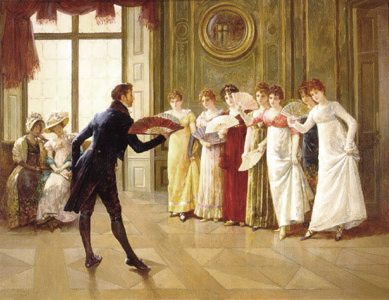
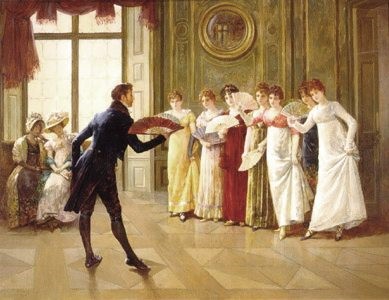
During the Regency, an introduction was much more than just discovering someone’s name. If you’ve seen Austen or other historical adaptations on television or film or read them in books, you’re probably familiar with the concept of an introduction. When a lady catches a gentleman’s eye, he would ask a common acquaintance to introduce him to the heroine. If they were at a ball or a soiree, he would likely ask the hostess for the introduction. He would never simply present himself to her. The same goes for meeting anyone with whom one did not already have an association.
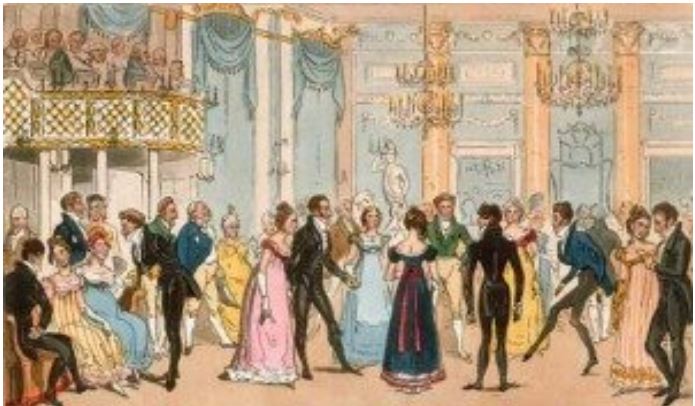
Assembly Rooms in Bath
In a formal social setting such as a ball, the introductions would be performed by a hostess, a patroness at Almack’s, or the Master of Ceremonies at an assembly room.
If one allowed someone to present another person to him or her, one was accepting the relationship because an introduction was a sort of recommendation. If a hostess presented a gentleman to a lady, the hostess was, in essence, recommending him to the lady based on his character, rank, status, etc. Only after the introduction had been made could the relationship begin.
Basic Rules for Introductions
in the Regency:
A gentleman is introduced to a lady, regardless of rank
A younger person is introduced to an older person, regardless of rank
If they are of the same gender and similar age, the lower-ranking person is introduced to the higher-ranking person
Everyone is introduced to royalty
One never introduces oneself to another person--one must be introduced by a mutual acquaintance
The lady or the higher-ranked person may decline the introduction. So, at a ball, a lady--or her chaperon--could refuse an introduction to someone whose acquaintance was considered undesirable. In all honesty, I have yet to encounter a written instance when someone rejects a request for a presentation, but it does leave a great deal for the imagination, doesn’t it? It could be so deliciously awkward! But keep in mind, such an act would probably snub the third party who asked to make to introduction.
Though this is later in the century, Routledge’s Manual of Etiquette 1899 has great insight on this concept:
To introduce persons who are mutually unknown is to undertake a serious responsibility, and to certify to each the respectability of the other. Never undertake this responsibility without in the first place asking yourself whether the persons are likely to be agreeable to each other; nor, in the second place, without ascertaining whether it will be acceptable to both parties to become acquainted.
So, the third person should have given some thought as to whether this would be a mutually beneficial introduction. By accepting an introduction, the lady welcomes the relationship.
However, balls are a different animal. This same guide makes this statement:
At a ball, or evening party where there is dancing, the mistress of the house may introduce any gentleman to any lady without first asking the lady’s permission.
This is probably because it is assumed that the hostess gave serious thought to her guest list, so she can safely assume if she accepts them all, they all ought to accept each other.
Also, an introduction at a ball or assembly was not considered an introduction anywhere else but that particular event. If, however, the lady or the higher-ranking person first acknowledges the other in a different setting the next time they meet, then the first introduction can carry over as a non-event-specific introduction. I know, it seems odd and overly stuffy to us in these days, but the Regency era was a very different time.
Once the introduction is made, the lady would be expected to make herself available to dance with the gentleman--unless she was not dancing at all or already promised the dance to another.
When two gentlemen are being introduced, the person of the higher also has the option of accepting or rejecting. If he accepts, he’s basically accepting the other man’s association into his social circle.
How it Wasn’t Done
Presenting oneself to another is a major social faux pas, as we see from Jane Austen’s Pride and Prejudice (1813). When Mr. Collins proposed to introduce himself to Mr. Darcy, his superior in rank, Elizabeth is appropriately shocked, as evidence by her reaction:
“You are not going to introduce yourself
to Mr Darcy!”
“Indeed I am. I shall entreat his pardon
for not having done it earlier. I believe him to be Lady Catherine’s nephew. It
will be in my power to assure him that her ladyship was quite well yesterday
se’nnight.”
Elizabeth tried hard to dissuade him from
such a scheme, assuring him that Mr Darcy would consider his addressing him
without introduction as an impertinent freedom, rather than a compliment to his
aunt; that it was not in the least necessary there should be any notice on
either side; and that if it were, it must belong to Mr Darcy, the superior in
consequence, to begin the acquaintance.
Mr. Collins, of course, dismisses her advice. His presumption in addressing the lofty Mr. Darcy received an appropriate response:
Mr Darcy was eyeing him with unrestrained
wonder, and when at last Mr Collins allowed him time to speak, replied with an
air of distant civility. Mr Collins, however, was not discouraged from speaking
again, and Mr Darcy’s contempt seemed abundantly increasing with the length of
his second speech, and at the end of it he only made him a slight bow, and
moved another way.
This ill-mannered ruffian who was related to the Bennets no doubt added further proof that Elizabeth’s family was uncultured, contemptible, and therefore unworthy of Mr. Darcy’s notice.
According to The Social Historian, Victorian Etiquette,
No gentleman should ask a lady to dance unless he has previously met her acquaintance. An introduction can be arranged through the Master of Ceremonies or through the lady of the house or a member of her family. Should a lady be approached by a man to whom she has not been introduced, she should reply that she would accept his invitation with pleasure if he would first procure an introduction.
How to Perform an
Introduction
Manners and Rules of Good
Society (1888) states:
The correct formula in use when making introductions would be to say, ‘Mrs X – Lady Z,’ thus mentioning the name of the lady of lowest rank first, as she is the person introduced to the lady of highest rank. It would be unnecessary and vulgar to repeat the names of the two ladies in a reversed manner – thus, ‘Mrs X – Lady Z. Lady Z – Mrs X.’
This makes sense because if a gentleman asked to be introduced to a young lady, it stands to reason that he’d already have gone to the trouble to inquire as to her name, and possibly has asked enough about her to decide if he desires to make her acquaintance.
That being said, it is possible to introduce two people. Northanger Abbey (1817), gives an example of a two-way introduction:
The young ladies were introduced to each
other, Miss Tilney expressing a proper sense of such goodness, Miss Morland
with the real delicacy of a generous mind making light of the obligation.
Perhaps, then, it depends on the situation. If adults are introducing their children to each other in the hopes that a friendship, or more, might result, there would be a two-way introduction such as “Oliva, dear, please meet Miss Rose Jones, the youngest daughter of our newest neighbor, Mr. Jones. Miss Jones, this is my eldest daughter, Olivia.”
Imagine a handsome lord sees a lovely lady across a crowded ballroom. Intrigued, he asks his hostess who she is. Upon learning a little about her, and more determined than ever to make her acquaintance, he begs to be introduced to this vision who has piqued his interest.
The introduction would be something like, “Miss Palmer, I'm pleased to introduce Lord Amesbury.”
Welcome to our blog for readers and writers--or anyone, really, who loves history! We are historical romance authors. Very well, we confess; we're historical nerds! We are fascinated with ancient wedding traditions, Irish food, Roman Warfare, Regency Clothing, Scottish swords--you get the idea. Watch our blog for informative tidbits that just might figure in your next manuscript or deepen your appreciation for the next book you read, or even give you some useless trivia to spout at a party when you can't think of a thing to say. We welcome comments and followers, so chime in and enjoy the group!










 Posts
Posts


