
Search This Blog

Friday, September 18, 2015

Dukes and Duchesses

Sir_Arthur_Wellesley,_1st_Duke_of_Wellington
Sir Thomas Lawrence, Portrait of Arthur Wellesley, 1st Duke of Wellington

Next to the royal family, the most distinguished and highest ranking title in England is the Duke. They are usually in possession of great wealth and power, owning vast amounts of lands, tenants, and other properties. However, the title itself is fairly recent in England’s history.
Originally from the French word Duc, the duke was first used only as a title of power and responsibility for the sons of the king. Being a mere prince suggested he was something of a wastrel who had no responsibility or power. A duke, or royal duke, meant the king trusted this son to rule on a more local level and enjoyed a higher level independence.

During the Medieval, earls and barons owned and managed their land in a feudal system. They were knights who answered the call to aid the king in war. But unlike other mere knights, these lords had vast lands and responsibilities. They provided the land that the tenants or serfs farmed, and they collected rent. They offered (ideally) protection in times of need to the serfs who fled to safety of the castle walls when enemies attacked. Local sheriffs had the charge of keeping law and order but sometimes the ruling lord took on that duty as well.

During Medieval England, earls and barons were the highest ranking lords--behind the royal dukes, of course. Later the monarchy created other titles which included marquis (a word that by Regency had the odd pronunciation of mar-kwiss). The spelling of marquis eventually changed to marquess to sound more English but for many years, both spellings were considered correct. Marquess ranked just below duke and above earl. Another newly added title was that of viscount (vi-count) which ranked below earl and above baron.
According to Debrett’s, the first British subject to receive the rank of duke who was not a member of the royal family, nor one nearly related, was Sir William de la Pole, Marquess of Suffolk, who was made Duke of Suffolk in the fifteenth century. I am mystified as to why his name was Sir William, suggesting he bore the rank of knight, when he was, in fact, a marquess, a much higher rank. According to my research, he would have been called Lord William in that era which signified he was more than a mere knight. But I digress. Anyway, the title of duke was originally awarded only for exemplary loyalty and valor to the crown, so no more than 40 dukes ever existed, the last being created during Queen Victoria’s reign. The first time that happened under her rule was when the earl of Fife Married the eldest daughter of the Prince of Wales in 1889; the second when no male heir was born to that line, the title jumped to the male heir of Fife’s daughter—not a common practice.

When a peer failed to have a son, the practice of a title going to a female heir’s husband or son occurred anciently, but by the Regency, the title either went to the closest, eldest male relative, or it reverted to the crown. At that point, it either went extinct or (in theory but not usually in practice) the monarch had the power to bestow it upon someone else.

Therefore, the need for a male heir was of supreme importance. Many wives of peers, and even wives of untitled landowners, often gave their lives in the attempt to produce a son to guarantee continuation of the line and succession of a direct descendant. If you are familiar with Jane Austen’s Pride and Prejudice, you will remember Mr. Bennett’s wife and daughters’ anxiety over the land and house all going to a distant cousin, and what that would mean to the family.
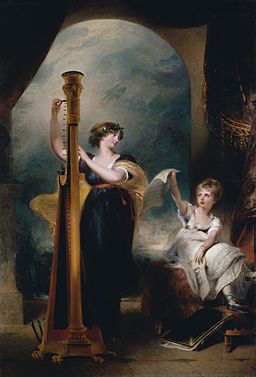
Princess Charlotte of Wales and_Duchess Caroline of Brunswick by Thomas Lawrence

A duchess’s primary role was to bear at least one son, an “heir and a spare” as was the common phrase. In addition, she, at the top of the social ladder next to the royal family, had other demands. Just as we today idolize and follow celebrities, professional athletes, and the very rich and powerful who often find themselves in the news, the British adored and scrutinized the aristocracy and nobility, and even the gentry. Let’s face it, they were the beautiful people. They set the standards for dress and behavior and everyone wanted to emulate them. The Prince of Wales, the Regent who later became King George IV, was notorious for hedonistic ways which paved the way for the party lifestyle for his subjects, many of whom followed his lead. “Prinny’s” friend, Beau Brummell’ revolutionized men’s clothing as everyone hurried to adopt style of the prince’s favorite.

As a duchess is so high in rank, she, too, was constantly in the limelight either for good or ill, whether or not she wanted to be. A duchess, or any wife of a peer, was expected to throw lavish balls, dinner parties, house parties as well as support charitable organizations and sponsor musicians. And heaven help her if she wore the same gown in public or failed to have the best, most tasteful gowns, shoes, jewels, gloves, hats! Demands on her time, appearance, and favor probably led to a great deal of stress as she strove to uphold the ideal. The higher the rank, the higher the expectations, and the more subject she was to criticism from the bitter and jealous.

During that era, as today, public opinion delighted at faulting the very people the idolized. If a person of great importance slipped up, tabloids and social columns in the newspapers, as well as word-of-mouth gossips delighted in spreading the titillating news.

I can only imagine the pressure.

It is this standard of excellence, and all the burdens that go with it, that creates one of the stumbling blocks for my heroine to overcome in “Unmasking the Duke” part of Autumn Masquerade, the newest Timeless Romance Anthology, Regency Collection. This is one of three Regency romances included in this anthology.
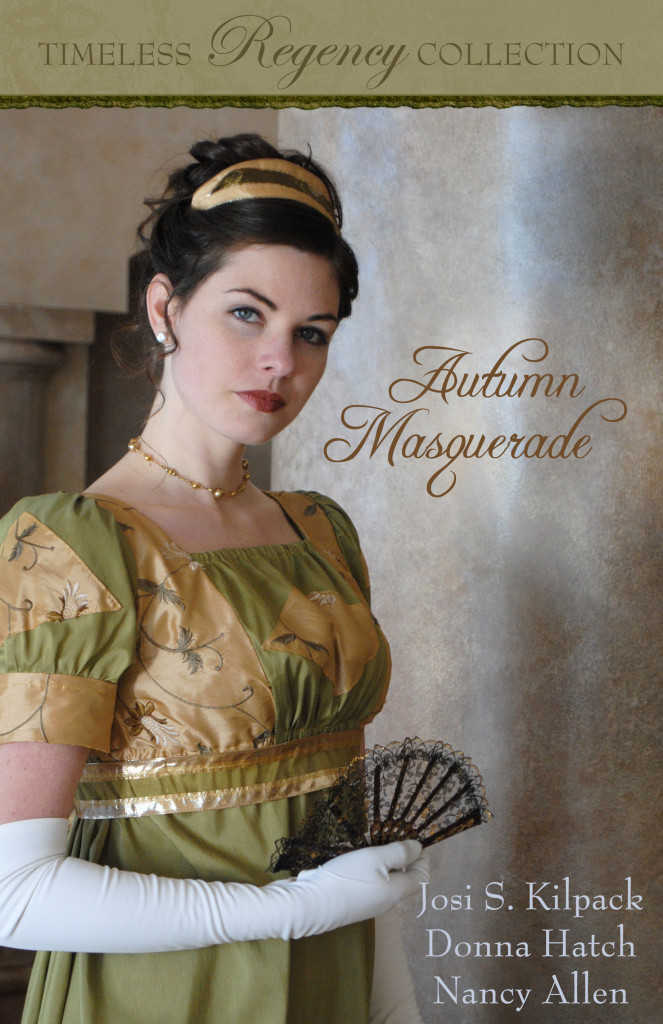
Autumn Masquerade ebookHere are the first few pages from "Unmasking the Duke" in Autumn Masquerade:

Birthdays were overrated. People really ought to stop celebrating them after the age of sixteen. Snuggled into the featherbed of her sister’s country estate, Hannah Palmer toyed with a croissant. This evening she might very well die of humiliation. Or worse, embarrass her sister and brother-in-law, the Earl and Countess of Tarrington.
Alicia practically bounced into the room. “Happy birthday, Sis!”
Hannah smiled wryly. “I think you’re happier about it than I am.”
At odds with her rank as a countess, Alicia grinned and climbed into bed with Hannah, holding her tightly. “I am happy about it. How often does a girl get to wish her favorite sister happy eighteenth birthday?”
Hannah gave her a wry smile. “I’m so relieved to learn I’m your favorite, since I have no competition.”
Alicia laughed. “It would be sad if I claimed another for that auspicious honor.” She wound a strand of Hannah’s blond hair around her finger.
“You’re more energetic than usual today.”
“Little Nicholas actually slept all night long.” A maternal tenderness crept into Alicia’s expression as it always did when she spoke of her infant son.
When the time came—if it came—Hannah planned to keep her baby in her room, rather than follow the convention of letting a nursemaid care for her child during the night hours. She vowed to be the devoted, loving mother her sister had already proved to be. Of course, she might never realize the sweet dream of motherhood.
Alicia twisted around in bed and fixed her amber gaze on Hannah. “And I’m so happy that you’re finally letting me throw a ball in your honor.”
Hannah winced. “Yes, I just love big parties filled with rooms of people I don’t know.”
“I know how you feel about it, dearest,” Alicia said soothingly. “But this will be a good practice for you before you go to London next Season. When I’m finished with you, society will toast you as the New Incomparable.”
“I’ll be a clumsy, tongue-tied idiot, just like always.”
“You’re only clumsy when you’re nervous. More practice at social events will help you not be nervous.”
Not be nervous in public? Hardly likely.
Alicia tapped her on the nose. “You are a beautiful and accomplished daughter of a respected gentleman, and the sister of a countess. No need to fear.”
“I hear blonds aren’t fashionable at present.”
“The only ones who say blond hair isn’t in fashion are those who are jealous. Just keep your head high and smile as if you know an embarrassing secret about everyone.”
Hannah stared into the flames writhing in the hearth. “It’s not that simple.”
“It is that simple.” Alicia squeezed her. “If you say next to nothing, everyone will think you are mysterious and will be all the more fascinated with you. Besides, you’ll wear a mask tonight. Surely anonymity will lend you courage.”
“I hope you’re right.”
Spending the evening alone with Alicia and her charming husband, Cole, would be preferable to a room full of strangers. But perhaps Alicia was right; a costume mask might help Hannah find some courage buried deep inside.
Hannah put a large spoonful of lumpy brown sugar into her chocolate, followed by a dash of cream. While Alicia rhapsodized about the ball, Hannah stirred absently before wrapping her hands around the china to warm her fingers.
Alicia ended on a sigh. “Maybe you’ll meet him tonight.”
“Him?” Hannah sipped the chocolate and snuggled into her pillows to drink the hot liquid turned decadent by the addition of the sugar and cream. Why most people chose to drink chocolate in its bitter form remained a mystery.
“Him,” Alicia repeated. “The man of your dreams. Your future husband.”
Hannah said dryly enough to be impertinent had she been speaking to a lady of rank who was not her sister, “Yes, meeting him at a ball would be convenient. I am persuaded that one must have a bit of cliché in one’s life to obtain a measure of happiness.”


Hannah is younger sister of Alicia Palmer in The Stranger She Married. I thought she needed her own story, too.

My special thanks to Joyce Dipastena, author of sweet Medieval romances, for helping me with some of the early history of Dukes.
You can read more about dukes and duchesses at:

Friday, August 21, 2015

Regency House Party

Original cover art
The Guise of a Gentleman
By Donna Hatch

A time-honored English tradition, dating back hundreds of years, is the House Party. In England, house parties served multiple purposes: the gathering of friends; an informal setting in which to discuss politics and possibly sway a member of Parliament; showing off one’s wealth to friends or anyone else the host is trying to impress; and it also could provide a last-ditch effort to help a young lady secure a marriage proposal if her Season had failed to produce such a coveted event—a hostess could easily bring the hopeful young lady in contact with the gentleman of choice and provide a variety of activities to show her best side. 

House parties most often occurred during the Season, while Parliament was in recess, and were especially popular the autumn months of August and September because they coincided with hunting and shooting season. House parties usually lasted three to four days, from Thursday or Friday until Monday, including what is now known as the weekend. Part of the reason for the long stay lay in the difficulty of travel over dangerous and poorly-maintained roads.


Longleat House
Country estates were the perfect way to highlight the host’s wealth. Often a long and meandering driveway took visitors through a picturesque plot of land designed to inspire and awe. The Longleat House driveway was noted for taking guests through beautifully landscaped acres of land to the main house. There an impressing outer stairway led to an imposing great hall. Everyone in attendance viewed art, furniture and other luxuries, such as carriages, a stable full of impressive horses, and lawn tennis courts. A house party cost a great deal of money due in part to the lavish meals provided to guests. Expensive imported alcohol and lavish desserts were served, and the best glasses, china, and silver were used, or purchased, for such an event. Hosts often outfitted their servants with new, expensive livery and sometimes hired additional servants to accommodate the strain of so many guests. Female guests usually brought their ladies’ maids, and some gentlemen brought their valets. If so, these servants had to be fed and given accommodations. If not, the host and hostesses’ house maids and footmen filled these roles. Families often ate and lived very modestly for months after a house party to make up for the cost. Others simply incurred enormous debt they had no hope of paying.

Guests during the Regency enjoyed a simple buffet breakfast whenever they arrived in the dining room which included eggs, fruits, toast, ham, pastries and jam. They drank tea, coffee, chocolate (which was hot and bitter like coffee). Men might also drink beer or a cherry brandy were the drink of choice. Some hostess served luncheon but this was a new tradition during the Regency. Some old-fashioned folk held to breakfast, dinner and supper. Luncheons could be informal meals in the dining room or picnics al Fresca, or they could be as formal as dinner. Afternoon tea always appeared, of course, and dinner was always formal, requiring a change into formal wear. Of course, for the ladies, every activity or meal seemed to have its own dress code and often a chair of hairstyle as well.
John_Wootton's "A Fox Hunt"

Activities at a house party during the day usually involved the men hunting or shooting (depending on the season), the fox hunt, and billiards.  Alas, the ladies usually got stuck inside much of the day visiting, writing letters, and other tame activities. Sometimes, they went outside for walks or carriage rides, or they watched the men plays sports and even joined in on croquet, lawn tennis, and lawn bowling.  Indoor games that involved both sexes included word games, charades, musicales, dances and card games. Baccarat gained popularity because the Prince of Wales loved this card game, which was illegal. “Prinny” reportedly provided his own set of counters so he’d be prepared for an on-the-spot game. Eventually bridge took Baccarat’s place in popularity.

After dinner, the ladies left the men and retired to the drawing room, leaving the gentleman to drink port, smoke cheroots, and discuss manly topics such as horses and politics. Later, the gentlemen joined the ladies for cards or music or dancing or games.

The house party, like most events, evolved over time. However, its purpose and popularity lasted for generations.

Sources:
Years of researching Regency customs inspired the bulk of this post, however, I also drew from:

https://janeaustensworld.wordpress.com/2010/12/28/entertaining-visitors-in-an-english-country-house-such-as-downton-abbey/

Evangeline Holland / Posted in Season, Society
http://www.edwardianpromenade.com/season/the-country-house-party/

Further Reading:
The Country House Party by Phyllida Barstow
The Marlborough House Set by Anita Leslie
Society in the Country House by Thomas Hay Sweet Escott
Manners and Rules of Good Society by A Member of the Aristocracy
Etiquette of Good Society by Lady Colin Campbell
A Country House Party by Lord Byron in “A Satire Anthology"‎ by Carolyn Wells

Tuesday, August 18, 2015

A Regency Exhibit

Cheryl Bolen attended the exhibit to commemorate the 200th anniversary of the English Regency at California's Huntington Library.

©By Cheryl Bolen

As an author whose first Regency historical romance was published in 1998, I've long been a student of the period, and in 2011 I had the opportunity to visit a fabulous exhibit on the English Regency at the Huntington in Los Angeles County.

The Huntington (Library, Art Museum and Botanical Gardens) offered the exhibit to commemorate the 200th anniversary of the Regency, which began in 1811 when George III was declared too mad to rule. His eldest son served as Prince Regent until his father died in 1820, whereupon the regent became King George IV.

I particularly enjoyed reading the era's newspapers. The following advertisement (these were intermingled with news stories) I think must be geared to men, but could also apply to women:

HAIR
A new oil which gradually changes white, gray or red hair to a beautiful brown – gives softness, elasticity, curl and thickens – 7 shillings, 6 pence per bottle
 
A loan office, located at 2 Craven, Strand, advertised that it gave loans "to persons of fashion, promisary notes to persons of known credit and consequence." The office was open from 10-4.
 
The most well-known jewelry store of the era offered this advertisement:
Rundell, Bridge, Rundell
Goldsmiths & Jewelers
to Their Majesties
Their Royal Highnesses the Prince of Wales
and the Duke of York and Royal Family
Ludgate Hill
 

And the last advertisement I'm going to feature was for an on-premises auction by "Mr. Christie." Yes, that Christie's auction house!
Valuable Library Richmond Surrey – By Mr. Christie on the premises by order of the Executors of Miss Hotham deceased, 6,000 volumes. Catalogues are preparing.
 

The Huntington Library and Art Museum itself is a treasure to visit. The former estate of rail magnate Henry Huntington, it's nestled on a few hundred acres of lush botanical gardens in the foothills of the San Gabriel Mountains. The Huntington collections of rare manuscripts and old master paintings is particularly geared for English history. It houses Gainsborough's Blue Boy (as well as Pinkie), first editions of Jane Austen, and an original Chaucer manuscript. And almost half a million rare manuscripts.

This article was first published in The Regency Reader in September 2011.
 
Cheryl Bolen is pleased to announce the re-elease of her Counterfeit Countess, a book that has been out of print for more than a decade and which has never before been an eBook. This Daphne finalist for Best Historical Mystery is the first book in the lighthearted Brazen Brides series and releases on Sept. 1. It can be preordered everywhere now.
 

Friday, August 14, 2015

Paris 1814


Paris 1814

This August, Lady Chance, a Regency romance set in Paris, 1814 comes out. It’s the follow-up book to Lady Scandal, which was set in France of 1803. Both years are times represent short breaks in the Napoleonic wars—the peace of 1803 was a fragile thing that barely lasted, and the surrender of Paris to the allied armies in 1814 didn’t last. But Paris in 1814 was the place to be for excitement and to watch history being made.

On March 30 to 31, 1814, the battle for Paris was fought. Napoleon was advancing to Paris to reinforce his troops, but with Russian in control of the Montmartre Heights and Prussian troops ready to take the fight into the streets of Paris, Marshall Marmont contacted the Coalition and reached a secret agreement with them to spare Paris.

On March 31, Prince Talleyrand gave the key of the city to Tsar Alexander The Tsar and his staff entered the city followed by the King of Prussia and Prince Schwarzenberg. The city had feared for its safety. However, Tsar Alexander made it clear that he regarded Napoleon as the enemy of Europe—not France. He entered the city as a liberator, riding a white horse, and was cheered as the man who has spared Paris looting, burning, and destruction.

On April 2, the French Senate passed an act to declare Napoleon deposed. Napoleon had advanced as far as Fontainebleau and heard that Paris had surrendered. His marshals would not fight with him and urged surrender. On April 4, Napoleon abdicated in favor of his son, the King of Rome, but this was not to be allowed. Napoleon had to abdicate unconditionally, and he did so on April 6, and was exiled to Elba. On April 11, the war was officially over when the Treaty of Fontainebleau was signed—Napoleon took a poison that had been mixed for him and that he carried with him in case of capture. But the mix of belladonna and opium had lost its potency, and doctors revived him. He recovered and left for Elba on April 20. However, it is thought that he never regained full heath for stomach problems plagued him the rest of his life.

Napoleon was allowed to take with him one thousand of his Imperial Guards, which would pave his return the following year—and there is every indication that plans for his return were already being made in 1814.

In Lady Chance, the heroine—Diana—and her cousin come to Paris in mid April, with treaties still being drafted and signed. Only English diplomats, such as Diana’s cousins, were in Paris, but a few brave souls also traveled to Paris in April. Letters from a Lady (Miss Anne Carter) to her Sister during a tour to Paris in the months of April and May 1814 offers up terrific, colorful details of events including the return of the Bourbons.

On May 3, Louis XVIII arrived in Paris with a grand procession through the city. Parisians turned out to throw lilies—the flower of the kings—to cheer and shout, and only a little grumbling was heard. The comte d'Artois—Louis’ younger brother who would later become Charles X after Louis XVIII’s death—had ruled as Lieutenant-General until his brother's arrival, and would continue on as part of his brother’s council. Louis’ niece—married to the comte d'Artois son, the duc d’Angoulême—sat next to Louis XVIII. The only surviving child of Louis XVI, the duchesse was described as “very fair, and has rather large eyes, which still bear the marks of the Revolution…” She was seen to be nervous of the crowds, and rightly so, given that many of these same people had cheered when her parents were beheaded.

Napoleon's senate called Louis XVIII to the throne, but they set down the condition that he must accept a constitution that included recognition of the Republic, an elected parliament, and the tricolore of the Revolution. Louis XVIII opposed most of those ideas, disbanded the senate and made his appeal to the French people—who were split in their loyalties. Royalists wanted their king back, but some hid their tricolor flags and bided their time; the army was sullen, but the marshals of France swore their loyalty to the king. Anyone who had power was working hard to keep it, and anyone wanting power was plotting to take it.

Paris was a city split—as was France. Louis XVIII needed to keep the country functioning and stable, which meant he must retain those who had held power under the empire. But Louis also had to reward those who had stayed loyal to the crown, with a return of their lands and titles. The comte d’Artois, the ducs d’Angoulême and d’Berry sat on the king's council and it was headed by Talleyrand, who’d been made a prince by Napoleon. Louis wanted to be king in the old style, but he faced an empty treasury, and he had an occupying army who were trying to make a lasting peace.

The leaders of the occupying armies demanded a constitutional monarchy—they wanted France to remain stable. To pacify them, Louis drew up the Charter of 1814, which was very progressive for that era. It kept intact many of the reforms of the Revolution, along with the Napoleonic Code, which guaranteed legal equality and civil liberties. However, the preamble declared it a ‘concession and grant’, given ‘by the free exercise of our royal authority’—meaning Louis wanted the ability to reverse everything if he chose.

Louis also signed the Treaty of Paris on May 30, in which Paris gave up the territories Napoleon had conquered. That was the main reason the allies were supporting Louis—they got their lands back. In exchange, France would not have to pay war penalties, and the foreign armies would withdraw from Pairs. This left many unhappy—many Frenchmen thought the Empire had been a natural extension of France’s borders.

It didn’t help that Louis XVIII soon went back on promises. Unpopular taxes were left in place. Louis chose the traditional white flag of the kings of France. Returning aristocrats were given back their lands, while those who had been ennobled by Napoleon saw their lands taken away with the return to France’s old borders. Expenditures on the army were slashed, leaving them grumbling, and Louis’ devotion to the Catholic Church left non-Catholics unhappy. A post-war slump in the economy hit everyone, and Paris began to resent the English who came in droves and had money to spend.

But the bitter unhappiness that was to hit in the fall and winter of 1814 was months away in spring. April and May of that year was one of entertainments and celebration. Paris glittered with illuminations and the campfires of the armies. Diana and her cousin had balls to attend—and plots to uncover.

For an undercurrent of waiting wove through the city to see what the Emperor would do. There was still a belief in Napoleon’s magic—that he wasn’t just an ordinary man. There were still doubts that Louis—old and ridden by gout—would be a just king. There were plots and schemes, and all of that is what makes for rich ground to set a novel.

AN EXCERPT FROM LADY CHANCE


Taliaris waited in the alley two streets down from the Palais Royal. Away from the boulevards, the cafés and the restaurants, this street seemed dingy and dark. A single reverbères hung from a rope stretched across the street, its light dim though the dirty glass. 
He could smell filth from the gutter than ran down the center of the lane.

He settled his shoulders against the wall and kept his hands loose and ready. It was a narrow, mean street, its square cobblestones worn by the centuries. Typical Paris, he thought, wishing for open countryside and the smell of things that grew—not piss in the street and god knew what else.

The small shops that lined the way had closed hours ago. Only a thin slice of moon and a scattering of stars lit the unshuttered windows. Distant voices floated to him. He could make out a drunken song in some language. It wasn’t French. Rough Cossacks, he guessed and hunched a shoulder against the dragging, sad melody.

This was a spot for melancholy and ill remembrances.

Perhaps the late queen’s tumbrel had creaked down this street, weaving its path from her final prison at La Conciergerie to the Place de la Concorde. That had been rechristened yet again back to the Place Louis XV and the guillotine no longer stood in the elegant square, but that was about all he knew of Paris. He had been gone long years from France, and Paris was not his city. He was a man from Bordeaux, from a small village where the grapes grew fat and every man knew his neighbor. He could wish himself there now.

However, he still had a duty to France. And to his family. And then at last he would have time to look to his own future. He could think of a wife at last. A woman who would not mind the hard work of a vineyard. A woman who could give him strong sons. A woman who could cook and clean. The image of his family’s old stone house rose to mind—but a picture flashed of a pretty girl with golden hair at the door of what was now his home. Ah, but no. Lady Chauncey had soft hands. She wore fine silks. A lady such as her would have nothing to do with life in a village such as his.

Still, the image teased at him.

What would have happened if ten years ago he had kept hold of his English girl? He could not say. And how could he have left her alone in his village, knowing no one, while he returned to war?

Footsteps echoed, and Giles put away such thoughts. A large man strode down the alley toward Giles.

Tall and heavily built, the giant trod light upon the cobblestones for one so hulking. But then Andre Dufour had always been one to surprise. Dufour still wore his uniform and the brass buttons from his white waistcoat gleamed in the faint light, but Giles knew Dufour had to be on leave.

Andre stopped before him and tucked his right hand into the pocket of an open greatcoat that had seen much service. “A cold spring, eh, but not so much chill as the Pyrenees gave us.”

“Careful, my friend. It is not fashionable these days to speak too much of La Grande Armée’s past.”

“Fashion? I am not one for that. Not like your brother. I hear young Françoise has taken up with an actress who rivals the diamond of the Comédie Française, Mad’moiselle Mars. And so it is now the rage to haunt l’Odeon for a glimpse of this girl. Seems a stupid thing to do with a woman—to only watch for her. But who am I to judge since I have no woman?”
Regret tugged at Giles, an old and familiar one that settled in his chest like a weight. He ought to have…

Ah, but he had done what he must. His wants did not enter into this. Still, it had been unsettling to have his past come back to him tonight. His cheek tingled and he rubbed it with his thumb. An even greater shock had sizzled over his skin to see his English girl and hear her voice again. He allowed himself to pull out the memory one last time—salt air damp on his face, a girl in his arms, her hair spilling long and golden in the pale light of early morning, her lips soft and parting. The ache lifted in his chest.

With a shake of his head, he pulled the flask from the inside pocket of his coat. He opened it and the aroma of brandy stung the night. Giles offered the flask to Dufour, who took a long swallow.

A skittering from the dark end of the alley froze Giles. Andre slipped his hand from his pocket and half turned. Moonlight flashed on the steel of a small pistol. Giles slapped Andre’s upper arm, took back his flask and tucked it away again. “Walk with me. Let us find a place with noise and something better to drink.”

Friday, July 31, 2015

Gentleman's Clubs in Regency England


©By Cheryl Bolen

The three most exclusive gentlemen’s clubs during the Regency — White’s, Brooks, and Boodle’s — were all located on the same street (St. James) in London’s west end, and all are still in existence today.

But don’t expect to see any signs out front.

 
This is White's. See the famed bow window on the ground floor.
 
Most members of these private establishments in the borough of Mayfair come from the upper echelons of society. Their male ancestors have likely held memberships since the clubs moved to St. James Street in the late 1700's. When Prince Charles married Diana, he hosted his bachelor party at White’s. His son, Prince William, is also a member.

White’s, originally a chocolate shop in 1693, moved to 37-38 St. James in 1778. During the Regency it was strongly associated with Tories. Members could take their meals at the club, and they especially enjoyed the gambling, as well as White’s well-known betting book. The book recorded bets about battles during the Napoleonic wars and often included bets on prospective matrimonial partners. It was at the club’s famed bow window that Lord Alvanley bet a friend £3,000 (over $100,000 today) which of two raindrops would fall fastest.

Brook’s, founded in 1764 by a group of men which included four dukes, moved to 60 St. James in 1778. While many prominent men of the era held membership in both clubs, Brook’s was a bastion for Whig leaders such as Charles James Fox, the Duke of Portland and the Duke of Devonshire. The Prince Regent was a member. Like White’s, Brook’s also had a betting book. One of its most interesting entries is, "Ld Cholmondeley has given two guineas to Ld. Derby, to receive 500gs whenever his lordship f**** a woman in a balloon one thousand yards from earth." Boodle’s is located directly across the street from Brook’s. Established in 1762, Boodle’s has also boasted many famous members, including Beau Brummel. More recently (relatively speaking), it was author Ian Fleming’s club. He bases James Bond’s club on Boodle’s.

One of the chief attractions to gentlemen’s clubs was the select gambling. Gentlemen of their class always paid their debts of honor.

Friday, July 10, 2015

Paris in 1814: The Palais Royal


I've just finished my next Regency romance, Lady Chance, a book that is a follow up to Lady Scandal, and am getting it ready for publication, and the fun part has been digging into Paris of 1814. For the setting, the Palais Royal plays a part in the story, and it's both a beautiful (and still standing) structure, and one with a great deal of history.

The Palais Royal was originally designed by Jacques Lemercier and built from 1629 to 1639 for the infamous Cardinal Richelieu (the one who is the menace in The Three Musketeers). The building was first known as the Palais Cardinal, but it became a royal palace after the cardinal bequeathed the building to King Louis XIII after his death.

When Louis XIII passed, the palace became the home of the Queen Mother, Anne of Austria, and then Henrietta Maria and her daughter Henrietta Anne Stuart, who had escaped from the English civil war, took up residence. Henrietta Anne married Phillipe de France, duc d’Orléans, and the palace became known as the House of Orléans, and the duchess installed the ornamental garden of the palace.


After the death of Louis XIV, the duc d’Orléans became regent of Louis XV. The Palais Royal was then opened so the public could view the Orléans art collection, starting its history as a much more public building.

In the late 1700's, Louis Philippe II renovated the palace, surrounding the garden with a mall of shops, cafes, salons, refreshment stands and bookstores.


The Palais Royal also became a meeting ground for revolutionaries. During the Revolution, Philippe d'Orléans became Philippe Égalité and changed the building to be the Palais de l'Égalité. He opened the gardens to everyone and enclosed the gardens with regular colonnades.

Upon the death of the duc, the palace's ownership lapsed to the state, whence it was called Palais du Tribunat for a time.  But under Napoleon and his empire, the Palais Royal took back its name but continued its function as a place where anything might be had for a price.


On the ground floor shops sold “perfume, musical instruments, toys, eyeglasses, candy, gloves, and dozens of other goods. Artists painted portraits, and small stands offered waffles.” The demi-monde could parade here in the gallery--alongside proper ladies--and the demi-monde often had rooms on the upper floors for their customers convenience.


While the more elegant restaurants were open on the arcade level to those with the money to afford good food and wine, the basements of the Palais Royal offered cafes with cheaper drinks, food and entertainment for the masses, such as at the Café des Aveugles. And the cafes were place to see, be seen, and plot.

In 1807, the Palais Royal boasted “twenty-four jewelers, twenty shops of luxury furniture, fifteen restaurants, twenty-nine cafes and seventeen billiards parlors.” And that wasn’t all of the the shops. A theater occupied each end of the galleries, and the building offered some of the most popular cafés and restaurants in Paris, including Le Grand Véfour.


On the second floor, elegant card rooms offered deep play--these were the gaming rooms, both elegant and notorious for places where a young, rich man might lose his fortune.

During the Restoration of the Bourbons, the Palais Royal’s former gardens with its chestnut trees were enclosed by three large arcades, one of stone, one of glass and one of wood. The stone arcade still stands.

The Palais Royal became a shopping heaven for the English visiting in 1814--and they adored the restaurants and food (and the fact that ladies could dine on their own in the more loose society of Paris). And all of that made for some fun scenes in Lady Chance. I also had the chance to visit the Palais Royal, which still houses wonderful shops under the stone arcade.
 

Friday, June 12, 2015

Pinterest and Regency England

I'm late to the party with Pinterest--but I am not generally an early adopter. I like to see if something's going to stay around before I invest time into it. But Pinterest is a great place to hang out--lots of great images, which is perfect for anyone who loves either research or Regency England. There's fashion (lots of it), images for personalities (with small bios), furniture, sports, food of the era, and lots more. But my favorite are actually prints of old London and England, and even some photos taken before both World War II bombing and the march of progress meant the end of many a beautiful inn or building. I also really, really like maps--any map. I have many books with maps of England, but there are always extra details that any writer needs.

Many of the images come with small bits of information--and, yes, it's a great consumer of time. But it's also great since a photo really can help you better "see" the world that once was. And it's not just the Regency that's covered--pick any era and you'll find cool stuff. As anyone who uses Pinterest knows, you can "pin" images to a board so you can more easily find them--great to help you stay organized--and you can follow other people's boards. A lot of writers post images useful for their books. I'm still uploading images I've found for horses, Regency portraits, and more.

Search works similar to any search engine--type in words, or put a plus sign between them if you want a phrase searched. The really nice part is that Pinterest brings up suggestions of things recently pinned that you might be interested in--they just show up on your home page.

I'm working now on a Pinterest for Paris 1814--I'm working on a Regency set there. It's a lot like having a ton of books open, or having a board with images set in place to inspire. It's also fun to create--so it's really important not to get too carried away.

But if you're on Pinterest, let me know--I'm always looking for new bits of research.