Search This Blog

Friday, March 29, 2013

Britain's Top 10 Castles

Can you guess which castle British Heritage selected as the number one castle in the country?
Sadly for me, it's not one I've been to. It's Corfe in Dorset. The "ruin" dates to the 11th century.


I can't imagine it besting Tintagle, a magnificent Arthurian ruin on Cornwall's rocky north coast (see in photo directly above). The Ten Best Castles in Britain were selected by the editors of British Heritage.


Three of the Top 10 I've toured – and loved: Arundel in West Sussex (above, top), coming in third; Dover Castle, at fifth; and Kent's Hever Castle (above, bottom), called the childhood home of Anne Boleyn, at tenth.


I've done a drive-by of two others: Stirling in Scotland, fourth; and Warwick Castle, which was selected eighth.


Rounding out the list were Conwy Castle in North Wales, second; Caerphilly Castle, also in Wales, at sixth; Alnwick in Northumberland, which celebrated 700 years as home of the Percy family, seventh; and Scotland's Blair Castle at ninth. -- By Cheryl Bolen, author of Falling for Frederick, a Stately Homes Murder


Monday, March 25, 2013

Regency Libraries

Free public libraries as we know them today did not exist in the Regency. Libraries were part of book shops, and a fee was required to take out books.

Most of the bookshops were concentrated in large cites, such as London. Here’s a list of booksellers in London, with their specialties: http://www.londonancestor.com/leighs/books.htm

Some booksellers kept libraries, and some had Reading Rooms only.

Hatchard’s, the bookseller that figures most prominently in Regency romances, had a Reading Room, while Hookham’s had both a Reading Room and a circulating library.

Here’s Hookham’s library catalog: http://books.google.com/books/about/A_catalogue_of_Hookham_s_circulating_lib.html?id=WJYIAAAAQAAJ

Here’s Hookham’s ad for its library: http://quod.lib.umich.edu/e/ecco/004773836.0001.000/1:4?rgn=div1;view=fulltext

Libraries were not for the poor. Hookham’s yearly fee for taking out twelve books was forty-two shillings (two guineas, or two pounds, two shillings), about $150 in today’s money. Part of the large fee was due to Hookham’s location in high-priced Mayfair, but some was also due to the cost of books. Books were expensive, thanks to a tax on paper, and only the well-heeled could afford to buy or borrow.

In A Similar Taste in Books, my hero and heroine meet in Hookham’s circulating library over a copy of Pride and Prejudice. Since they both like Pride and Prejudice, can love be far behind?

A Similar Taste in Books, Book 1 of Love and the Library, available at Amazon, Barnes and Noble, Smashwords and other places where eBooks are sold.

Thank you all,

Linda

Top picture is of the British Museum Reading Room, from Wikipedia

Monday, March 18, 2013

Gretna Green: Runaway Brides (Part 1)


A forbidden young love. A frantic carriage chase across England. A hasty wedding “over the anvil” at Gretna Green. Such a scene is a staple of many a Regency romance. In fact, it is with such a mad drive to the border that I chose to end A Dangerous Compromise, and I used an elopement to Scotland again in Border Bride.

But why might a young couple have to elope to Scotland to marry?

A chance of geography and an act of Parliament led Gretna Green to become famous as a haven for young lovers who could not win their parent's consent.

In 1753, Lord Chancellor Hardwicke's Act for the Prevention of Clandestine Marriages passed. The law took effect on the twenty-fifth of March in 1754.

The act had been passed after a good deal of debate and struggle, to regularize marriages and protect wealthy families from having their underage offspring preyed upon. Prior to this, London had become infamous for "Fleet marriages" where disreputable ministers would perform a wedding within the “Rules of the Fleet Prison.” Clergymen who had been imprisoned for debt could live in the Rules, an area just outside the prison, meant to provide them a sanctuary. Since they were already here for being in debt they could not be fined for performing irregular marriages, and so were effectively beyond the law of the time.

By the 1740's, it is estimated that around a hundred minister had set up in business to marrying anyone who had the money for it. They could even provide a groom if a pregnant woman needed legitimate status for her child. The bride and groom exchange vows, coins exchange hands, and the couple was married.

These Fleet weddings had been the bane of many a rich family. Stories circulated of underage heiresses who had been tricked, or kidnapped and forced, into marriage by unscrupulous men. Fathers also complained of sons who had married unsuitable brides—two dukes saw their sons married in such secret ceremonies.

In 1754, the informal wedding was swept away. The new act required that the groom and bride must each be 21 years of age, or have the consent of their parents or guardians. The wedding had to take place during daylight hours in a parish church ceremony within the Church of England. For "three several Sundays" prior to the wedding, the banns had to be posted—meaning the curate would ask "after the accustomed manner" if anyone knew any reason why these two could not marry. If the couple lived in separate parishes, banns had to be called in each. Finally, a license had to be obtained and the marriage had to be recorded in the parish church.

To avoid these conditions, a Special License could be bought, so that bans did not have to be posted and the marriage ceremony could take place anywhere. But such a license had to be obtained from the Archbishop of Canterbury's offices, and the names of those to be married had to be written on the license. With these constraints, such a license did not help young couples who were trying to wed against the wishes of their families.

By requiring parental consent, the act gave parents the right to invalidate any marriage they considered undesirable. A clergyman who preformed an illegal marriage could be transported for up to fourteen years. English legislators expressed relief at having done away with foolish notions of romantic love in favor of more practical statutes governing the institution.

However, because Scotland and Ireland (and also the Isle of Man) were separate countries, the act applied to only those marriages contracted in England. It also did not apply to Quakers and Jews, who wed outside the Church of England (and who also stood outside the power and wealth the act sought to protect).

Ireland had already enacted laws with heavy penalties to do away with clandestine marriages. However, in Scotland, a couple had only to be 16 years of age and had only to declare their intentions to be husband and wife in the presence of two witnesses, and their word was law. So Scotland became one of the main places to flee to for a quickie wedding.

On the west of Scotland, at the most southerly point of the English border, the main road between Carlisle and Glasgow passed through the small village of Gretna Green. A half-mile from Gretna, the road crossed the river Sark, which marked the border itself. The closest village on the English side, before you reached Carlisle, was Longtown.

Near the Solway Firth, the Greta Green of Regency era is described in Gretna Green Memoirs as, "...a small village with a few clay houses, the parish kirk, the minister's house, and a large inn...from it you have a fine view of the Solway, port Carlisle and the Cumberland hills, among which is the lofty Skiddaw; you also see Bowness, the place where the famous Roman wall ends."

Within Gretna, at the Headlesscross, is the junction of five coaching roads, and here lay the Blacksmith's Shop.

Next month, Part II of Gretna Green

Sources:
Romances of Gretna Green and its Runaway Marriage by Lochinvar
Gretna Green Memoirs by Robert Elliott

Shannon Donnelly Bio
Shannon Donnelly’s writing has won numerous awards, including a RITA nomination for Best Regency, the Grand Prize in the "Minute Maid Sensational Romance Writer" contest, judged by Nora Roberts, RWA's Golden Heart, and others. Her writing has repeatedly earned 4½ Star Top Pick reviews from Romantic Times magazine, as well as praise from Booklist and other reviewers, who note: "simply superb"..."wonderfully uplifting"....and "beautifully written."

Her Regency romances, including A Dangerous Compromise, can be found as ebooks on all formats, and include four novellas now out as a collection with Cool Gus Publishing.

Her Regency Novella, Border Bride, can be found as an ebook, or in print in her collection of Regency Novellas.

Wednesday, March 6, 2013

Fashions in Era of Jane Austen


Jody Gayle is the editor/designer of Fashions in the Era of Jane Austen, and it is solely through her efforts that this wonderful resource is now available both electronically and as an oversized paperback with hundreds of color illustrations.


Cheryl Bolen: Thank you, Jody, for being our guest today, and thank you for introducing a whole new generation (and more) to Ackermann's Repository. First, will you tell us what Ackermann's Repository was?


The Ackermann’s Repository of the Arts was a monthly British periodical published from 1809-1829 by Rudolph Ackermann.  It was a highly popular nineteenth-century publication devoted to the study of the arts, literature, commerce, manufacturing, politics and fashion.  I believe a contemporary example could be a monthly version of the New York Times with somewhere between 60-80 pages.  However, the Repository of the Arts included a significant amount of information provided by the readers including personal letters, poems, opinion pieces and general articles. 


Each monthly issue contained several illustrations produced by artists using a technique called etching. Two of the illustrations were always hand-painted prints normally featuring the whole body of a woman dressed in the latest fashions.  Every fashion print included a detailed description of the type of clothing shown, its style, cut, trim, color, type of fabric and the accompanying accessories. 


Cheryl Bolen: In compiling your book, why did you make the decision to reproduce all the illustrations with the exact same language that was used in their original publication?


There were a couple reasons why it was important to include the language of the time to accompany the fashion plates.  When I began my research I found books with tons of beautiful fashion prints.  Then I began reading Ackermann’s Repository that included the descriptions and discovered a whole new dimension and depth to the illustrations.  It seemed sad that the words of the past were being forgotten and I felt there would be others who might like to read the descriptions.  Plus, I wanted to provide a convenient means for scholars and authors to access this information.  There are over 240 issues of Ackermann’s Repository and over 16,000 pages!  It can take months to research or find all the fashion prints.  


Cheryl Bolen: Can you describe for us the some of the steps you had to take in order to produce your incomparable work?


Just a few years ago I worked for a local newspaper company and they also published a bridal magazine so I had some idea of the process of printing and design.  I was able to publish my book due to the fantastic program through Amazon.  It allows authors to self-publish their own digital and paperback books but then every little detail and decision has to be made by the author without the assistance of a publishing house.

I began by contacting the Philadelphia Museum of Art Library for the permission to use their copies of Ackermann’s Repository of Arts.   Then I spent my time searching, scanning, and organizing the illustrations and then searching, typing and organizing all of the text.  Developing the organization system was crucial to keep the illustrations and the accompanying descriptions straight.  I had to be meticulous since one of my goals was to provide a resource to scholars and authors.  Everything had to be exactly right and accurate.   There wasn’t an easy way to accomplishing this task other than pure determination and hard work.  Then I had the whole book professionally proofread and compared to the original documents. 


The Kindle book was designed by me but I paid an experienced company to format the book but for future projects I can format the book myself.  A critical decision in designing the paperback book was choosing the size of the book.  This decision impacted everything from the fashion plate quality and detail, the book design, and ultimately the price of the book and shipping costs.  In the end I chose the largest book size available and the size is similar to a textbook. 


Cheryl Bolen: Just how many pages are in your book, and how many illustrations?


Well, since you asked I counted and there are 291 illustrations and 376 total pages.  When I first uploaded my book to Amazon it was too many pages and I had to redesign the book so some of the illustrations included the descriptions on the same page.  When you purchase the Kindle version there is a note to readers that due to its large file size, this book may take longer to download.  Fashions in the Era of Jane Austen are the fashion plates from 1809 to 1820.  My next project will contain the next nine years I was unable to include in the in the first book.  I am having a difficult time deciding on a title. 

Cheryl Bolen: Thank you, Jody, for visiting with us -- and for making this fabulous resource available to us.
 

Friday, March 1, 2013

The Language of Fans

by Historical Romanced Author Donna Hatch
www.donnahatch.com

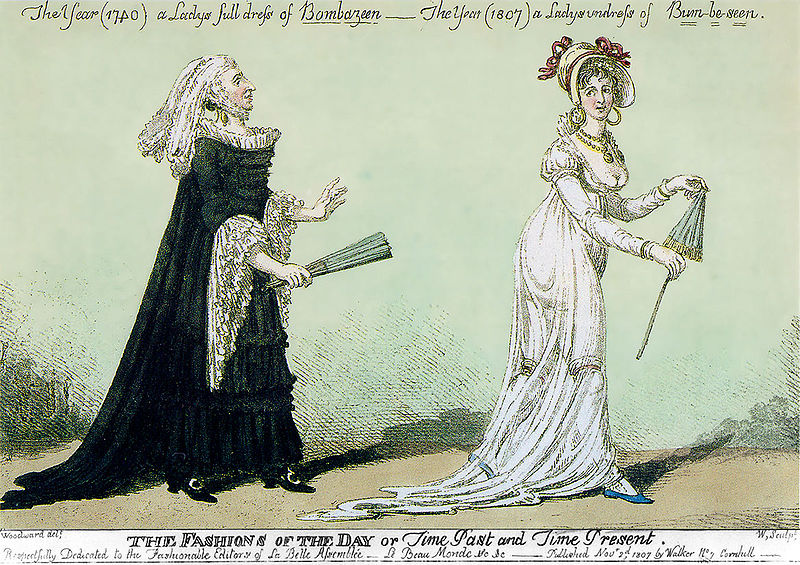
File:1807-pseudo1740 Fashion-contrast Bombazine-pun.jpgFans have been used as both a fashion accessory and a useful tool of staying comfortable for hundreds of years. Nearly every culture has a fan of some sort and the Regency Era, the time period in which I base all my romance novels, is no exception.


Unfortunately, the sources I read don't agree on what each action means. For example,  according to one source,* to fan slowly means "I am married." But according to another** to fan slowly means, "Don't waste your time; I'm not interested."

Likewise, according to one***, fanning oneself quickly means "I am married." But yet another ****says the same action means" I love you so much."

Shrug.

Also, the modern reader might wonder why go to all the trouble of learning such an elaborate language? But I think it might work well for the very shy, the very tongue-tied, or the person who needs to get the message across but fears coming on too strong. Also, telling a man she's not interested in him might be easier to say in fan language than in speaking. How many times have you told a guy who asked you out that you were busy when you really wanted to tell him to buzz off?

So, unless I can make friends with Dr. Who and jump into his time machine to find out what, exactly, these gestures really meant during the Regency Era, we may never know. Still, here are a few hand signals on which my sources seem to agree:

Touching right cheek: yes
Touching left cheek: no
Touching finger to tip of fan: I wish to speak with you.
Running fingers through the fan's ribs: I want to talk to  youResting the fan over the heart: my love for you is breaking my heart
Resting fan NEAR the heart: you have won my love
Resting fan on lips: I don't trust you.
Twirling in left hand: we are watched
Twirling in right hand: I love another
Open and shut: you are cruel
Open wide: wait for me
Presented shut: do you love me?
With handle to lip: Kiss me
In right hand in front of face: Follow me
Drawing across the cheek: I love you
Placing on left ear:  Leave me alone
Placing closed fan to the right eye: When may I see you?
Covering left ear with open fan: Do not betray our secret.
Changing fan to left hand: I love another.

So far, all the heroines in my Regency Romance novels have done with a fan is to keep cool or use it as a shield behind which they speak quietly to another. I admit, however I'm intrigued by the subtle, demure way a woman might have communicated to a man without speaking a word. She'd just have to time it when he's looking and not one else is, or her secret feelings would no longer be secret.


Sources:
*http://www.allhandfans.com/handfans/levels/language_of_the_fan.htm
**http://myhandfan.com/language.htm,
***Minute Company
****myhandfan.com

Monday, February 25, 2013

Guest Jane Ashford: Marriage Laws in Regency England

Linda Banche here. My guest today is Jane Ashford and her Regency historical, Once Again a Bride. Marriage figures prominently in the book, and here she tells us about what the heroine had to contend with in her marriage.

Leave a comment with your email address for a chance to win the copy of Once Again a Bride which Sourcebooks has generously provided. Jane will select the winner. Check the comments to see who won, and how to contact me to claim your book. If I cannot contact the winner within a week of selection, I will award the book to an alternate. Note, Sourcebooks can mail to USA and Canada addresses only.


And the winner is Joye! Congratulations, Joye, and thanks to all for coming over.
 
Welcome Jane!

Jane Ashford:

Marriage Laws in Regency England

Today, many of us take a host of legal rights for granted. We just assume that married women can own property, administer bank accounts, sign binding contracts. If they want to take someone to court to fight an injustice, they can. If they want to file for divorce, difficult at that may be emotionally, there’s no legal impediment. It’s a no brainer.

The situation was quite different in Regency England. Married women then had next to no legal rights. As soon as she married, a woman's existence was incorporated into that of her husband, giving her the status of a feme covert (English spelling of a medieval Anglo-Norman phrase meaning "covered woman"). She became, essentially, a non-person in the eyes of the law. As the legal authority Blackstone put it, “the very being or legal existence of the woman is suspended.” Her husband gained control of all her property and income, including any future earnings she might make. She couldn’t get an education without her husband’s permission, and he could even prevent her from seeing their children. It was hardly a compensation that she couldn’t be sued (except in conjunction with her husband) and that any debts she ran up were his obligations. (As recently as 1972, two U.S. states allowed a wife to plead “obeying her husband's orders” as a defense in criminal court.)

Of course individual cases varied greatly in those past times. There were kind, liberal husbands, and wives who had great influence over their mates’ decisions. Many families tried to safeguard their daughters' property rights and futures by creating written bonds or settlements, a prenup of sorts. But in the absence of such a document, if a husband wanted to tyrannize, there was nothing stopping him.

This is what happened to the heroine of my recent historical Once Again a Bride. Charlotte Rutherford Wylde was married off by her father to keep her safe. Aware of his failing mental faculties and general health, he wanted to ensure her future. But his judgment was more affected by his illness than he realized, and he picked a disasterous husband in Henry Wylde. Charlotte, loving her father and wanting to believe he’s still the strong, wise figure who has taken such care of her all her life, accepts his choice.

And so, at the age of nineteen, she’s married, and trapped. The aged Henry Wylde has no interest in Charlotte herself. He only wants her money, and he gets it all. Dowry, inheritance when her father dies soon after the wedding, everything. It’s his to spend, and he has no obligation even to tell Charlotte how he’s doing that (wasting it all on bogus antiquities). Charlotte has no recourse. She can’t even complain. Henry is acting completely within the law.

When Henry is killed in the dark London streets, Charlotte discovers that she’s practically penniless. So even though she regains some legal rights as a feme sole, she has no resources. But through determination and an ardent desire to recapture the light and joy of life, she finally earns her HEA ending.

ONCE AGAIN A BRIDE BY JANE ASHFORD – IN STORES FEBRUARY 2013
She couldn’t be more alone…
Widowhood has freed Charlotte Wylde from a demoralizing and miserable marriage. But when her husband’s intriguing nephew and heir arrives to take over the estate, Charlotte discovers she’s unsafe in her own home… Alec Wylde was shocked by his uncle’s untimely death, and even more shocked to encounter his uncle’s beautiful young widow. Now clouds of suspicion are gathering, and charges of murder hover over Charlotte’s head.

He could be her only hope…or her next victim…

ABOUT THE AUTHOR
Jane Ashford discovered Georgette Heyer in junior high school and was captivated by the glittering world and witty language of Regency England. That delight led her to study English literature and travel widely in Britain and Europe. Jane’s historical and contemporary romances have been published all over the world, and she has been nominated for a Career Achievement Award by RT Book Reviews. Eighteen of her Regency romances will be published by Sourcebooks in the near future! Born in Ohio, Jane currently lives in Boston. For more information, please visit www.janeashford.com and her Facebook Page.

To Purchase Once Again a Bride:


Wednesday, February 13, 2013

February: The Month of Love


by Shannon Donnelly

Valentine’s Day was a saint’s day long before it became associated with greeting cards and chocolates—and romance. But even with the romantic connection it has today, not that many romances use a Valentine’s setting.

Silver Links, one of my Regency Novellas, is placed right around Valentine’s—partly because the editor asked for the connection, but also because it worked very well into the plot (the heroine tries to arrange a romantic Valentine’s event for her husband, to help patch a rocky bit, but of course it all goes wrong). Maybe that’s why Valentine’s isn’t used much in romances—a romance is all about the rocky bits of a relationship, instead of the perfect day we all hope to have on Feb 14.

Traditionally in England, spring began on St Valentine's Day (February 14th), the day on which birds chose their mates. Given England’s usual weather that seems optimistic thinking to try and put spring so early, but perhaps it was the hint of warmth coming that encouraged both people and birds to look ahead. In parts of Sussex, Valentine’s Day was even called 'the Birds' Wedding Day'.

For the Celtic year, winter ended February 1 with the celebration of Imbolc or Oimelc. This was the time when ewes begin to lamb, and life began to return. For the ancient Celts, this was the celebration for Brigid (also Brigit, Brighid or Bride), the Light-Bringer, one of the main Celtic goddesses. She was strong enough to survive and be transformed by early Catholics into Saint Bridget, who was celebrated, along with the Virgin Mary, on February 2, Candlemas Day. (Yes, the days are getting longer again and that’s always a reason to celebrate.)

Many other English traditions and superstitions came to be associated Valentine’s day, and some of these were in place in the early 1800’s, the time of the English Regency :
  • The first man an unmarried woman saw would be her future husband (can you imagine what this would do to try and arrange your schedule to make this work out as you wished?).
  • If the names of all a girl's suitors were written on paper and wrapped in clay and the clay put into water, the piece that rose to the surface first would contain the name of her husband-to-be.  (And it seems to me you could rig this with the right type of clay.)
  • If a woman saw a robin flying overhead, she would marry a sailor. If she saw a sparrow, she would marry a poor man and be very happy. If she saw a goldfinch, she would marry a rich man. (No mention, however, of if she’d be happy with the rich man.)
  • In the Middle Ages, young men and women drew names from a bowl to see who their Valentine would be. They would wear these names on their sleeves for one week (which just sounds an awful fuss to me).
  • In Wales, wooden love spoons were carved and given as gifts. (These spoons are beautiful—and still sold in Wales.)
February is also the time of Shrove Tuesday (the last day before Lent begins on Ash Wednesday). Traditionally, Shrove Tuesday was the day to indulge, so pancakes were a traditional food (the butter, fat and eggs might all be things to give up for the forty days of Lent). So, after romance comes indulgence, and then you must give up some things. Hmmm—that sounds about right for any romance, so perhaps February is the month of love.

Do you have any special Valentine’s traditions? (Personally, I love those candy hearts with message—so very non-historical, but they have deep roots in my childhood.)

Shannon Donnelly Bio
Shannon Donnelly’s writing has won numerous awards, including a RITA nomination for Best Regency, the Grand Prize in the "Minute Maid Sensational Romance Writer" contest, judged by Nora Roberts, RWA's Golden Heart, and others. Her writing has repeatedly earned 4½ Star Top Pick reviews from Romantic Times magazine, as well as praise from Booklist and other reviewers, who note: "simply superb"..."wonderfully uplifting"....and "beautifully written."

Her Regency romances can be found as ebooks on all formats, and with Cool Gus Publishing, and include a series of four novellas.

She also has out the Mackenzie Solomon, Demon/Warders Urban Fantasy series, Burn Baby Burn and Riding in on a Burning Tire, and the Urban Fantasy, Edge Walkers. Her work has been on the top seller list of Amazon.com and includes Paths of Desire, a Historical Regency romance.
She is the author of several young adult horror stories, and computer games. She lives in New Mexico with two horses, two donkeys, two dogs, and only one love of her life. Shannon can be found online at sd-writer.com, facebook.com/sdwriter, and twitter/sdwriter.