Wednesday, November 6, 2019
Having A Ball ~ The Upper Assembly Rooms in Bath by Jenna Jaxon
Bath!
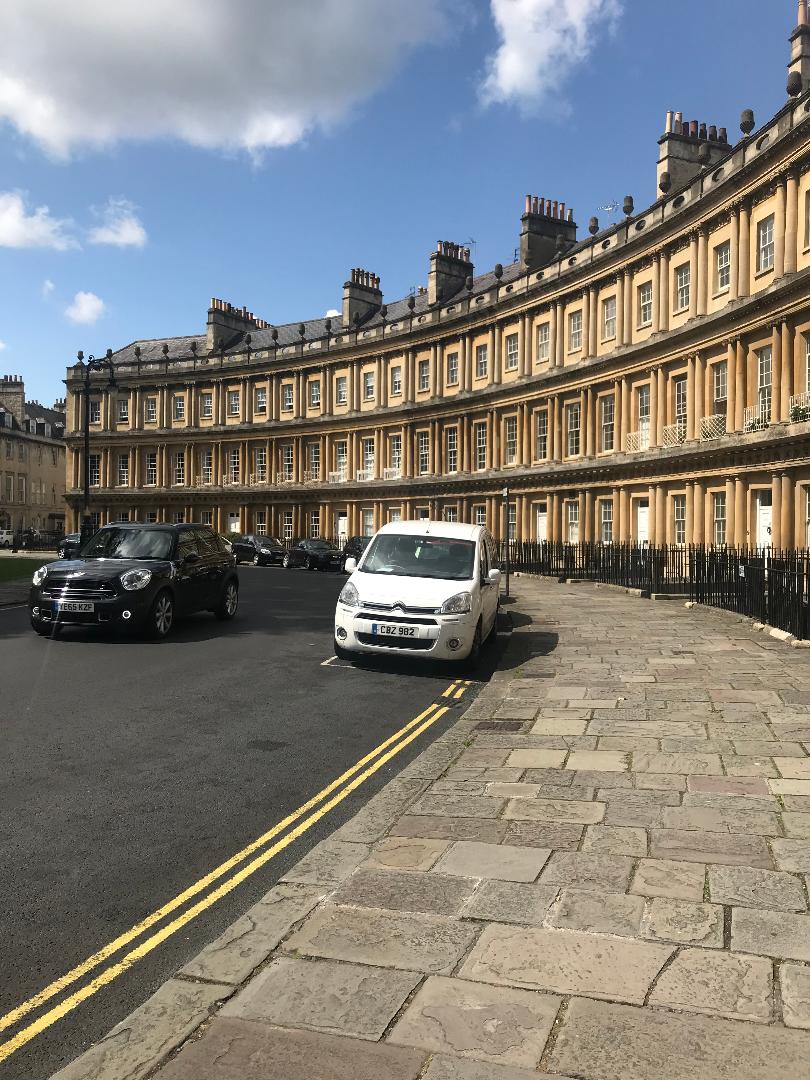
So I walked all over the town. I got to walk to the Royal Crescent, (and take a picture of No. 12 where the hero of my story lived), I visited the Jane Austen Center and spent a lovely afternoon there (writing with quill and ink, no less!), but my biggest thrill was visiting the Upper Assembly Rooms and especially the ballroom! As I walked in I was aware as never before how close in time we are to the past. I was looking at the same walls, the same chandeliers, the same alcoves as Jane Austen did two centuries ago. The same room I wrote about and mycharacters danced in two nights ago. I must admit I had a bit of a fan-girl moment—for a room!
The Upper Assembly Rooms began to be a “thing” in Georgian England. They were completed by John Wood in 1771 with the building shaped like a huge U, the ball room on one side, connected by an octagonal room, with the tea room opposite and an octagonal room connecting them on one end. Unfortunately, the Upper Assembly Rooms were pretty much passe by the time the Regency came into bloom, although a lot of very fashionable folk still came to take the waters and see and be seen.
These rooms were the express domain the Master of Ceremonies, beginning with Mr. Richard “Beau” Nash. The Master of Ceremonies was in charge of running the balls each week, of which there were two, one on Tuesday (Dress Ball) and one on Thursday (Fancy Ball), and overseeing the card games several night each week. The Master of Ceremonies would also introduce young gentlemen to young ladies for the purposes of facilitating their dancing together.
The Tea Room was used as a refreshment room, where the most popular beverage was, in fact, tea. Concerts were held there on Wednesdays. The Octagonal Room was for cards and gambling.
The Bath Season ran from October through early June, at which point everyone who had a country estate retired to it to escape the heat.
I hope you’ve enjoyed my little tour down memory lane, walking through Bath an soaking up the history.
Monday, July 5, 2010
Regency Balls, a vital part of courtship
Anyone who’s read Regency-set novels may have at one point asked the question: “Why does practically every Regency novel contain a ball?”
There’s a very good answer to that question and it isn’t because authors have no imagination. It’s because balls and dancing were a vital part of social life and courtship. Children at a very young age were taught to dance, even young boys who joined the army or navy.
Where were these balls held?
A public ’subscription’ ball, was held anyplace with an assembly room. Guests were admitted only if they possessed a purchased ticket. High ticket prices might keep out the lowest class, but didn’t stop the rich in trade from attending. (Horrors!) Subscription balls were held just about anywhere–the main room of an inn, a large clearing outside, or a rented public house.
Almack’s is an example of a public assembly but the matrons were very particular about who received a voucher to attend. No one was admitted into Almack’s without a voucher.
Gentlemen had to be considered eligible, but the “weeding out” process wasn’t so strict for the gentlemen as it was for the ladies. For a young lady to receive a voucher, one of the patronesses of Almack’s had to approve of her background and character before she was given a coveted voucher.
This picture is of a ballroom in Bath, where Catherine in Northanger Abby meets a dashing stranger who cleverly arranges an introduction.
A private ball was another matter. Most of the great houses had either a ballroom or a large drawing room. People were allowed to attend by invitation only. In Pride and Prejudice, the local matrons convinced Mr. Bingley to host the event and invite all the ‘good’ families because Netherfield house had a ballroom. Throwing a ball took a great deal of money; servants, candles, food and drink all cost a goodly amount, so only someone well off could afford it. Of course, since most Regency romance novels are about the beau monde, a ball is treated as common-place.
In my newest Regency, The Guise of a Gentleman, Elise is shocked to find that the seemingly common man who accosted her only days ago, is now present at a ball hosted by her good friend. Normally, only the very best ton would be present. What was he doing in such an elite gathering?
And most pressing of all, would he ruin her reputation and tell everyone he’d kissed her at their previous encounter?
The Guise of a Gentleman, available at Amazon, and The Wild Rose Press in both paperback and e-book.
Or, you can win a free copy (and you have four chances if you do all four):
1. Leave a comment in this blog, then send me an email at donnahatch29@gmail.com and put “free book” in the subject line
2. Follow my blog, then send me an email at donnahatch29@gmail.com, telling me you’re now following me and put “free book” in the subject line
3. Friend me on Facebook, then send me an email at donnahatch29@gmail.com, telling me you’re now my friend on Face book and put “free book” in the subject line
4. go to my website and then find out what is the name of the hero, then send me an email atdonnahatch29@gmail.com, telling me the answer to the question and put “free book” in the subject line
Remember, for each thing you do, you have another chance to win. Good Luck!!!
Monday, May 3, 2010
Regency Dancing and the Quadrille
Dancing was an important part of British society. Most everyone, from lower gentry to upper aristocracy considered dancing as an indispensible form of courtship. Almack’s was famous for hosting gatherings of the Beau Monde. One of these popular dances was called the Quadrille.In his memoirs, Captain Gronow recalls its first appearance within the fashionable ballroom at Almack's:
"In 1814, the dances at Almack's were Scotch reels and the old English country-dance; and the orchestra, being from Edinburgh, was conducted by the then celebrated Neil Gow. It was not until 1815 that Lady Jersey introduced from Paris the favourite quadrille, which has so long remained popular. I recollect the persons who formed the very first quadrille that was ever danced at Almack's they were Lady Jersey, Lady Harriet Butler, Lady Susan Ryder, and Miss Montgomery; the men being the Count St. Aldegonde, Mr. Montgomery, Mr. Montague, and Charles Standish."
Within a few short years, dozens of sets of music for quadrilles were being published and new sets of figures composed. The opinionated Jane Austen, however, was less than impressed with this new dance:
"Much obliged for the quadrilles, which I am grown to think pretty enough, though of course they are very inferior to the cotillions of my own day." Jane Austen to her niece Fanny Knight, February 20, 1816
Every fashionable Regency ballroom must include at least one quadrille, which is actually a set of five shorter dances. The most highly fashionable dancers might even indulge in some of the brand-new dance forms of the very end of the 1810s that adapted the formation of a couple facing a couple, and figures of the quadrille into country dances and recreated the idea of "improper" dances, in which the leading couple in a set started off on the opposite gender's side. Scandalous!
Dances were not started with everyone moving simultaneously. Instead, the first couple, or head couple, began a set. The rest watched to see what the dance would be. This was a position of honor and responsibility, an opportunity for that couple to show off the excellence of their steps and set the standard for the other dancers. In Mansfield Park, Fanny found herself in this honored position:
"...and she found herself the next moment conducted by Mr. Crawford to the top of the room, and standing there to be joined by the rest of the dancers, couple after couple, as they were formed."
As the couple worked their way down a long set of dancers, which could take ten minutes or more, the other dancers joined in, until the entire set was moving. Once the lead couple reached the bottom, they stood out briefly before rejoining the dance to assist the other couples progressing down the set. This time was a great opportunity for private conversation with one's partner. It also had the additional advantage of allowing time to catch one's breath after such vigorous non-stop dancing.
In my newest Regency Romance Novel, The Guise of a Gentleman, the hero, Jared, knew attending balls and dinner parties in the country was his best way of getting to know the other members of the aristocracy to help him discover the leader of the pirate ring he'd been steadily tracking down. Such gatherings were also a place where the heroine, Elise, went when she decided to cast of her mourning dress and reenter society. But, unbeknownst to them, they'd already met...