Search This Blog

Wednesday, March 6, 2013

Fashions in Era of Jane Austen


Jody Gayle is the editor/designer of Fashions in the Era of Jane Austen, and it is solely through her efforts that this wonderful resource is now available both electronically and as an oversized paperback with hundreds of color illustrations.


Cheryl Bolen: Thank you, Jody, for being our guest today, and thank you for introducing a whole new generation (and more) to Ackermann's Repository. First, will you tell us what Ackermann's Repository was?


The Ackermann’s Repository of the Arts was a monthly British periodical published from 1809-1829 by Rudolph Ackermann.  It was a highly popular nineteenth-century publication devoted to the study of the arts, literature, commerce, manufacturing, politics and fashion.  I believe a contemporary example could be a monthly version of the New York Times with somewhere between 60-80 pages.  However, the Repository of the Arts included a significant amount of information provided by the readers including personal letters, poems, opinion pieces and general articles. 


Each monthly issue contained several illustrations produced by artists using a technique called etching. Two of the illustrations were always hand-painted prints normally featuring the whole body of a woman dressed in the latest fashions.  Every fashion print included a detailed description of the type of clothing shown, its style, cut, trim, color, type of fabric and the accompanying accessories. 


Cheryl Bolen: In compiling your book, why did you make the decision to reproduce all the illustrations with the exact same language that was used in their original publication?


There were a couple reasons why it was important to include the language of the time to accompany the fashion plates.  When I began my research I found books with tons of beautiful fashion prints.  Then I began reading Ackermann’s Repository that included the descriptions and discovered a whole new dimension and depth to the illustrations.  It seemed sad that the words of the past were being forgotten and I felt there would be others who might like to read the descriptions.  Plus, I wanted to provide a convenient means for scholars and authors to access this information.  There are over 240 issues of Ackermann’s Repository and over 16,000 pages!  It can take months to research or find all the fashion prints.  


Cheryl Bolen: Can you describe for us the some of the steps you had to take in order to produce your incomparable work?


Just a few years ago I worked for a local newspaper company and they also published a bridal magazine so I had some idea of the process of printing and design.  I was able to publish my book due to the fantastic program through Amazon.  It allows authors to self-publish their own digital and paperback books but then every little detail and decision has to be made by the author without the assistance of a publishing house.

I began by contacting the Philadelphia Museum of Art Library for the permission to use their copies of Ackermann’s Repository of Arts.   Then I spent my time searching, scanning, and organizing the illustrations and then searching, typing and organizing all of the text.  Developing the organization system was crucial to keep the illustrations and the accompanying descriptions straight.  I had to be meticulous since one of my goals was to provide a resource to scholars and authors.  Everything had to be exactly right and accurate.   There wasn’t an easy way to accomplishing this task other than pure determination and hard work.  Then I had the whole book professionally proofread and compared to the original documents. 


The Kindle book was designed by me but I paid an experienced company to format the book but for future projects I can format the book myself.  A critical decision in designing the paperback book was choosing the size of the book.  This decision impacted everything from the fashion plate quality and detail, the book design, and ultimately the price of the book and shipping costs.  In the end I chose the largest book size available and the size is similar to a textbook. 


Cheryl Bolen: Just how many pages are in your book, and how many illustrations?


Well, since you asked I counted and there are 291 illustrations and 376 total pages.  When I first uploaded my book to Amazon it was too many pages and I had to redesign the book so some of the illustrations included the descriptions on the same page.  When you purchase the Kindle version there is a note to readers that due to its large file size, this book may take longer to download.  Fashions in the Era of Jane Austen are the fashion plates from 1809 to 1820.  My next project will contain the next nine years I was unable to include in the in the first book.  I am having a difficult time deciding on a title. 

Cheryl Bolen: Thank you, Jody, for visiting with us -- and for making this fabulous resource available to us.
 

Friday, March 1, 2013

The Language of Fans

by Historical Romanced Author Donna Hatch
www.donnahatch.com

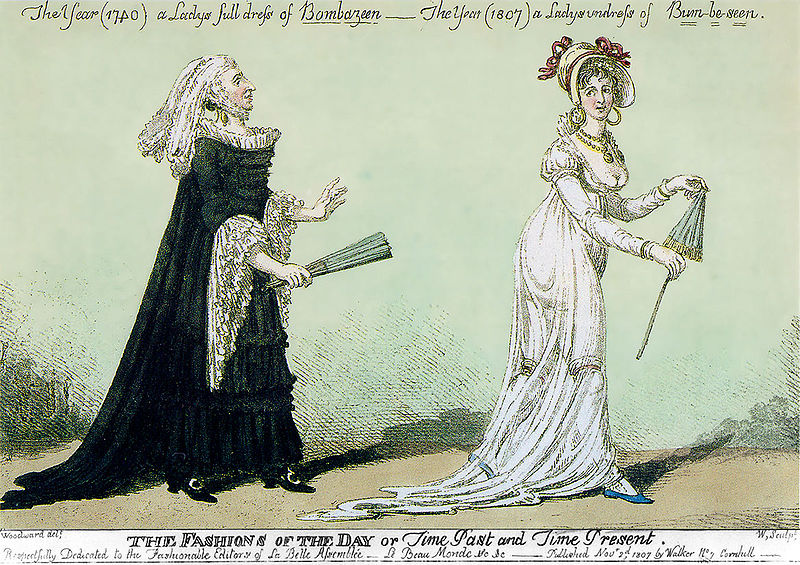
File:1807-pseudo1740 Fashion-contrast Bombazine-pun.jpgFans have been used as both a fashion accessory and a useful tool of staying comfortable for hundreds of years. Nearly every culture has a fan of some sort and the Regency Era, the time period in which I base all my romance novels, is no exception.


Unfortunately, the sources I read don't agree on what each action means. For example,  according to one source,* to fan slowly means "I am married." But according to another** to fan slowly means, "Don't waste your time; I'm not interested."

Likewise, according to one***, fanning oneself quickly means "I am married." But yet another ****says the same action means" I love you so much."

Shrug.

Also, the modern reader might wonder why go to all the trouble of learning such an elaborate language? But I think it might work well for the very shy, the very tongue-tied, or the person who needs to get the message across but fears coming on too strong. Also, telling a man she's not interested in him might be easier to say in fan language than in speaking. How many times have you told a guy who asked you out that you were busy when you really wanted to tell him to buzz off?

So, unless I can make friends with Dr. Who and jump into his time machine to find out what, exactly, these gestures really meant during the Regency Era, we may never know. Still, here are a few hand signals on which my sources seem to agree:

Touching right cheek: yes
Touching left cheek: no
Touching finger to tip of fan: I wish to speak with you.
Running fingers through the fan's ribs: I want to talk to  youResting the fan over the heart: my love for you is breaking my heart
Resting fan NEAR the heart: you have won my love
Resting fan on lips: I don't trust you.
Twirling in left hand: we are watched
Twirling in right hand: I love another
Open and shut: you are cruel
Open wide: wait for me
Presented shut: do you love me?
With handle to lip: Kiss me
In right hand in front of face: Follow me
Drawing across the cheek: I love you
Placing on left ear:  Leave me alone
Placing closed fan to the right eye: When may I see you?
Covering left ear with open fan: Do not betray our secret.
Changing fan to left hand: I love another.

So far, all the heroines in my Regency Romance novels have done with a fan is to keep cool or use it as a shield behind which they speak quietly to another. I admit, however I'm intrigued by the subtle, demure way a woman might have communicated to a man without speaking a word. She'd just have to time it when he's looking and not one else is, or her secret feelings would no longer be secret.


Sources:
*http://www.allhandfans.com/handfans/levels/language_of_the_fan.htm
**http://myhandfan.com/language.htm,
***Minute Company
****myhandfan.com

Monday, February 25, 2013

Guest Jane Ashford: Marriage Laws in Regency England

Linda Banche here. My guest today is Jane Ashford and her Regency historical, Once Again a Bride. Marriage figures prominently in the book, and here she tells us about what the heroine had to contend with in her marriage.

Leave a comment with your email address for a chance to win the copy of Once Again a Bride which Sourcebooks has generously provided. Jane will select the winner. Check the comments to see who won, and how to contact me to claim your book. If I cannot contact the winner within a week of selection, I will award the book to an alternate. Note, Sourcebooks can mail to USA and Canada addresses only.


And the winner is Joye! Congratulations, Joye, and thanks to all for coming over.
 
Welcome Jane!

Jane Ashford:

Marriage Laws in Regency England

Today, many of us take a host of legal rights for granted. We just assume that married women can own property, administer bank accounts, sign binding contracts. If they want to take someone to court to fight an injustice, they can. If they want to file for divorce, difficult at that may be emotionally, there’s no legal impediment. It’s a no brainer.

The situation was quite different in Regency England. Married women then had next to no legal rights. As soon as she married, a woman's existence was incorporated into that of her husband, giving her the status of a feme covert (English spelling of a medieval Anglo-Norman phrase meaning "covered woman"). She became, essentially, a non-person in the eyes of the law. As the legal authority Blackstone put it, “the very being or legal existence of the woman is suspended.” Her husband gained control of all her property and income, including any future earnings she might make. She couldn’t get an education without her husband’s permission, and he could even prevent her from seeing their children. It was hardly a compensation that she couldn’t be sued (except in conjunction with her husband) and that any debts she ran up were his obligations. (As recently as 1972, two U.S. states allowed a wife to plead “obeying her husband's orders” as a defense in criminal court.)

Of course individual cases varied greatly in those past times. There were kind, liberal husbands, and wives who had great influence over their mates’ decisions. Many families tried to safeguard their daughters' property rights and futures by creating written bonds or settlements, a prenup of sorts. But in the absence of such a document, if a husband wanted to tyrannize, there was nothing stopping him.

This is what happened to the heroine of my recent historical Once Again a Bride. Charlotte Rutherford Wylde was married off by her father to keep her safe. Aware of his failing mental faculties and general health, he wanted to ensure her future. But his judgment was more affected by his illness than he realized, and he picked a disasterous husband in Henry Wylde. Charlotte, loving her father and wanting to believe he’s still the strong, wise figure who has taken such care of her all her life, accepts his choice.

And so, at the age of nineteen, she’s married, and trapped. The aged Henry Wylde has no interest in Charlotte herself. He only wants her money, and he gets it all. Dowry, inheritance when her father dies soon after the wedding, everything. It’s his to spend, and he has no obligation even to tell Charlotte how he’s doing that (wasting it all on bogus antiquities). Charlotte has no recourse. She can’t even complain. Henry is acting completely within the law.

When Henry is killed in the dark London streets, Charlotte discovers that she’s practically penniless. So even though she regains some legal rights as a feme sole, she has no resources. But through determination and an ardent desire to recapture the light and joy of life, she finally earns her HEA ending.

ONCE AGAIN A BRIDE BY JANE ASHFORD – IN STORES FEBRUARY 2013
She couldn’t be more alone…
Widowhood has freed Charlotte Wylde from a demoralizing and miserable marriage. But when her husband’s intriguing nephew and heir arrives to take over the estate, Charlotte discovers she’s unsafe in her own home… Alec Wylde was shocked by his uncle’s untimely death, and even more shocked to encounter his uncle’s beautiful young widow. Now clouds of suspicion are gathering, and charges of murder hover over Charlotte’s head.

He could be her only hope…or her next victim…

ABOUT THE AUTHOR
Jane Ashford discovered Georgette Heyer in junior high school and was captivated by the glittering world and witty language of Regency England. That delight led her to study English literature and travel widely in Britain and Europe. Jane’s historical and contemporary romances have been published all over the world, and she has been nominated for a Career Achievement Award by RT Book Reviews. Eighteen of her Regency romances will be published by Sourcebooks in the near future! Born in Ohio, Jane currently lives in Boston. For more information, please visit www.janeashford.com and her Facebook Page.

To Purchase Once Again a Bride:


Wednesday, February 13, 2013

February: The Month of Love


by Shannon Donnelly

Valentine’s Day was a saint’s day long before it became associated with greeting cards and chocolates—and romance. But even with the romantic connection it has today, not that many romances use a Valentine’s setting.

Silver Links, one of my Regency Novellas, is placed right around Valentine’s—partly because the editor asked for the connection, but also because it worked very well into the plot (the heroine tries to arrange a romantic Valentine’s event for her husband, to help patch a rocky bit, but of course it all goes wrong). Maybe that’s why Valentine’s isn’t used much in romances—a romance is all about the rocky bits of a relationship, instead of the perfect day we all hope to have on Feb 14.

Traditionally in England, spring began on St Valentine's Day (February 14th), the day on which birds chose their mates. Given England’s usual weather that seems optimistic thinking to try and put spring so early, but perhaps it was the hint of warmth coming that encouraged both people and birds to look ahead. In parts of Sussex, Valentine’s Day was even called 'the Birds' Wedding Day'.

For the Celtic year, winter ended February 1 with the celebration of Imbolc or Oimelc. This was the time when ewes begin to lamb, and life began to return. For the ancient Celts, this was the celebration for Brigid (also Brigit, Brighid or Bride), the Light-Bringer, one of the main Celtic goddesses. She was strong enough to survive and be transformed by early Catholics into Saint Bridget, who was celebrated, along with the Virgin Mary, on February 2, Candlemas Day. (Yes, the days are getting longer again and that’s always a reason to celebrate.)

Many other English traditions and superstitions came to be associated Valentine’s day, and some of these were in place in the early 1800’s, the time of the English Regency :
  • The first man an unmarried woman saw would be her future husband (can you imagine what this would do to try and arrange your schedule to make this work out as you wished?).
  • If the names of all a girl's suitors were written on paper and wrapped in clay and the clay put into water, the piece that rose to the surface first would contain the name of her husband-to-be.  (And it seems to me you could rig this with the right type of clay.)
  • If a woman saw a robin flying overhead, she would marry a sailor. If she saw a sparrow, she would marry a poor man and be very happy. If she saw a goldfinch, she would marry a rich man. (No mention, however, of if she’d be happy with the rich man.)
  • In the Middle Ages, young men and women drew names from a bowl to see who their Valentine would be. They would wear these names on their sleeves for one week (which just sounds an awful fuss to me).
  • In Wales, wooden love spoons were carved and given as gifts. (These spoons are beautiful—and still sold in Wales.)
February is also the time of Shrove Tuesday (the last day before Lent begins on Ash Wednesday). Traditionally, Shrove Tuesday was the day to indulge, so pancakes were a traditional food (the butter, fat and eggs might all be things to give up for the forty days of Lent). So, after romance comes indulgence, and then you must give up some things. Hmmm—that sounds about right for any romance, so perhaps February is the month of love.

Do you have any special Valentine’s traditions? (Personally, I love those candy hearts with message—so very non-historical, but they have deep roots in my childhood.)

Shannon Donnelly Bio
Shannon Donnelly’s writing has won numerous awards, including a RITA nomination for Best Regency, the Grand Prize in the "Minute Maid Sensational Romance Writer" contest, judged by Nora Roberts, RWA's Golden Heart, and others. Her writing has repeatedly earned 4½ Star Top Pick reviews from Romantic Times magazine, as well as praise from Booklist and other reviewers, who note: "simply superb"..."wonderfully uplifting"....and "beautifully written."

Her Regency romances can be found as ebooks on all formats, and with Cool Gus Publishing, and include a series of four novellas.

She also has out the Mackenzie Solomon, Demon/Warders Urban Fantasy series, Burn Baby Burn and Riding in on a Burning Tire, and the Urban Fantasy, Edge Walkers. Her work has been on the top seller list of Amazon.com and includes Paths of Desire, a Historical Regency romance.
She is the author of several young adult horror stories, and computer games. She lives in New Mexico with two horses, two donkeys, two dogs, and only one love of her life. Shannon can be found online at sd-writer.com, facebook.com/sdwriter, and twitter/sdwriter.


Friday, February 1, 2013

Regency Chocolate


I am a total chocolate fan. Well, perhaps I should say, I have a sweet tooth that demands something creamy and decadent. I'm not really a chocolate connoisseur, and I prefer milk chocolate to dark, which apparently proves I'm don't have a sophisticated pallet. Whatever. If it's sweet and creamy and sinful, I love it.

Which made me wonder; what was candy, and more specifically, chocolate, like in Regency England? 

As it turns out, they had quite a variety of chocolate, actually. These were not like a box of Russell Stover or Godiva chocolates, but according to "In Savoring the Past: The French Kitchen and Table from 1300 to 1789," culinary historian Barbara Ketcham Wheaton cites a cookbook from 1750, there WERE chocolate candies. "There are also some chocolate candies: the still familiar diablotins -- flat disks of bitter chocolate, thickly sprinkled with nonpareils, chocolate "olives" (which we call chocolate truffles), and a conserve of chocolate, which turns out to be very like fudge...dipped chocolates... were not invented until the nineteenth century."

The Coffee Mill and Tobacco Roll was a popular shop that served chocolate but the chocolate they served was a hot beverage that people drink like coffee.  Some people prefer black coffee; others like theirs fairly sweet with cream. From my research, it appears that most people drank chocolate black. It always amazes me that anyone would like coffee without sweetener, but apparently a lot of people liked their chocolate the same way. Maybe the caffeine in chocolate gave a rush people craved just as they do from coffee. Due to the cost of cocoa beans, chocolate was a drink mostly enjoyed by the wealthy until about 1730 when the price of cocoa beans dropped.

The Spanish started adding cane sugar, vanilla and spices to cocoa beverage. Since plain chocolate is pretty bitter, this practice quickly caught on across Europe. People probably experimented on their own, but the problem with a lot of old recipes is that most of them had ingredients but lacked measurements which makes it difficult to replicate, obviously. Since honey is so old, they probably sweetened chocolate with that first, but I'm sure they used sugar, too. It just wasn't refined like it is today. In fact, it came brown and lumpy more like our modern day brown sugar or raw sugar.

I'd like to research this further, because I'm sure the French, who were noted as amazing chefs even from the medieval times, had a lot to do with perfecting the art of chocolate. If I find anything of note, I'll share it in a future blog post.

Chocolate is indeed an art. I'm told by those who make candy that there are 3 keys to making chocolate: refined sugar, cocoa butter, and temperature. If you get it too cool, it fails. If you get it too warm, it fails. The temperature of your own fingers and body affected rolling, molding and shaping. I discovered this when I took up cake decorating.  There is a great deal of trial and error today and I'm sure it was even more so back in those days.

So the next time you enjoy fine chocolate, spare a thought for the science, and art, that goes into its creation. And send some my way :-)

My sources: http://regencyredingote.wordpress.com/2011/05/13/regency-chocolate-mdash-pale-thick-and-frothy/
And comments from my awesome writer friends from The Beau Monde.

Thursday, January 24, 2013

The Grand Tour

By Cheryl Bolen


The eighteenth century was the golden age of the requisite Grand Tour wealthy young Englishmen took to finish their education. These weren't tours as we know them today. They often covered several years and employed a small army of private tutors to facilitate the acquisition of knowledge and proficiency in European languages. These young men would also take valets and fencing masters.


Thomas Coke, 1st Earl of Leicester, 5th creation (1697-1759) took a six-year Grand Tour, returning to England in 1718 at age 21. At a time when a servant earned £6 a year, the 15-year-old Coke left England with a dispersal income of £10,000 for each of the six years he was gone.


His contemporary, Richard Boyle, 3rd Earl of Burlington (1694-1753) toured the Lowlands and Italy in 1714 at age 20, returning with 878 caskets of art, clocks, and musical instruments. After the English publication of Andrea Pallidio's architectural works, Burlington (the Architect Earl) was keen to follow in Pallidio's footsteps as well as Inigo Jones' and returned to Italy in 1718 and 1719.


Still another of their contemporaries, Philip Dormer Stanhope (1694-1730), the bastard only child of the 3rd Earl of Chesterfield, spent just under six years on the Continent to acquire the attributes his father deemed necessary for him to take a position in Society and in the diplomatic corp. He left England at age 14, accompanied by another young aristocrat and his own master. In each country he visited, his father demanded his valet be a native speaker so Philip could become more proficient in each language. He spent time in Germany, Austria, Switzerland, and Italy. At age 18, he took up residence in Paris, no longer obligated to study with his various tutors. At this time his father wanted him to learn the manly pursuits in Society: low-stakes gambling, attending salons, and operas. Also at 18, he received his own carriage, footman, a valet de chamber, and a valet de place.


A few decades later, Whig Statesman Charles James Fox (1749-1806), a grandson of the Duke of Lennox, was taken from Eton by his father so he could gain some "polish" on the Continent. In Spa at age 14, urged on by his father, he lost his virginity at the same time he embarked on his disastrous association with high-stakes gambling.


The Grand Tour was not just the privilege of the aristocracy. William Beckford (1760-1844), the once-wealthiest commoner in England, embarked on his Grand Tour at age 18. No expense was spared. It was said that because his entourage consisting of three carriages, outriders and relays of spare horses was so large, he was mistakenly taken for the Austrian emperor. Beckford's Grand Tour journal was published, and a paperback edition edited by Elizabeth Mavor was published by Penguin in 1986. Those looking for an accounting of great excesses will be disappointed. As one whose greatest passions were directed at young boys and nature, Beckford's observations are not very enlightening to today's readers.


The French Revolution and the Napoleonic Wars affected Englishmen's Grand Tours, and the advent of rail travel a few decades later made the progression through the Continent available to the middle classes.—By Cheryl Bolen

Cheryl Bolen's latest novel, Falling for Frederick, a contemporary romantic suspense set in England, is a Kindle Serial in nine installments. "Aided by lord of the manor, lovely graduate student archivist seeks priceless medieval artifact—just steps ahead of those who've already killed to get it." More articles on Georgian England can be found at www.CherylsRegencyRamblings.wordpress.com.

Wednesday, January 9, 2013

When Was a Duke a Duke?

by
Shannon Donnally

We tend to think of dukes and viscounts as having always been around in the British nobility. In fact, these titles were created at specific dates, often as the result of the ruling monarch looking to reward a favorite person. English nobility grew as a result of the crown granting a “Patent” that stipulated the degree of the title and how it could devolve (go on to future generations). This leads to one of the fun things in fiction—creating your characters background.

It’s great fun to make up things—and inventing the background for a character’s title means going back in time. Perhaps you here has a recent creation—he’s only the first earl. Or perhaps, as in A Much Compromised Lady, the earldom dates back to Saxon times—meaning it’s a more important title than any newer dukedom. What all of this means is that you have to have some idea of when titles first came into use.

In England, King and queen are ancient titles. The Old Saxon was cyng or cing, and cwen.  For Saxons, the title designated an elected leader.  Then William came along in 1066 and made it something that’s inherited and brought along all his Normal feudal laws.
Prior to the Normans, the highest Saxons title was earl—in fact, William was called Wyllelm, earl of Normandize in a chronicle of 1066. But the Normans changed everything. Knights as a title start to show up after the conquest, in the 1000’s—it was a general term for any military leader. The Normans brought the titles of prince/princess with them in the 1200’s (but, until the early 1600’s, only the king’s eldest son could call himself a prince).

The Normans also tried to change the title of earl to count—which is why an earl’s wife is called a countess. However, count never stuck well with the Saxons, and so we’re left with an earl and his countess.

Duke and duchess remained a foreign title until 1338 when Edward III raised his son from Earl of Cornwall to Duke of Cornwall (there are 26 dukedoms, other than the royal dukedoms that go the sons of the ruling monarch).

 In 1385, Richard II made Robert de Vere the Marquess of Dublin, bringing this title into existence. The title came from the French, which shows the strong Normal roots still hanging around.
And from the late 1300’s we also get the title of baron.

In 1440, Henry VI made John, Baron Beaumont, into Viscount Beaumont. Henry made the title of viscount official, but the word had been around for almost a hundred years as a term for an earl’s assistant (specifically as a term to denote a high sheriff).

Rounding out the list, in 1611, James I needed cash to hang onto Ulster, which the Irish wanted back. James created the hereditary title of baronet, and the Red Hand of Ulster became their badge. However, baronets are not really members of the nobility—they hold no seats in the House of Lords and the title usually comes without lands.

So when you’re creating a character’s past titles, all this goes into the mix.

Perhaps your character has Norma roots in the family, and so there might be an old barony created in the 1300’s, given to a young knight ancestor. The family may not do anything for a few generations, but may end up with one of Henry VI’s viscount titles for services rendered the crown. And then, perhaps for services to Charles II’s restoration the famiy might come into a higher title, such as marquess. (Notice how titles are like a promotion—you always get the next one up.)
Very rarely, such as was the case with the Duke of Wellington, multiple honors may be awarded by the crown. Wellington was heaped with titles for his victories against Napoleon’s forces—and both lands and money came with these titles.

But what the crown gives, the crown can also take. Treason was one reason to remove a title from a man (and from his family)—and titles with no clear heir went into abeyance until an heir could be found or until the crown decided they wanted to give the title elsewhere.

BIO
Shannon Donnelly’s Regency noveallas are now available as from Cool Gus Publishing, as well as on Kindle, Nook, from Kobo and other ebook retailers. Her latest book Burn Baby Burn, is an Urban Fantasy, also out from Cool Gus Publishing, and she is now at work on another Regency romance.

Her writing has won numerous awards, including a RITA nomination for Best Regency, the Grand Prize in the "Minute Maid Sensational Romance Writer" contest, judged by Nora Roberts, RWA's Golden Heart, and others. Her writing has repeatedly earned 4½ Star Top Pick reviews from Romantic Times magazine, as well as praise from Booklist and other reviewers, who note: "simply superb"..."wonderfully uplifting"....and "beautifully written."

Her work has been on the top seller list of Amazon.com and includes Paths of Desire, a Historical Regency romance, of which Romantic Historical Lovers notes: “a story where in an actress meets an adventurer wouldn’t normally be at the top of my TBR pile; but I’ve read and enjoyed other books by this author and so I thought I’d give this one a go. I’m glad I did. I was hooked and pulled right into the world of the story from the very beginning…Highly recommended.”
She has also published young adult horror stories, is the author of several computer games, and now lives in New Mexico with two horses, two donkeys, two dogs, and the one love of her life. Shannon can be found online at sd-writer.com, facebook.com/sdwriter, and twitter/sdwriter.