The institution of marriage made a drastic change during the 18th century and it seems that the early romance novel may have had a hand in switching the focus from power and money to love.
Early in the 18th century, marriages were arranged affairs as they had been from ancient times. Couples were brought together usually as a business deal to secure wealth, title, and status between families. What’s love got to do with it? Absolutely nothing in most cases. Love was thought to be a bad thing for a marriage, because passion and love led to erratic behavior and could keep the couple from focusing on important things, like social, military, and financial duty.
By the 1760s, however, there were as many marriages for love as there were by arrangement. And the trend continued until the end of the century, when most marriages were made based on love rather than worldly considerations. Why this shift?
One cause seems to be the up-and-coming middle class. As more and more middle class families gained substantial wealth, usually through trade, they attracted the attention of impoverished nobility. However, middle class families usually placed greater significance on a love match in marriage rather than monetary gains. So if daughters of this class married “up,” they often did it for love.
Another influence that comes to bear and that has been cited as a possible cause for love matches are romance novels such as Samuel Richardson’sPamela; or Virtue Rewarded, in which the maid, Pamela, fends off the unwanted advances of her employer, Mr. B, until he realizes he loves her and asks her to marry him. When Pamela realizes she is in love with him, she agrees, and they are married. Written in 1740, the novel was wildly popular, a best-seller of its time, and may have begun people thinking about the advantages of a love match.
Later in the century, in Richard Brinsley Sheridan’s play The Rivals, first performed in 1775, the heroine, Lydia Lavish, has based her requirements for marriage on the heroes she has encountered in a myriad of romance novels. She wants a purely romantic, love-based match with a poor soldier, as so often figures in the romances she reads. The man she loves, however, ends up being a wealthy, titled man and she has to reconcile herself to that, but love is stronger than principle, so she marries him.
In my just released Georgian romance, Only Seduction Will Do, set in the middle of the 18th century, Miss Alethea Forsythe has been seduced by a married peer and must submit to an arranged marriage to escape a ruined reputation. She, however, manages to arrange the marriage between herself and the man she loves. Unfortunately, the gentleman in question doesn’t return her sentiments and marries her only out of a sense of honor. So Alethea sets out to seduce her husband, to create a love match so they can have a happy ever after, just like a romance novel should.
Only Seduction Will Do is available at Amazon, B & N, Kobo, iTunes, and Google.
Wednesday, June 6, 2018
Wednesday, May 2, 2018
Crime in Regency England 1816
NOTE: *This post was originally scheduled for March, but I made a mistake in scheduling it and it ended up as a draft. So here is my research on robber gangs in Regency England*
When I began writing my most Regency romance, To Woo A Wicked Widow, I came upon a scene in which my hero needed a reason to be recalled to his primary estate in Kent. It needed to be a grave enough reason that he would put off wooing his particular widow to attend to it. So I began researching crime in 1816 Regency England to see what might indeed be a viable plot point.
What I discovered was that by the summer of 1816, there were a lot of very desperate men in England. The end of the Napoleonic wars with the Battle of Waterloo in 1815 had resulted in “discharged sailors and disbanded militia-men” returning to the private sector to find themselves without any means of supporting themselves or their families. The “exhaustion of British capital, the unavoidable consequences of the weight of taxation, the depression of agricultural stock, the want of markets for native and colonial produce, had produced that paralysis of industry which marked the latter months of 1815 and the beginning of 1816.” And as there was a surplus of labor in every corner of the country, many of the disenfranchised abandoned their homes and fled to the city, only to encounter a similar dearth of employment.
The result was a “rebellion of the belly” a term coined by Francis Bacon, in which these disenfranchised men took matters into their own hands in order to feed themselves. Workers following “General Ludd,” called Luddites, went around England smashing machinery, especially in textile manufactories, trying to save their jobs.
Instances of burglaries and highway robbery rose during this period, despite the harsh sentence meted out by the English courts of death by hanging for these crimes. Even petty thievery carried this sentence, so that not even children of less than ten years of age were spared. Still the crime rate rose substantially in 1816.
With all these facts and statistics running around my head, I came up with the idea that a gang of robbers (disenfranchised sailors and soldiers with a few agricultural workers) had been terrorizing the neighboring county and now had moved into Kent to rob the hero’s tenant farmers. A neat fit with the landscape of unrest in England in 1816.
If you’d like to read about my robber gang in action, To Woo A Wicked Widow is available in print and e-book at Amazon, B&N, and iTunes.
References:
Martineau, Harriet. The History of England During the Thirty Year’s Peace: 1816-1846, Vol. 1. Charles Knight, 1849.
Rule, John and Roger Wells. Crime, Protest and Popular Politics in Southern England, 1740-1850. The Hambledon Press, 1997.
When I began writing my most Regency romance, To Woo A Wicked Widow, I came upon a scene in which my hero needed a reason to be recalled to his primary estate in Kent. It needed to be a grave enough reason that he would put off wooing his particular widow to attend to it. So I began researching crime in 1816 Regency England to see what might indeed be a viable plot point.
What I discovered was that by the summer of 1816, there were a lot of very desperate men in England. The end of the Napoleonic wars with the Battle of Waterloo in 1815 had resulted in “discharged sailors and disbanded militia-men” returning to the private sector to find themselves without any means of supporting themselves or their families. The “exhaustion of British capital, the unavoidable consequences of the weight of taxation, the depression of agricultural stock, the want of markets for native and colonial produce, had produced that paralysis of industry which marked the latter months of 1815 and the beginning of 1816.” And as there was a surplus of labor in every corner of the country, many of the disenfranchised abandoned their homes and fled to the city, only to encounter a similar dearth of employment.
The result was a “rebellion of the belly” a term coined by Francis Bacon, in which these disenfranchised men took matters into their own hands in order to feed themselves. Workers following “General Ludd,” called Luddites, went around England smashing machinery, especially in textile manufactories, trying to save their jobs.
Instances of burglaries and highway robbery rose during this period, despite the harsh sentence meted out by the English courts of death by hanging for these crimes. Even petty thievery carried this sentence, so that not even children of less than ten years of age were spared. Still the crime rate rose substantially in 1816.
With all these facts and statistics running around my head, I came up with the idea that a gang of robbers (disenfranchised sailors and soldiers with a few agricultural workers) had been terrorizing the neighboring county and now had moved into Kent to rob the hero’s tenant farmers. A neat fit with the landscape of unrest in England in 1816.
If you’d like to read about my robber gang in action, To Woo A Wicked Widow is available in print and e-book at Amazon, B&N, and iTunes.
References:
Martineau, Harriet. The History of England During the Thirty Year’s Peace: 1816-1846, Vol. 1. Charles Knight, 1849.
Rule, John and Roger Wells. Crime, Protest and Popular Politics in Southern England, 1740-1850. The Hambledon Press, 1997.
Wednesday, April 25, 2018
18th and 19th century London Rookeries
During the 18th and 19th century, London’s slums were commonly referred to as rookeries. These areas were synonymous with overcrowded, unsanitary, and squalid living conditions. Poorly constructed, blackened dwellings were crammed together, forcing out natural light, thus creating gloomy streets and alleyways. Open sewers lined the narrow streets, strewn with carcasses of dead animals, where rats commonly scurried about uninterrupted.
Little children, or “street urchins,” ran through the muddy streets, skirting animal dung and dressed in tattered clothing. Women wore shapeless, faded dresses, grateful to have any clothes at all. People of all ages went to work but earned just enough money to survive.
![]() |
| Jacobs' Island |
The only available drinking water came directly from the River Thames, whose water was hideously filthy and gave off a terrible stench. At times, the Thames was so dirty that the top layer of water became a thick, black scum.
Recognizing the rookeries’ dire situation, a Parliamentary Committee was set up in 1816 to discuss the problems of the London slums, and explore what could be done to ease their suffering. Professionals were called in to give evidence and to share their firsthand experiences of the rookeries.
One London doctor, William Blair, had this to say:
“Human beings, hogs, and dogs, were associated in the same habitations; and great heaps of dirt, in different quarters, may be found piled up in the streets. Another reason of their ill health is this, that some of the lower inhabitations have neither windows nor chimneys nor floors, and were so dark that I can scarcely see there at midday without a candle. I have actually gone into a ground floor bedroom, and could not find my patient without the light of a candle.”
Unfortunately, many believed the rookeries were a result of idleness, sin, and the wicked behavior of the lower classes. It wasn’t until the second half of the 19th century, that journalists and social researchers began rallying support for an immediate public action to improve the slums’ living conditions.
Slowly, they garnered support in Parliament, only after they argued convincingly that the slums were caused by unemployment, lack of access to education, poverty, and homelessness.
Despite their efforts, the higher social classes mostly overlooked the people residing in the rookeries, but I doubt those inhabitants dwelt on it for too long. They were just trying to stay alive for another day.
-Written by Laura Beers
A Regency Spy Romance Author
Laura's blog page:
Laura's social media links:
Wednesday, April 4, 2018
“Let the Punishment Fit the Crime”: Crime and Punishment for Peers in Regency England
Last month it was robber gangs, this month it’s more crime and punishment. But I was doing research on punishments for peers for my just finished WIP, and what I found was rather fascinating.
With the exceptions of treason and murder, peers could not be prosecuted for crimes. John Palmer, in his 1830 work entitled, “The Practice in the House of Lords, on appeals, writs of error and claims of peerage,” affirms that, with some exceptions, that peers and their widows and peeresses in their own right, are “protected from Arrest, in all Civil Suits, either in the first instance or after judgement…Nor are they liable to be attached for non-payment of money, though they are not exempt from attachment for not obeying the processes of the Court.” Apparently there was a process that allowed for someone to sue a peer for their debts, but it had to be done at the King’s Bench or before the King’s Justices in Westminister. The caveat was, the peer in question had to be present in the court. And although you could, theoretically, get a court summons to compel the peer to appear, practically it just wouldn’t happen.
After 1547 if peers or peeresses were convicted of a misdemeanor crime, such as non-payment of a debt, they could claim “privilege of peerage,” if they had no prior convictions and escape punishment. This privilege was invoked five times, and finally abolished in 1841.
Peers could, however, be prosecuted and convicted of the crimes of treason and murder. The most famous murder trial of a peer may have been that of Laurence Shirley, 4th Earl Ferrers, tried and convicted of murder of his land-steward during an argument. Ferrers went to the gallows at Tyburn on May 5, 1760, the last peer to die so.
Other punishments, even more severe, could be meted out to peers. If a noble was found guilty of treason or murder, he would be served with a bill of attainder, an act of legislature that declared the peer guilty of his crime and affixing him with the verdict of “corruption of blood,” a metaphorical stain on the peer, whereby he would lose not only his life, but his property and titles, for it stripped him of the right to pass them on to his family or heirs. They instead reverted to the crown, rendering the titles extinct.
The peerage may have had its privileges, however, no one was completely free from the long arm of the law.
References:
“Earl Ferrers.” Capital Punishments, U.K. n.d.
Lee, Emery. “A Peer’s Privilege.” Georgian Junkie, November 28, 2010.
Milan, Courtney. “Crime and Punishment.”
Friday, March 9, 2018
Poet William Wordsworth
by Donna Hatch
www.donnahatch.com
William Wordsworth was a poet whose life spanned the Georgian, Regency, and Victorian Eras. He and his beloved wife, Mary, and three children lived in Rydal Mount during much of his years as a poet. The Lake District where he made his home inspired many of his poems.
I was fortunate enough to visit Rydal Mount during a trip to England in June of 2017. Thought Wordsworth never owned this home, he rented it for many years. The home itself is lovely and beautifully furnished, but it was the gardens that really captured my attention. The Wordsworths loved gardening and created a lush, vibrant retreat in their four acre property, which William designed. He also designed the gardens for many of his friends and neighbors.
One garden is named "Dora's Field" which they gave to their only daughter. After her death at the early age of 43, William and Mary planted daffodils in the field to commemorate her life. The offspring of those bulbs survive today. In the spring, Dora's Field is filled with golden, cheerful daffodils. Unfortunately, daffodils have a short blooming season and they were done by the time I visited.
One of my mother's favorite poems, which she taught me when I was child, is one of his.
I Wandered Lonely as a Cloud, By William Wordsworth
I wandered lonely as a cloud
That floats on high o'er vales and hills,
When all at once I saw a crowd,
A host, of golden daffodils;
Beside the lake, beneath the trees,
Fluttering and dancing in the breeze.
Continuous as the stars that shine
And twinkle on the milky way,
They stretched in never-ending line
Along the margin of a bay:
Ten thousand saw I at a glance,
Tossing their heads in sprightly dance.
And twinkle on the milky way,
They stretched in never-ending line
Along the margin of a bay:
Ten thousand saw I at a glance,
Tossing their heads in sprightly dance.
The waves beside them danced; but they
Out-did the sparkling waves in glee:
A poet could not but be gay,
In such a jocund company:
I gazed—and gazed—but little thought
What wealth the show to me had brought:
Out-did the sparkling waves in glee:
A poet could not but be gay,
In such a jocund company:
I gazed—and gazed—but little thought
What wealth the show to me had brought:
For oft, when on my couch I lie
In vacant or in pensive mood,
They flash upon that inward eye
Which is the bliss of solitude;
And then my heart with pleasure fills,
And dances with the daffodils.
In vacant or in pensive mood,
They flash upon that inward eye
Which is the bliss of solitude;
And then my heart with pleasure fills,
And dances with the daffodils.
Friday, March 2, 2018
Making it Work: Women & Personal Care in the 1940s
by guest blogger, Renee Clark
www.raneesclark.com
www.raneesclark.com
In the late 1940s, one would imagine women had access to
many of the conveniences for personal care that we have today, right? One
glance at the popular rolled hairstyles that women did at home, without the use
of a maid, makes one assume things had come a long way since the Regency and
Victorian periods.
That’s what I thought too, until I sat down to fact check
for my historical novel, Beneath the
Bellemont Sky, which takes place on a Wyoming farm in 1946-47. Radios were
common in nearly every household by then and we were on the cusp of many people
owning a TV. Hairspray seems like a given, right?
It wasn’t. The technology we’ve come to associate with
aerosol sprays we use now was perfected for the use of insecticides during
World War II, and using it on the sticky solutions that set hair styles didn’t
become widespread until the 1950s. When the main character of Beneath the Bellemont Sky, Vera, fixes
her hair for a fall festival, she has to rely on curlers and good luck for
keeping her hair in place. Being thrust into the work place during World War II
and beauty supply shortages, women’s hairstyles during the 1940s were
utilitarian, and as the decade wore on, soft, brushed out curls became the
go-to styles.
Setting up the perfect hairstyle wasn’t the only thing that
took much more thought than we give it today. While writing the second section
of the book, I assumed that it would be just slightly more complicated than it
is in modern times for Eleanore, one of Vera’s friends, to find out that she
was pregnant. After all, the forties weren’t that long ago! A few hours of research later, I realized it was
much more complicated than even a trip to the doctor. Did you know that the
at-home pregnancy tests we use today weren’t even developed until the 1970s? In
the book, Eleanore has to rely on knowing her body as she suspects her
condition. At that time, one of the only known ways to test if a woman was
pregnant was to inject a sample of her hormones into a mouse and wait for a few
days to see if it went into “heat.” The tests were long and expensive, and not
something Eleanore would likely have access to or even choose to do.
You can find out more about Raneé S. Clark and her new book, Beneath the Bellemont Sky at www.raneesclark.com
Sources
“A Thin Blue Line: The History of the Pregnancy Test Kit,”
National Institutes of Health, Office of History, history.nih.gov
Encyclopedia of Hair:
A Cultural History by Victoria Sherrow, pages 183-184
Friday, February 9, 2018
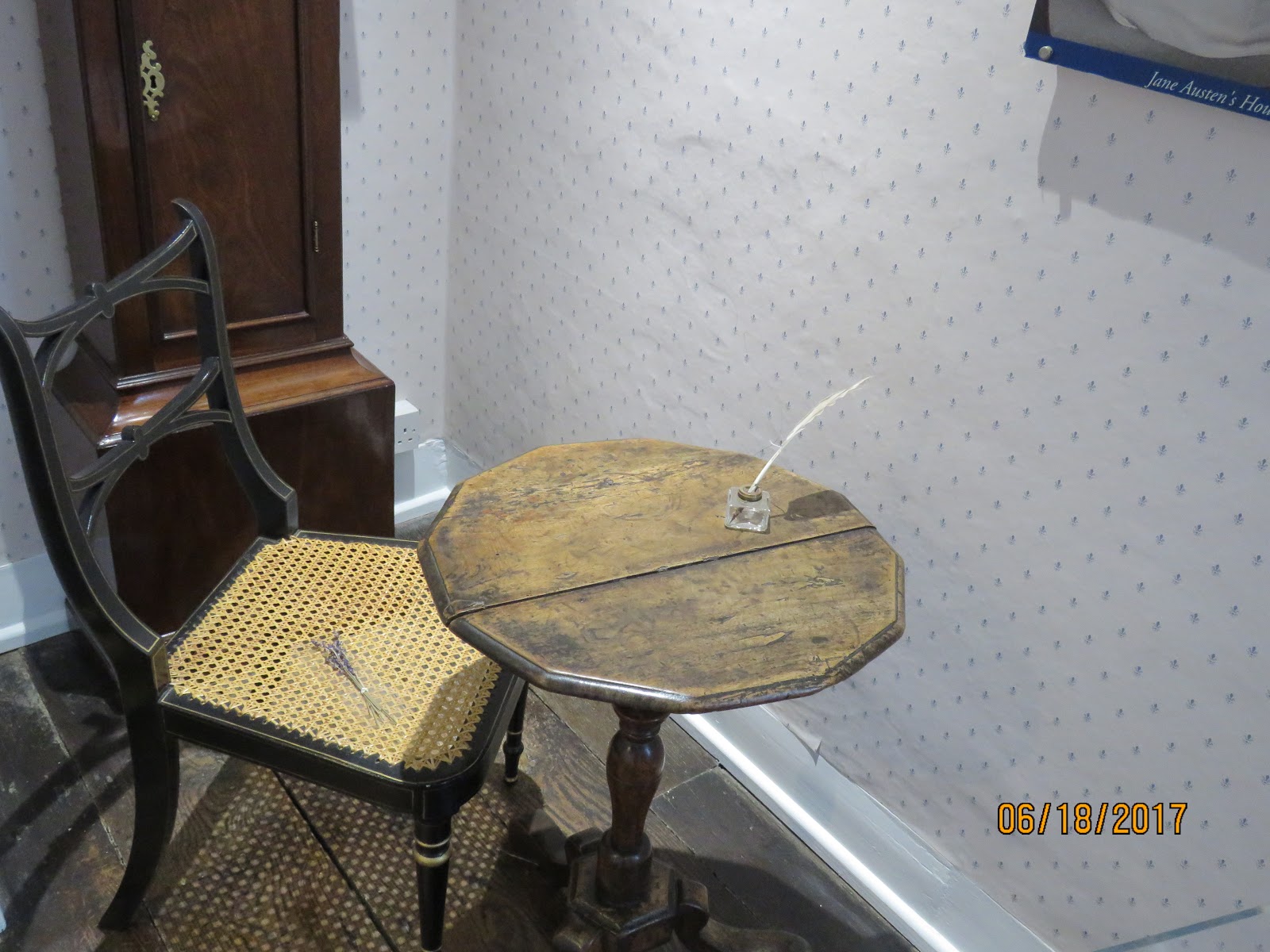
| Jane Austen's writing table, copyright Donna Hatch |
www.donnahatch.com
In a time before phones, email, text messages, and social media, Regency ladies and gentlemen had only one way of keeping in touch with friends and family too far distant to see frequently; they wrote letters. The upper classes took their writing very seriously, and often wrote long, detailed letters to family and friends. Many also wrote religiously in their journals. And, of course, poets and authors needed reliable writing instruments.
Necessary writing tools included a quill pen, an inkstand or inkwell filled with ink, a pen knife, and sand or blotters. Often these implements were stored together in a little box inside a desk.
Looking at the process through the lens of our modern eye, it is easy to overlook the pen knife. Yet it is as essential as the pen and ink for anyone who wanted to write. Quill pens, which were usually goose quills (but could also be from peacock, swan, or even crow feathers) always needed sharpening, trimming, and shaping, just as today's pencils need sharpening. They could also be used to sharpen the pencil, which had only been in use since the 1700's, as opposed to the quill pen that people had been using for two centuries.
Cutting a quill pen took a great deal of skill. The nib had to be carefully shaped in order for the hollow core to hold the correct amount of ink, and then be released smoothly as the writer pressed on it. I found detailed instructions about how to sharpen a quill here.
Many quills were kept together in a little box. I suspect if one planned to do a lot of writing, one sharpened the quills all at once, then in the course of their writing, simply set aside a flattened or misshapen quill and picked up another from the box without losing the rhythm of writing.
In Pride and Prejudice, the proud yet fawning Caroline Bingley offered to mend Mr. Darcy's pen, adding that she mended pens "remarkably well."
![]() |
| Quills and inkwell (Photo credit: studentofrhythm) |
For hundreds of years, pen knives had a blade that was fixed in the handle. During the 1700's pen knives could be folded, like today's pocket knife.
In Jane Austen's Mansfield park, Fanny Price's two younger sisters fight over a silver pen knife which had been a gift from the godmother of a dead sister. The sister had handed the knife to Susan before she died.
Pen knives had other uses. Many new few books were uncut at top and front. They had to be sliced open so one could read the book. A sharp knife was needed to keep the pages from tearing. I suspect the wealthy had a knife specifically used for this purpose, and did not double up using the precious pen knife, but the average person probably had to made do with an all-purpose knife.
Pen knives were as important to a Regency household as pencil sharpeners are to an elementary student today.
| Jane Austen's Chawton House Museum, copyright Donna Hatch |
Here is a photo of the house where she lived so happily with her mother and beloved sister, Cassandra, and did so much writing.
I found the images of pen knives that you may wish to view here, and here.
Sources:
Subscribe to:
Posts (Atom)