Search This Blog

Friday, February 12, 2021

 by Donna Hatch

www.donnahatch.com

As a romance author and hopeless romantic, I cannot possibly ignore Valentine’s Day. I admit, until I started researching the topic, I really didn't know the real history behind Valentine’s day except it was to honor a Christian named Valentine who was martyred for marrying people in secret. Which really didn't make sense to me. Was he martyred because he was Christian? Or because he was marrying people? To my surprise, I found the answer to be a bit of both. Maybe. Although no one really sure who, exactly the famous Valentine actually was. He may have actually been more than one person. Much is couched in myth and speculation. However, here's some fun history, sprinkled liberally with legend.

This much appears to be factual: In Rome 270 C.E. Emperor Claudius II put out an edict saying no man could marry. Ever.

??????

Talk about a stupid law! No marriage? At all? And sex outside of marriage was considered to "prostitution" which was also illegal. Talk about a bunch of lonely, unhappy people. And how were children to be brought into the world? Did he think it was okay for his entire country to become extinct in a single generation? Clearly, this brainless emperor didn’t think that one through.

He apparently did have a reason for it, however short-sighted. He felt that marriage made men "soft" and therefore unreliable soldiers. Men wouldn’t want to leave his wife and child AND die for his country, and because Emperor Claudius needed a massive army to maintain his vast empire. So, he outlawed marriage. Clearly, he wasn't worried about becoming unpopular with his crazy law nor having a country peopled with soldiers for his posterity.

Into this confusing chaos steps Valentine, the Bishop of Interamna, who invited all young lovers to come secretly marry and, in turn, converted quite a few people to Christianity. This man was intelligent – much smarter than the Emperor because while getting his way of converting people to Christianity, he also saw to the needs of disgruntled lovers. Aw, isn’t that sweet?

Or it might have been a ploy to convert heathens. Either way, the Emperor inevitably found out and had Valentine arrested.

The odd thing is, Valentine may not have been condemned for going against the Emperor's edict. Some accounts suggest it was because he refused to renounce Christianity and convert to Roman ways AND even attempted to convert the Emperor to Christianity. Talk about pluck! According to legend, while Valentine was awaiting execution, he befriended a girl who was the blind daughter of the jailer. While in jail, Valentine restored her eyesight through his faith. Some people believe he fell in love with her. Then he supposedly wrote her a farewell letter on the day that he was stoned (or beaten, according to some sources) and then beheaded. Another account reports he simply died in prison, probably of typhus, or gaol (jail) fever. At any rate, Valentine reportedly signed his love letter, "FROM YOUR VALENTINE."

morning_st_valentineWe have been using his name, and even that phrase, ever since.

Also, there appears to have been anywhere from three to seven men who bore that name and were martyred, or died while in service to the church. Apparently one helped a number of Christians escape prison where they were being beaten and tortured. This Valentine was caught and executed. Another Valentine was a missionary in Africa, but little is known about him. Or, it’s possible, they were all the same men, but accounts of his death have been muddied. However, we do know that Valentinus, or Valentine, was a very common Roman name.

Though the marrying Valentine was executed on February 24, (according to some sources, anyway) 270, the Christian church chose to honor him and all the Valentines – who all supposedly died on or near February 14 – on February 14th because they wanted to replace a Roman rite of passage to the God of Lupercus. Part of the festival included men running around and slapping young women with a strap dipped in blood with the idea it was supposed to make them fertile. Another practice in that festival involved putting the names of virgins in a box (I wonder if they were willing or unwilling?) and drawn by not so virginal men (ARE there any virginal men?) in a lottery. Whichever girl was drawn was then assigned to "pleasure" the lucky man until the next lottery, which was a year later. (poor girl!!!) Sounds like a premise for a book, doesn’t it?

Anyway, the church was appalled by this pagan holiday (I don't blame them) so they chose to substitute it with a close second. Well, okay, maybe by the men’s standards it wasn’t such a close substitute. But Valentine’s Day appealed to the love aspect of the ritual instead of sex. I’m sorta surprised the men went for it, men being what they are. But I guess pleasing his wife, or the girl whom he hopes will be his wife someday, in the hopes he’ll get lucky (ahem) was the best substitute a good Christian man could hope for.

So, happy Valentine's day! And be grateful we aren't Roman!!!

Wednesday, February 3, 2021

No Occupation for a Lady: The Plight of Ladies Without Means in the 18th Century By Jenna Jaxon

For centuries women of the upper classes have lived precariously on the wealth of their families or their husband’s families. Lower and middle class women, especially in the 18th century, were allowed a variety of occupations, including “spinners, tailoresses, milliners, and washerwomen.” Other possible occupations were domestic service, midwives, and milkmaids. They have also been recorded as working as apothecaries, barbers, blacksmiths, seamstresses, and printers. Many of these were family-run businesses and the women of the family would learn the family trade and work there until they married, at which point they would take care of their own family and children or go into their husband’s family business. Not so for women of the upper classes. The occupation most young ladies of the aristocracy were trained for was marriage. It was the duty of each young woman to marry and afterwards take care of her husband’s house, bear and raise his children, and take over his duties with his estate should he be called away from it for any amount of time. This was the primary job opportunity for ladies, and should they not make a marriage, their life became extremely perilous.
A daughter who, after three Seasons found herself still unmarried, was deemed a spinster or “on the shelf” and usually was relegated to remaining in her father’s house to take care of her parents, or any of her brothers and sisters with families who needed assistance. At the death of her father, she might stay on in her brother’s household, helping as best she could, but could be sent away if she did not get along with her brother’s wife. One of the few other permissible occupations for ladies was as a companion to a respectable member of the family or another family
of good reputation. This could be a good position for any lady left alone (through widowhood or simple fate) must have a companion with her at all times to preserve her reputation. If the companion and her employer suited one another, then the companion position could be a godsend. However, if the employer was difficult, it might not be a permanent solution. The third occupation that was respectable for ladies was that of governess. Every house with daughters employed a governess once they attained the age of six or so. The family wanted a woman of good family and reputation who could instruct their children not only in their studies, but in their deportment. Of course, governesses were hired for a finite period of time, until the girls were ready to go out into society. They would then go on to another family, hopefully with a good reference.
If a lady could not secure any of these positions she would have to find some other means of making ends meet. Occupations such as domestic servant or shopkeeper were not considered “genteel,” thus rendering her no longer part of the upper class.
In my romance Only A Mistress Will Do, the heroine, Violet Carlton, is one such woman whose circumstances have brought her terribly low. She has been unable to marry and has not been able to secure a position as either a companion or a governess. She has been brought so low, in fact, that in order for her to live, she must seek employment at a brothel and sell her body at the House of Pleasure. A circumstance that, unfortunately, happens both then and now.

Wednesday, January 6, 2021

The Frost Fair of 1814 by Jenna Jaxon

Winter days during the Regency were particularly cold as The Little Ice Age was in full swing during the early 19th century. In early February of 1814 the Thames River in London froze over completely and to a depth of more than eighteen inches, prompting what would be the final Frost Fair in London.
The first Frost Fair occurred in 1608, although the river had frozen over many times before that. This initial fair consisted of out-of-work watermen who erected temporary sheds out of blankets or canvas and sold hot drinks to passersby. However, the last time the Thames froze solid, the Frost Fair that occurred on its ice-bound waters was a huge carnival that lasted from February 1-4 and spread from London Bridge to Blackfriars Bridge. To open the fair and prove the ice was frozen solid, an elephant walked across the river.
Like any fair or carnival there were many varied attractions. There were, of course, vendors with food and drink to sell. One popular type of stall cooked mutton or beef right on the ice and charged not only for the meat after it was cooked, but also for the privilege of watching it cook. Purveyors of nuts and fruits carried their wares around the fair rather than have a stationary stall. All manner of drinks were also sold: tea, coffee, hot chocolate, mulled wine, beer, and spirits.
Souvenirs of all sorts were sold to commemorate the Frost Fair. Printers were moved onto the ice and printed customized souvenirs for customers. Also popular were any manner of items—from cutlery to cups to plates—were labeled with the information that they were purchased at the Frost Fair. One of the most unusual souvenirs was a piece of gingerbread, still extant, bought at this fair in 1814.
When one had eaten their fill and bought their souvenirs, there were any other manner of entertainment at the Frost Fair. Animal races, bear and bull baitings, donkey rides were part of the celebration. Games of football, skittles, and archery took place as well as ice skating. Rides were another part of the entertainment. Swings were erected and as well as a whirling chair ride. Acts such as jugglers, sword and fire swallowers, and stilt-walkers enhanced the carnival-like atmosphere. Another very popular entertainment was puppet shows. This stunning display of winter revelry came to an abrupt end when, on February 4th, the cold snap broke, the temperature moderated, and the ice turned back into rushing water. As soon as the ice began to crack and creak, most vendors pulled up stakes and hurried to the safety of the banks of the river, although a few left it too late and ended up with their stalls floating down the river.
An extraordinary gathering that was destined, by the end of the Little Ice Age in the 19th century and global warming in the 20th and 21st centuries, to be the final Frost Fair.

Friday, December 4, 2020

by Regency Romance Author, Donna Hatch

www.donnahatch.com


Few symbols of Christmas are more admired than the Christmas tree, and nowadays, most countries that celebrate this holiday have their own version of Christmas trees. Before that, evergreens were a commonly hung adornment in homes, not just at Christmas but all winter.  

Dating back hundreds of years, people in many countries hung evergreen boughs over their doors and windows, hoping to ward off witches, ghosts, evil spirits, and even illness. According to legend, it wasn’t until about 722 in Germany, that whole trees arrived on the scene. In the Middle Ages, the Germans and Scandinavians brought evergreen trees to the door or sometimes even inside their homes to display their hope that spring would soon come. It also symbolized eternal life.

One popular story about the origin of the evergreen being a Christmas tree tells of Saint Boniface who encountered a group of pagans about to sacrifice a child at the base of an oak tree. Appalled, and rightly so, Saint Boniface stopped the sacrifice and even cut down the tree to prevent future sacrifices. Later, a Fir tree grew at the base of that oak stump. St. Boniface took that as a sign and spread the word that the evergreen was a holy tree because its branches pointed to heaven as a sign that it belonged to the Christ child, and that the fir was a symbol of His promise of eternal life.

Another legend attributes Martin Luther the credit for the origin of the Christmas tree. In the 1500’s on Christmas tree, Mr. Luther took a walk through a snowy forest. The sight of the moonlight shimmering in on the snow-covered woods that starry night touched him so much that he cut down a small fir tree and brought it home for his family. They decorated the tree with small lit candles in honor of the birth of the Christ child.

According to All About Jesus Christ, The Origin of the Christmas Tree:  

Research into customs of various cultures shows that greenery was often brought into homes at the time of the winter solstice. It symbolized life in the midst of death in many cultures. The Romans were known to deck their homes with evergreens during Kalends of January 15. Living trees were also brought into homes during the old Germany feast of Yule, which originally was a two month feast beginning in November. The Yule tree was planted in a tub and brought into the home. But there is no evidence that the Christmas tree is a direct descendent of the Yule tree. Evidence does point to the Paradise tree, however. This story goes back to the 11th century religious plays. One of the most popular was the Paradise Play. The play depicted the story of the creation of Adam and Eve, their sin, and their banishment from Paradise. The only prop on the stage was the Paradise tree, a fir tree adorned with apples. The play would end with the promise of the coming Savior and His Incarnation. The people had grown so accustomed to the Paradise tree, that they began putting their own Paradise tree up in their homes on December 24.

The Hanoverian kings, who were from a duchy of what became present-day Germany, adopted the use of Christmas trees -- the tabletop variety -- with real lit candles. While the candles were lit, a footman or a member of the family stood by with a water pot to prevent the risk of causing a fire.

Christmas trees came to England with the German Prince, Albert, when he married Queen Victoria in 1840, and brought his German Christmas traditions with him. In 1848, an engraving of the Royal Family celebrating Christmas at Windsor was published in the newspaper which showed Victoria and Albert standing with their children around a Christmas tree. Since the English adored Queen Victoria, the general populace adopted the custom of a Christmas tree with ornaments.

German immigrants brought the Christmas tree to America as early as 1747. Pennsylvania had the first record of one being on display in the 1830s. The average American in New England, however, rejected Christmas trees, viewing them as pagan symbols. Puritans viewed Christmas as sacred and shunned anything they considered frivolous. However, with an influx of German and Irish immigrants, the Puritans lost their power, further fueled by the illustrated version of the newspaper that had a sketch of the royals with their tree. After all, what was done at court immediately became fashionable—not only in England but with fashion-conscious East Coast American Society.  This combination eventually undermined the Puritan legacy. Never to do anything small, the Americans soon graduated from small table-top trees such as the Europeans used, to the floor-to-ceiling trees we know today.

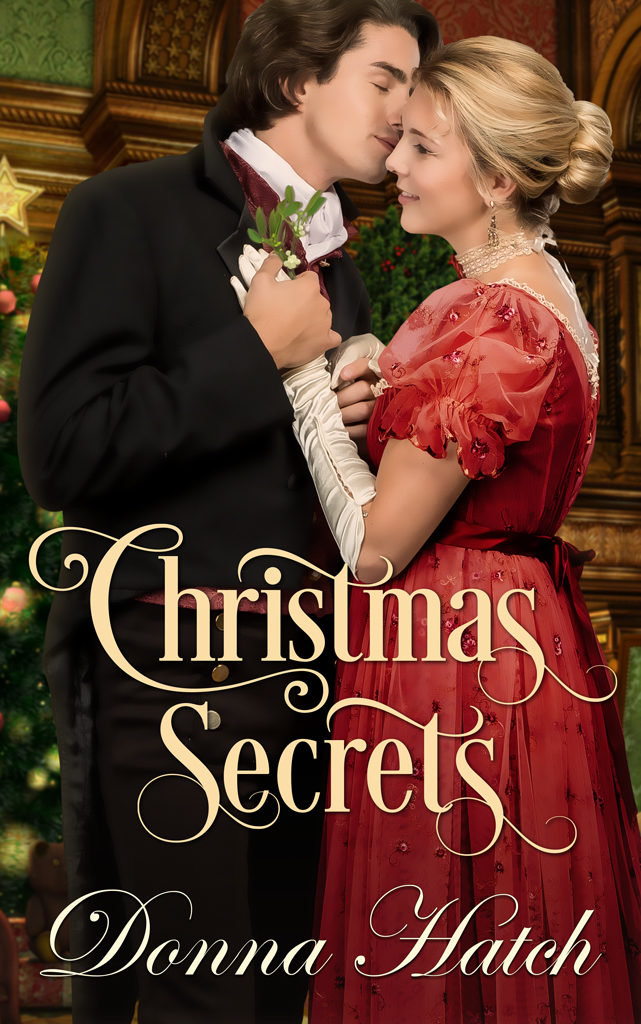
As a Regency author, I seldom use Christmas trees in my stories unless I establish a family tradition with German roots for my fictional characters. But there are lots of other English fun traditions I discovered, after much careful research, that were honored, and that I include in my writing. Many of those traditions, including Yule Logs, Mistletoe or kissing balls, and other fun Christmas traditions went into my full-length novel, Christmas Secrets, available in print and ebook, and free on Kindle Unlimited. You can purchase your own copy, or give it as a gift, here:

A stolen Christmas kiss leaves them bewildered and breathless.

A charming rogue-turned-vicar, Will wants to prove that he left his rakish days behind him, but an accidental kiss changes all his plans. His secret could bring them together...or divide them forever.

Holly has two Christmas wishes this year; finally earn her mother's approval by gaining the notice of a handsome earl, and learn the identity of the stranger who gave her a heart-shattering kiss...even if that stranger is the resident Christmas ghost.

Grab your copy on here!

Don't have time to read a full-length novel during the holiday season? Check out these novellas, short enough to enjoy and romantic afternoon escape, and long enough to have a swoony happily ever after.

"A Winter's Knight"

"A Christmas Reunion"

"Mistletoe Magic"


Sources:

https://www.britannica.com/plant/Christmas-tree

https://www.regencyhistory.net/2012/12/did-they-have-christmas-trees-in-regency.html

https://www.allaboutjesuschrist.org/origin-of-the-christmas-tree-faq.htm

Wednesday, December 2, 2020

Celebrating a Regency Christmas by Jenna Jaxon

One of the problems of writing a Christmas story set in the Regency period is the fact that during about the early years of the nineteenth century, Christmas was celebrated almost not at all. Between 1811 and 1820 people seemed to not wish to commemorate the season very much at all. However, if one digs really deeply, you can find a few distinctive traditions that were observed during this most wonderful time of year.
The season itself was very different from our own, which now begins the day after Thanksgiving in the United States and is in full swing by December 1. In the Regency Christmastide began on Christmas Eve. This was the traditional day for going out into the woods (or to a shop in the city) to gather greenery to decorate the house with. Holly, rosemary, bay, laurel, and mistletoe were the traditional fresh greens brought in and either hung up (as in mistletoe) or draped around windows or mantlepieces. Mistletoe, then as now, was hung up all over the house waiting for couples to meet and kiss underneath it. The tradition was for each kiss, one of the white balls was plucked from the mistletoe ball. When no balls remained, that particular bough was finished. The Christmas tree, sadly, did not come into being until the Victorian age. One practice that most sources agree on was that it was a time for families to gather together with neighbors and friends. There
are many references to a big dinner on Christmas day that one either held in one’s home or was invited to dine with another family. The dinner was filled with rich meats like roast beef, venison, goose, pheasant, and swan or peacock. Bread based stuffing and vegetables such as potatoes, squash, and carrots rounded out the meal. The Christmas pie (mincemeat) and Christmas pudding were staples of the dinner as well. Charity was another tradition during the season. Those more fortunate were sure to celebrate it by sharing with those less fortunate. Gifts of food and drink and money were given to the poor. Wassailers and mummers paraded through towns performing songs or skits in exchange for foodstuffs and money. The day could also end with parlor games such as charades, blindman’s bluff, any number of card games, and the infamous Snapdragon. For this last, raisins were soaked in brandy, then the dish was lit on fire and everyone had to grab a raisin and eat it without getting burned. Obviously, you do NOT want to try this at home!
The celebration continued through Epiphany or Twelfth Night, on which day all the greenery had to be taken out and burned to avoid bad luck throughout the year.
While writing six Regency Christmas tales, I’ve incorporated quite a few of these traditions including bringing in the greenery, parlor games, Christmas dinner, and of course, kissing under the mistletoe. My current release, It Happened Under the Mistletoe and other Yuletide Tales, contains five Christmas novellas in which mistletoe is prominently featured. The anthology is available on Amazon and Smashwords for just .99, a Christmas gift from me to you. Here’s wishing everyone a very happy holiday season! Sources: Beverley, Jo. Christmas Traditions in the Regency. Hoppe, Michelle J. The Regency Christmas Feast, 1999. Rowland, Jane. Regency Christmas Games. Austen Authors, December 12, 2018.

Wednesday, November 4, 2020

An Unlikely Sport for Gentlemen: Boxing in the Regency Era by Jenna Jaxon

When thinking of gentleman-like sports of the Regency era, one may immediately think of shooting, hunting, riding, racing as being cultured and likely to be attended by the well-dressed and well-mannered men of the Regency. However, one not so refined sport that took the period by storm was, surprisingly, boxing.
Boxing as sport in England had begun in the 17th century, a bare-knuckle free-for-all termed prizefighting. The first champion of this form of the sport was James Figg in1719, a time when the term “boxing” first began to be used. As may be expected, these fight had no rules to them and included pummeling, punching, headbutting, eye-gouging, and choke-holds. From this sort of melee in 1743 a few rules emerged, such as no hitting below the belt and a count of thirty to determine when a fight was over. One of the most successful boxers of the Regency was “Gentleman” John Jackson, son of a builder turned prizefighter. He fought in three fights, losing only one, then retired to create a boxing academy, teaching gentlemen to fight in his rooms at 13 Bond
Street, London. He created rules for his fighters, including the outlawing of kicking and hair holding, making the sport more gentleman-like. He also helped make the bouts safer, although bouts could go on for 50 rounds and were usually fought bare handed. In 1814 Jackson opened the Pugilistic Club, an organization that took subscriptions for fights and sponsored fights several times a year. He worked to keep the sport honest. Many gentlemen of the nobility took lessons from Jackson, although his clientele tended to bet on fights rather than participate in them. Still, boxing gave gentlemen of the ton the opportunity for strenuous exercise, a way to defend themselves without a weapon, and a reputation for being manly. In my upcoming Christmas novella, It Happened Under the Mistletoe, two gentlemen use this method to settle their grievous differences. It Happened Under the Mistletoe will be releasing in mid-November! Look for a cover reveal later this week!

Wednesday, October 7, 2020

The Tradition of the Stirrup Cup by Jenna Jaxon

I don’t know when I first heard of stirrup cups, but while writing my WIP recently, I added the tradition into a scene where riders were about to ride off in search of someone. I had them handed a stirrup cup and, because I had to research it thoroughly, ended up finding out quite a lot about this ancient custom. Although the tradition of the stirrup cup became most popular in the 18th and 19th centuries and is most often associated with fox
hunting, the handing of a drink to a person about to make a journey dates back well into medieval times. Apparently the action is found in Chaucer’s Canterbury Tales, so it was certainly an established practice by the mid-14th century.
A stirrup cup is a small cup, originally without a base, handed to a traveler or hunter when they were just about to leave for a journey or a hunt, when their boots were literally in the stirrups. They would drink the small libation, usually port or sherry (and in the Victorian period could be something called Cherry Heering, a combination of cherry liqueur and brandy from Denmark), before leaving for home or sport. The Scots were well known for bestowing a parting drink called the dochan dorious, the “drink of the door.”
The cups themselves were small, holding only about two ounces of spirits making it easy to drink quickly. They were traditionally made of silver or pewter, although you can also find them made of
ceramics. Traditionally, the cups are made in the shape of foxes or hounds, but you can also find deer and horses heads. Some are crafted so that the animal becomes the legs of the cup allowing it to be placed on a tray. Others are meant to be handed to the rider, who drinks, then hands it back to the servant. Of course, today we would not think of giving a friend, “one for the road,” so with the exception of fox hunting, the stirrup cup may be relegated to historical romance novels. Still, it would be a stirring scene, with the hunters milling around, being handed up a shiny silver up, downing the drink and feeling the glow as it burns down into your stomach, a bracing beginning before heading out for a cold day of hunting. Tally-ho! Sources: “A Drink on Your Way Out: The History of Stirrup Cups.” Manhattan Art& Antiques Center Blog, 2020. French, Derek. “The Stirrup Cup Tradition.” Covertside, n.d. “The History of the Stirrup Cup.” Horse Canada, January 22, 2013. Thompson, Shea Davidson. “The History of Stirrup Cups and Where You Can Purchase Your Own.” The Bourbon Magazine, August 5, 2020.