


I’ve always loved historical fiction. As a child, I devoured Anne of Green Gables, Little Women, the Little House books, The Secret Garden and A Little Princess. Later I discovered Jane Eyre, the Jane Austen novels, and other historical classics. But again, I craved more romance. Fortunately for me, historical fiction was a hot market. The hard part was finding a book clean enough for me because I don’t like to read hot sex scenes. Once I discovered traditional Regency romances, which were generally very clean, sweet romances, I was in heaven. It was not to last, however.
Historical fiction's popularity waned, and for about a decade, sales across the board plummeted. Perhaps readers tired of hot, sexy romance novels referred to as “bodice rippers” and "clean and wholesome" romance novels had not yet become a category. Instead, they were termed Traditional Regencies, which enjoyed success for a while, but they, too, fell out of popularity. The worst blow came when I learned two major traditional Regency romance publishers closed their doors. The news broke my heart, not only because I loved reading them, but because I’d written a sweet, traditional Regency romance novel that I’d been hoping they’d publish. For a long time, people called historical romance—and Regency romance in particular—a “dead” market. Sob!
As a historical author, I had to wonder; why the return of the historical romance?
I think there are many reasons. One is with all the recent movies based on famous books such as all the Jane Austen's, North and South with the dreamy Richard Armitage, and many other historical novel adaptations, especially Jane Austen adaptations, a whole new generation of fans have been converted to historical stories--historical romances in particular.
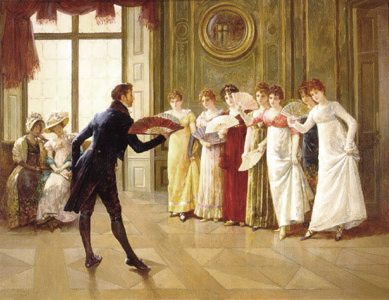
In Regency England, manners were very formal. There was a protocol to everything from how many sets a lady could dance with a gentleman in one evening (two), to what to wear while walking (a walking gown).
I love the way people in Regency England spoke so eloquently. They also prized wit and they excelled in using the understatement. As a historical author, I try to bring that out in every historical novel I write.
I hope that historical romance is a here-to-stay market.
What do you love best about historical novels or historical romance?


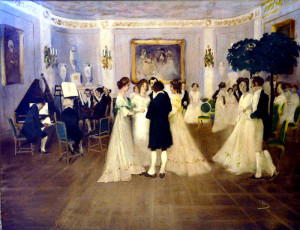

by Donna Hatch
In our informal modern society, it’s socially acceptable to introduce ourselves to a stranger without needing a third person to get involved. Meeting someone new might start with a clever (or corny) pick up line or be as simple as saying, “Hi, my name is____.” We can be confident that the other person will tell us his or her name. And thus an acquaintance, or more, begins.
During the Regency, an introduction was much more than just discovering someone’s name. If you’ve seen Austen or other historical adaptations on television or film or read them in books, you’re probably familiar with the concept of an introduction. When a lady catches a gentleman’s eye, he would ask a common acquaintance to introduce him to the heroine. If they were at a ball or a soiree, he would likely ask the hostess for the introduction. He would never simply present himself to her. The same goes for meeting anyone with whom one did not already have an association.
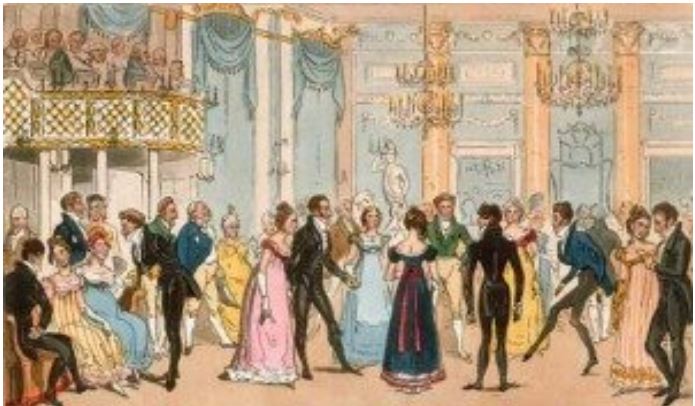
In a formal social setting such as a ball, the introductions would be performed by a hostess, a patroness at Almack’s, or the Master of Ceremonies at an assembly room.
If one allowed someone to present another person to him or her, one was accepting the relationship because an introduction was a sort of recommendation. If a hostess presented a gentleman to a lady, the hostess was, in essence, recommending him to the lady based on his character, rank, status, etc. Only after the introduction had been made could the relationship begin.
Basic Rules for Introductions in the Regency:
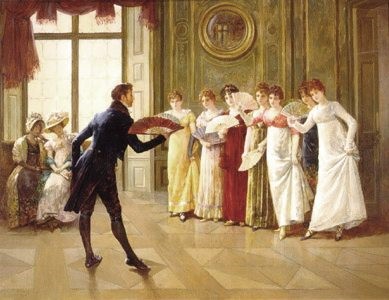
The lady or the higher-ranked person may decline the introduction. So, at a ball, a lady--or her chaperon--could refuse an introduction to someone whose acquaintance was considered undesirable. In all honesty, I have yet to encounter a written instance when someone rejects a request for a presentation, but it does leave a great deal for the imagination, doesn’t it? It could be so deliciously awkward! But keep in mind, such an act would probably snub the third party who asked to make to introduction.
Though this is later in the century, Routledge’s Manual of Etiquette 1899 has great insight on this concept:
To introduce persons who are mutually unknown is to undertake a serious responsibility, and to certify to each the respectability of the other. Never undertake this responsibility without in the first place asking yourself whether the persons are likely to be agreeable to each other; nor, in the second place, without ascertaining whether it will be acceptable to both parties to become acquainted.
So, the third person should have given some thought as to whether this would be a mutually beneficial introduction. By accepting an introduction, the lady welcomes the relationship.
However, balls are a different animal. This same guide makes this statement:
At a ball, or evening party where there is dancing, the mistress of the house may introduce any gentleman to any lady without first asking the lady’s permission.
This is probably because it is assumed that the hostess gave serious thought to her guest list, so she can safely assume if she accepts them all, they all ought to accept each other.
Also, an introduction at a ball or assembly was not considered an introduction anywhere else but that particular event. If, however, the lady or the higher-ranking person first acknowledges the other in a different setting the next time they meet, then the first introduction can carry over as a non-event-specific introduction. I know, it seems odd and overly stuffy to us in these days, but the Regency era was a very different time.
Once the introduction is made, the lady would be expected to make herself available to dance with the gentleman--unless she was not dancing at all or already promised the dance to another.
When two gentlemen are being introduced, the person of the higher also has the option of accepting or rejecting. If he accepts, he’s basically accepting the other man’s association into his social circle.

Presenting oneself to another is a major social faux pas, as we see from Jane Austen’s Pride and Prejudice (1813). When Mr. Collins proposed to introduce himself to Mr. Darcy, his superior in rank, Elizabeth is appropriately shocked, as evidence by her reaction:
“You are not going to introduce yourself to Mr Darcy!”
“Indeed I am. I shall entreat his pardon for not having done it earlier. I believe him to be Lady Catherine’s nephew. It will be in my power to assure him that her ladyship was quite well yesterday se’nnight.”
Elizabeth tried hard to dissuade him from such a scheme, assuring him that Mr Darcy would consider his addressing him without introduction as an impertinent freedom, rather than a compliment to his aunt; that it was not in the least necessary there should be any notice on either side; and that if it were, it must belong to Mr Darcy, the superior in consequence, to begin the acquaintance.
Mr. Collins, of course, dismisses her advice. His presumption in addressing the lofty Mr. Darcy received an appropriate response:
Mr Darcy was eyeing him with unrestrained wonder, and when at last Mr Collins allowed him time to speak, replied with an air of distant civility. Mr Collins, however, was not discouraged from speaking again, and Mr Darcy’s contempt seemed abundantly increasing with the length of his second speech, and at the end of it he only made him a slight bow, and moved another way.
This ill-mannered ruffian who was related to the Bennets no doubt added further proof that Elizabeth’s family was uncultured, contemptible, and therefore unworthy of Mr. Darcy’s notice.
According to The Social Historian, Victorian Etiquette,
No gentleman should ask a lady to dance unless he has previously met her acquaintance. An introduction can be arranged through the Master of Ceremonies or through the lady of the house or a member of her family. Should a lady be approached by a man to whom she has not been introduced, she should reply that she would accept his invitation with pleasure if he would first procure an introduction.
How to Perform an Introduction
Manners and Rules of Good Society (1888) states:
The correct formula in use when making introductions would be to say, ‘Mrs X – Lady Z,’ thus mentioning the name of the lady of lowest rank first, as she is the person introduced to the lady of highest rank. It would be unnecessary and vulgar to repeat the names of the two ladies in a reversed manner – thus, ‘Mrs X – Lady Z. Lady Z – Mrs X.’
This makes sense because if a gentleman asked to be introduced to a young lady, it stands to reason that he’d already have gone to the trouble to inquire as to her name, and possibly has asked enough about her to decide if he desires to make her acquaintance.
That being said, it is possible to introduce two people. Northanger Abbey (1817), gives an example of a two-way introduction:
The young ladies were introduced to each other, Miss Tilney expressing a proper sense of such goodness, Miss Morland with the real delicacy of a generous mind making light of the obligation.
Perhaps, then, it depends on the situation. If adults are introducing their children to each other in the hopes that a friendship, or more, might result, there would be a two-way introduction such as “Oliva, dear, please meet Miss Rose Jones, the youngest daughter of our newest neighbor, Mr. Jones. Miss Jones, this is my eldest daughter, Olivia.”
Imagine a handsome lord sees a lovely lady across a crowded ballroom. Intrigued, he asks his hostess who she is. Upon learning a little about her, and more determined than ever to make her acquaintance, he begs to be introduced to this vision who has piqued his interest.
The introduction would be something like, “Miss Palmer, I'm pleased to introduce Lord Amesbury.”
One look into her eyes changes him forever.
And their story begins…
References:
The Pocket Book of Etiquette by Arthur Freeling
The Social Historian, Victorian Etiquette
Regency introductions - a Regency History guide by Rachel Knowles

Charades was invented in 16th century France and became very popular in Britain by the time of the Regency. Unlike our contemporary version, during the Regency the game wasn’t carried out in silence with contestants acting out the words of the answer. Instead, a riddle was spoken that gave clues to the syllables of a word then a description of the whole. And the whole thing had to rhyme.
The first one to guess the charade won.
Charades was a popular game with Jane Austen, both to play with her family and guests and as an entertainment for her characters in several of her novels.
Some people created their own charades, but many were published in books and magazines so people could use them ready-made. Sometimes they were printed on ladies' fans, with the answer on the reverse side. Usually the charades are in three parts, the first denotes the first syllable, the second, the second syllable, and the third describes the whole word.
Below are a couple of charades printed in the book Riddles, Charades, and Conundrums, complied by John Winter Jones in 1822.
(1)
My first, whatever be its hue,
Will please, if full of spirit;
My second critics love to do,
And stupid authors merit.
(2)
My first a blessing sent to earth,
Of plants and flowers to aid the birth;
My second surely was design’d
To hurl destruction on mankind:
My whole a pledge from pardoning heaven,
Of wrath appeas’d and crimes forgiven.
In the Victorian period the game changed to include acting out the words without words (in Jane Eyre the company plays charades and acts out the word Bridewell in silence). And has continued on that way to the present day.
Solutions:
(1) Eye-lash
(2) Rainbow


 Posts
All Comments
Posts
All Comments


 Posts
All Comments
Posts
All Comments


