From Ancient Rome to Victorian England, We Love History
Search This Blog
Friday, October 15, 2021
Early in my writing career, the best piece of writing advice I ever got—right behind “be persistent”—was “write what you love.” So I did. I wrote everything because I loved everything, but eventually settled on historical romance.
I’ve always loved historical fiction. As a child, I devoured Anne of Green Gables, Little Women, the Little House books, The Secret Garden and A Little Princess. Later I discovered Jane Eyre, the Jane Austen novels, and other historical classics. But again, I craved more romance. Fortunately for me, historical fiction was a hot market. The hard part was finding a book clean enough for me because I don’t like to read hot sex scenes. Once I discovered traditional Regency romances, which were generally very clean, sweet romances, I was in heaven. It was not to last, however.
Historical fiction's popularity waned, and for about a decade, sales across the board plummeted. Perhaps readers tired of hot, sexy romance novels referred to as “bodice rippers” and "clean and wholesome" romance novels had not yet become a category. Instead, they were termed Traditional Regencies, which enjoyed success for a while, but they, too, fell out of popularity. The worst blow came when I learned two major traditional Regency romance publishers closed their doors. The news broke my heart, not only because I loved reading them, but because I’d written a sweet, traditional Regency romance novel that I’d been hoping they’d publish. For a long time, people called historical romance—and Regency romance in particular—a “dead” market. Sob!
Good news! Historical Romance novels, specifically Regency Romance novels, have regained popularity. Sales are skyrocketing for all historical romance, both on the hotter side and those sweeter, more traditional romances such as what we expect from Jane Austen era novels or Georgette Heyer. Personally, I love a clean romance, and if it’s a clean historical romance—even better!
As a historical author, I had to wonder; why the return of the historical romance?
I think there are many reasons. One is with all the recent movies based on famous books such as all the Jane Austen's, North and South with the dreamy Richard Armitage, and many other historical novel adaptations, especially Jane Austen adaptations, a whole new generation of fans have been converted to historical stories--historical romances in particular.
Another reason I believe historical romance novels have regained popularity is because most people read either to relax or escape (and escaping is part of relaxing, don’t you think?). We crave a true escape from the modern world with all our troubles that only a journey into new world can provide. Maybe it’s the fantasy element of vicariously living the life of the very rich, wearing beautiful gowns, having handsome heroes vie for our favor or even dueling over our honor.
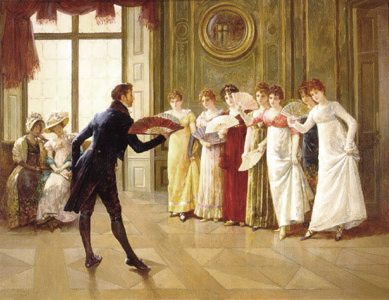
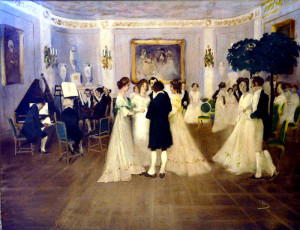
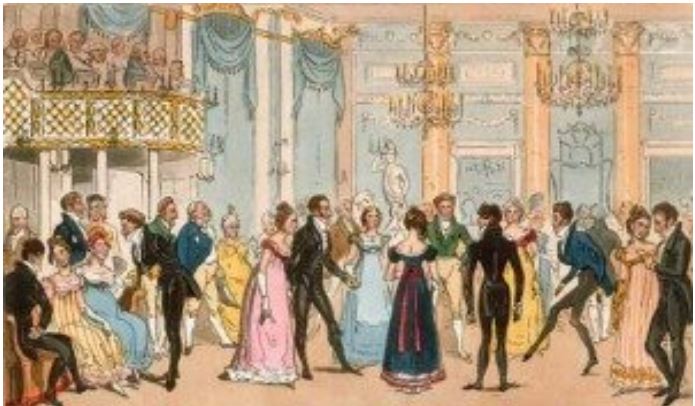
In Regency England, manners were very formal. There was a protocol to everything from how many sets a lady could dance with a gentleman in one evening (two), to what to wear while walking (a walking gown).
I love the way people in Regency England spoke so eloquently. They also prized wit and they excelled in using the understatement. As a historical author, I try to bring that out in every historical novel I write.
Regency men were civilized and treated women with courtesy. When a lady entered the room, gentlemen stood, doffed their hats, curtailed their language, offered an arm, bowed, and a hundred other little things I wish men still did today. But they were also very athletic; they hunted, raced, fenced, boxed, rode horses. They were manly. Strong. Noble. Resolute. Honorable. And that is why I love them!
I hope that historical romance is a here-to-stay market.
What do you love best about historical novels or historical romance?
One trope or event found very often in period romances is “the swoon.” It is true ladies did faint with some frequency in the Georgian, Regency, and Victorian periods. In some cases tightly laced clothing is the culprit for these fainting fits, but there were other reasons for it as well.
The tightly laced corsets and heavy fabrics of the Georgian and Victorian periods almost assured that ladies would faint from the
sheer lack of oxygen at some point in her day. Regency ladies, however, enjoyed lighter fabrics and a very short demi-corset or stays that gave them closer to a natural experience as far as clothing was concerned. Still, Regency ladies still fainted regularly for a variety of reasons.
The actual medical condition associated with fainting is called Vasovagel syncope. It’s the nervous system’s reaction to great stress or some kind of emotional trigger. What happens is the heart rate slows, there’s a sudden drop in blood pressure, depriving the brain of oxygen and therefore triggering “the swoon.”
An attack of nerves or “the vapours” might be enough to make a lady swoon. Some ladies, wishing to be thought very delicate or sensitive (a popular quality during the Regency) would faint or pretend to faint to give the appearance of delicacy. This show of weakness was a prized quality by gentlemen, brought up to believe that women were the weaker sex and therefore could not bear such vulgarities as foul language, explicit talk (especially about sex or anything having to do with bodily functions), or even bad manners. In fact, so many ladies felt the need to swoon that a popular piece of furniture during the period was the fainting couch.
Every lady was forearmed against the possibility of an attack of the vapours with a small vial of smelling salts called a vinaigrette.
These were small glass bottles or boxes, often with silver filigree coverings, that held sal volatile, one of several concoctions designed to jolt the fainter back to consciousness. Smelling salts could contain a mixture of ammonium carbonate and alcohol, or spirit of hartshorn (water and ammonia). By the Regency, a strong distilled vinegar with added essential oils like lavender, was the preferred potion used. The vinaigrette was held beneath the victim’s nose and the inhalation of the spirits would snap them back to consciousness.
In my recent release, Almost a Countess, my heroine, Dora Harper, uses her vinaigrette several times to revivie the hero, Lord Aberfoyle when he is injured. But the table turns when he also wields the smelling salts to revive her from their first kiss! You can find Almost a Countess on Amazon.
Sources:
Hewitt, D. G. “The 10 Do’s and Don’ts of Etiquette to Become a Lady in Regency England.” History
Collection, May 13, 2018.
Karsten, Susan. “Fainting in the Regency.” Vanessa Riley’s Regency Reflections, October 3, 2013.
Penrose, Andrea. “Why Do Regency Heroines Swoon?” Word Wenches, February 4, 2021.
In our informal modern society, it’s socially acceptable to introduce ourselves to a stranger without needing a third person to get involved. Meeting someone new might start with a clever (or corny) pick up line or be as simple as saying, “Hi, my name is____.” We can be confident that the other person will tell us his or her name. And thus an acquaintance, or more, begins.
During the Regency, an introduction was much more than just discovering someone’s name. If you’ve seen Austen or other historical adaptations on television or film or read them in books, you’re probably familiar with the concept of an introduction. When a lady catches a gentleman’s eye, he would ask a common acquaintance to introduce him to the heroine. If they were at a ball or a soiree, he would likely ask the hostess for the introduction. He would never simply present himself to her. The same goes for meeting anyone with whom one did not already have an association.
Assembly Rooms in Bath
In a formal social setting such as a ball, the introductions would be performed by a hostess, a patroness at Almack’s, or the Master of Ceremonies at an assembly room.
If one allowed someone to present another person to him or her, one was accepting the relationship because an introduction was a sort of recommendation. If a hostess presented a gentleman to a lady, the hostess was, in essence, recommending him to the lady based on his character, rank, status, etc. Only after the introduction had been made could the relationship begin.
Basic Rules for Introductions
in the Regency:
A gentleman is introduced to a lady, regardless of rank
A younger person is introduced to an older person, regardless of rank
If they are of the same gender and similar age, the lower-ranking person is introduced to the higher-ranking person
Everyone is introduced to royalty
One never introduces oneself to another person--one must be introduced by a mutual acquaintance
The lady or the higher-ranked person may decline the introduction. So, at a ball, a lady--or her chaperon--could refuse an introduction to someone whose acquaintance was considered undesirable. In all honesty, I have yet to encounter a written instance when someone rejects a request for a presentation, but it does leave a great deal for the imagination, doesn’t it? It could be so deliciously awkward! But keep in mind, such an act would probably snub the third party who asked to make to introduction.
Though this is later in the century, Routledge’s Manual of Etiquette 1899 has great insight on this concept:
To introduce persons who are mutually unknown is to undertake a serious responsibility, and to certify to each the respectability of the other. Never undertake this responsibility without in the first place asking yourself whether the persons are likely to be agreeable to each other; nor, in the second place, without ascertaining whether it will be acceptable to both parties to become acquainted.
So, the third person should have given some thought as to whether this would be a mutually beneficial introduction. By accepting an introduction, the lady welcomes the relationship.
However, balls are a different animal. This same guide makes this statement:
At a ball, or evening party where there is dancing, the mistress of the house may introduce any gentleman to any lady without first asking the lady’s permission.
This is probably because it is assumed that the hostess gave serious thought to her guest list, so she can safely assume if she accepts them all, they all ought to accept each other.
Also, an introduction at a ball or assembly was not considered an introduction anywhere else but that particular event. If, however, the lady or the higher-ranking person first acknowledges the other in a different setting the next time they meet, then the first introduction can carry over as a non-event-specific introduction. I know, it seems odd and overly stuffy to us in these days, but the Regency era was a very different time.
Once the introduction is made, the lady would be expected to make herself available to dance with the gentleman--unless she was not dancing at all or already promised the dance to another.
When two gentlemen are being introduced, the person of the higher also has the option of accepting or rejecting. If he accepts, he’s basically accepting the other man’s association into his social circle.
How it Wasn’t Done
Presenting oneself to another is a major social faux pas, as we see from Jane Austen’s Pride and Prejudice (1813). When Mr. Collins proposed to introduce himself to Mr. Darcy, his superior in rank, Elizabeth is appropriately shocked, as evidence by her reaction:
“You are not going to introduce yourself
to Mr Darcy!”
“Indeed I am. I shall entreat his pardon
for not having done it earlier. I believe him to be Lady Catherine’s nephew. It
will be in my power to assure him that her ladyship was quite well yesterday
se’nnight.”
Elizabeth tried hard to dissuade him from
such a scheme, assuring him that Mr Darcy would consider his addressing him
without introduction as an impertinent freedom, rather than a compliment to his
aunt; that it was not in the least necessary there should be any notice on
either side; and that if it were, it must belong to Mr Darcy, the superior in
consequence, to begin the acquaintance.
Mr. Collins, of course, dismisses her advice. His presumption in addressing the lofty Mr. Darcy received an appropriate response:
Mr Darcy was eyeing him with unrestrained
wonder, and when at last Mr Collins allowed him time to speak, replied with an
air of distant civility. Mr Collins, however, was not discouraged from speaking
again, and Mr Darcy’s contempt seemed abundantly increasing with the length of
his second speech, and at the end of it he only made him a slight bow, and
moved another way.
This ill-mannered ruffian who was related to the Bennets no doubt added further proof that Elizabeth’s family was uncultured, contemptible, and therefore unworthy of Mr. Darcy’s notice.
According to The Social Historian, Victorian Etiquette,
No gentleman should ask a lady to dance unless he has previously met her acquaintance. An introduction can be arranged through the Master of Ceremonies or through the lady of the house or a member of her family. Should a lady be approached by a man to whom she has not been introduced, she should reply that she would accept his invitation with pleasure if he would first procure an introduction.
How to Perform an
Introduction
Manners and Rules of Good
Society (1888) states:
The correct formula in use when making introductions would be to say, ‘Mrs X – Lady Z,’ thus mentioning the name of the lady of lowest rank first, as she is the person introduced to the lady of highest rank. It would be unnecessary and vulgar to repeat the names of the two ladies in a reversed manner – thus, ‘Mrs X – Lady Z. Lady Z – Mrs X.’
This makes sense because if a gentleman asked to be introduced to a young lady, it stands to reason that he’d already have gone to the trouble to inquire as to her name, and possibly has asked enough about her to decide if he desires to make her acquaintance.
That being said, it is possible to introduce two people. Northanger Abbey (1817), gives an example of a two-way introduction:
The young ladies were introduced to each
other, Miss Tilney expressing a proper sense of such goodness, Miss Morland
with the real delicacy of a generous mind making light of the obligation.
Perhaps, then, it depends on the situation. If adults are introducing their children to each other in the hopes that a friendship, or more, might result, there would be a two-way introduction such as “Oliva, dear, please meet Miss Rose Jones, the youngest daughter of our newest neighbor, Mr. Jones. Miss Jones, this is my eldest daughter, Olivia.”
Imagine a handsome lord sees a lovely lady across a crowded ballroom. Intrigued, he asks his hostess who she is. Upon learning a little about her, and more determined than ever to make her acquaintance, he begs to be introduced to this vision who has piqued his interest.
The introduction would be something like, “Miss Palmer, I'm pleased to introduce Lord Amesbury.”
Although the first entertainment one usually thinks of when talking of the Regency period is usually a ball, musical evening, cards, or dance assembly, there were actually many other forms of amusement Regency men and women engaged in. When having an intimate night at home or at a house party with myriad guests, quite often parlor games were played with much gusto. These games included many that we are still familiar with, such as blind man’s bluff, twenty questions, hide and seek, snapdragon, and charades.
Charades was invented in 16th century France and became very popular in Britain by the time of the Regency. Unlike our contemporary version, during the Regency the game wasn’t carried out in silence with contestants acting out the words of the answer. Instead, a riddle was spoken that gave clues to the syllables of a word then a description of the whole. And the whole thing had to rhyme.
The first one to guess the charade won.
Charades was a popular game with Jane Austen, both to play with her family and guests and as an entertainment for her characters in several of her novels.
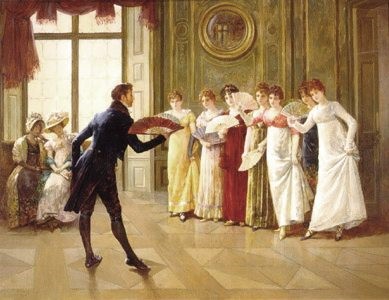
Some people created their own charades, but many were published in books and magazines so people could use them ready-made. Sometimes they were printed on ladies' fans, with the answer on the reverse side. Usually the charades are in three parts, the first denotes the first syllable, the second, the second syllable, and the third describes the whole word.
Below are a couple of charades printed in the book Riddles, Charades, and Conundrums, complied by John Winter Jones in 1822.
(1)
My first, whatever be its hue,
Will please, if full of spirit;
My second critics love to do,
And stupid authors merit.
(2)
My first a blessing sent to earth,
Of plants and flowers to aid the birth;
My second surely was design’d
To hurl destruction on mankind:
My whole a pledge from pardoning heaven,
Of wrath appeas’d and crimes forgiven.
In the Victorian period the game changed to include acting out the words without words (in Jane Eyre the company plays charades and acts out the word Bridewell in silence). And has continued on that way to the present day.
The turn of the 19th century was quite a bit wilder and an extremely bawdy period as we approach the Regency period.
The 18th century had been time of great eroticism and overt sexuality. The book Fanny Hill had been published in 1732, one of the leading erotic novels of the day. Jack Harris (pen name of Samuel Derrick) published Harris's List of Covent Garden Ladies (prostitutes) that was a best seller for years.
And Thomas Rowlandson, a popular engraver and caricaturist in Georgian London, created a series of highly erotic engravings at the end of the century, reportedly for the Prince Regent.
Rowlandson, an orphan raised by his aunt, studied art in Paris and began to exhibit his work in London in the mid-1770s. He etched and
printed several series his works, such as Dr. Syntax's Tour and The Microcosm of London for which he gained much fame. He illustrated prominent authors' works of the period such as Smollett, Goldsmith, Sterne, and Swift. He worked primarily in pen and ink, with a watercolor wash, the delicate nature of his work contrasting sharply with the coarseness of his subjects.
One of his most popular series depicted men and women in the most licentious poses imaginable. These were the ones done for the prince and that now are on display in the British Museum and the Victoria and Albert Museum. (These three prints are the only ones not too bawdy to print!) But I chose some that I think will give you a feel for Rowlandson's works. These prints were so popular the original engraved plates were worn completely out with the printing of them.
Thanks to Diana Gabaldon’s Outlander series, many readers of romance know about the Jacobite Rising of 1745 and how the Scottish
Highland clans were slaughtered on Culloden moor. This horrible defeat was only the beginning of the oppression suffered by the surviving clan members. As a subjugated people, the Scots were put under the yoke of British domination in many ways—taking their lands, burning, pillaging, taking their arms, and eventually taking away their most traditional form of dress.
Issued on August 1, 1747, the Dress Act of 1746 states that
“No Man or Boy, within that part of Great Britain called Scotland, other than such as shall be employed as Officers and Soldiers in His Majesty's Forces, shall, on any pretence whatsoever wear or put on the Clothes commonly called Highland Clothes (that is to say) the Plaid, Philabeg, or little Kilt, Trowse, Shoulder Belts, or any part whatsoever of what peculiarly belongs to the Highland Garb; and that no Tartan, or party-coloured Plaid or Stuff shall be used for Great Coats, or for Upper Coats;”
This Act, in one swoop, forbade the Highlanders from wearing not tartan plaid per se, but the garments that were usually made in tartan fabrics.
This law was aimed specifically at the Highlanders, but it also affected Lowlanders, many of whom had fought on the British side in the Rising and who also wore tartans and kilts. The only men who it excluded were those serving in the British Army.
The penalty for disobeying this law was severe:
“and if any such Person shall presume after the first day of August, to wear or put on the aforesaid Garments, or any part of them, every such Person so offending, being convicted thereof by the Oath of One or more credible Witness or Witnesses before any Court of Justiciary or any one or more Justices of the Peace for the Shire or Stewartry, or Judge Ordinary of the Place where such Offence shall be committed, shall suffer imprisonment, without Bail, during the space of Six Months, and no longer, and that being convicted for a second Offence before a Court of Justiciary, or at the Circuits, shall be liable to be transported to any of His Majesty's Plantations beyond the Seas, there to remain for the space of Seven Years."
As a result, many Highlanders and Lowlanders joined the Army in order to be able to be exempt from the Act.
There are, however, cases in which men were charged with wearing the kilt and tartan plaid and faced stiff consequences. In 1748 one young man in full Highlander dress drowned as he swam across a loch near Stathglass to avoid capture. A servant of Laird MacLean of Duart was arrested and imprisoned for six months for wearing Highland dress.
Finally, in 1782 the Dress Act was repealed, but it had done its job. The Highland dress had become strange to the Highlanders and therefore was not worn as it had once been, a symbol of Scottish autonomy.
The Dress Act and its consequences figure prominently in my current WIP Almost a Countess. The heroine helps a Scotsman who has been arrested for wearing a kilt. After that, things get rather complicated. You can read the first chapter, on Amazon as A Solitary Ridehere.
Underwear, garments worn underneath outer garments, has been in existence for thousands of years. The first form was the simple loincloth that covered men’s genitals, in evidence 7,000 years ago. In fact, more than this simple undergarment was deemed unnecessary by most people until the Middle Ages.
By the Medieval period, men’s clothing had changed and men acquired several new undergarments. Braies were a loose fitting pant-like garment that men stepped into, then tied at the waist and around the calves. Wealthier men wore chausses, worn only on the legs and again tied at the waist. These were eventually replaced by hose that in the Renaissance were adorned with a codpiece, a pouch covering the genitals that was also meant to accentuate that area.
What we would deem women’s underwear does not come on the scene until the Renaissance. Previously women would have worn a chemise,
a shirt-like garment made of linen worn next to the skin that could be laundered easier than the costly silk and velvet outer garments. At this time women also acquired stays, a garment of linen stiffened with buckram, whalebone, reeds or canes that flattened their breasts.
In the 18th and 19th centuries, stays changed to be more lightly boned and were called corsets. In the Regency period they were more relaxed, less constricting. By the Victorian era, when a wasp waist was the cornerstone of beauty, they became extremely constrictive. Corsets remained the major women’s undergarment until the 20th century when the liberty bodice gave them more freedom.
In the 19th century, women also acquired pantalettes or pantaloons, crotchless underwear designed to hide the legs and provide
warmth under the huge bell-shaped gowns of the period.
The modern brassiere was invented in 1913 by Mary Phelps Jacob and caught on during World War I when metal for boning corsets was in short supply.
Men and women’s underwear changed constantly during the 20th century as the garments became increasingly more comfortable due to new fabrics. Modern underwear came about largely in the 1930s. Men’s briefs and boxer shorts, women’s girdle and bra all became popular in the 30s. By the 1960s and 70s underwear was touted for its sex appeal rather than its durability. Current popular items include the G-string and thong for women and boxer briefs for men.
Welcome to our blog for readers and writers--or anyone, really, who loves history! We are historical romance authors. Very well, we confess; we're historical nerds! We are fascinated with ancient wedding traditions, Irish food, Roman Warfare, Regency Clothing, Scottish swords--you get the idea. Watch our blog for informative tidbits that just might figure in your next manuscript or deepen your appreciation for the next book you read, or even give you some useless trivia to spout at a party when you can't think of a thing to say. We welcome comments and followers, so chime in and enjoy the group!





 Posts
Posts


